A1.1.4—Adhesion of water
Adhesion attracts water to other polar or charged surfaces, supporting capillary movement through narrow spaces such as soil pores and plant tissues.
- Syllabus
- First assessment 2025
- Objective
- A1.1.4
- Level
- SL
Adhesion attracts water to other polar or charged surfaces, supporting capillary movement through narrow spaces such as soil pores and plant tissues.
Coverage 2025–2025 · Updated 14 Jul 2026
| Force | Attractive contact | Main biological consequence |
|---|---|---|
| Cohesion | water ↔ water | maintains a connected xylem column that can resist tension |
| Adhesion | water ↔ polar or charged surface | wets cellulose and pulls water along narrow spaces |
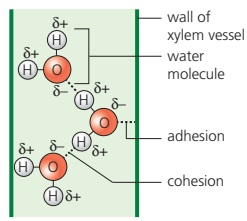
In narrow soil pores and spaces between cellulose fibres, adhesion pulls water along the hydrophilic wall. Cohesion draws neighbouring water molecules with it, producing capillary movement and keeping leaf cell walls moist.
Adhesion helps water enter and wet narrow spaces, but cohesion is the dominant force preventing a transpiring xylem column from breaking under tension.
