IGCSE Chemistry Electrolysis: Products, Rules, and Exam Mistakes
Revise IGCSE Chemistry electrolysis with molten vs aqueous products, cathode and anode rules, half-equations, and common product mistakes. Includes examples and targeted FAQ.
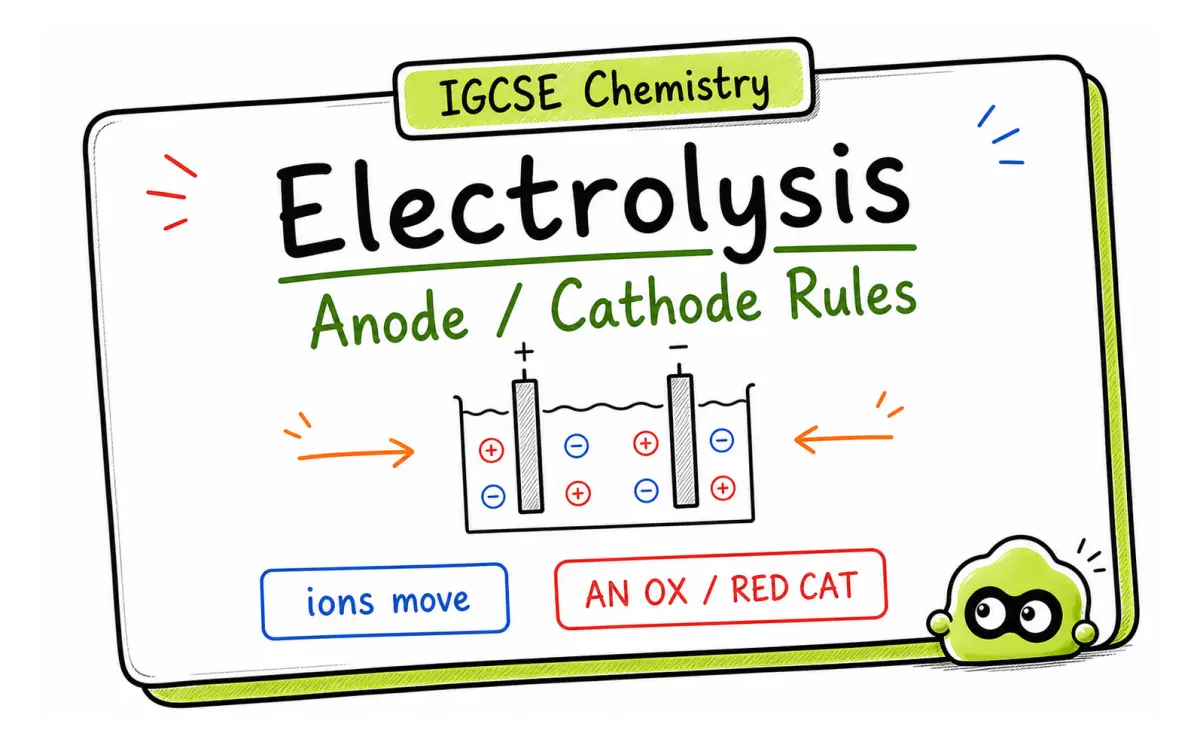
IGCSE Chemistry electrolysis is a topic where many students know the words anode and cathode, but still choose the wrong products. The real skill is reading whether the electrolyte is molten or aqueous, then applying the product rules carefully.
This guide gives you a simple exam method for electrolysis questions.
Use the relevant EduNinja course pages as your base:
- IGCSE Chemistry Question Bank
- IGCSE Chemistry Notes
- 12.5.2 Cation tests using aqueous sodium
- 10.1.2 To test for the purity of water using
- Chemistry examiner tips
- Important Chemistry equations
Do not open every link at once. Start with the notes or topic page, then move into question practice and use any PDF resource only when it helps clarify the exact idea you are revising.
Quick Answer
For IGCSE Chemistry electrolysis, use this order.
- Identify the electrolyte.
- Decide whether it is molten or aqueous.
- Identify cations and anions.
- Cations move to the cathode.
- Anions move to the anode.
- Work out the products using the rules.
- Practise with the IGCSE Chemistry Question Bank.
Core Concept That Gets Marks
Electrolysis is a rule-application topic. Identify the electrolyte, electrode, ion movement, and discharge rule before predicting products or writing half-equations.
What Electrolysis Tests
Electrolysis uses electricity to break down ionic compounds. The substance must contain mobile ions, so molten ionic compounds and aqueous ionic solutions can conduct electricity.
Use IGCSE Chemistry Notes to revise ions and ionic bonding before moving into product prediction.
Anode and Cathode
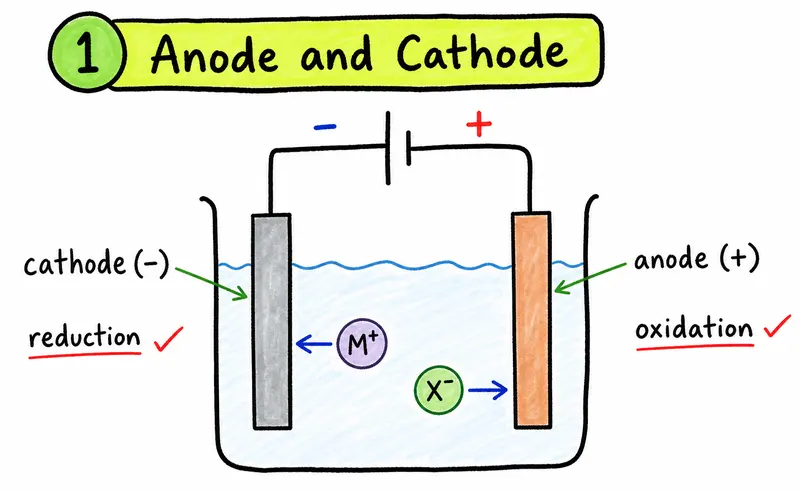
In electrolysis, the cathode is the negative electrode and attracts positive ions. The anode is the positive electrode and attracts negative ions.
| Electrode | Charge | Attracts | Process |
|---|---|---|---|
| Cathode | Negative | Cations | Reduction |
| Anode | Positive | Anions | Oxidation |
A useful memory check is that reduction happens at the cathode because positive ions gain electrons.
Molten vs Aqueous
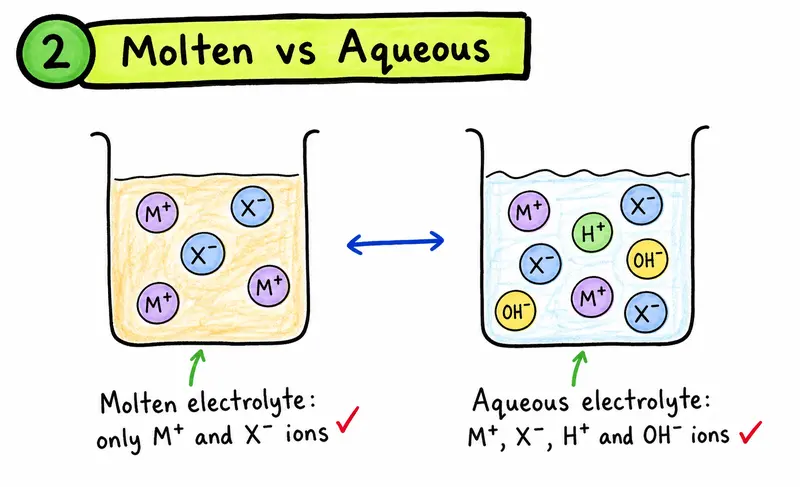
Molten electrolytes are simpler because only the ions from the compound are present. Aqueous electrolytes are trickier because water contributes hydrogen ions and hydroxide ions, so the products may not be the ions you first expect.
For aqueous solutions, learn the product rules carefully. At the cathode, hydrogen or a metal may form depending on reactivity. At the anode, halides may form halogens; otherwise oxygen is often produced.
Half-Equations
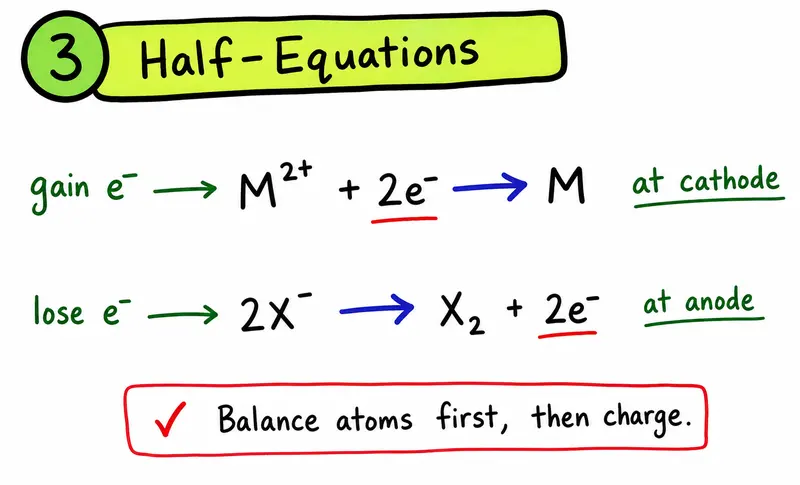
Half-equations show electron transfer. They are a common source of marks because they test whether you understand oxidation and reduction.
Use ionic half-equation practice after revising the electrode rules.
Common Mistakes That Cost Marks
| Mistake | Fix |
|---|---|
| Mixing up anode and cathode | Cathode negative, anode positive |
| Forgetting aqueous solutions include water ions | List all possible ions first |
| Predicting the metal when hydrogen should form | Check metal reactivity |
| Writing charges incorrectly | Balance charge in half-equations |
| Saying electrons flow through solution | Ions move in solution; electrons move in wires |
Topic-Specific Revision Route
Draw one electrolytic cell. Label anode, cathode, power supply, electrolyte, and ion movement. Then practise three examples: molten lead bromide, concentrated sodium chloride solution, and dilute sulfuric acid.
Use EduNinja Notes for the rules, then use the question bank to test product prediction and half-equations.
Worked Example 1
Worked Example 1: Turn the Topic Into a Marked Explanation
Question: A student writes a short answer about Electrolysis but loses marks. What is usually missing?
Worked answer: The answer often names the idea but does not connect it to particles, bonding, moles, energy, or observations. A stronger answer explains the chemical reason and uses the correct technical term.
Markscheme-style answer: Uses correct chemical terminology; identifies the relevant particles or quantities; links the idea to the observation or calculation; avoids vague phrases such as "it reacts more".
Worked Example 2: Check Units, State Symbols, or Conditions
Question: What should you check before moving on from a Electrolysis calculation or equation?
Worked answer: Check whether the answer needs moles, concentration, mass, energy, pH, or percentage. For equations, check balancing, charges, state symbols where required, and whether the question asks for observations or explanation.
Markscheme-style answer: Balanced chemistry is shown; units are consistent; the final quantity matches the question; explanation is linked to evidence from the reaction or data.
Question-Type Breakdown
Electrolysis questions are decision problems. You need to decide electrolyte type, electrode, ion movement, and product.
| Question type | What it is really asking | First move | Common trap |
|---|---|---|---|
| Molten electrolyte | Products from ions present only | List cation and anion | Adding water ions when no water is present |
| Aqueous electrolyte | Products from ions plus water | List all possible ions | Forgetting hydrogen or hydroxide ions |
| Cathode product | Reduction at negative electrode | Identify cations competing | Calling the cathode positive in electrolysis |
| Anode product | Oxidation at positive electrode | Identify anions competing | Mixing up oxidation and reduction |
| Half-equation | Show electron transfer | Balance atoms and charge | Putting electrons on the wrong side |
Weak Answer vs Mark-Worthy Answer
Weak answer:
- The positive ion goes to the positive electrode.
Mark-worthy answer:
- Positive ions move to the cathode, which is negative in electrolysis, where they gain electrons and are reduced.
Weak answer:
- Chlorine forms because it is in the solution.
Mark-worthy answer:
- In concentrated chloride solution, chloride ions can be discharged at the anode and oxidised to chlorine gas.
Exam-Ready Mini Checklist
| Check | What good work looks like |
|---|---|
| electrodes labelled | checked before moving on |
| ions listed | checked before moving on |
| molten/aqueous checked | checked before moving on |
| product rule applied | checked before moving on |
| half-equation balanced | checked before moving on |
How EduNinja Helps
A clean revision loop is easier when the tools sit in one place. Rebuild the idea in EduNinja Notes, test it in the Questionbank, then turn every missed mark into a flashcard or a follow-up AI Tutor prompt. That keeps the article's method practical: learn the concept, answer a real question, mark it, and fix the exact weakness.
FAQ
What is made at the cathode during electrolysis?
At the cathode, positive ions gain electrons and are reduced. In molten electrolytes the metal usually forms; in aqueous solutions, hydrogen may form if the metal ion is more reactive than hydrogen.
What is made at the anode during electrolysis?
At the anode, negative ions lose electrons and are oxidised. In many aqueous solutions, oxygen forms from hydroxide ions, but concentrated halide solutions can produce halogen gases such as chlorine.
Why are products different in molten and aqueous electrolysis?
Molten electrolytes contain only the ions from the compound. Aqueous electrolytes also contain hydrogen and hydroxide ions from water, so there are more possible ions competing for discharge.
How do I write half-equations for electrolysis?
Balance the atoms first, then balance the charge with electrons. For reduction, electrons are on the left. For oxidation, electrons are on the right. Always check the electrode matches the process.
Related Study Links
- IGCSE Chemistry Notes
- IGCSE Chemistry Question Bank
- Ionic half-equation practice
Exam Strategy
Electrolysis questions are easiest when you make a quick ion list. Write the cations and anions present, then decide which ions are discharged at each electrode. For aqueous solutions, remember that water contributes ions too, so the visible product may be hydrogen, oxygen, or a halogen rather than the first ion you noticed.
In half-equations, balance atoms first, then charges using electrons. Check that reduction happens at the cathode and oxidation happens at the anode.
Put electrolysis back into your full IGCSE CAIE Chemistry study plan.
Return to the complete course overview, or move directly into the most relevant study tool.
Related articles
More course notes, updates and study resources from the EduNinja blog.
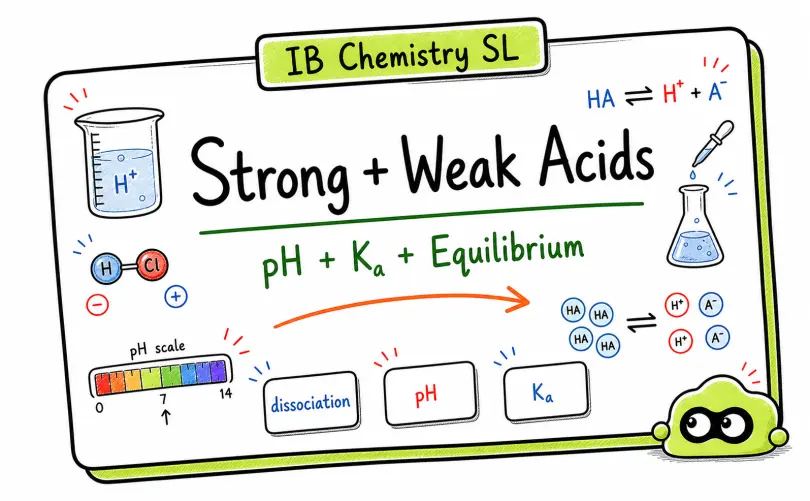
IB Chemistry SL Strong and Weak Acids: Exam Answer Guide
Revise IB Chemistry SL strong and weak acids with pH logic, equilibrium language, Ka, neutralisation, and mark-worthy answer patterns.
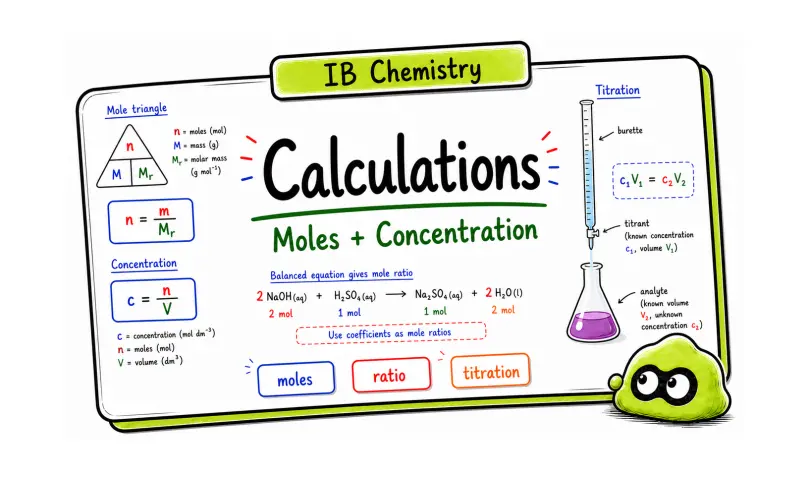
IB Chemistry Calculations: Mole Ratios, Concentration, and Titration Practice
A source-backed IB Chemistry guide for IB Chemistry calculations, using EduNinja PDF notes, worked examples, and markscheme-style answers.
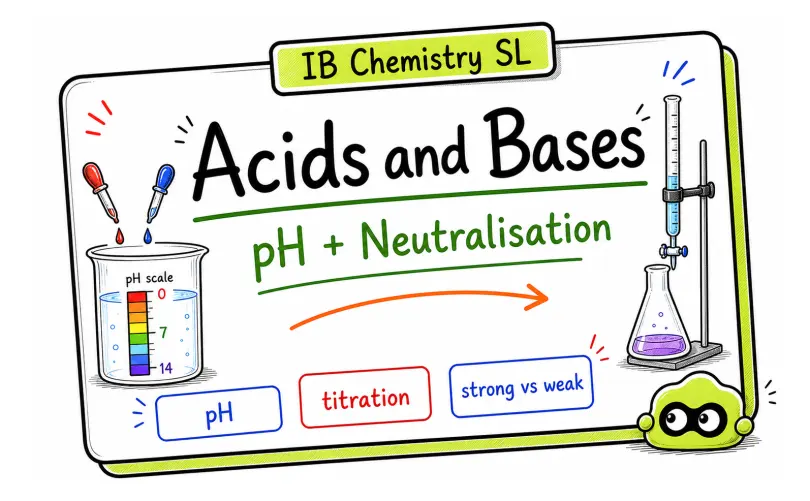
IB Chemistry Acids and Bases: pH, Neutralisation, and Common Mistakes
Revise IB Chemistry acids and bases with pH, strong vs weak acids, conjugate pairs, neutralisation, buffers, and markscheme wording. Includes examples and targeted FAQ.