IB Chemistry Stoichiometry: Mole Calculations Guide
Revise IB Chemistry stoichiometry with mole ratios, balanced equations, mass, concentration, gas volume, limiting reactants, and unit checks.
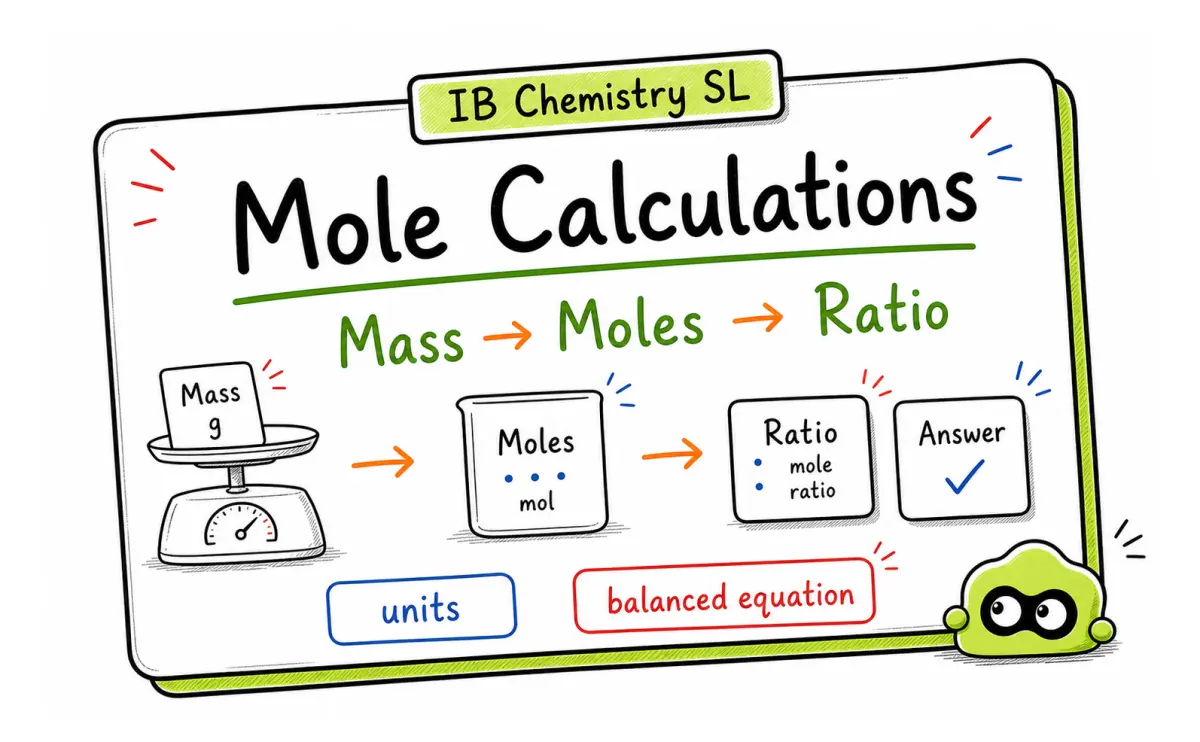
IB Chemistry stoichiometry is one of those topics that feels easy during notes and suddenly messy in questions. You may know the formulas, but the exam rarely says, "use this exact formula now." It gives a mass, volume, concentration, gas amount, percentage yield, or equation, then expects you to build the calculation path yourself.
Current syllabus map: This article is aligned to the IB Chemistry first assessment 2025 syllabus through Structure and Reactivity, especially quantitative relationships in chemical reactions.
The good news is that most IB Chemistry mole calculations use the same core route: convert to moles, use the equation ratio, then convert to what the question asks for. This guide gives you a repeatable method so stoichiometry feels less like guessing and more like a checklist.
Use the relevant EduNinja course pages as your base:
Do not open every link at once. Start with the notes or topic page, then move into question practice and use any PDF resource only when it helps clarify the exact idea you are revising.
Quick Answer
For IB Chemistry stoichiometry, use this routine:
- Balance the chemical equation before doing any ratio work.
- Convert the information given into moles.
- Use the equation coefficients as the mole ratio.
- Convert from moles into the requested unit.
- Check whether there is a limiting reagent.
- Keep units visible at every step.
- Practise with topic questions in the IB Chemistry Question Bank.
If your answer feels confusing, write down what each number represents. Most mistakes come from using the right formula at the wrong stage.
Core Concept That Gets Marks
Stoichiometry is a route-building topic. The calculation becomes stable when every number is labelled as given quantity, moles, mole ratio, or final requested unit.
What Stoichiometry Means in IB Chemistry
Stoichiometry is the part of chemistry that connects substances in a reaction through amounts. In the IB syllabus structure, it sits across the mole concept, molar mass, empirical and molecular formula, concentration, gas volume, chemical equations, mole ratio, limiting reactant, percentage yield, and atom economy.
The topic is not only "n = m / M". That formula is important, but it is only one doorway into moles. A question may give you mass, volume of solution, gas volume, number of particles, or an equation. Your job is to turn the given information into an amount of substance, then use the reaction ratio.
For the concept base, start with the EduNinja topic page for the mole. Once you can explain what one mole means, calculation questions become much easier to organise.
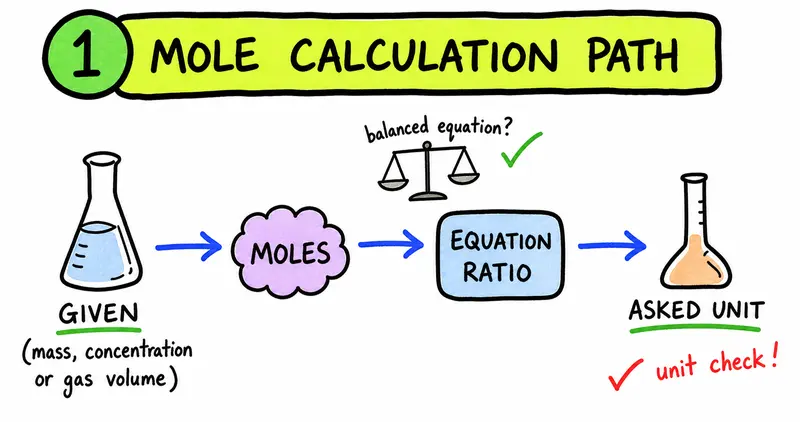
The Core Mole Calculation Path
Most stoichiometry questions can be reduced to this path:
| Stage | Question to ask | Common tool |
|---|---|---|
| 1. Given information | What do I know? | mass, concentration, volume, particles |
| 2. Convert to moles | How do I express this as amount? | n = m / M, n = cV, gas volume relation |
| 3. Mole ratio | What does the balanced equation say? | coefficients in the equation |
| 4. Convert out | What does the question want? | mass, concentration, volume, yield |
| 5. Check | Does the answer make chemical sense? | units, limiting reagent, significant figures |
The most important step is the balanced equation. Coefficients give the ratio between reactants and products. If the equation is not balanced, the whole calculation is built on the wrong ratio.
For targeted practice, use mole ratio questions and force yourself to write the ratio line before touching the calculator.
Key Formulas Students Actually Use
You do not need a giant formula sheet to start. You need a small group of formulas and a habit of choosing the right one.
| Situation | Formula or idea | Watch out |
|---|---|---|
| Mass to moles | n = m / M | Molar mass must use the formula correctly |
| Moles to mass | m = nM | Use grams if M is in g mol-1 |
| Solution concentration | c = n / V | Volume must usually be in dm3 |
| Particles to moles | n = N / NA | Avogadro constant links particles and moles |
| Gas calculations | use molar volume or gas law if given | Check the conditions in the question |
| Yield | percentage yield = actual / theoretical x 100 | Theoretical yield comes from stoichiometry |
The formula is rarely the hard part. The hard part is knowing where you are in the path. If you are before the mole ratio, convert to moles. If you are after the mole ratio, convert to the answer unit.
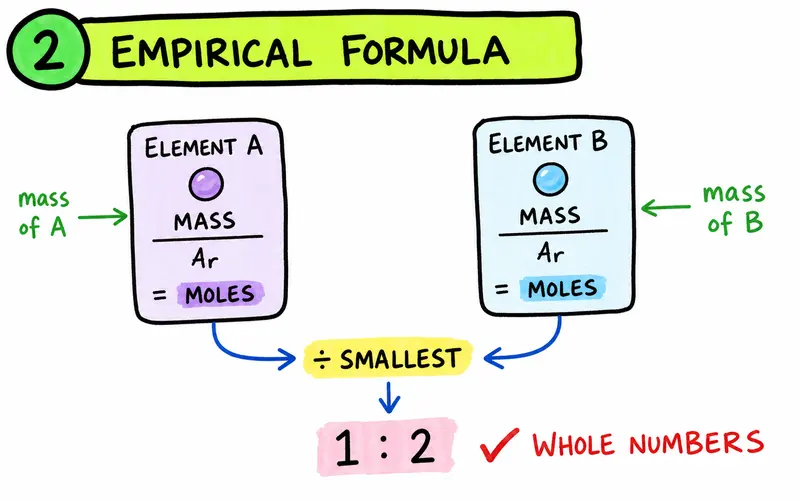
Empirical Formula and Molecular Formula
Empirical formula questions ask for the simplest whole-number ratio of atoms. Molecular formula questions ask for the actual number of atoms in one molecule.
For empirical formula:
- Convert each element's mass or percentage into moles.
- Divide all mole values by the smallest value.
- Multiply if needed to get whole numbers.
- Write the simplest ratio as the empirical formula.
For molecular formula:
- Find the empirical formula mass.
- Compare it with the relative molecular mass.
- Multiply the empirical formula by that factor.
Use empirical and molecular formula practice when you need to train the ratio steps. This is a good subtopic for students who understand moles but lose marks on rounding.
Limiting Reagent and Percentage Yield
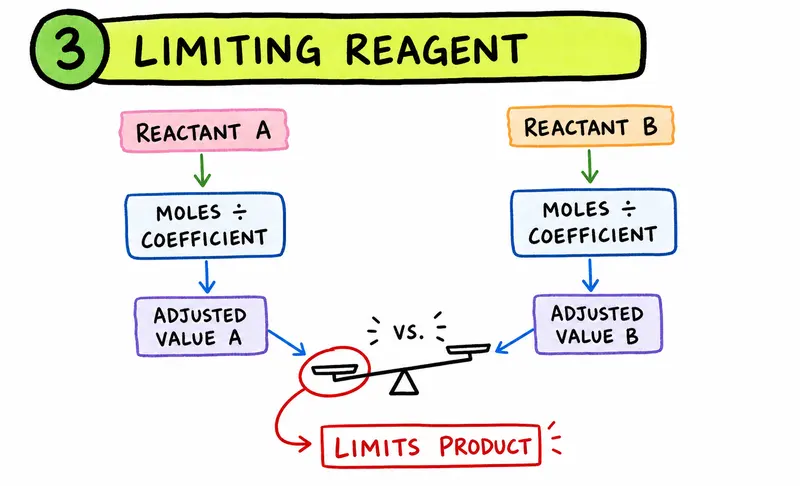
Limiting reagent questions are where many students accidentally use only one reactant and ignore the other. The limiting reagent is the reactant that runs out first and determines the theoretical yield.
A clean method is:
- Convert each reactant into moles.
- Divide each amount by its coefficient in the balanced equation.
- The smaller adjusted value identifies the limiting reagent.
- Use the limiting reagent to calculate product amount.
Percentage yield is then based on the theoretical yield:
percentage yield = actual yield / theoretical yield x 100
The theoretical yield comes from the balanced equation and the limiting reagent. The actual yield comes from the experiment or question. If you mix them up, your answer may look reasonable but be chemically wrong.
Practise this with percentage yield questions, especially questions where two reactants are given.
Common Mistakes That Cost Marks
| Mistake | Why it happens | Fix |
|---|---|---|
| Forgetting to balance the equation | Student starts with numbers too quickly | Balance first, then write the ratio |
| Using cm3 as dm3 | Concentration formula needs consistent units | Convert cm3 to dm3 by dividing by 1000 |
| Using mass ratio instead of mole ratio | Equation coefficients are mistaken for grams | Convert to moles before using coefficients |
| Ignoring limiting reagent | Only one reactant is followed | Compare both reactants in mole terms |
| Rounding too early | Small ratio errors become formula errors | Keep extra figures until the final answer |
The best fix is to write units on every line. Units make invisible mistakes visible. If you see grams going into a mole ratio directly, stop and convert first.
Topic-Specific Revision Route
Use this short routine when you need a focused study block.
Minutes 0-5: formula warm-up. Write the formulas for mass, concentration, particles, and percentage yield. Add the unit beside each variable.
Minutes 5-10: equation ratio practice. Take three balanced equations and write only the mole ratios. Do not calculate yet.
Minutes 10-18: mixed questions. Do three questions from the IB Chemistry Question Bank. Choose one mole-ratio question, one empirical formula question, and one yield question.
Minutes 18-23: mark and diagnose. Every error goes into one of four buckets: equation, units, ratio, or limiting reagent.
Minutes 23-25: flashcard the mistake. Turn the mistake into a rule. For example: "Before using c = n / V, convert cm3 to dm3."
How EduNinja Helps
Use IB Chemistry Notes 2 - 1.2 The mole concept and Avogadro's Constant when you want a focused mole concept refresher. For broader calculation practice, use IB Chemistry calculation and IB SL Chemistry Notes - Stoichiometric Relationships.
If the first set feels too dense, the simplified note IB Chemistry simplified note - 1.2 The mole concept can be a lighter restart before moving back into exam questions.
Worked Example 1
Worked Example 1: Turn the Topic Into a Marked Explanation
Question: A student writes a short answer about Stoichiometry but loses marks. What is usually missing?
Worked answer: The answer often names the idea but does not connect it to particles, bonding, moles, energy, or observations. A stronger answer explains the chemical reason and uses the correct technical term.
Markscheme-style answer: Uses correct chemical terminology; identifies the relevant particles or quantities; links the idea to the observation or calculation; avoids vague phrases such as "it reacts more".
Worked Example 2: Check Units, State Symbols, or Conditions
Question: What should you check before moving on from a Stoichiometry calculation or equation?
Worked answer: Check whether the answer needs moles, concentration, mass, energy, pH, or percentage. For equations, check balancing, charges, state symbols where required, and whether the question asks for observations or explanation.
Markscheme-style answer: Balanced chemistry is shown; units are consistent; the final quantity matches the question; explanation is linked to evidence from the reaction or data.
Question-Type Breakdown
Stoichiometry gets easier when you name the calculation type before touching the calculator.
| Question type | What it is really asking | First move | Common trap |
|---|---|---|---|
| Mass to moles | Convert grams into amount of substance | Use n = m / Mr | Dividing by atomic mass when a compound needs Mr |
| Moles to mass | Convert amount into grams | Use m = n x Mr | Forgetting the final unit |
| Mole ratio | Use the balanced equation | Write the coefficient ratio | Using the unbalanced equation |
| Limiting reagent | Find which reactant runs out first | Convert both reactants to moles, then compare ratios | Choosing the smaller mass |
| Percentage yield | Compare actual and theoretical yield | actual / theoretical x 100 | Reversing the fraction |
| Empirical formula | Find the simplest whole-number ratio | Convert mass or percentage to moles | Rounding too early |
Worked Example 2
Use this four-step method whenever a question gives amounts of two reactants:
- Write the balanced equation.
- Convert each reactant amount into moles.
- Divide each mole value by its coefficient in the equation.
- The smaller adjusted value identifies the limiting reagent.
Weak answer:
- The limiting reagent is the one with the smaller mass.
Mark-worthy answer:
- The limiting reagent is the reactant that produces the smaller amount of product after the mole ratio from the balanced equation has been applied.
This is why the Questionbank is useful for stoichiometry: you are not only practising formulas, you are training the decision of which formula and ratio to use first.
Exam-Ready Mini Checklist
| Check | What good work looks like |
|---|---|
| equation balanced | checked before moving on |
| units visible | checked before moving on |
| moles calculated | checked before moving on |
| ratio line written | checked before moving on |
| answer unit checked | checked before moving on |
FAQ
What is the mole in IB Chemistry?
The mole is a counting unit for particles. One mole contains Avogadro's constant of particles, so mole calculations connect mass, molar mass, concentration, gas volume, and reacting ratios.
How do I start a stoichiometry calculation?
Start by converting the information given into moles. Then use the balanced equation ratio to find the moles of the unknown substance before converting into the requested unit.
Why is the balanced equation important in mole calculations?
The coefficients in the balanced equation give the reacting mole ratio. Without that ratio, you may calculate moles correctly but connect the wrong substances in the wrong amounts.
How do I avoid unit mistakes in stoichiometry?
Write the unit next to every value and convert before using formulas. Common checks include grams to moles, cm³ to dm³, and concentration in mol dm⁻³.
Related Study Links
- Explore the course Study Hub
- IB Chemistry Question Bank
- The mole
- Empirical and molecular formulas
- Mole ratio
- Percentage yield
Put stoichiometry back into your full IB Chemistry SL study plan.
Return to the complete course overview, or move directly into the most relevant study tool.
Related articles
More course notes, updates and study resources from the EduNinja blog.
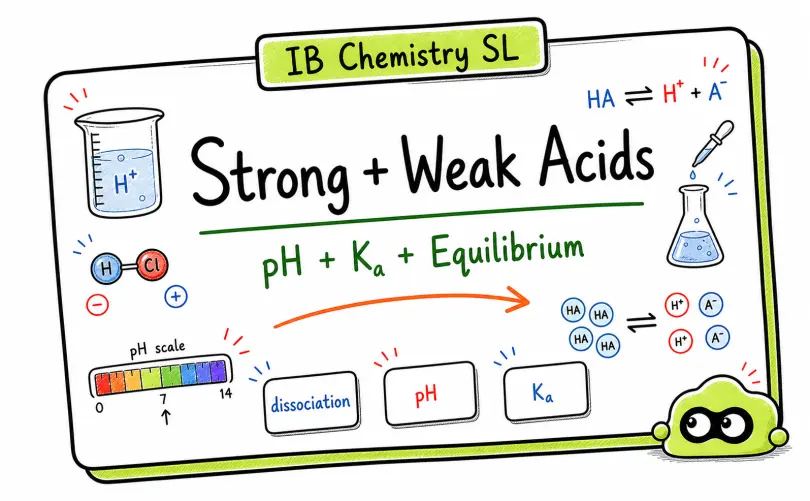
IB Chemistry SL Strong and Weak Acids: Exam Answer Guide
Revise IB Chemistry SL strong and weak acids with pH logic, equilibrium language, Ka, neutralisation, and mark-worthy answer patterns.
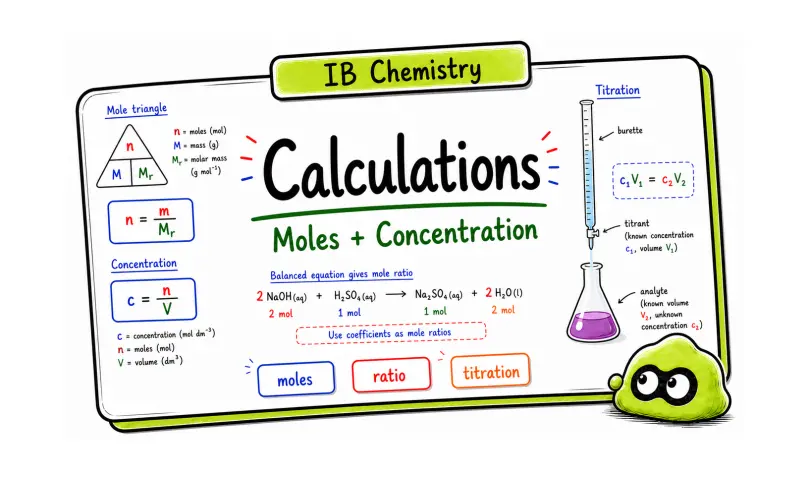
IB Chemistry Calculations: Mole Ratios, Concentration, and Titration Practice
A source-backed IB Chemistry guide for IB Chemistry calculations, using EduNinja PDF notes, worked examples, and markscheme-style answers.
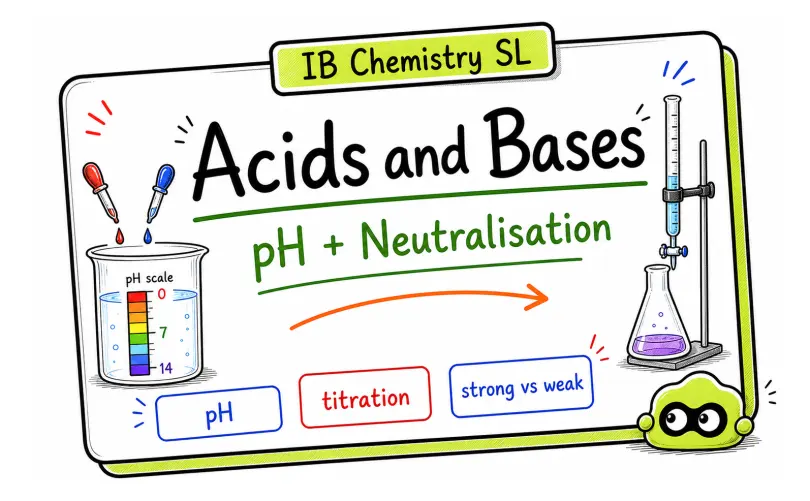
IB Chemistry Acids and Bases: pH, Neutralisation, and Common Mistakes
Revise IB Chemistry acids and bases with pH, strong vs weak acids, conjugate pairs, neutralisation, buffers, and markscheme wording. Includes examples and targeted FAQ.