IB Chemistry Organic Chemistry: Structure and Reactivity Guide
Revise IB Chemistry 2025 organic chemistry through Structure and Reactivity, including carbon chains, functional groups, formulas, naming and isomers.
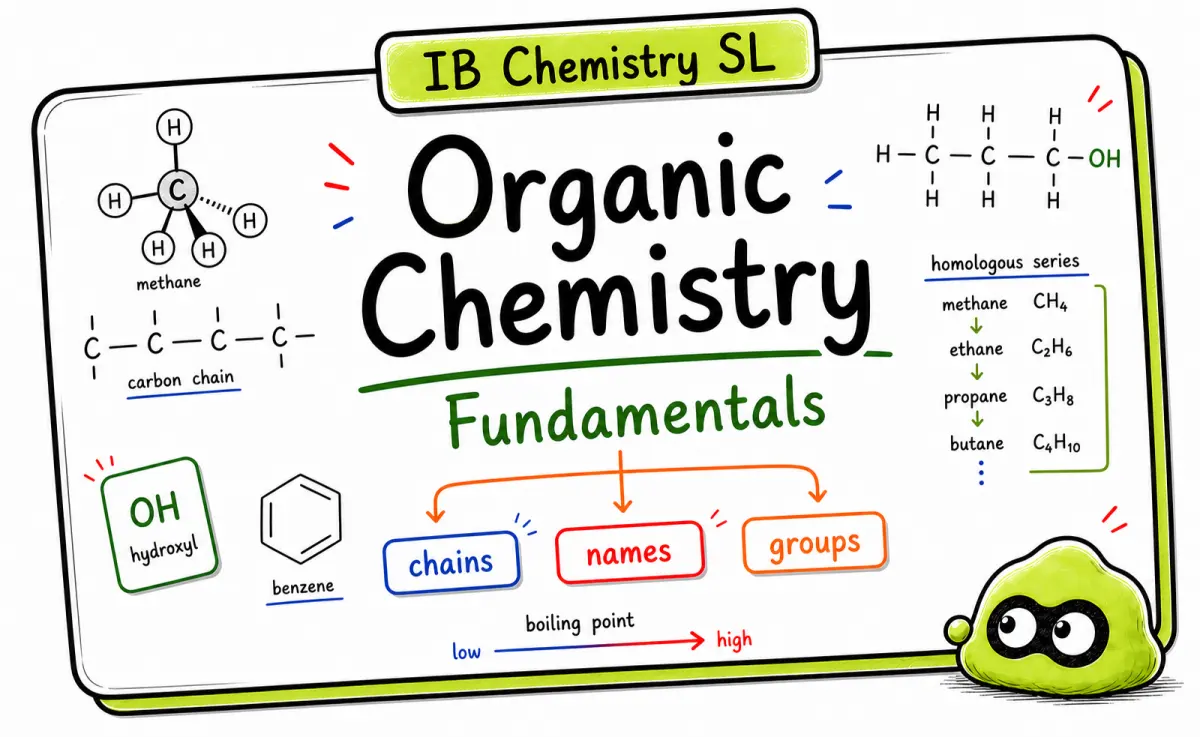
Organic chemistry feels huge because it is not just one topic. It is a language for describing carbon compounds: their chains, functional groups, formulas, names, and reactions. If you try to memorise every molecule separately, the chapter becomes messy very quickly.
Current syllabus map: This article is aligned to the IB Chemistry first assessment 2025 syllabus through the organizing concepts of Structure and Reactivity, rather than the old numbered topic label.
The better revision route is simpler: identify the carbon skeleton, find the functional group, choose the correct naming pattern, then check whether the molecule is saturated, unsaturated, aliphatic, aromatic, or part of a homologous series.
Quick Answer
For IB Chemistry 10.1, focus on these exam-ready moves:
- Distinguish saturated, unsaturated, aliphatic, aromatic, arene, electrophile, and nucleophile.
- Explain what a homologous series is and why members share chemical behaviour.
- Move between empirical, molecular, full structural, and condensed structural formulas.
- Name straight-chain and branched organic compounds using the longest chain, suffix, and locant.
- Identify common functional groups, including alcohols, aldehydes, ketones, carboxylic acids, esters, amines, amides, nitriles, and arenes.
- Explain structural isomerism and recognise primary, secondary, and tertiary carbon or nitrogen environments.
- Connect functional groups to reactivity, especially addition, substitution, condensation, and bond fission.
Use the relevant EduNinja course pages as your base:
Do not open every link at once. Start with the notes or topic page, then move into question practice and use any PDF resource only when it helps clarify the exact idea you are revising.
Core Concept That Gets Marks
Organic chemistry starts with classification. If you can identify the functional group, formula type, naming pattern, and isomer possibility, the rest of the question becomes less random.
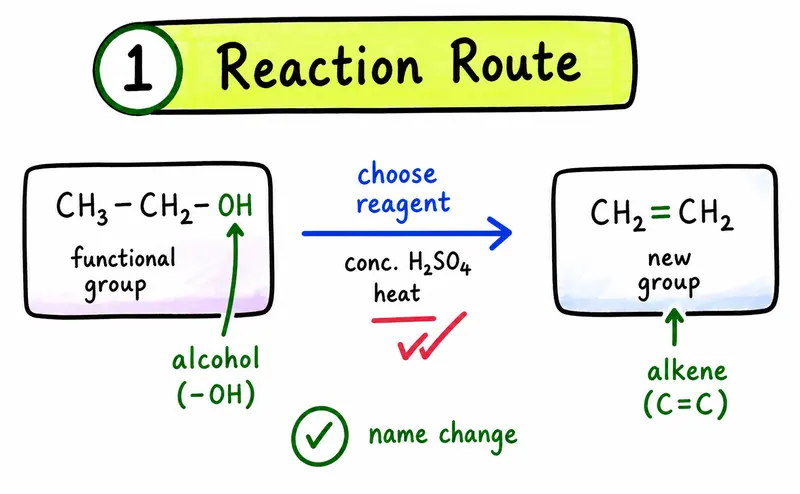
The Core Organic Chemistry Route
Start every molecule with the same three questions.
| Step | Question | What to check |
|---|---|---|
| 1 | What is the carbon chain? | Longest chain, branches, and whether it is aliphatic or aromatic |
| 2 | What functional group is present? | Alcohol, alkene, carboxylic acid, ester, amine, nitrile, arene, and so on |
| 3 | What name follows from that structure? | Prefix, stem, suffix, and the lowest useful locants |
The stem tells you the number of carbons in the main chain. Meth-, eth-, prop-, and but- are the first four; then pent-, hex-, hept-, oct-, non-, and dec- continue the pattern. The suffix depends on the main functional group, such as -ane, -ene, -yne, -ol, or -oic acid.
Key Terms You Need To Separate
Saturated compounds contain single carbon-carbon bonds only. Unsaturated compounds contain at least one carbon-carbon double or triple bond. That matters because double and triple bonds can react in addition reactions.
Aliphatic compounds are not based on a benzene ring. Arenes contain a benzene ring. Benzene itself is the simplest arene, and its stability comes from delocalised electrons rather than ordinary alternating single and double bonds.
Electrophiles are electron-pair acceptors. Nucleophiles are electron-pair donors. In organic mechanisms, this electron movement explains why some sites are attacked and why some bonds break.
Homologous Series
A homologous series is a family of compounds with the same functional group and a similar general formula, where neighbouring members usually differ by CH2.
This gives two useful exam points:
- Members have similar chemical reactions because they share the same functional group.
- Physical properties change gradually because larger molecules usually have stronger London dispersion forces.
For example, as a homologous series gets longer, boiling point usually increases because there are more electrons and stronger instantaneous dipole-induced dipole attractions.
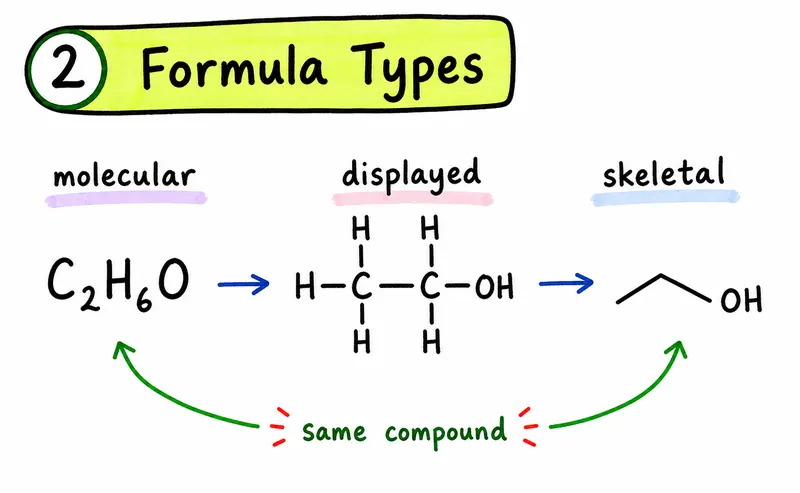
Formula Types
Organic chemistry questions often test whether you can move between formula styles.
| Formula type | What it shows | Exam use |
|---|---|---|
| Empirical formula | Simplest whole-number ratio | Composition problems |
| Molecular formula | Actual number of atoms | Isomer comparison |
| Full structural formula | Every atom and bond | Naming, functional groups, reactions |
| Condensed structural formula | Grouped atoms without every bond | Fast written answers |
For example, ethane can be shown with all C-H bonds in a full structural formula, or written as CH3CH3 in condensed form.
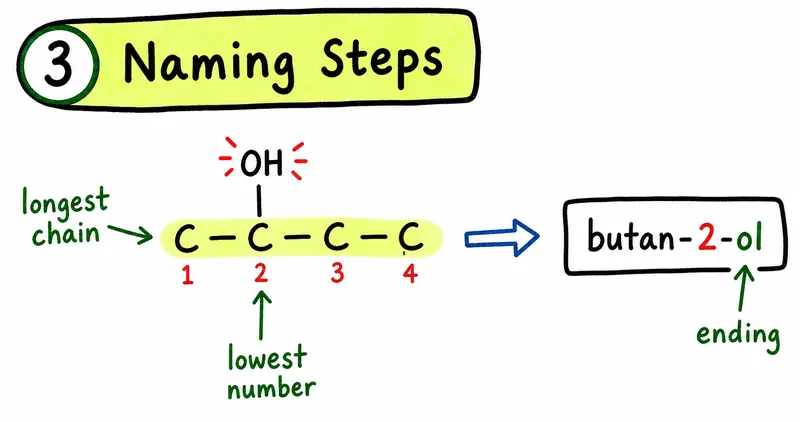
Naming Organic Compounds
Use this naming order:
- Find the longest carbon chain.
- Identify the highest-priority functional group for the suffix.
- Number the chain from the end that gives the functional group the lowest useful locant.
- Add substituents such as methyl, ethyl, fluoro, chloro, bromo, iodo, or amino.
- Check the final name against the structure.
Do not start with the first chain you see. Many wrong answers happen because the student names a shorter visible chain instead of the longest continuous chain.
Common Mistakes That Cost Marks
The most common naming errors are small but expensive:
- choosing a shorter chain because it looks simpler
- numbering from the wrong end
- treating a substituent as the main functional group
- forgetting the locant for the functional group
- mixing up
-ane,-ene, and-yne - confusing phenyl, benzene, arene, aromatic, and aliphatic
The fix is to slow the first 20 seconds down. Before writing the final name, circle the longest chain, mark the functional group, and write the carbon numbers clearly.
Isomers, Primary, Secondary, and Tertiary
Structural isomers have the same molecular formula but different structures. This is why a formula alone is not enough in organic chemistry. You may need to draw or recognise the arrangement of atoms.
Primary, secondary, and tertiary labels describe how many carbon groups are attached to the key carbon or nitrogen environment. For alcohols and halogenoalkanes, look at the carbon bearing the functional group. For amines, look at how many carbon groups are attached to the nitrogen.
Benzene and Arenes
Benzene is not best treated as a simple cyclohexatriene with alternating double bonds. Its electrons are delocalised, which helps explain its stability and why benzene more readily undergoes substitution than addition.
For revision, separate these words:
| Term | Meaning |
|---|---|
| Benzene | C6H6, the simplest aromatic ring |
| Arene | A compound containing a benzene ring |
| Phenyl | A benzene ring attached as C6H5- |
| Aliphatic | Not based on a benzene ring |
Topic-Specific Revision Route
Use a short active loop:
- Pick five molecules from your notes.
- Draw the longest chain and number it.
- Identify the functional group and suffix.
- Write the name.
- Check the answer and record the exact error.
- Repeat with a different functional group.
Use IB Chemistry SL notes to rebuild weak concepts, then practise with the IB Chemistry SL question bank. When an answer is wrong, turn the error into a flashcard: longest chain, locant, suffix, functional group, or formula type.
EduNinja is independently developed and is not endorsed by the International Baccalaureate Organization.
Exam-Ready Mini Checklist
| Check | What good work looks like |
|---|---|
| functional group identified | checked before moving on |
| formula type read | checked before moving on |
| name numbered correctly | checked before moving on |
| isomer checked | checked before moving on |
| reaction context considered | checked before moving on |
How EduNinja Helps
A clean revision loop is easier when the tools sit in one place. Rebuild the idea in EduNinja Notes, test it in the Questionbank, then turn every missed mark into a flashcard or a follow-up AI Tutor prompt. That keeps the article's method practical: learn the concept, answer a real question, mark it, and fix the exact weakness.
FAQ
What is the fastest way to revise IB Chemistry organic naming?
Practise short sets of molecules and use the same order every time: longest chain, functional group, numbering, substituents, final check. Organic naming improves through repeated correction, not passive rereading.
What is a homologous series in IB Chemistry?
A homologous series is a family of compounds with the same functional group and similar chemical reactions, where neighbouring members usually differ by CH2. Physical properties change gradually as the chain length changes.
Why do functional groups matter so much?
Functional groups control much of the reactivity of organic molecules. They help you predict likely reactions, classify compounds, and choose the correct suffix or prefix when naming.
Are benzene and phenyl the same thing?
No. Benzene is C6H6. Phenyl is a benzene ring acting as a substituent, usually written as C6H5- attached to another group.
Related Study Links
- Open the full revision Study Hub
- IB Chemistry SL notes
- IB Chemistry SL question bank
- IB Chemistry question bank
Put organic chemistry back into your full IB Chemistry SL study plan.
Return to the complete course overview, or move directly into the most relevant study tool.
Related articles
More course notes, updates and study resources from the EduNinja blog.

IB Chemistry SL 2025 Syllabus Changes: Assessment Guide
A practical IB Chemistry SL guide to the 2025 syllabus and assessment model: structure and reactivity, Paper 1A and 1B, Paper 2, scientific investigation and revision strategy.
Electron Domains and Molecular Geometry | A-Level Chemistry
Revise A-Level Chemistry electron domains, VSEPR shapes, lone pairs, bond angles, molecular geometry and common exam mistakes.
Salt Bridge Explained | A-Level Chemistry
Learn the function of a salt bridge in A-Level Chemistry, including ion movement, electrical neutrality, cell circuits and exam mistakes.