EduNinja
[Maximum number: 12]

This question is about stars in the constellation Canis Minor.

(a)

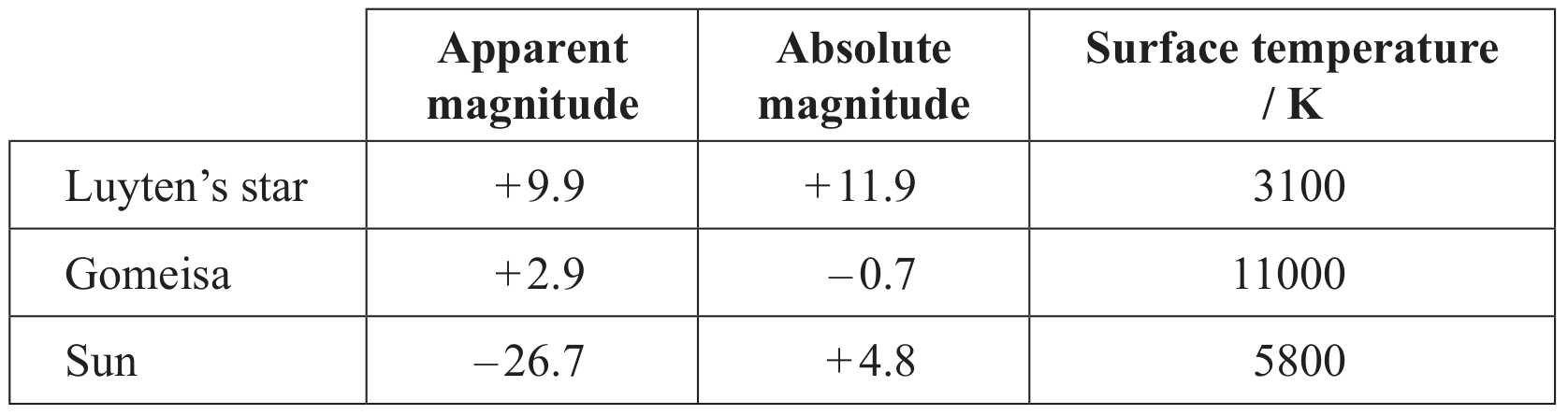
Luyten's star and Gomeisa are two stars associated with the constellation Canis Minor. The table gives data for these stars and for the Sun.
Table
[ 3 ]
(i)

Explain, with reference to magnitude data from the table, why it is possible to use the stellar parallax technique to determine the distance of Luyten's star from Earth.

[ 3 ]
(b)
(i)

Gomeisa has a radius four times that of the Sun. Use the data in (c) to show that the ratio

 luminosity of Gomeisa  luminosity of Sun \frac{\text { luminosity of Gomeisa }}{\text { luminosity of Sun }}

is about 200 .

[ 3 ]
(ii)

Assuming the value of n in the mass-luminosity equation to be 3.5 , calculate
 mass of Gomeisa  mass of Sun \frac{\text { mass of Gomeisa }}{\text { mass of Sun }}.

[ 2 ]
(iii)

Outline, with reference to the Chandrasekhar limit, the likely eventual fate of Gomeisa.

[ 2 ]
(c)

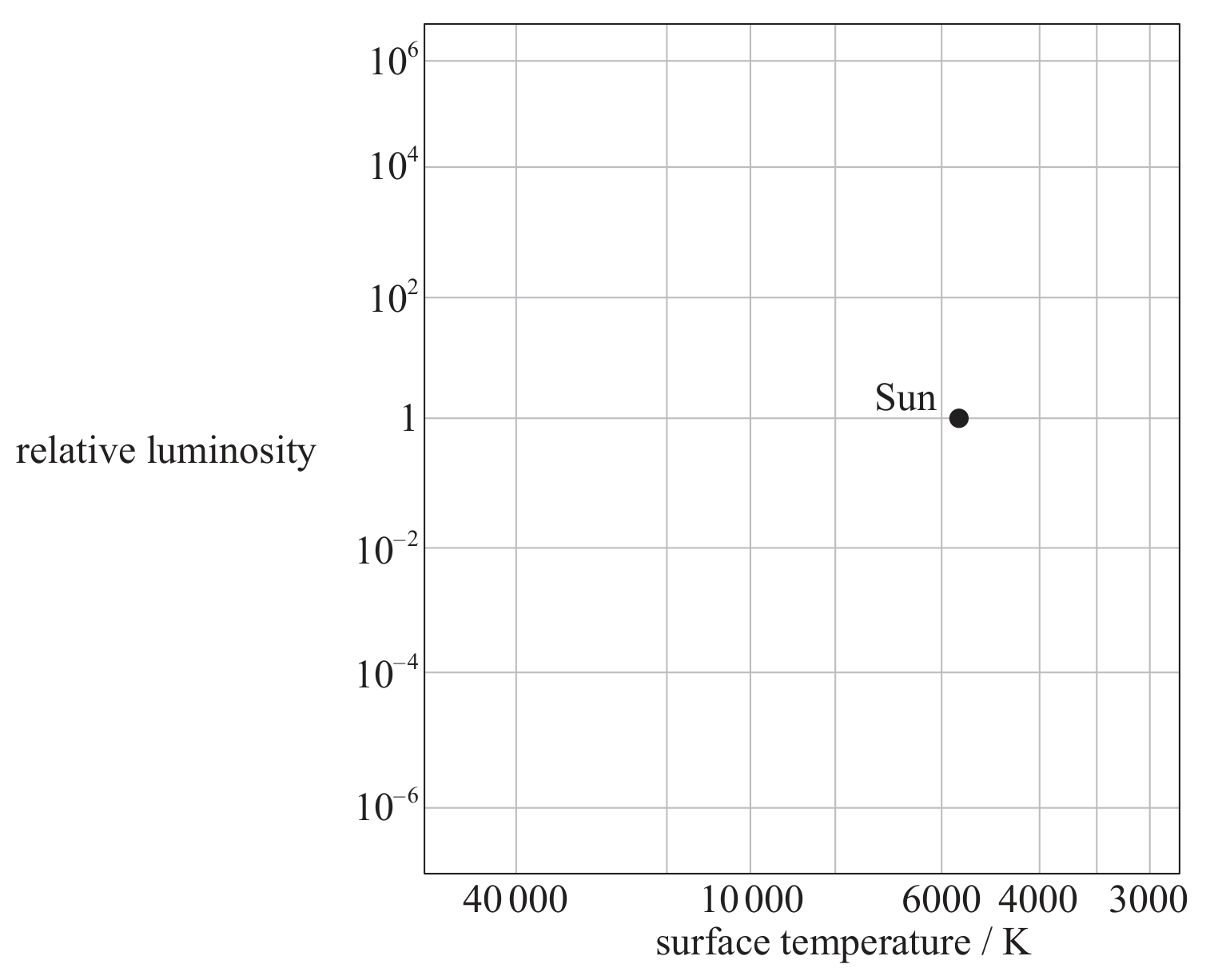
Gomeisa, Luyten's star and the Sun are main sequence stars. On the grid of the Hertzsprung-Russell (HR) diagram, identify the position of

[ 1 ]
(i)

Luyten's star, with the letter L .

Question image
[ 1 ]
(d)

On the HR diagram above, sketch the likely evolutionary path of Luyten's star.
[ 1 ]
(a)
(i)

Discuss how the discovery of the cosmic background radiation provides evidence for the Big Bang.

[ 2 ]
[Maximum number: 3]

This question is about the night sky.

(a)

Distinguish between a stellar cluster and a constellation.

[ 2 ]
(b)

Describe the apparent motion of stars in the sky over a period of 24 hours.

[ 1 ]
[Maximum number: 3]

This question is about objects in the universe.

(a)

State one difference between

[ 2 ]
(i)

a main sequence star and a planet.

[ 1 ]
(ii)

a stellar cluster and a constellation.

[ 1 ]
(b)

State how

[ 1 ]
(i)

a main sequence star remains in equilibrium despite it having a great mass.

[ 1 ]
[Maximum number: 3]

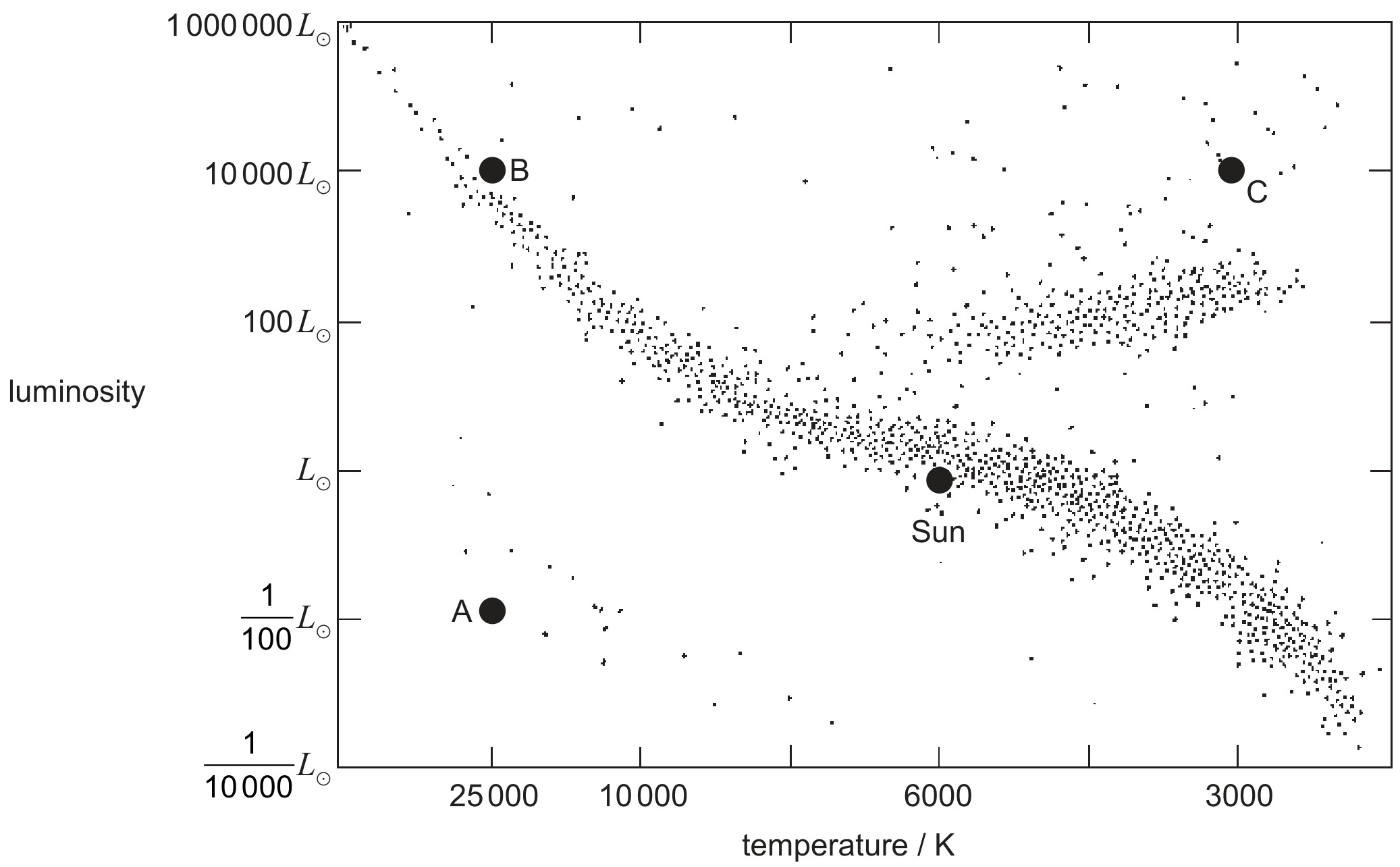
This question is about stars.

The Hertzsprung-Russell (HR) diagram shows the position of the Sun and three stars labelled A, B and C .

Question image
(a)

State the star type for A, B and C.

A:
B:
C:

[ 3 ]
[Maximum number: 7]

This question is about determining the distance to a nearby star.

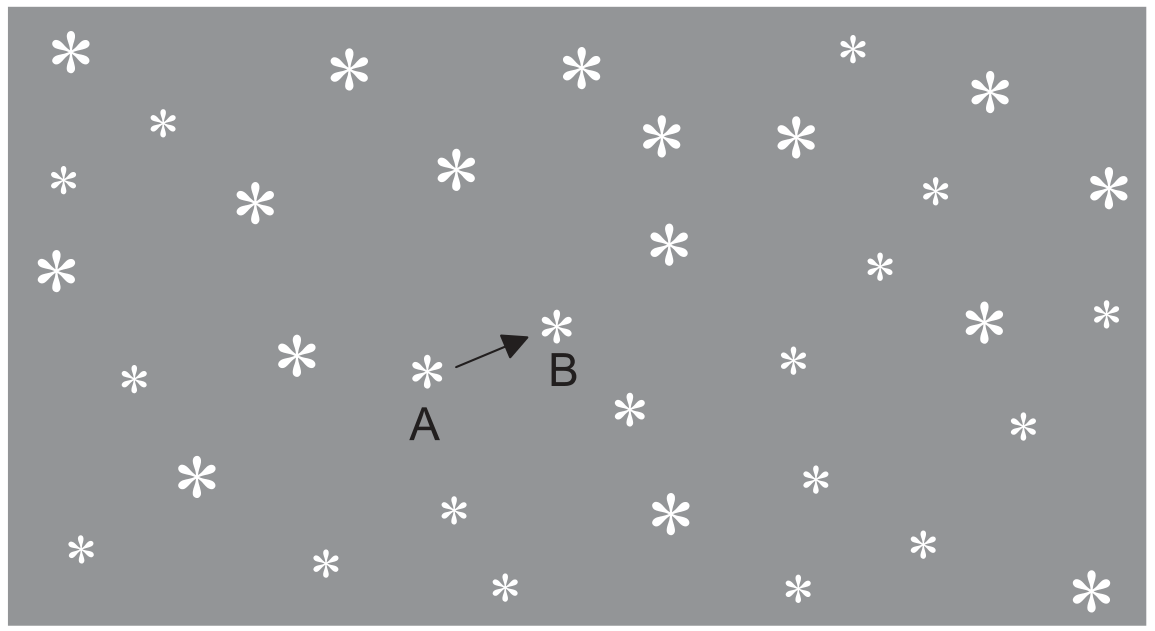
Two photographs of the night sky are taken, one six months after the other. When the photographs are compared, one star appears to have shifted from position A to position B, relative to the other stars.

Question image
(a)

Outline why the star appears to have shifted from position A to position B.

[ 1 ]
(b)

The observed angular displacement of the star is θ\theta and the diameter of the Earth's orbit is d. The distance from the Earth to the star is D.

[ 4 ]
(i)

Draw a diagram showing d, D and θ\theta.

[ 1 ]
(ii)

Explain the relationship between d, D and θ\theta.

[ 2 ]
(iii)

One consistent set of units for D and θ\theta are parsecs and arc-seconds.

State one other consistent set of units for this pair of quantities.

[ 1 ]
(c)

Discuss whether Hubble's Law can be used to determine reliably the distance from Earth to this star.

[ 2 ]
(a)

Aldebaran is a red giant star in the constellation of Taurus.

[ 3 ]
(i)

Describe the differences between a constellation and a stellar cluster.

[ 3 ]
(b)

Betelgeuse in the constellation of Orion is a red supergiant star.

[ 5 ]
(i)

Compare the fate of Aldebaran to that of Betelgeuse.
Aldebaran:
Betelgeuse:

[ 2 ]
(ii)

Outline, with reference to the Chandrasekhar limit, the circumstances under which the final state of Betelgeuse could be the same as the final state of Aldebaran.

[ 3 ]
[Maximum number: 8]

This question is about the life history of stars.

(a)

Outline, with reference to pressure, how a star on the main sequence maintains its stability.

[ 3 ]
(b)

A star with a mass equal to that of the Sun moves off the main sequence. Outline the main processes of nucleosynthesis that occur in the core of this star before and after this change.

[ 2 ]
(c)

Compare the fate of the star in (b) with that of a star of much greater mass.

[ 3 ]
[Maximum number: 7]

This question is about a particular star called Barnard's star.

The peak wavelength in the spectrum of Barnard's star is 940 nm . The following data are available.

 apparent brightness of Barnard’s star  apparent brightness of the Sun =2.5×10¹⁴ luminosity of Barnard’s star  luminosity of the Sun =3.8×10³\begin{array}{r} \frac{\text { apparent brightness of Barnard's star }}{\text { apparent brightness of the Sun }}=2.5 \times 10^{-14} \\ \frac{\text { luminosity of Barnard's star }}{\text { luminosity of the Sun }}=3.8 \times 10^{-3} \end{array}
(a)
(i)

Suggest why Barnard's star is not likely to be either a white dwarf or a red giant.

[ 2 ]
(b)
(i)

Calculate the parallax angle for Barnard's star as observed from Earth.

[ 2 ]
(ii)

Outline how the parallax angle is measured.

[ 3 ]
[Maximum number: 4]

E3. This question is about stellar evolution.
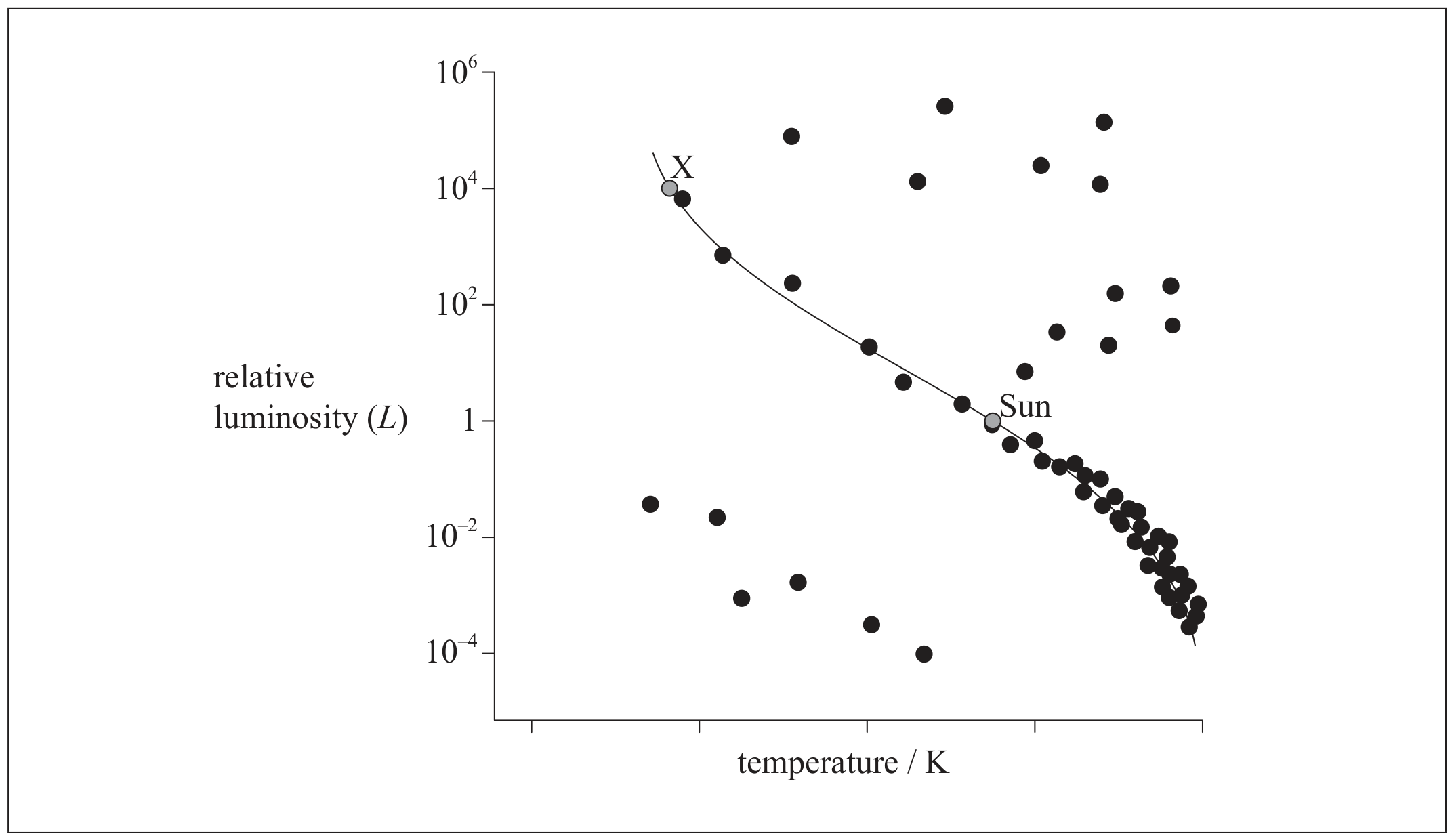
In the HR diagram below, the Sun and another main sequence star, X , have been marked.

Question image

(a) (i) On the diagram above, draw a line to show the evolutionary path of the Sun from its present position on the main sequence to the final stage in its evolution.
(ii) Explain, by reference to the Chandrasekhar limit, why the final stage in the evolution of the Sun is the one you indicated in (a)(i).
(b) (i) Show that the mass of star X is approximately 14 solar masses. (Assume that n=3.5 in the mass-luminosity relation.)
(ii) State the likely final stage of star X .

0