EduNinja
[Maximum number: 2]

This question is about stars in the constellation Canis Minor.

(a)

An astronomer in the northern hemisphere on Earth sees Canis Minor rise above the eastern horizon and subsequently set in the west. Explain this motion of Canis Minor as observed by the astronomer.

[ 2 ]
[Maximum number: 1]

This question is about planets.

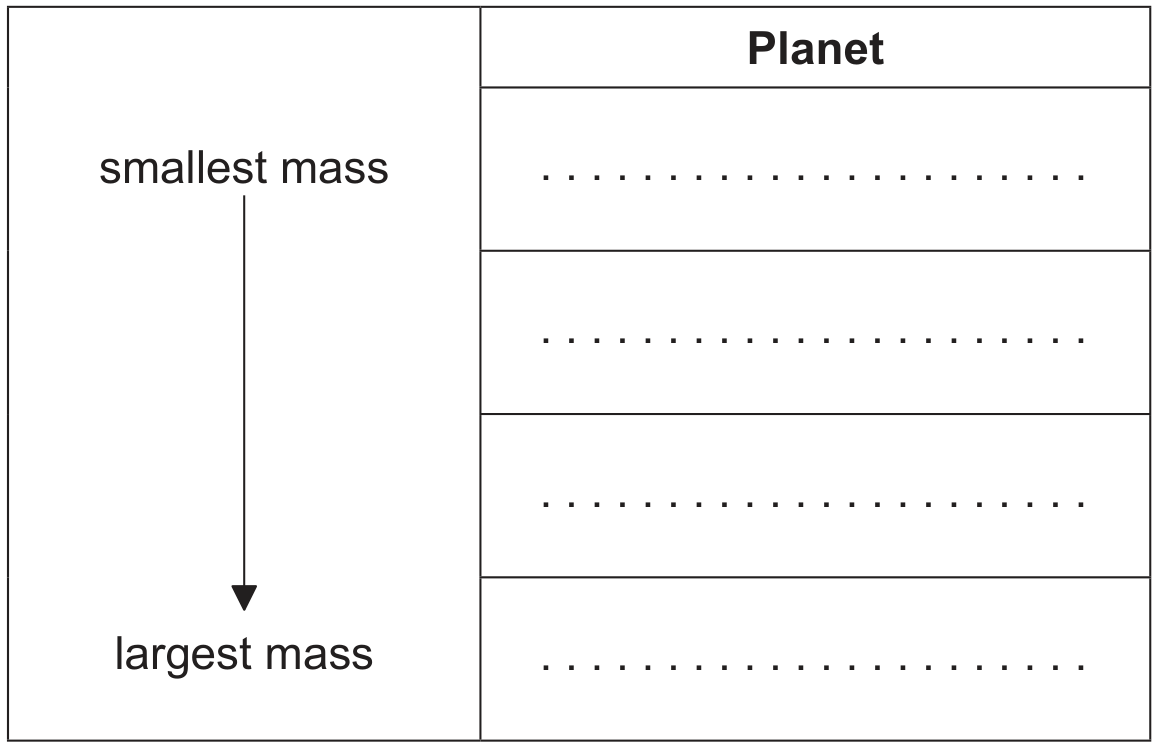
Four of the outer planets of the solar system are Jupiter, Neptune, Saturn and Uranus. List these planets in order of increasing mass.

Table
[Maximum number: 3]

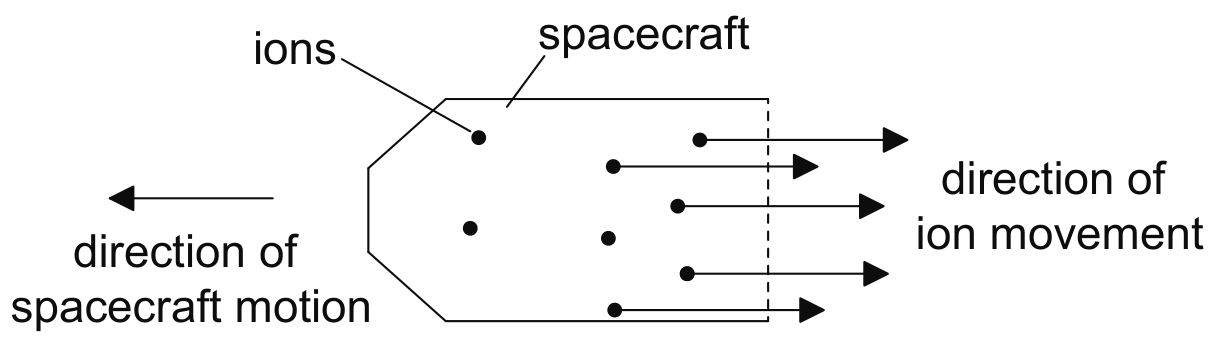
Ion-thrust engines can power spacecraft. In this type of engine, ions are created in a chamber and expelled from the spacecraft. The spacecraft is in outer space when the propulsion system is turned on. The spacecraft starts from rest.

Question image

The mass of ions ejected each second is 6.6×10⁶ kg6.6 \times 10^{-6} \mathrm{~kg} and the speed of each ion is 5.2×10⁴ m s15.2 \times 10^{4} \mathrm{~m} \mathrm{~s}^{-1}. The initial total mass of the spacecraft and its fuel is 740 kg . Assume that the ions travel away from the spacecraft parallel to its direction of motion.

(a)

On arrival at the planet, the spacecraft goes into orbit as it comes into the gravitational field of the planet.

[ 3 ]
(i)

Outline what is meant by the gravitational field strength at a point.

[ 2 ]
(ii)

Newton's law of gravitation applies to point masses. Suggest why the law can be applied to a satellite orbiting a spherical planet of uniform density.

[ 1 ]
[Maximum number: 4]

A space probe of mass 95 kg is designed to land on the surface of an asteroid. The gravitational field strength g of the asteroid at its surface is 2.7×10³ ms22.7 \times 10^{-3} \mathrm{~ms}^{-2}.

(a)

The radius r of the asteroid is 230 km . Calculate the mass of the asteroid.

[ 2 ]
(b)

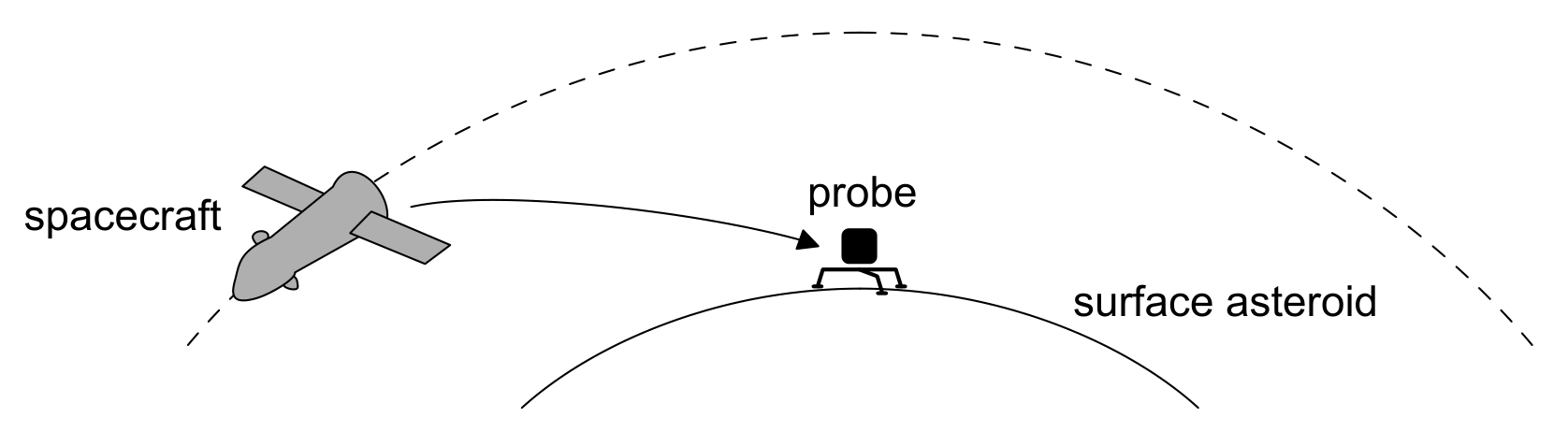
The probe is carried to the asteroid on board a spacecraft.

Question image

Calculate the weight of the probe when close to the surface of the asteroid.

[ 1 ]
(c)
(i)

Show that the escape speed vescv_{e s c} of the asteroid is given by

vesc=2grv_{\mathrm{esc}}=\sqrt{2 g r}
(ii)

Calculate the escape speed of the asteroid.

[ 1 ]
[Maximum number: 2]

A space probe of mass 95 kg is designed to land on the surface of an asteroid. The gravitational field strength g of the asteroid at its surface is 2.7×10³ ms22.7 \times 10^{-3} \mathrm{~ms}^{-2}.

(a)

The radius r of the asteroid is 230 km . Calculate the mass of the asteroid.

[ 2 ]
[Maximum number: 2]

A space probe of mass 95 kg is designed to land on the surface of an asteroid. The gravitational field strength g of the asteroid at its surface is 2.7×10³ ms22.7 \times 10^{-3} \mathrm{~ms}^{-2}.

(a)

The radius r of the asteroid is 230 km . Calculate the mass of the asteroid.

[ 2 ]
[Maximum number: 2]

E1. This question is about asteroids.
(a) State the nature of an asteroid.
(b) State the position of the asteroid belt in the solar system.

[Maximum number: 4]

Venus is a planet in the Solar System. The following data are given:

Orbital period of Venus =225 days
Orbital period of Earth =365 days

(a)

Calculate the ratio orbital radius of Venus

[ 2 ]
(b)

Explain how observations of the motion of the planets allow scientists to determine the mass of the Sun.

[ 2 ]
[Maximum number: 6]

Venus is a planet in the Solar System. The following data are given:

Orbital period of Venus =225 days
Orbital period of Earth =365 days

(a)

Calculate the ratio orbital radius of Venus

[ 2 ]
(b)

Explain how observations of the motion of the planets allow scientists to determine the mass of the Sun.

[ 2 ]
(c)

The difference between the maximum and minimum Earth-Sun distances is 5.0×10⁹ m5.0 \times 10^{9} \mathrm{~m}. The difference in gravitational potential due to the Sun between these positions is 3.0×10⁷Jkg13.0 \times 10^{7} \mathrm{Jkg}^{-1}.

Estimate the average gravitational field strength due to the Sun at the position of Earth.

[ 2 ]
[Maximum number: 1]

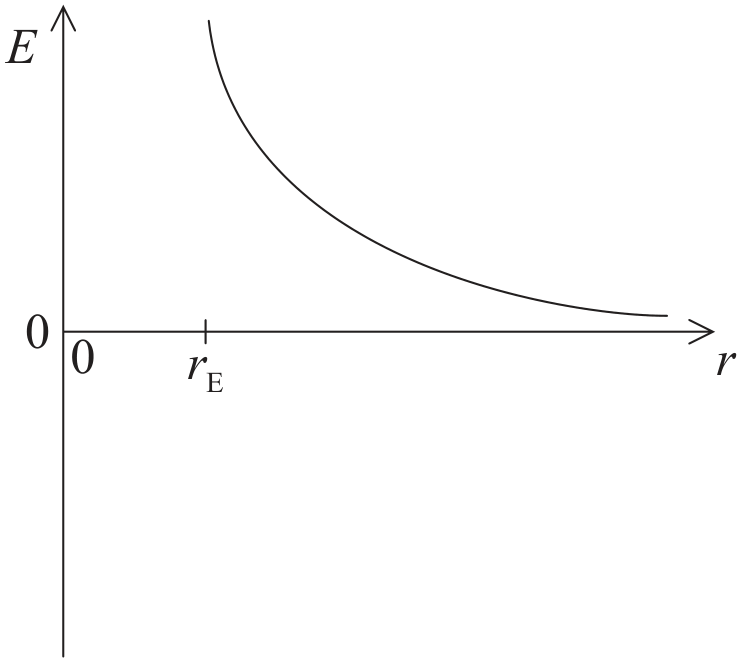
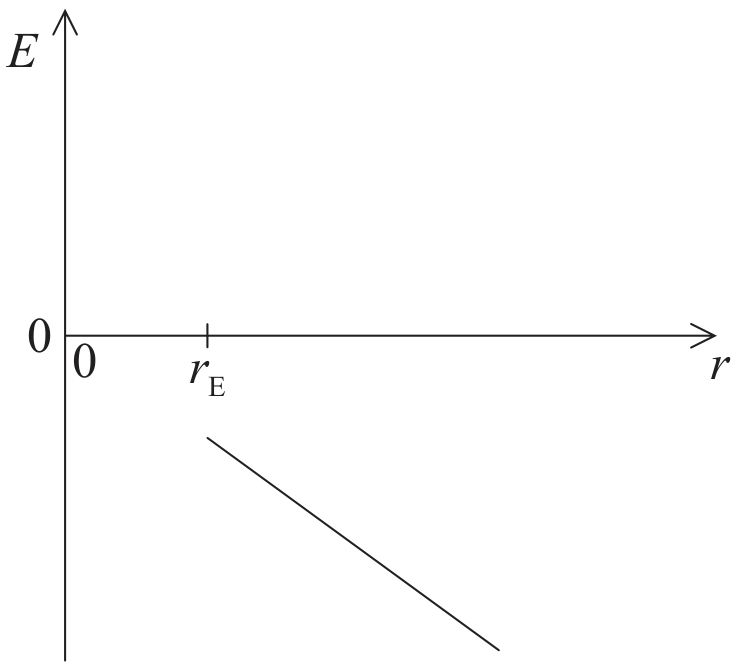
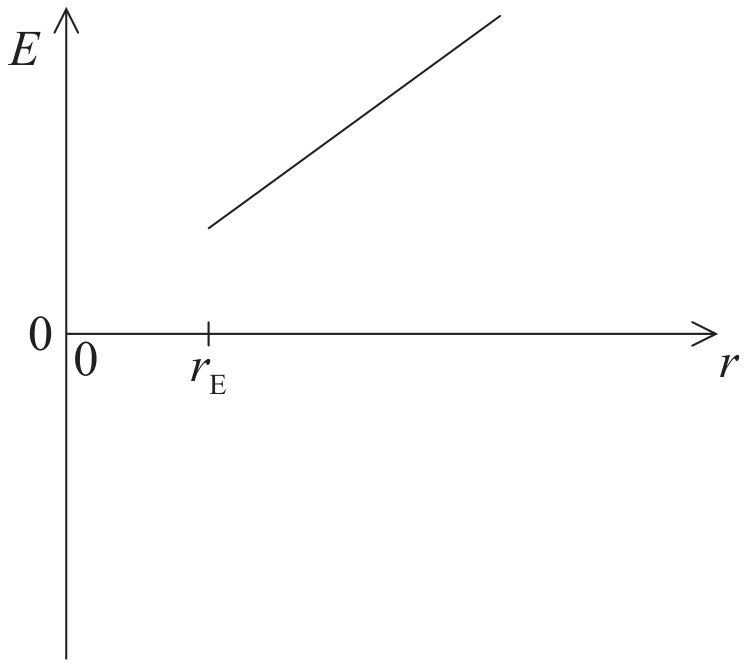
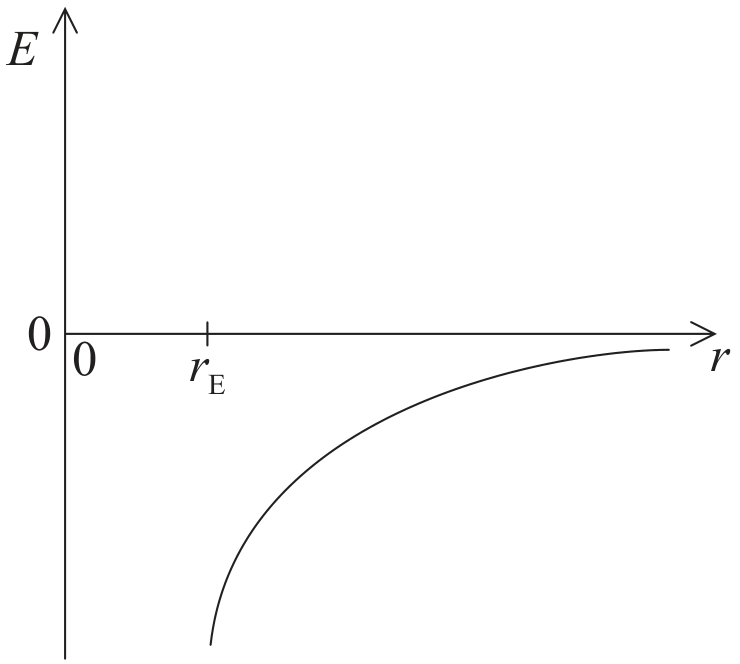
Which graph shows how the total energy E of an orbiting satellite varies with distance r from the centre of the Earth, where rEr_{\mathrm{E}} is the radius of the Earth?

A
Question image
B
Question image
C
Question image
D
Question image
0