EduNinja
[Maximum number: 7]

A2. This question is about radioactive decay.
(a) Describe the phenomenon of natural radioactive decay.
(b) A nucleus of americium-241 (Am-241) decays into a nucleus of neptunium-237 (Np-237) in the following reaction.

95241AmX237 Np+24α{ }_{95}^{241} \mathrm{Am} \rightarrow{ }_{X}^{237} \mathrm{~Np}+{ }_{2}^{4} \alpha

(i) State the value of X.
p
(ii) Explain in terms of mass why energy is released in the reaction in (b).
(iii) Define binding energy of a nucleus.
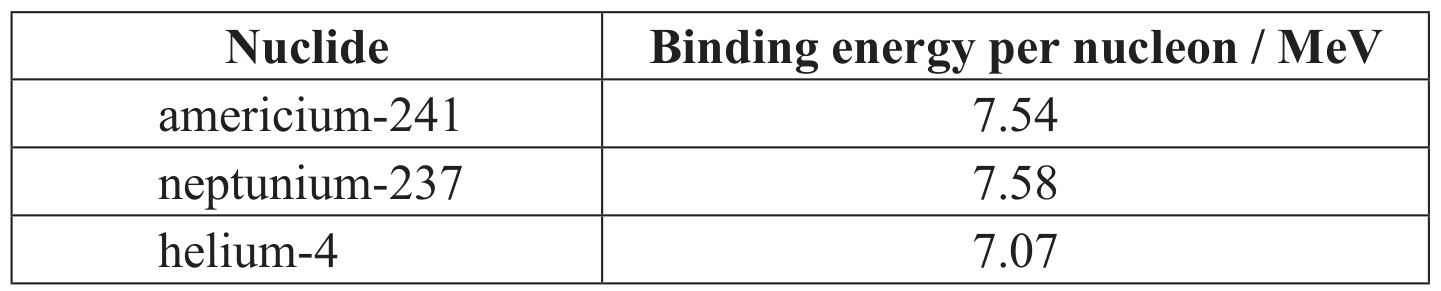
(iv) The following data are available.
Table

Determine the energy released in the reaction in (b).
[Maximum number: 10]

This question is about the use of radioactive isotopes in medicine.

(a)

Distinguish between the biological half-life and effective half-life of a radioactive isotope.

[ 2 ]
(b)

The radioactive isotope iodine-131 undergoes beta decay to the stable isotope xenon-131 with a physical half-life of 8.0 days. Gamma radiation is also emitted in this decay. Iodine-131 is readily absorbed by the thyroid gland. The biological half-life is 21 days.

[ 5 ]
(i)

Calculate the effective half-life of iodine-131.

[ 2 ]
(ii)

Suggest why iodine-131 is often chosen to treat cancer of the thyroid gland.

[ 3 ]
(c)

Iodine-131 can be used to estimate the total blood volume of a patient.

A small amount of the isotope is dissolved in 8.0 cm38.0 \mathrm{~cm}^{3} of a solution. 4.0 cm34.0 \mathrm{~cm}^{3} of this solution is injected into the patient. After a few minutes a 5.0 cm35.0 \mathrm{~cm}^{3} blood sample is taken. The activity of this sample is measured to be 96 Bq .

The remaining 4.0 cm34.0 \mathrm{~cm}^{3} of the solution is mixed with 1000 cm31000 \mathrm{~cm}^{3} of water. The activity of 5.0 cm35.0 \mathrm{~cm}^{3} of this solution is measured to be 510 Bq .

Estimate the total volume of blood in the patient.

J1. This question is about quarks.

[ 3 ]
[Maximum number: 5]

B1. This question is about plutonium as a power source.
Plutonium (94238Pu)\left({ }_{94}^{238} \mathrm{Pu}\right) decays by alpha emission. The energy of the alpha particle emitted is 8.8×10¹³ J8.8 \times 10^{-13} \mathrm{~J}. The decay constant of plutonium-238 is 8.1×10³yr18.1 \times 10^{-3} \mathrm{yr}^{-1}.
(a) Define decay constant.
(b) Plutonium-238 is to be used as a power source in a space probe.
(i) Determine the initial activity of plutonium such that the power released by plutonium is 6.0 W .
(ii) The power source becomes useless when the power released decreases to 4.0 W . Determine the time, in years, for which the power source can be used in the space probe.

[Maximum number: 6]

B2. This question is about nuclear energy levels and nuclear decay.
(a) The isotope bismuth-212 undergoes α\alpha-decay to an isotope of thallium. In this decay a gamma-ray photon is also produced. The isotope potassium-40 undergoes β+\beta^{+}decay to an isotope of argon.

Outline how the
(i) α\alpha particle spectrum and the gamma spectrum of the decay of bismuth-212 give evidence for the existence of discrete nuclear energy levels.
(ii) β+\beta^{+}spectrum of the decay of potassium-40 led to the existence of the neutrino being postulated.
(b) The isotope potassium-40 occurs naturally in many rock formations. In a particular sample of rock it is found that, out of the total number of argon plus potassium-40 atoms, 23 % are potassium-40 atoms.

Determine the age of the rock sample. The decay constant for potassium-40 is 5.3×10¹⁰yr15.3 \times 10^{-10} \mathrm{yr}^{-1}.

[Maximum number: 7]

This question is about binding energy and mass defect.

(a)

State what is meant by mass defect.

[ 1 ]
(b)
(i)

Data for this question is given below.

Binding energy per nucleon for deuterium (12H)\left({ }_{1}^{2} \mathrm{H}\right) is 1.1 MeV .
Binding energy per nucleon for helium- 3(23He)3\left({ }_{2}^{3} \mathrm{He}\right) is 2.6 MeV .
Using the data, calculate the energy change in the following reaction.

12H+11H23He+γ{ }_{1}^{2} \mathrm{H}+{ }_{1}^{1} \mathrm{H} \rightarrow{ }_{2}^{3} \mathrm{He}+\gamma
[ 2 ]
(ii)

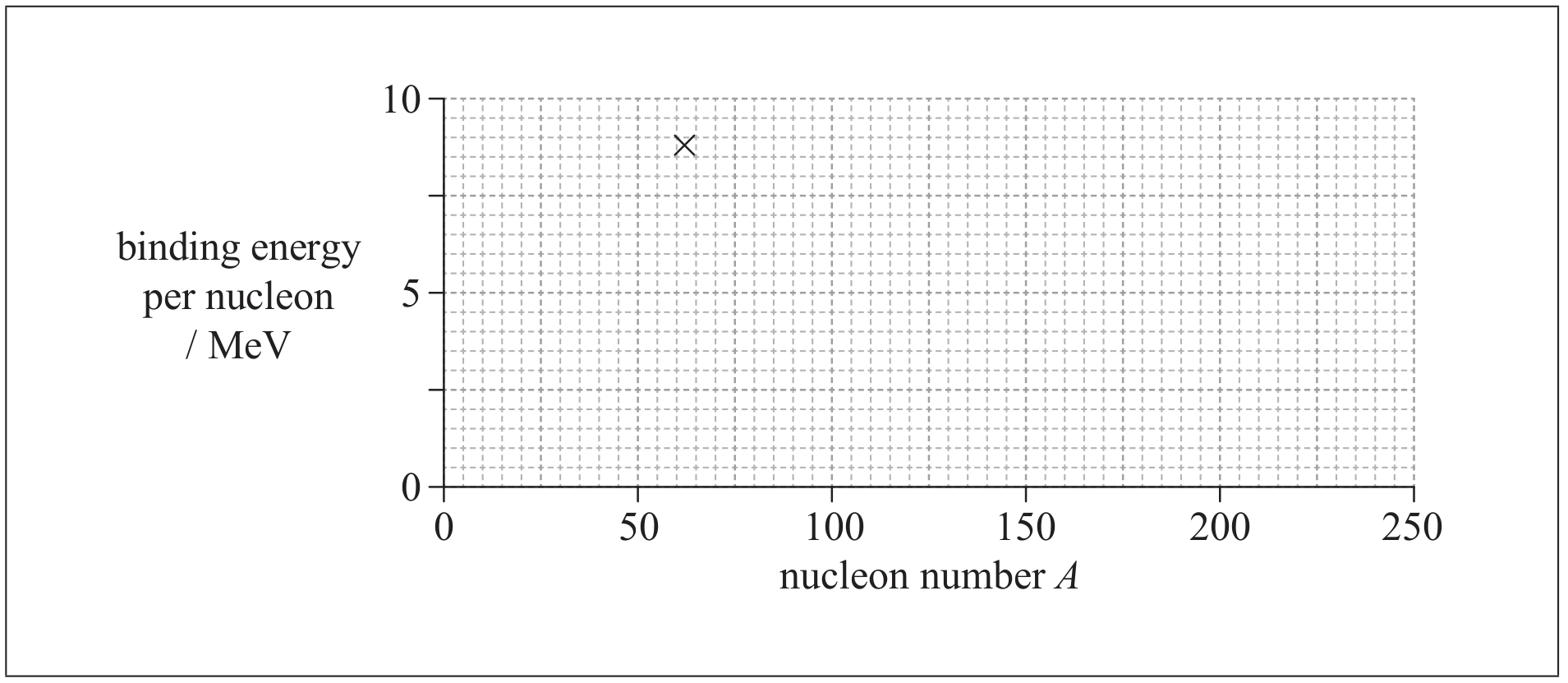
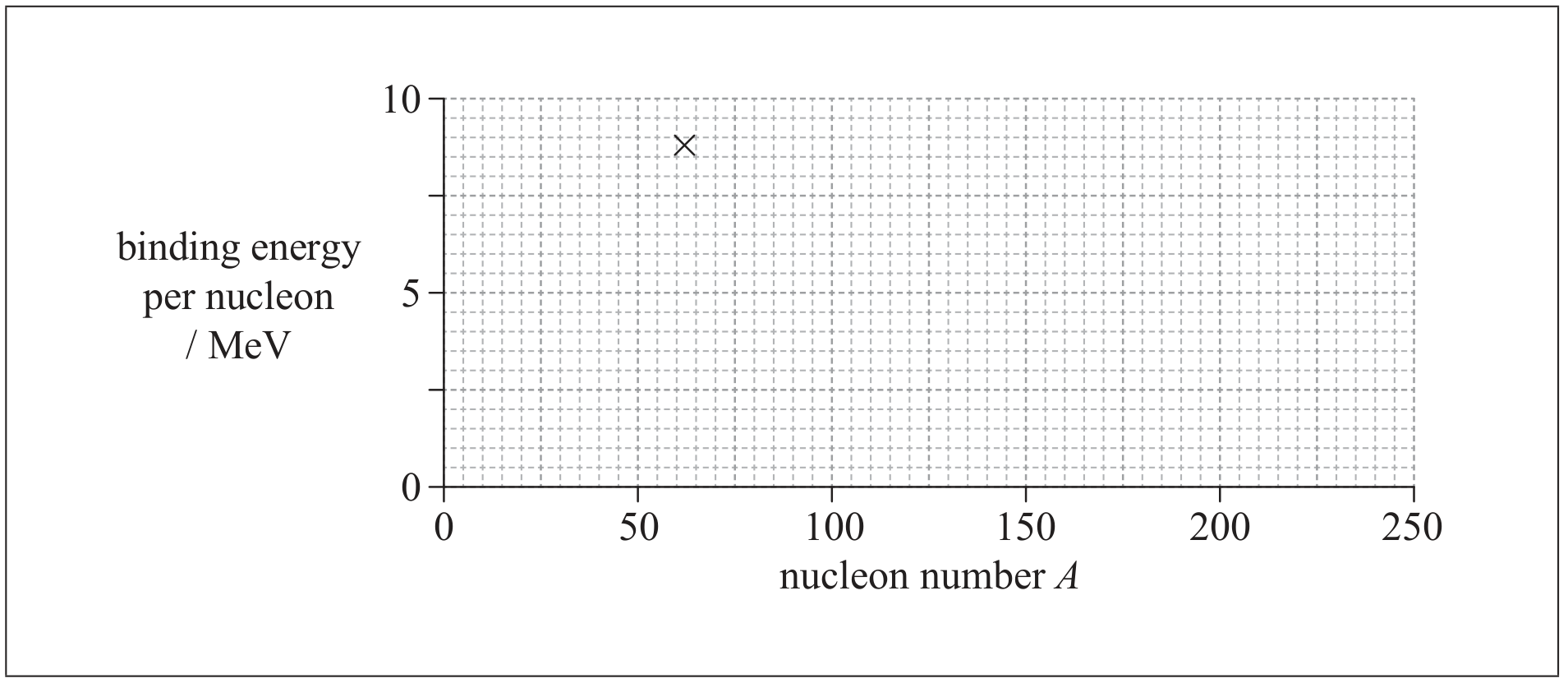
The cross on the grid shows the binding energy per nucleon and nucleon number A of the nuclide nickel-62.

Question image

On the grid, sketch a graph to show how the average binding energy per nucleon varies with nucleon number A.

[ 2 ]
(iii)

State and explain, with reference to your sketch graph, whether energy is released or absorbed in the reaction in (b)(i).
This section consists of three questions: 4,5 and 6.

[ 2 ]
[Maximum number: 9]

This question is about binding energy and mass defect.

(a)

State what is meant by mass defect.

[ 1 ]
(b)
(i)

The nuclear mass of the nuclide helium- 3(23He)3\left({ }_{2}^{3} \mathrm{He}\right) is 3.014931 u . Show that the binding energy per nucleon for the nuclide is about 2.6 MeV .

[ 2 ]
(ii)

The binding energy per nucleon for deuterium (12H)\left({ }_{1}^{2} \mathrm{H}\right) is 1.11 MeV . Calculate the energy change in the following reaction.

12H+11H23He+γ{ }_{1}^{2} \mathrm{H}+{ }_{1}^{1} \mathrm{H} \rightarrow{ }_{2}^{3} \mathrm{He}+\gamma
[ 2 ]
(iii)

The cross on the grid shows the binding energy per nucleon and nucleon number A of the nuclide nickel-62.

Question image

On the grid, sketch a graph to show how the average binding energy per nucleon varies with nucleon number A.

[ 2 ]
(iv)

State and explain, with reference to your sketch graph, whether energy is released or absorbed in the reaction in (b)(ii).

[ 2 ]
[Maximum number: 10]

This question is about nuclear energy.

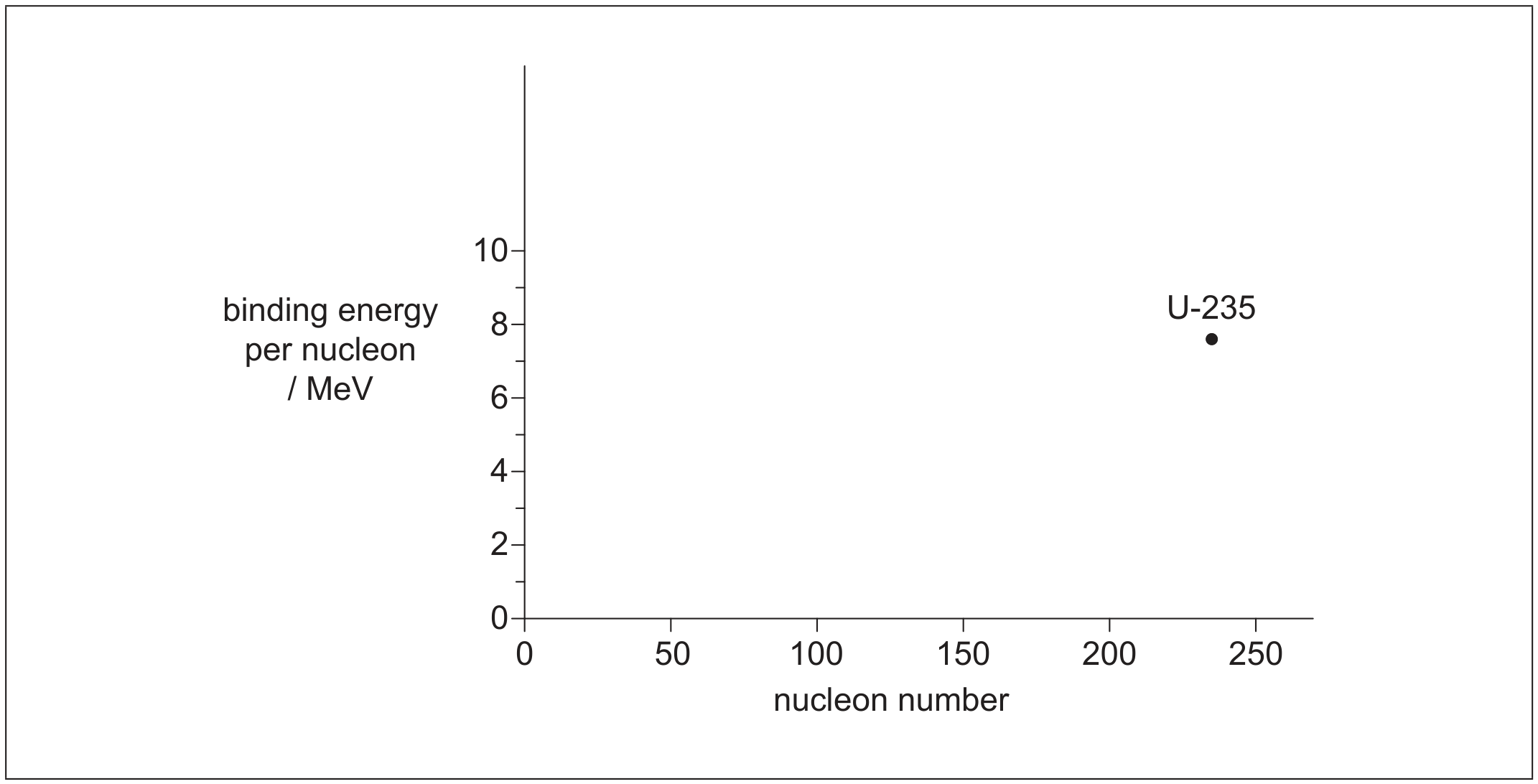
The graph shows the variation of binding energy per nucleon with nucleon number. The position for uranium-235 (U-235) is shown.

Question image
(a)

State what is meant by the binding energy of a nucleus.

[ 1 ]
(b)
(i)

On the axes, sketch a graph showing the variation of nucleon number with the binding energy per nucleon.

[ 2 ]
(ii)

Explain, with reference to your graph, why energy is released during fission of U-235.

[ 3 ]
(c)

U-235 (92235U)\left({ }_{92}^{235} \mathrm{U}\right) can undergo alpha decay to form an isotope of thorium (Th).

[ 4 ]
(i)

State the nuclear equation for this decay.

[ 1 ]
(ii)

A sample of rock contains a mass of 5.6 mg of U-235 at the present day.

The half-life of U-235 is 7.0×1087.0 \times 10^{8} years. Determine the initial mass of the U-235 if the rock sample was formed 3.9×1093.9 \times 10^{9} years ago.

[ 3 ]
[Maximum number: 2]

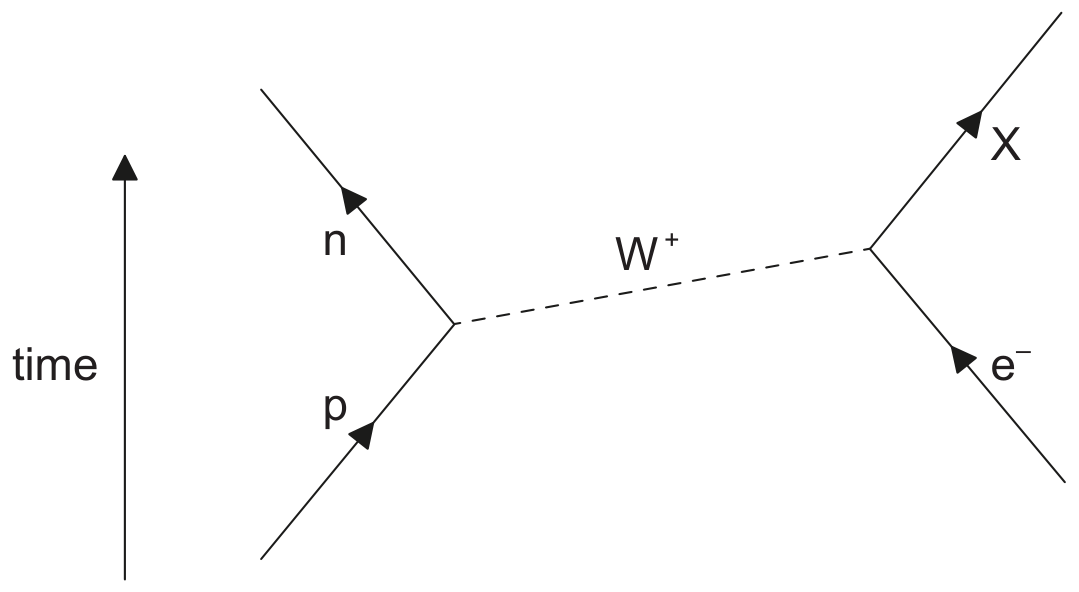
The Feynman diagram shows electron capture.

Question image
(a)

Deduce that X must be an electron neutrino.

[ 2 ]
[Maximum number: 3]

This question is about nuclear power production.

(a)

Outline the reason why fuel enrichment is necessary for the fuel used in a commercial nuclear reactor.

[ 3 ]
(a)
(i)

Calculate, in s1\mathrm{s}^{-1}, the decay constant of Au-198.

[ 1 ]
(ii)

A sample contains 5.0 mg of pure Au-198. Determine the mass of Hg-198 present in the sample after one week.

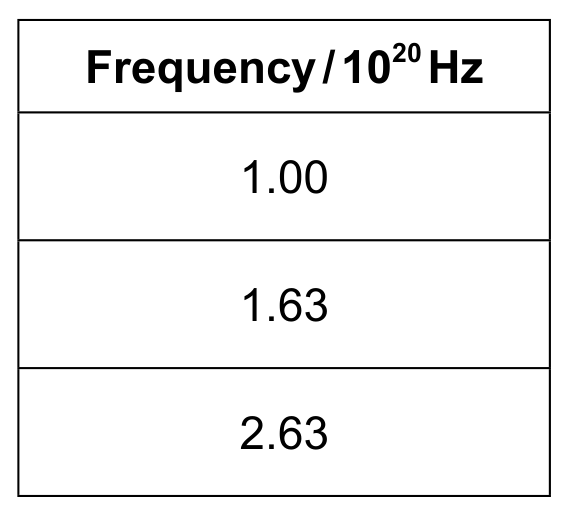
Gamma photons of the following frequencies are emitted in the decay of Au-198:

Table
[ 2 ]
(b)

Explain how this observation provides evidence that nuclear energy levels are discrete.

[ 2 ]
0