EduNinja
[Maximum number: 7]

A3. This question is about the Doppler effect.
(a) Describe the Doppler effect.
(b) A spectral line from a source on Earth has a frequency of 4.672×10¹⁴ Hz4.672 \times 10^{14} \mathrm{~Hz}. When this same line is observed from a distant galaxy it is found to have shifted to 4.669×10¹⁴ Hz4.669 \times 10^{14} \mathrm{~Hz}.
(i) State the direction of the motion of the galaxy relative to Earth.

(ii) Deduce the speed of the galaxy relative to Earth.
[Maximum number: 2]

This question is about sound waves.

A whistle on a steam train consists of a pipe that is open at one end and closed at the other. The sounding length of the whistle is 0.27 m and the steam pressure in the whistle is so great that the third harmonic of the pipe is sounding. The speed of sound in air is 340 ms1340 \mathrm{~ms}^{-1}.

(a)

The train is moving directly away from a stationary observer at a speed of 22 ms122 \mathrm{~ms}^{-1} while the whistle is sounding. Calculate the frequency heard by the observer.

[ 2 ]
[Maximum number: 7]

A4. This question is about the Doppler effect.
A source emits sound of frequency 100 Hz . The speed of sound in air is 330 m s1330 \mathrm{~m} \mathrm{~s}^{-1}.
(a) Calculate the frequency measured by an observer when
(i) the observer is stationary and the source is moving towards the observer at 120 m s1120 \mathrm{~m} \mathrm{~s}^{-1}.
(ii) the source is stationary and the observer is moving towards the source at 120 ms1120 \mathrm{~ms}^{-1}.
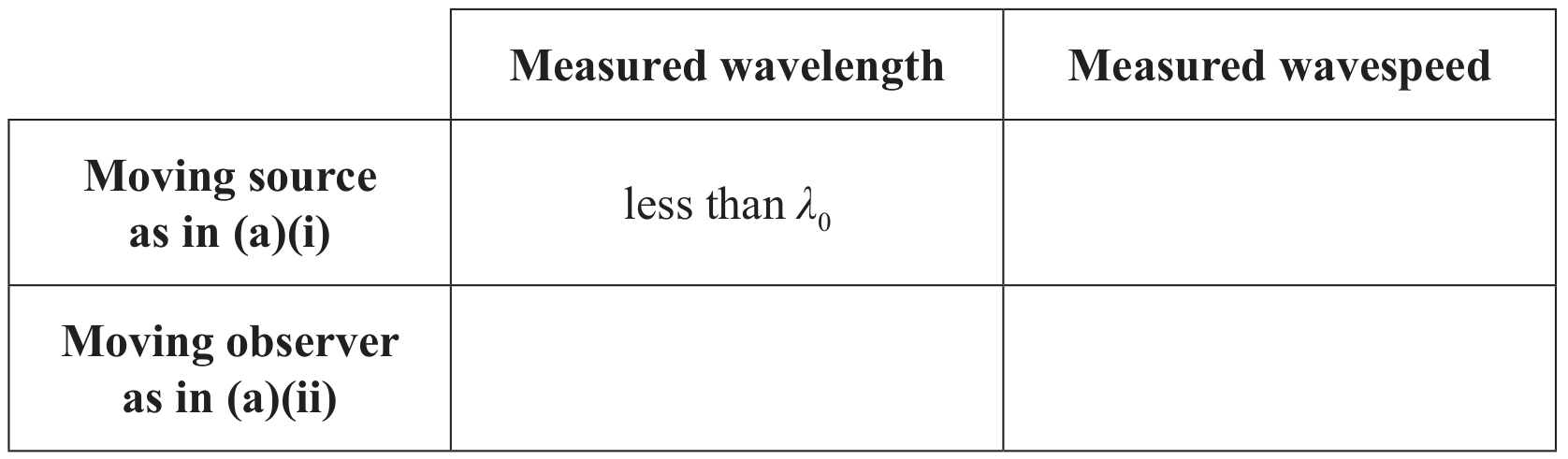
(b) When both source and observer are stationary the wavelength is λ0\lambda_{0} and the wavespeed is v0v_{0}.

In the table below, compare the values of measured wavelength and measured wavespeed, as measured by the observer, with respect to λ0\lambda_{0} and v0v_{0}. One of the values is given for you.

Table
[Maximum number: 4]

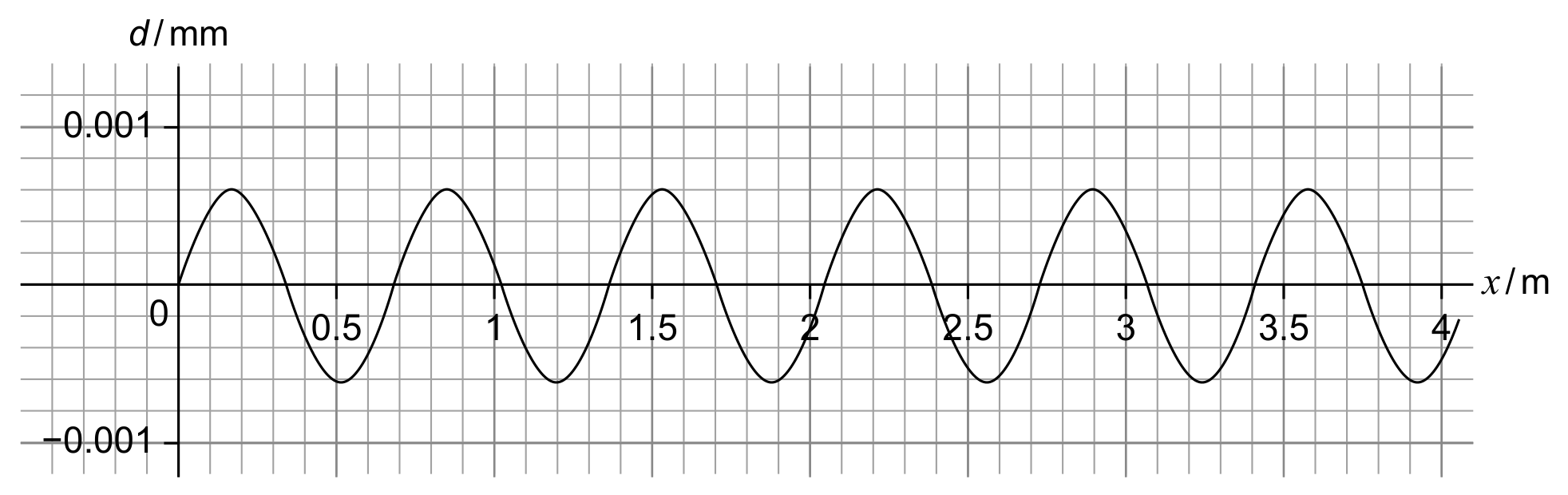
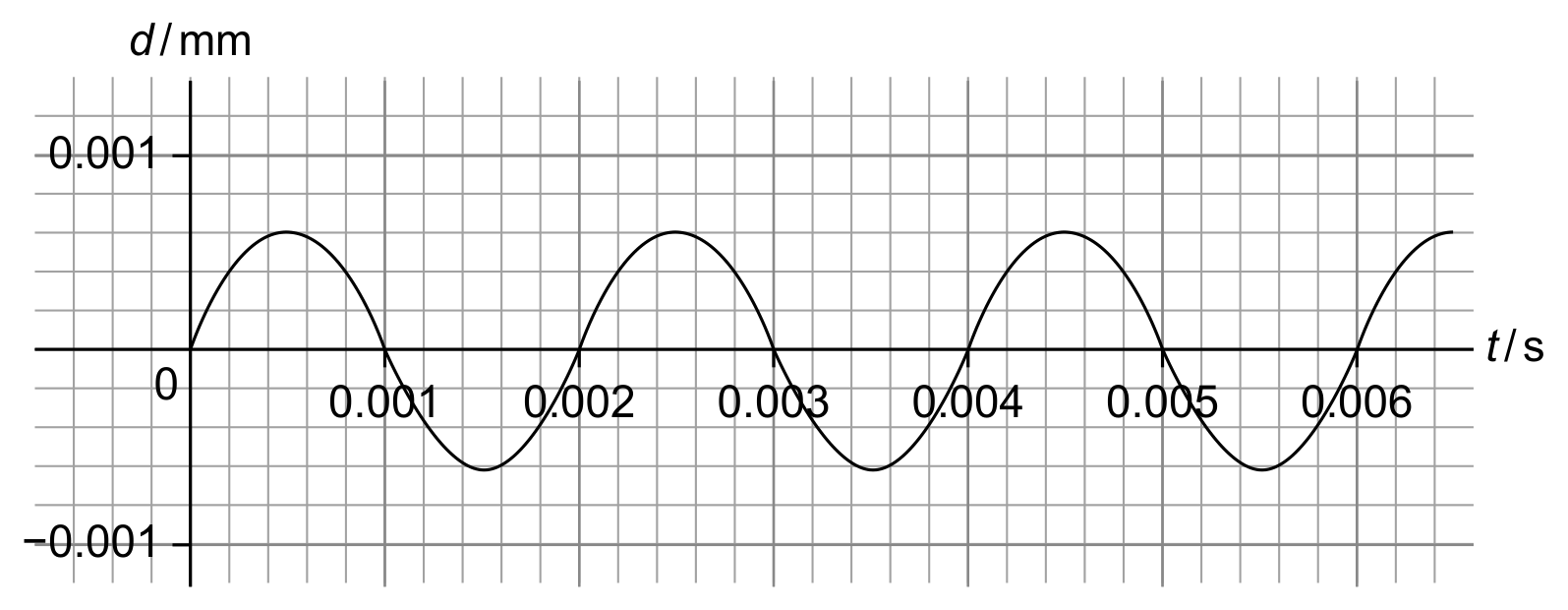
Graph 1 shows the variation of particle displacement d with position x for a travelling sound wave.

Graph 1

Graph 1

Graph 2 shows the variation of particle displacement d with time t for the same travelling sound wave.

Graph 2

Graph 2

(a)
(i)

Calculate the speed of the sound wave.

The Doppler effect applies to both sound and light waves.
A car is moving at constant velocity v between two sources of sound as shown in the diagram. The sources emit sound at 440 Hz and at 540 Hz . The driver hears both sounds at the same frequency.

Question image
[ 1 ]
(b)
(i)

Explain which frequency is emitted by source A.

[ 1 ]
(ii)

The spectrum of light received from a galaxy shows a peak at a wavelength of 659.0 nm . The peak corresponds to an atomic transition in the hydrogen atom that emits a wavelength of 656.1 nm when observed in a laboratory on Earth.

Calculate the velocity of the galaxy with respect to Earth.

[ 2 ]
[Maximum number: 3]

E5. This question is about red-shift.
The wavelengths of radio signals from galaxy A are found to be red-shifted from the wavelengths that would be observed from sources at rest relative to Earth.
(a) The fractional change in wavelength of the radio signals from galaxy A is 9.4×1039.4 \times 10^{-3}.

Calculate, in kms1\mathrm{km} \mathrm{s}^{-1}, the average velocity of galaxy A relative to Earth.
(b) A supernova was observed within galaxy A. At the peak of its emissions, the supernova had an absolute magnitude of -20 and an apparent magnitude of 13 .

Show that the distance from Earth to the supernova is about 40 Mpc .
(c) Estimate, using your answer to (a) and the result for (b), the age of the universe.

(1pc=3.1×10¹³ km)\left(1 \mathrm{pc}=3.1 \times 10^{13} \mathrm{~km}\right)
[Maximum number: 6]

This question is about the Doppler effect.

(a)

Describe what is meant by the Doppler effect.

[ 2 ]
(b)

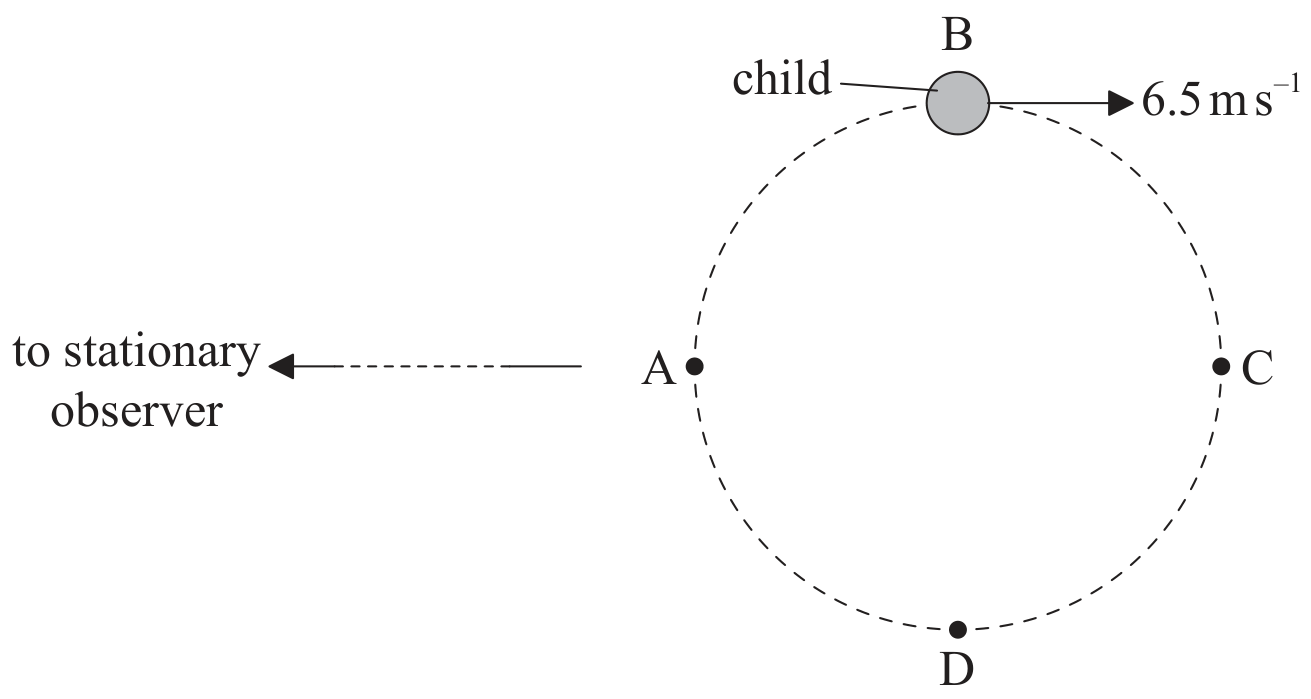
A child on a carousel (merry-go-round) moves with a speed of 6.5 m s16.5 \mathrm{~m} \mathrm{~s}^{-1} along a horizontal circular path ABCD A. A stationary observer is at a large distance from the carousel.

Question image

The child blows a whistle while moving from position B to position D . The whistle emits sound of frequency 850 Hz . The speed of sound in air is 330 m s1330 \mathrm{~m} \mathrm{~s}^{-1}.

[ 4 ]
(i)

Determine the minimum frequency of the sound heard by the observer.

[ 2 ]
(ii)

Describe the variation of the frequency of the sound heard by the observer.

[ 2 ]
[Maximum number: 5]

This question is about the Doppler effect.

(a)

Describe what is meant by the Doppler effect as it relates to sound.

[ 2 ]
(b)

An ambulance is travelling at a speed of 28.0 m s128.0 \mathrm{~m} \mathrm{~s}^{-1} along a straight road. Its siren emits a continuous sound of frequency 520 Hz . The ambulance is approaching a stationary observer. The observer measures the frequency of the note to be 566 Hz . Determine the speed of sound.

[ 3 ]
[Maximum number: 3]

This question is about radio telescopes.
A distant galaxy emits radio waves of frequency 6.0×10⁹ Hz6.0 \times 10^{9} \mathrm{~Hz} and is moving with speed 6.0×10⁶ m s16.0 \times 10^{6} \mathrm{~m} \mathrm{~s}^{-1} directly away from an observer on Earth.

(a)

Determine the wavelength of the radio wave as measured by the observer on Earth.

[ 3 ]
[Maximum number: 5]

This question is about the Doppler effect in sound.

(a)

A fire engine is travelling at a constant velocity towards a stationary observer. Its siren emits a note of constant frequency. As the engine passes close to the observer, the frequency of the note perceived by the observer decreases. Explain this decrease in terms of the wavefronts of the note emitted by the siren.

[ 3 ]
(b)

The frequency of the note emitted by the siren is 400 Hz . After the fire engine has passed, the frequency of the note detected by the observer is 360 Hz . Calculate the speed of the fire engine. (Take the speed of sound in air to be 340 m s1340 \mathrm{~m} \mathrm{~s}^{-1}.)

[ 2 ]
[Maximum number: 5]

This question is about the Doppler effect.

Georgia carries out an experiment to measure the speed of mosquitoes. She sets up a microphone to record the sounds of passing mosquitoes.

Question image

One mosquito is moving in a straight line with constant speed and passes very close to the microphone as seen in the diagram. The mosquito produces a sound of constant frequency. The speed of sound in air is 340 m s1340 \mathrm{~m} \mathrm{~s}^{-1}.

(a)

The maximum frequency recorded is 751 Hz and the minimum frequency recorded is 749 Hz . Explain this observation.

[ 2 ]
(b)

Determine the speed of the mosquito.

[ 3 ]
0