Structure 1. Models of the particulate nature of matter
- Syllabus
- First assessment 2025
- Section
- —
- Level
- SL
The kinetic molecular theory is a model that explains observable state properties using particle arrangement, movement, spacing, and attractions. Solid particles are closely packed and vibrate about fixed positions. Liquid particles remain close but change neighbours and flow past one another. Gas particles are far apart relative to their size and move freely, so a gas fills its container and is much more compressible.
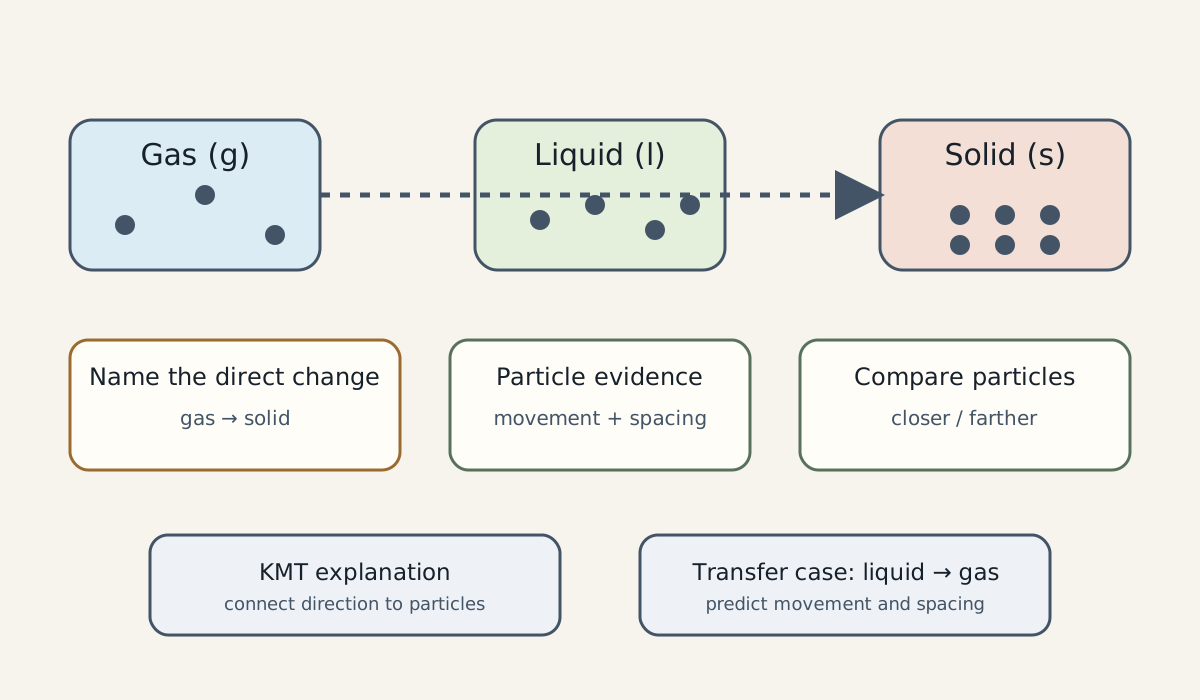
| State | Particle model | Fixed volume? | Fixed shape? | Symbol |
|---|---|---|---|---|
| Solid | Close, ordered or fixed positions; vibrate | Yes | Yes | (s) |
| Liquid | Close, disordered; move past neighbours | Yes | No | (l) |
| Gas | Widely spaced; rapid random motion | No | No | (g) |
(aq) does not name a fourth state of pure matter. It means the stated species is dissolved in water.
| Change | Direction | Energy transfer for the substance |
|---|---|---|
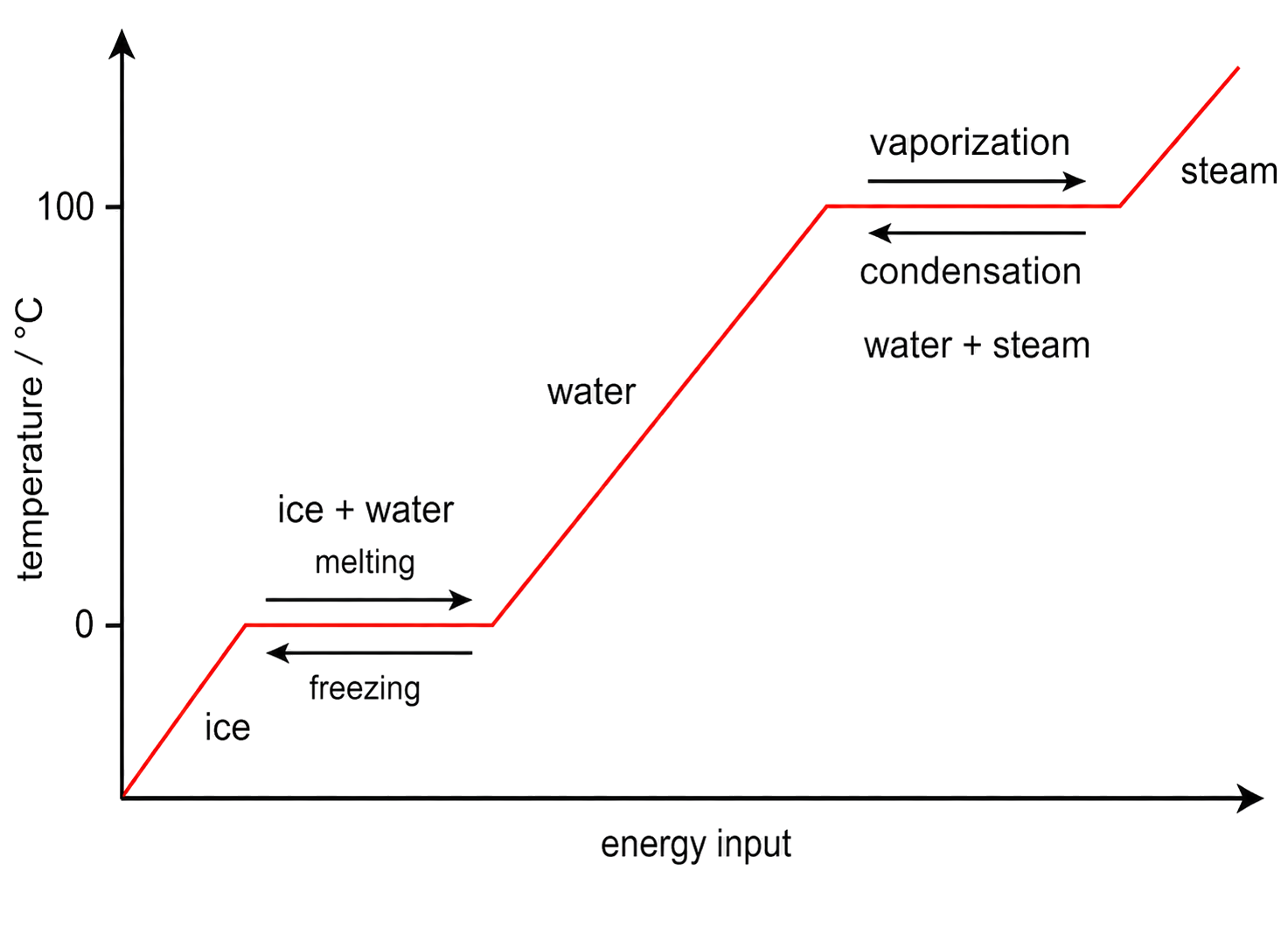
| Melting | solid → liquid | absorbed |
| Freezing | liquid → solid | released |
| Vaporization | liquid → gas | absorbed |
| Condensation | gas → liquid | released |
| Sublimation | solid → gas | absorbed |
| Deposition | gas → solid | released |
Heating increases particle motion until a transition begins. During the transition, supplied energy changes the extent of intermolecular attraction and particle arrangement; the chemical identity remains the same. Evaporation can occur at a liquid surface below the boiling point, whereas boiling occurs throughout a liquid when its vapour pressure matches the external pressure.
Do not say that particles themselves melt, expand, or become a different substance. In a physical state change, the same particles adopt different motion and arrangement. For molecular substances, the energy change is associated with intermolecular attractions; it does not generally break the covalent bonds inside each molecule.
Temperature on the Kelvin scale is proportional to the average translational kinetic energy of particles. At the same Kelvin temperature, samples of different gases have the same average kinetic energy, although lighter particles have a higher typical speed than heavier particles. Use absolute temperature, not degrees Celsius, when comparing kinetic energies or temperature ratios.
Worked example — convert before interpreting
For , substitute into the conversion: , reported as to one decimal place. The Kelvin value is the absolute temperature used for kinetic-energy comparisons; a rise of is the same temperature interval as a rise of .
Read a heating curve by first deciding whether the substance is within one state or changing state. On a sloping section, supplied energy increases average kinetic energy, so temperature rises. On a horizontal phase-change section at constant pressure, energy is still absorbed, but it is used to overcome intermolecular attractions and change particle arrangement; temperature and average kinetic energy stay constant until that change is complete. Cooling reverses the energy flow.
A 20 K temperature interval has the same size as a 20 °C interval, but 20 °C is not an absolute temperature of 20 K. Do not infer that heavier gas particles have greater average kinetic energy at the same temperature, and do not interpret a heating-curve plateau as a period when no energy is transferred.
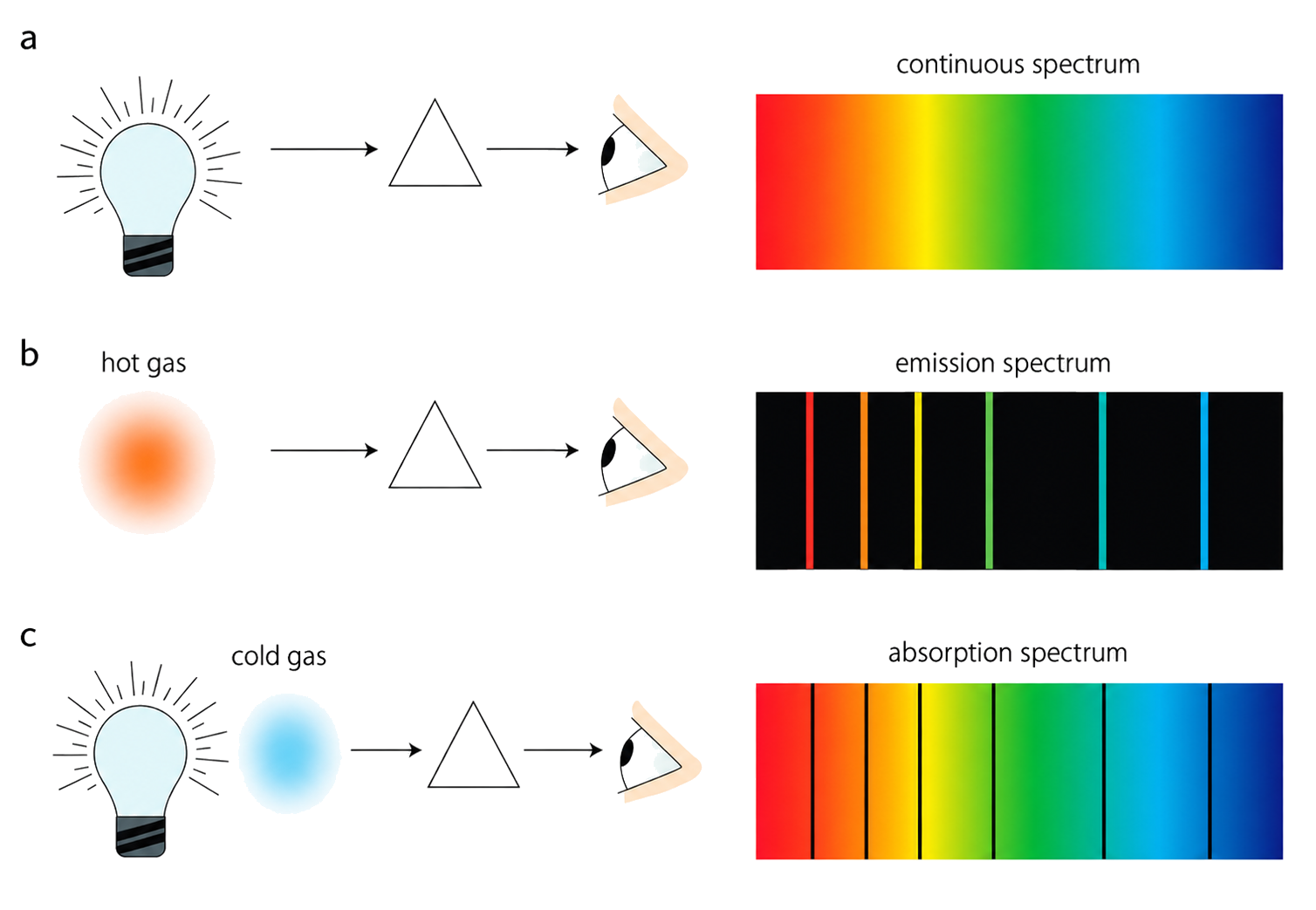
An emission photon is released when an electron falls from a higher energy state to a lower energy state. Absorption moves an electron upward and requires photon energy.
| Spectrum | What it contains | Why |
|---|---|---|
| Line spectrum | Specific wavelengths, frequencies, energies, or colours | Electrons occupy discrete energy levels, so only particular transitions occur |
| Continuous spectrum | A continuous range across the relevant values | The radiation spans the range rather than appearing as separated lines |
Across electromagnetic radiation, shorter wavelength means higher frequency, and higher frequency means higher photon energy. Explain the electron direction and photon exchange when distinguishing absorption from emission.
Read every spectral transition in two directions: absorption raises an electron by ΔE, while a downward transition emits a photon with ΔE = hf = hc/λ. A shorter-wavelength line therefore represents a larger energy gap, not a higher line intensity.
Orient the spectrum before comparing lines: radio → microwave → infrared → visible → ultraviolet → X-ray → gamma is increasing frequency and photon energy, and decreasing wavelength. Within visible light, red has longer wavelength and lower photon energy than violet.
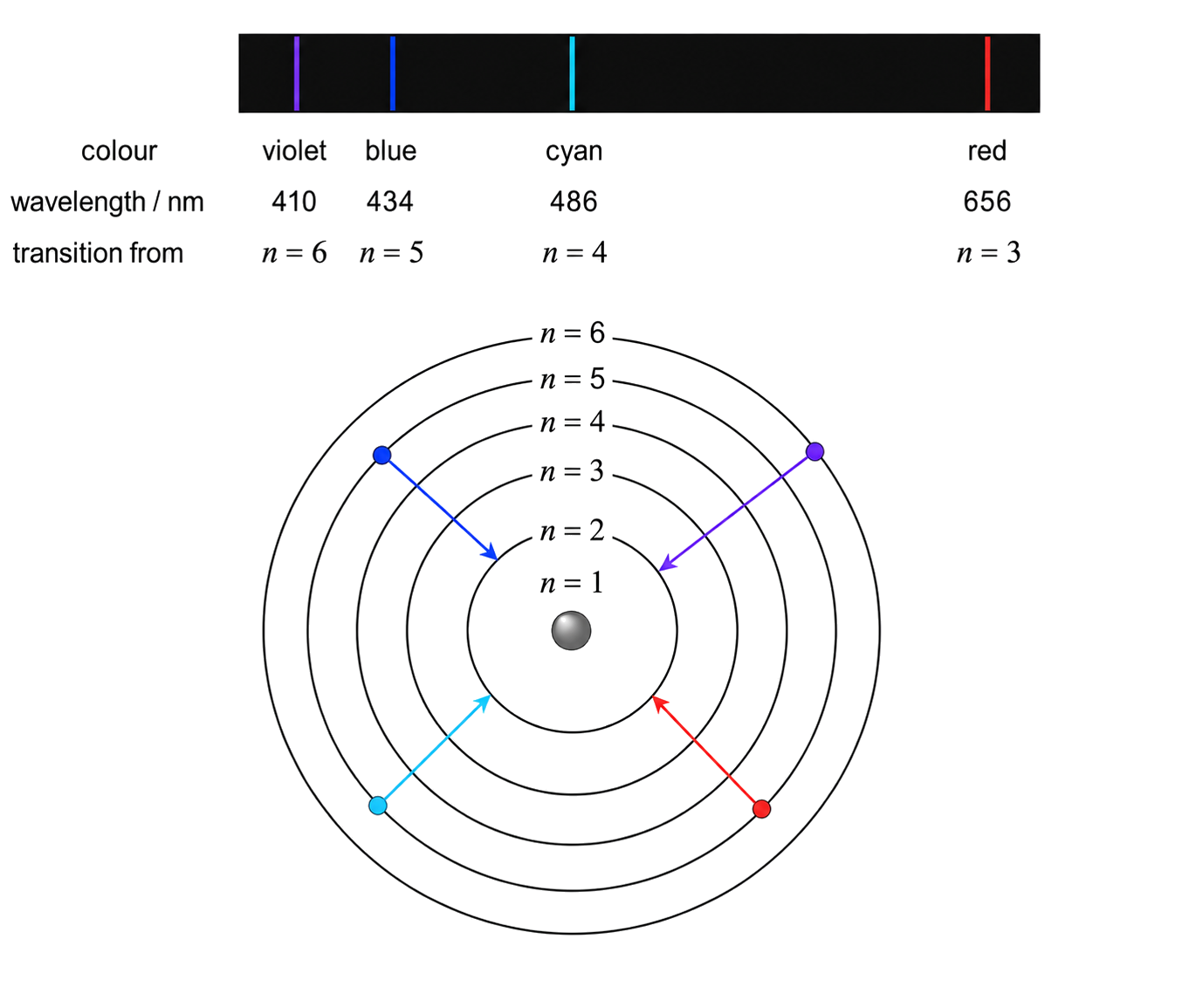
Hydrogen's emission spectrum contains discrete lines because electrons occupy discrete energy levels. Each line corresponds to a downward transition and the emitted photon's energy equals the energy difference between the levels.
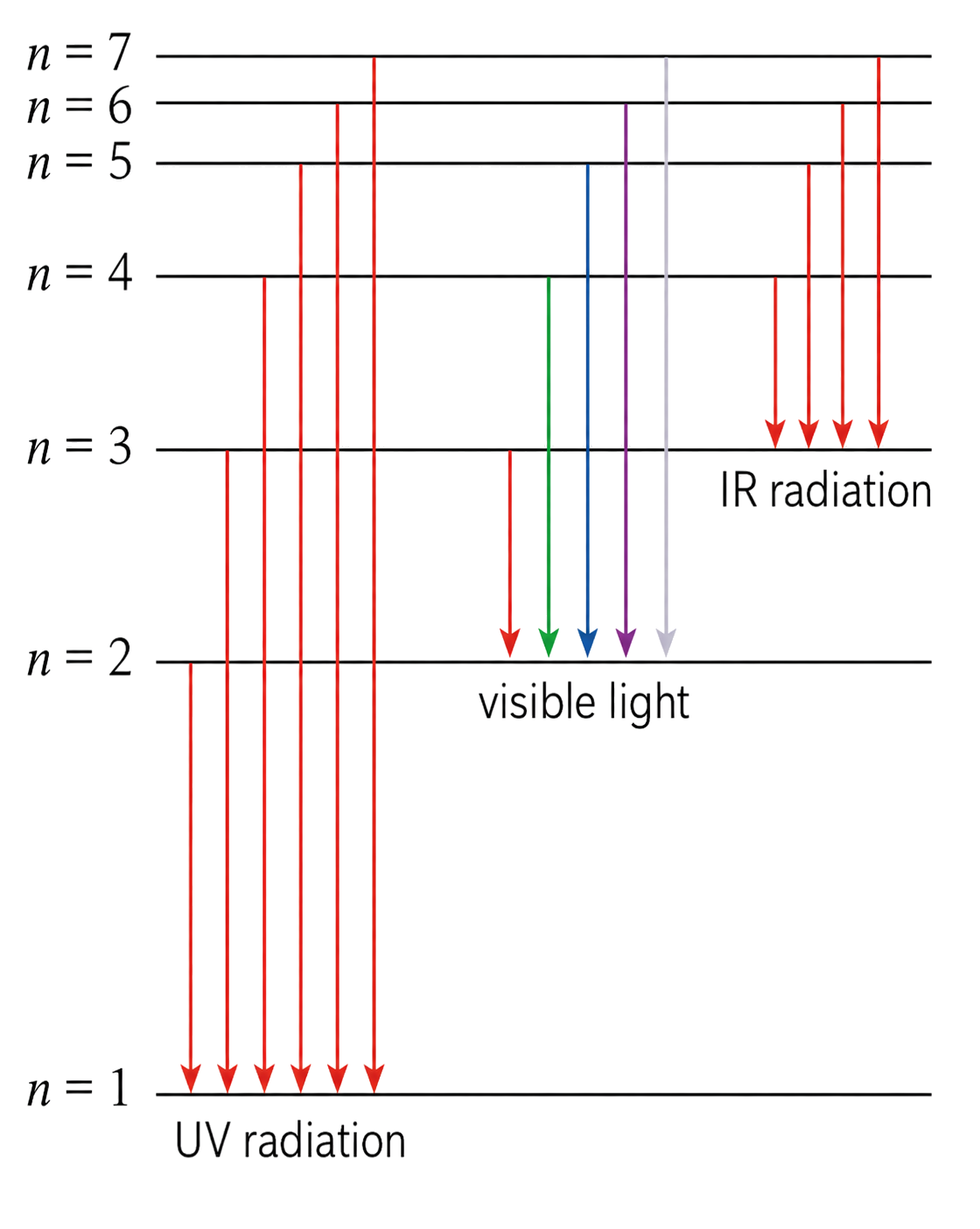
| Transition ending at | Region identified in the study guide |
|---|---|
| n = 1 | ultraviolet |
| n = 2 | visible |
| n = 3 | infrared |
At higher energy, the levels become closer together, so the lines converge. The names of the series are not required.
Use the presence of separate lines as evidence for discrete levels, and use convergence at higher energy or frequency as evidence that the level spacing becomes smaller.
Compare lines by their energy gaps. Transitions ending at n = 2 form the visible series, and lines crowd together as the starting level rises because adjacent high-n levels are closer in energy. The convergence limit represents removal of the electron, not one more bound-state transition.
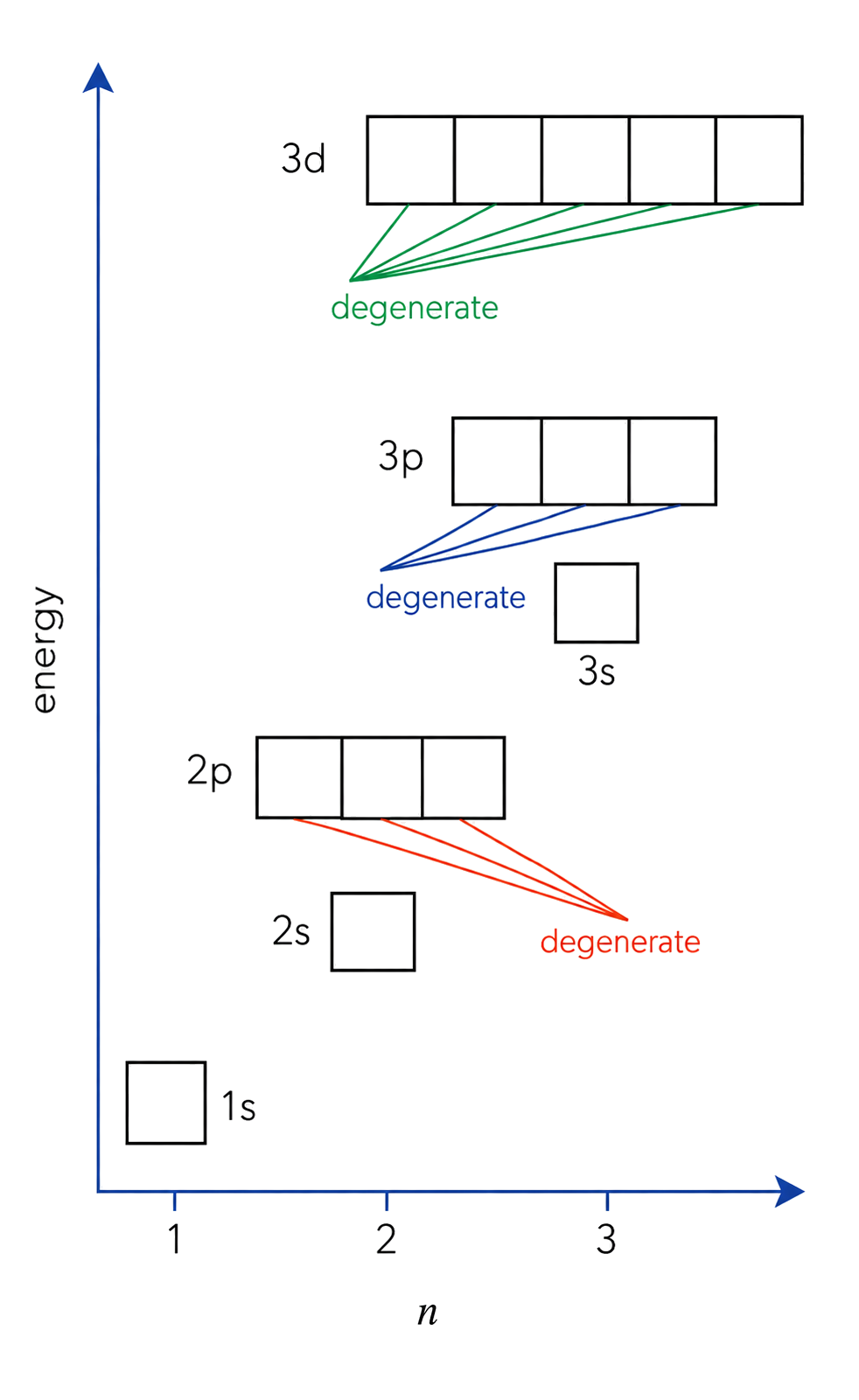
A main energy level contains only the sublevels allowed by its principal quantum number: n = 1 has s; n = 2 has s and p; n = 3 has s, p and d; and n = 4 can include s, p, d and f. Within one main level the sublevels rise in energy s < p < d < f, while the filling order across different levels can interleave, as the next card makes explicit. Each sublevel contains a fixed number of orbitals.
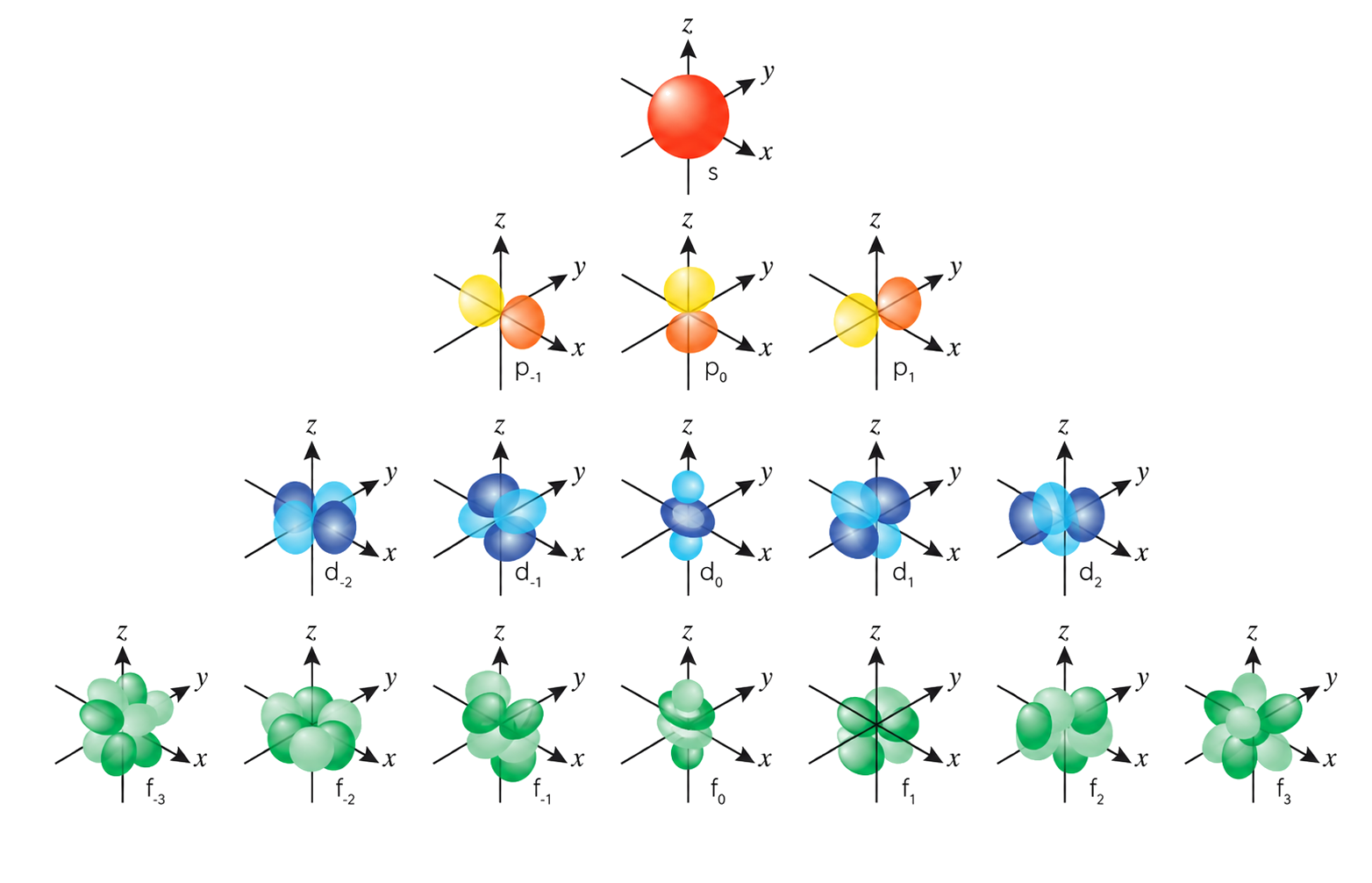
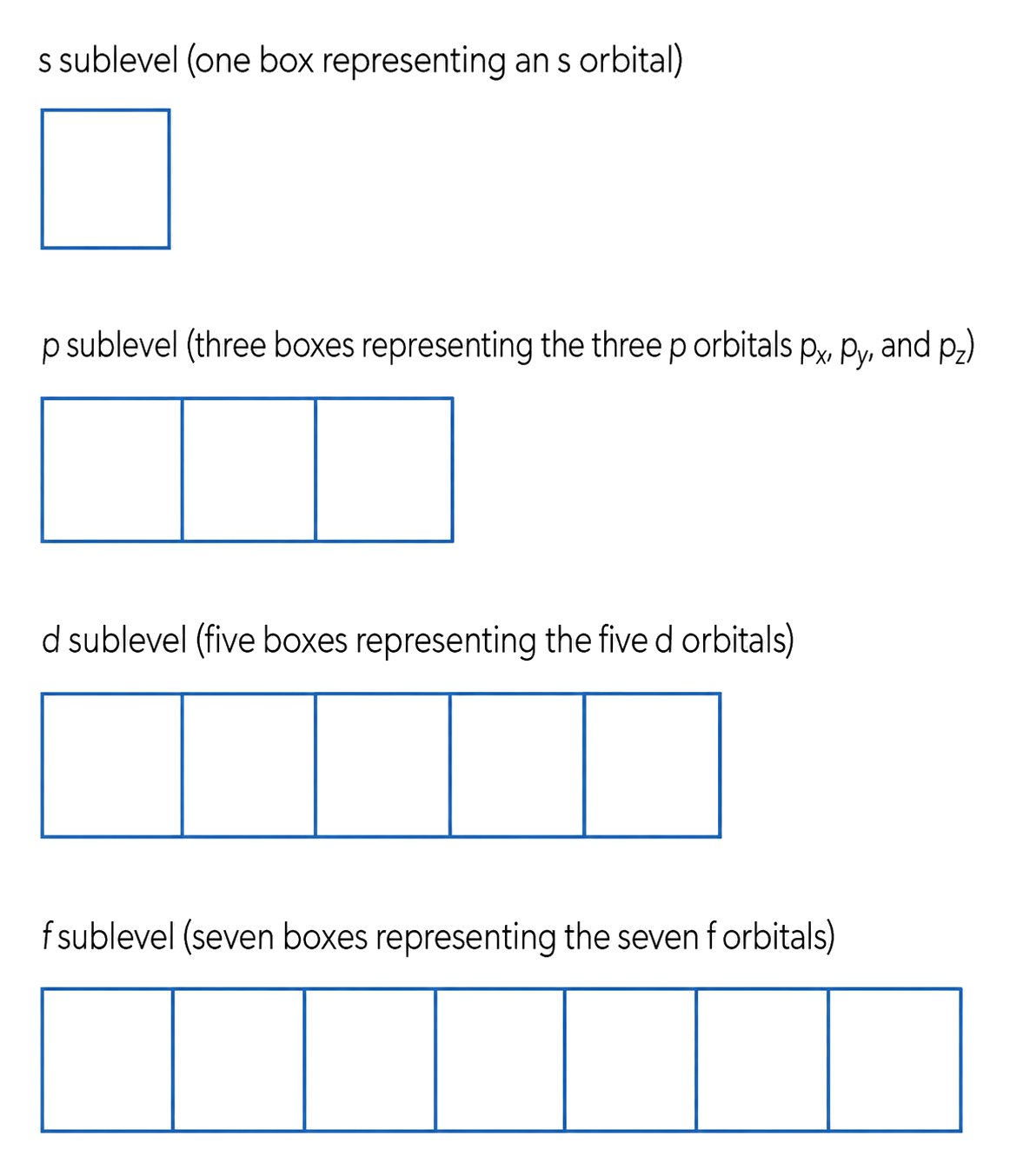
| Sublevel | Number of orbitals | Maximum electrons | Assessed shape evidence | Periodic-table block |
|---|---|---|---|---|
| s | 1 | 2 | spherical | s block |
| p | 3 | 6 | three dumbbell orbitals with different orientations | p block |
| d | 5 | 10 | shape detail not required here | d block |
| f | 7 | 14 | shape detail not required here | f block |
The block is identified by the subshell being filled; sublevel capacity is not the same as actual occupancy.
For recognition questions, keep the hierarchy clear: main energy level → sublevel → orbital. The s and p shapes are the explicitly required shape evidence here.
Use the hierarchy as a classification test: a p sublevel contains three orbitals, and each orbital can hold two electrons. An orbital describes a probability region with a characteristic shape; it is not a circular route travelled by an electron.
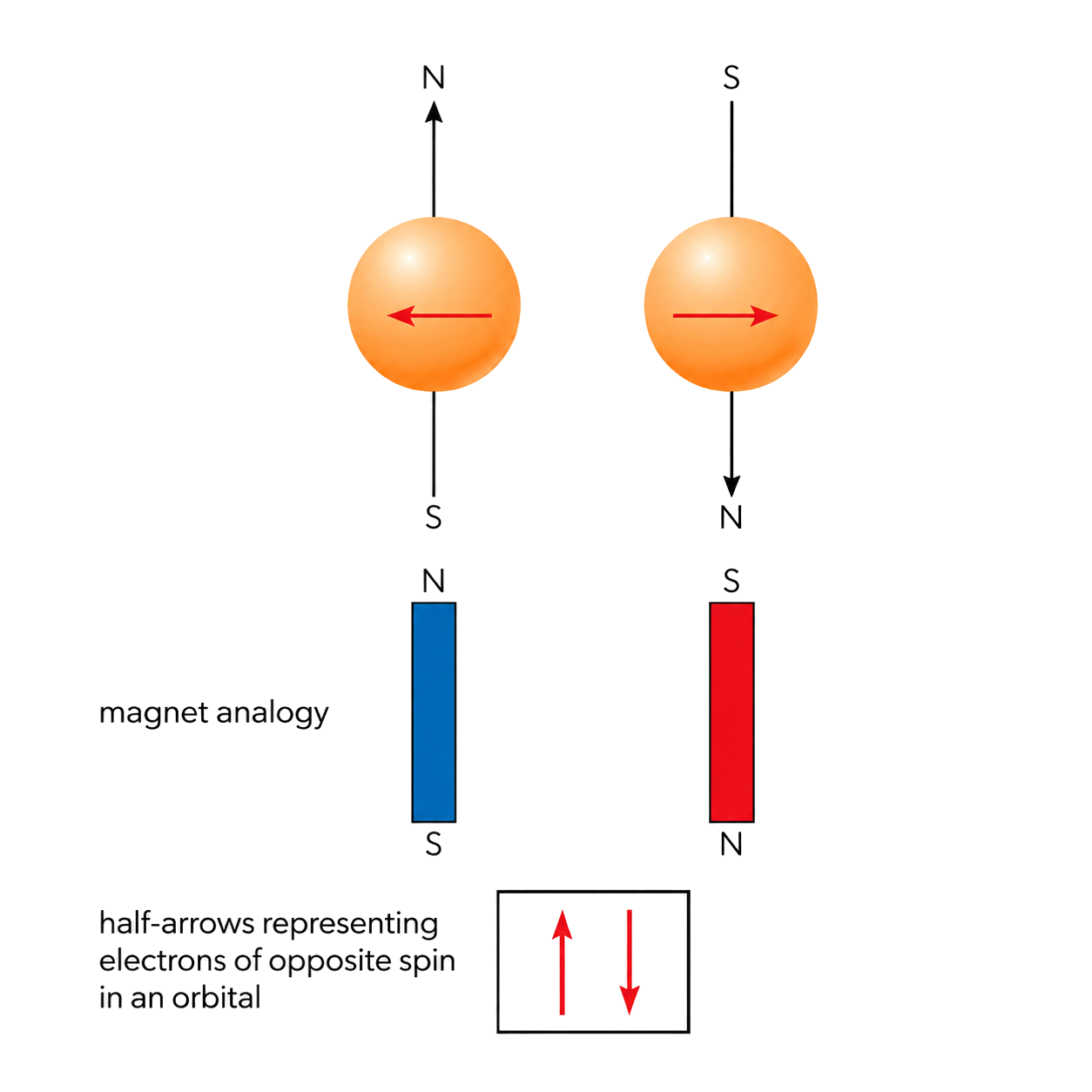
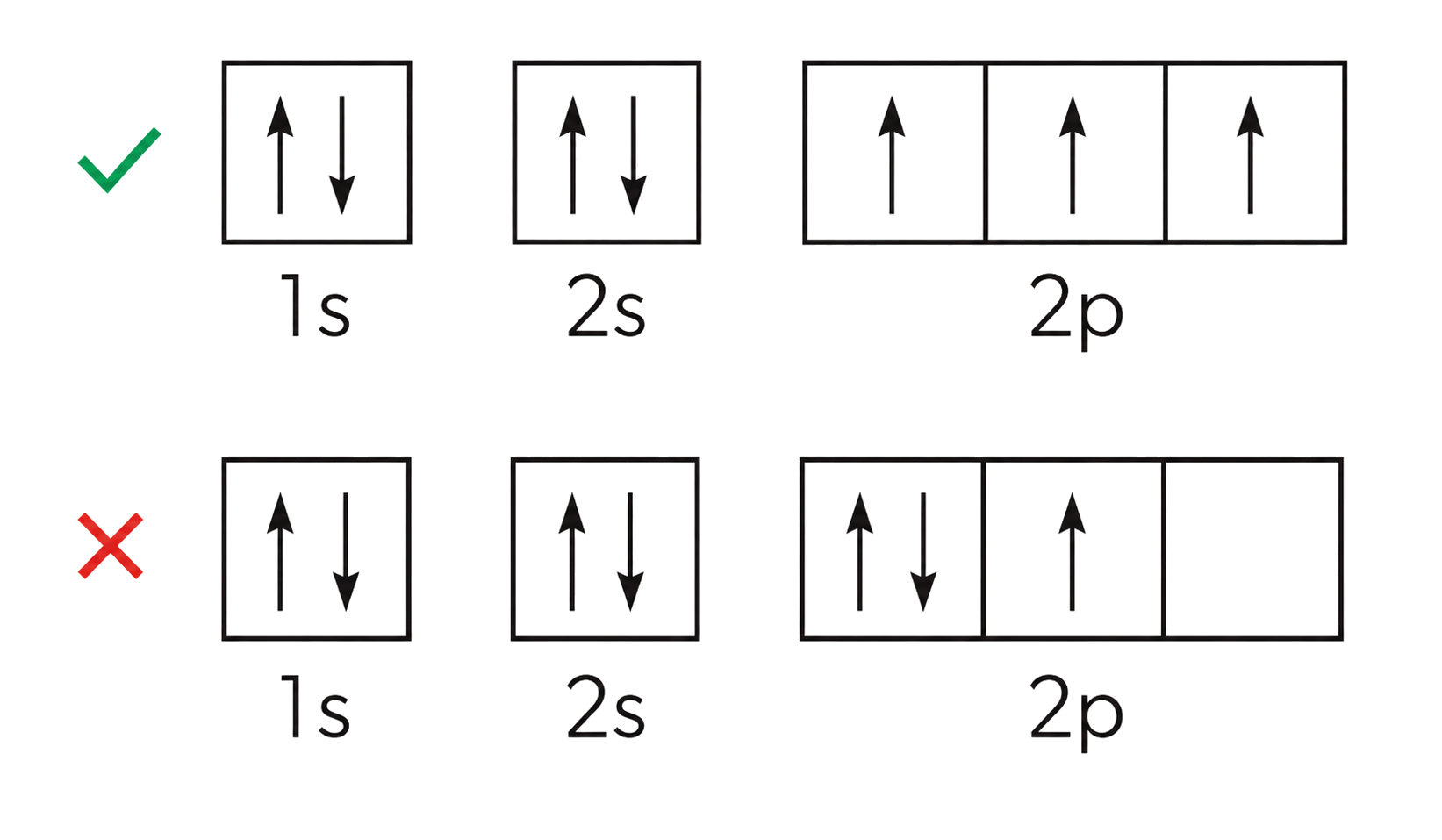
Aufbau fills lower-energy orbitals first. Pauli limits an orbital to two electrons with opposite spins. Hund's rule places electrons singly in degenerate orbitals before pairing.
| Representation | Use |
|---|---|
| Full configuration | Show the complete filling sequence |
| Condensed configuration | Replace the inner electrons with a noble-gas core |
| Orbital-box diagram | Show orbital occupancy and opposite-spin pairing |
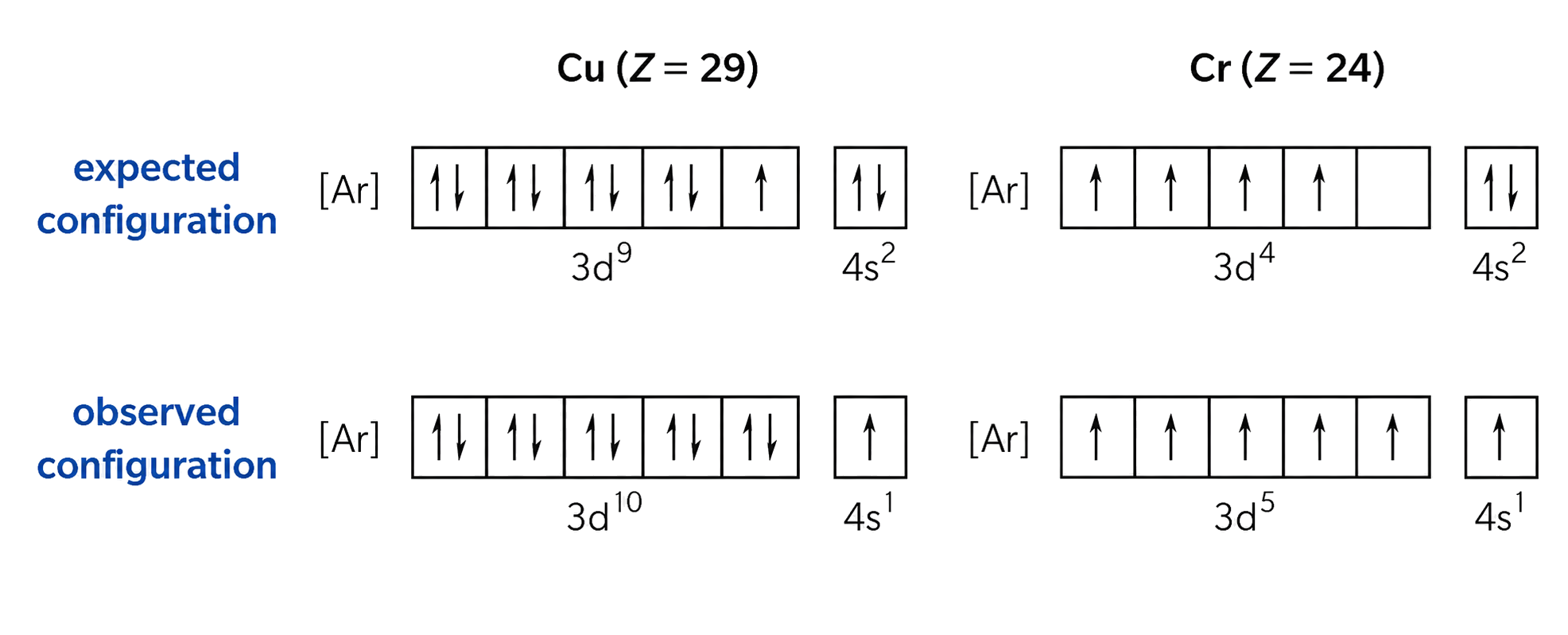
For ions, remove 4s electrons before 3d electrons. The exceptions in scope are Cr: [Ar] 4s1 3d5 and Cu: [Ar] 4s1 3d10.
Check total electrons, obey the filling order, apply Hund and Pauli in each sublevel, and treat the Cr/Cu exceptions explicitly rather than forcing the naive pattern.
Build an orbital diagram by checking electron total, energy order, single occupation of equal-energy orbitals, then opposite-spin pairing. For transition-metal ions remove 4s electrons before 3d, and verify Cr and Cu against the stated exceptions rather than forcing the simple filling pattern.
Worked ion check: Fe has 26 electrons and condensed configuration [Ar] 4s² 3d⁶. To form Fe³⁺, remove the two electrons from the highest principal level, 4s, before removing one 3d electron, giving [Ar] 3d⁵. The final superscripts total 23 electrons, matching 26 − 3.
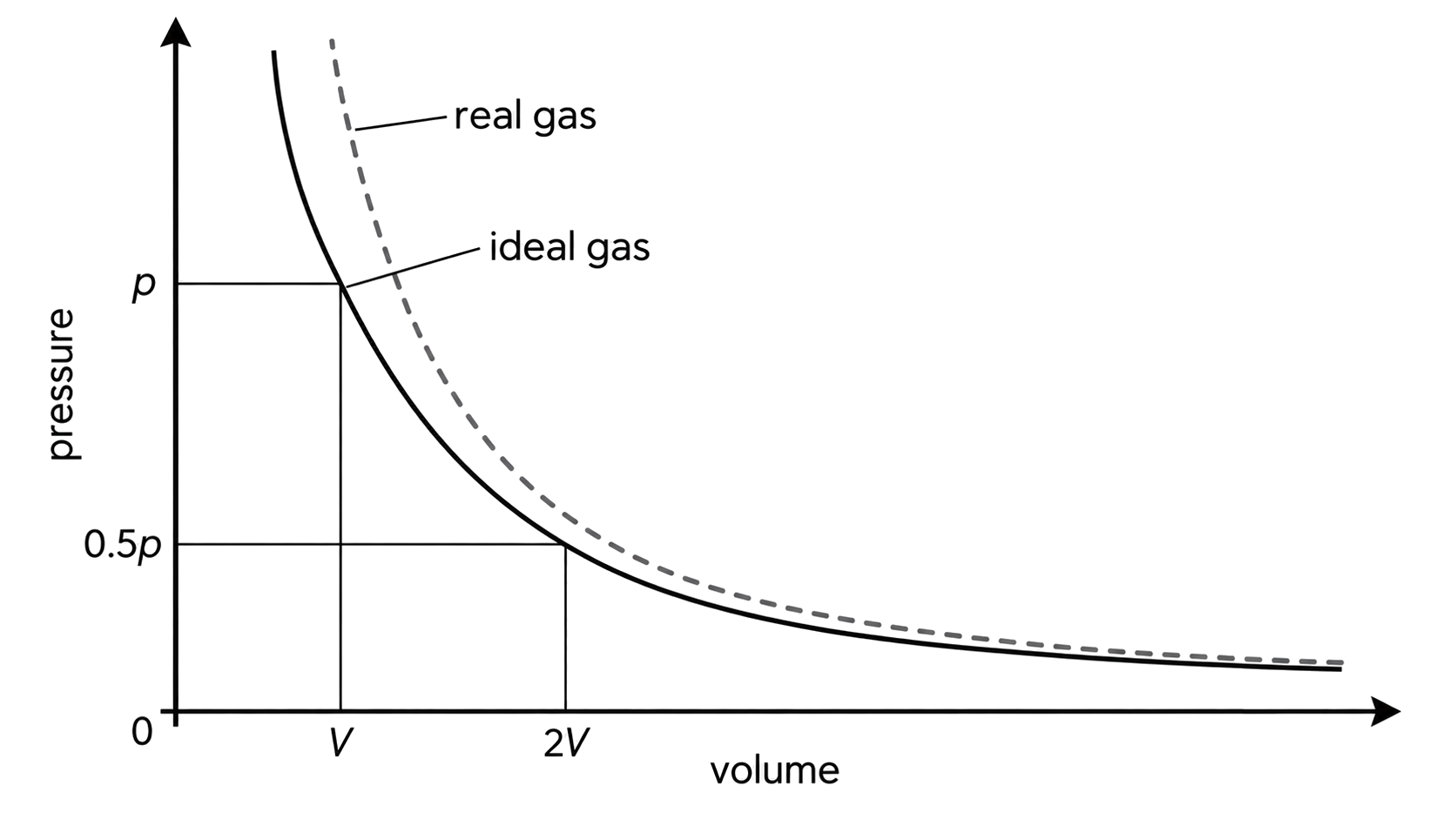
Real gases deviate most from ideal behaviour at low temperature and high pressure. Low temperature reduces particle kinetic energy, while high pressure brings particles close together.
| Ideal assumption that fails | Real-gas consequence |
|---|---|
| Intermolecular forces are negligible | Attractions matter when particles have low kinetic energy and are close |
| Particle volume is negligible | Finite molecular volume matters at very high pressure |
A strong explanation names the condition, identifies the failed ideal assumption, and links it to the observed deviation.
Diagnose the cause from the condition. Cooling makes attractive forces more important because particle kinetic energy is lower; strong compression exposes both attractions and finite particle volume. Name the failed ideal assumption rather than stating only that the gas is 'non-ideal'.
