Hyperbole Examples and Definition | English Language
Understand hyperbole with clear examples, literal meaning, intended effect and an exam-ready method for explaining exaggeration.
Hyperbole is deliberate exaggeration used to create emphasis, emotion or vivid imagery. In English Language analysis, the key is not simply to label a phrase as hyperbole. You need to explain what is exaggerated, why it cannot be taken literally, and how the exaggeration shapes the reader's response.
Quick Answer
Hyperbole is an overstatement that goes beyond what is literally true to make an idea feel stronger. In the sentence "I have a mountain of homework," the speaker does not mean that the homework is physically a mountain. The exaggeration communicates an overwhelming amount of work.
What Is Hyperbole?
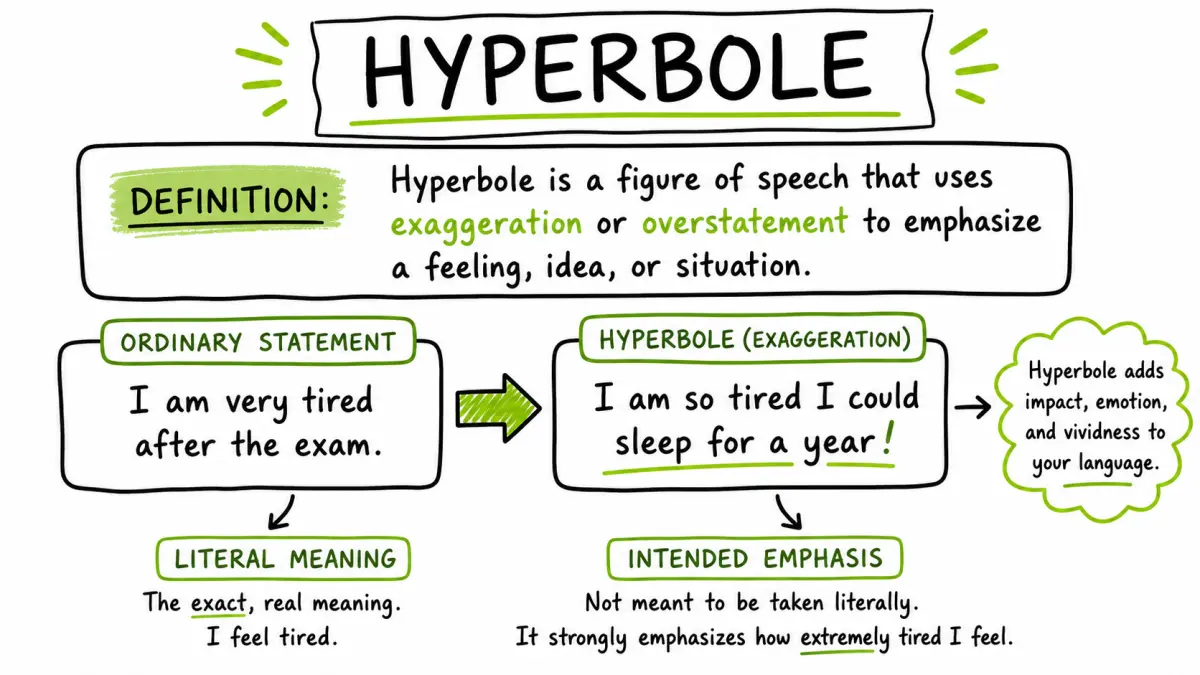
Hyperbole is a figure of speech. It may describe size, quantity, speed, time, emotion or importance in an extreme way. The reader recognises that the statement is not intended as a precise fact, so attention moves to the feeling or impression behind it.
| Feature | Question to ask | Example |
|---|---|---|
| Literal meaning | What would the words mean exactly? | I have a mountain of homework. |
| Exaggerated idea | What is made impossibly large or extreme? | The amount of homework is compared with a mountain. |
| Intended effect | What does the exaggeration make the reader feel? | The workload feels overwhelming. |
Hyperbole Examples
Here are original examples with the implied meaning:
- "I waited forever for the bus." The wait felt unusually long.
- "This bag weighs a tonne." The bag feels extremely heavy.
- "She has told me that story a million times." The story has been repeated many times.
- "The classroom was so quiet you could hear a pin drop." The silence felt complete.
The exact number is not the point. The exaggeration makes the writer's attitude more vivid.
Literal Meaning and Intended Meaning
Strong analysis separates what a phrase says from what it suggests. Start with the literal impossibility or extreme scale, then explain the realistic idea underneath it.
Example: "I am so tired I could sleep for a year."
- Literal meaning: the speaker would sleep continuously for a year.
- Realistic meaning: the speaker feels exceptionally tired.
- Effect: the extreme time scale makes the exhaustion sound intense and memorable.
How to Analyse Hyperbole in an Exam
Use this three-step method:
- Identify the exaggerated word or image.
- Explain the realistic meaning behind it.
- Link the exaggeration to the writer's purpose and the reader's response.
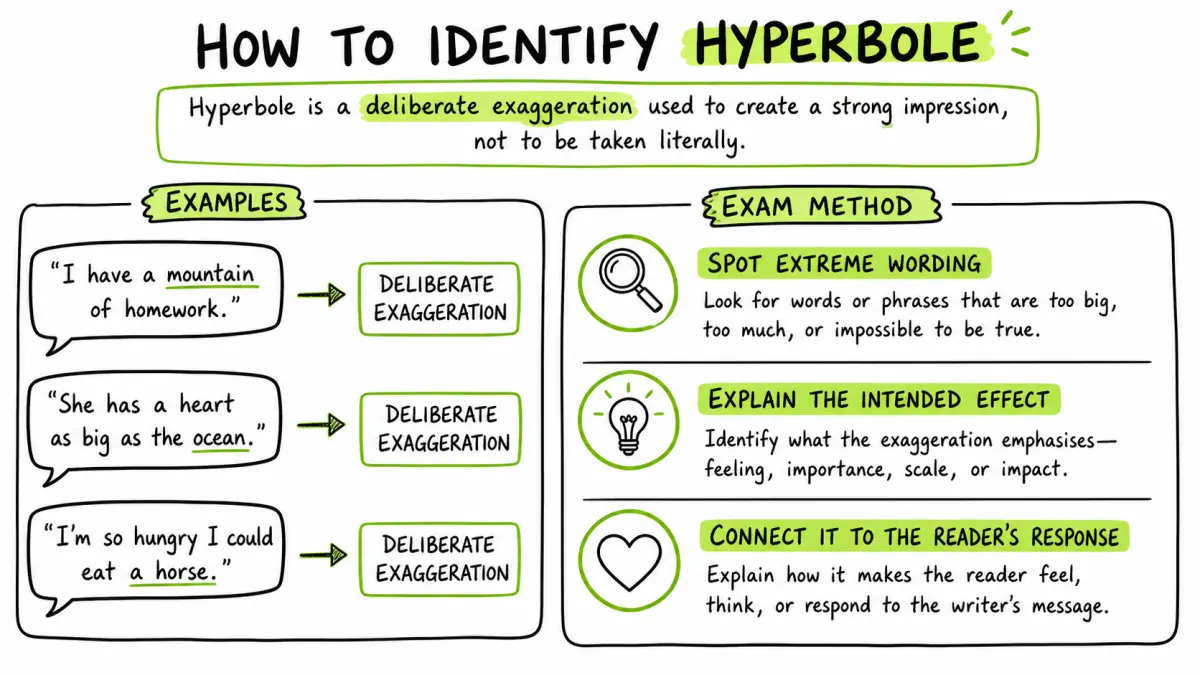
For IGCSE-style or general English Language revision, keep the explanation specific: identify the extreme wording, translate it into a realistic meaning, and then state the intended effect. A strong answer links the exaggeration to emotion, scale, urgency or the writer's attitude instead of stopping at the device label. Use the EduNinja Question Bank for wider language-analysis practice when a dedicated hyperbole set is not available.
A useful sentence frame is: The hyperbolic phrase "..." exaggerates ..., suggesting ...; this makes the reader ... and emphasises ...
Common Exam Mistakes
| Mistake | Why it weakens the answer | Better approach |
|---|---|---|
| Only writing "This is hyperbole" | It names the device but gives no analysis | Explain the extreme wording and its effect |
| Treating the phrase as a fact | It misses the figurative meaning | State what the writer really intends |
| Using a vague effect such as "engages the reader" | It does not describe a response | Name the feeling, image or attitude created |
| Ignoring context | The same exaggeration can sound humorous, angry or desperate | Link it to the surrounding situation |
Mini Practice
Analyse the phrase: "The queue stretched to the edge of the world."
Answer guide: The phrase exaggerates the length of the queue by comparing it with the whole world. It suggests that the wait feels endless and frustrating, while the impossible image makes the situation vivid for the reader.
Practice This Topic
Use the EduNinja Question Bank to practise identifying language choices, then explain the writer's intended effect in one complete sentence.
FAQ
What is a simple definition of hyperbole?
Hyperbole is deliberate exaggeration used to create emphasis or a strong impression. It is not normally intended to be taken literally.
Is hyperbole always humorous?
No. Hyperbole can create humour, but it can also express anger, excitement, fear, exhaustion or importance. The surrounding context determines the effect.
How do I explain hyperbole in an English exam?
Quote the exaggerated phrase, explain its realistic meaning, then connect the exaggeration to the writer's purpose and the reader's response.
Related Study Links
Final Takeaway
Do more than spot the exaggeration. Explain the gap between the literal words and the intended meaning, then show how that gap creates emphasis for the reader.
Choose a course and continue studying.
Pick your curriculum and subject, then continue into the right question bank or notes.