Historical Context in IB English: How to Use It in Analysis
Learn how to use historical context in IB English without turning analysis into a history paragraph, with examples and exam-safe wording.
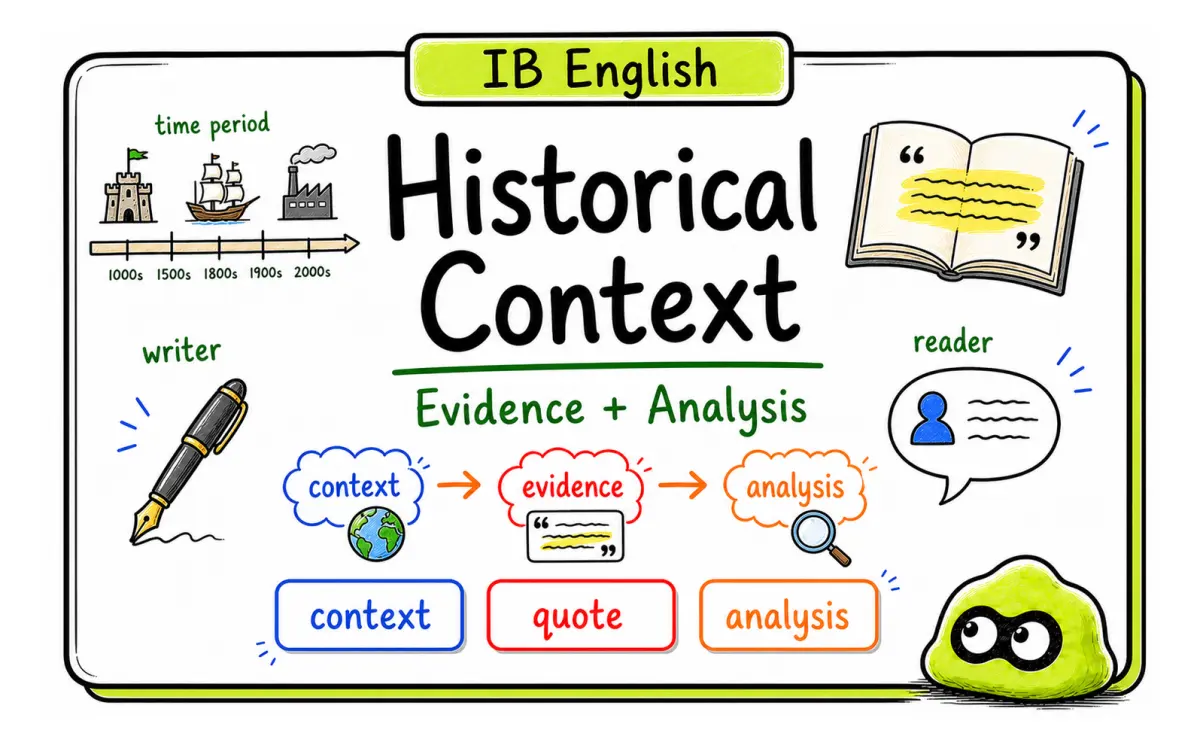
Historical context means the real-world conditions around a text: the time period, social attitudes, political pressure, cultural expectations, and audience assumptions that shape how meaning is made. In IB English, the goal is not to write a history paragraph. The goal is to use context to explain a writer's choices.
Students often know background information but lose marks because they do not connect it to language, structure, tone, or reader effect. This guide shows how to turn historical context into analysis rather than a fact dump.
Quick Answer
| Question | Exam-safe answer |
|---|---|
| What is historical context? | The social, political, cultural, and time-period background around a text |
| Why does it matter? | It helps explain why a writer makes certain choices |
| What should you avoid? | Dropping background facts without linking them to the text |
| Strong analysis pattern | Context -> evidence -> writer's choice -> effect -> claim |
| Best use in IB English | Use context to sharpen interpretation, not replace close reading |
What Historical Context Means in IB English
Historical context is not a separate paragraph that sits outside the text. It should help you read the text more precisely. If a poem was written during a period of war, censorship, migration, industrial change, or social inequality, that background may affect imagery, tone, voice, silence, conflict, or power relationships.
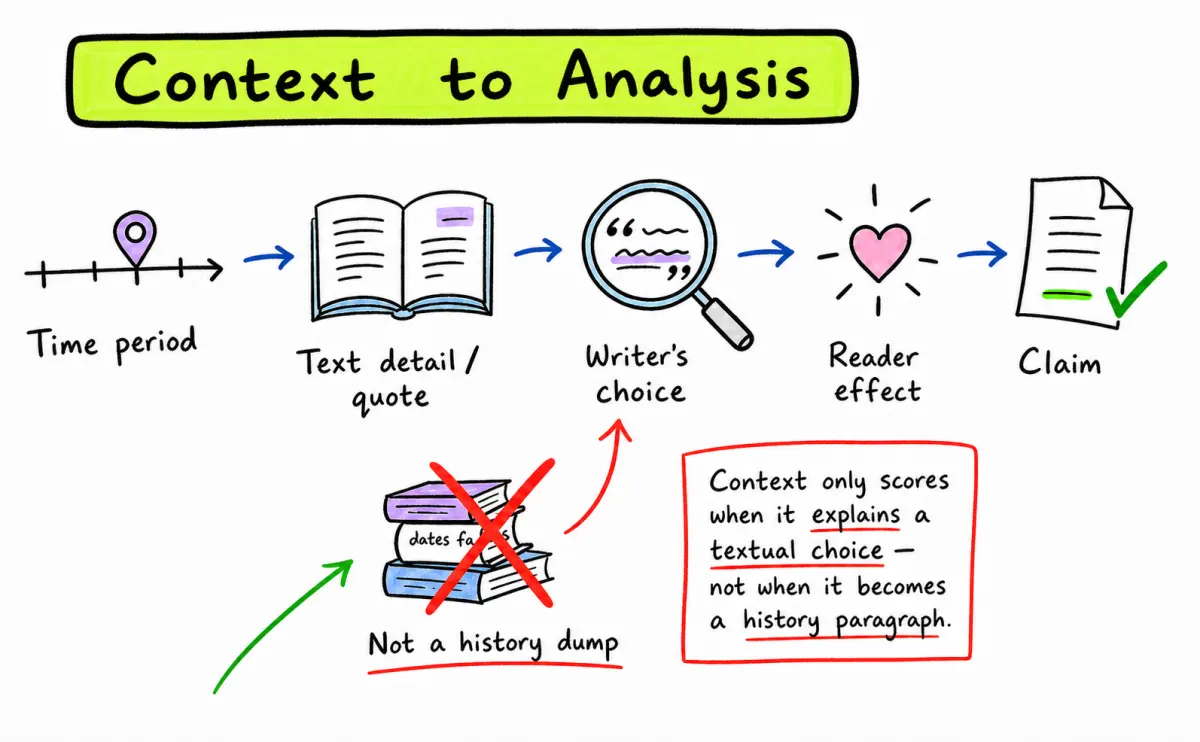
The key question is: What does this context help me notice in the wording? If the context does not change how you interpret a quote, it probably does not belong in the paragraph.
Historical Context vs Literary Context
| Context type | What it focuses on | Useful question |
|---|---|---|
| Historical context | Events, beliefs, social conditions, time period | What world was the text responding to? |
| Cultural context | Values, norms, roles, traditions | What assumptions might the audience bring? |
| Literary context | Genre, form, movement, conventions | What writing tradition is the text using or challenging? |
| Biographical context | Relevant details about the writer | Does this help explain a textual choice? |
Use context only when it helps your interpretation. A single well-linked sentence is usually better than a long paragraph of background.
How to Use Historical Context in Paper 1, Paper 2 and the IO
In IB English, historical context should not become a separate history paragraph. Use it only when it helps explain a writer's choice.
- In Paper 1, connect context to language, tone, structure, audience or purpose.
- In Paper 2, use context to compare how two texts respond to similar social or historical pressures.
- In the Individual Oral, link context to the global issue, but still return to specific textual evidence.
Example: Instead of writing only about the time period, connect the context to a specific image, tone shift or narrative voice, then explain how it shapes meaning for the reader.
Worked Example
Question: A student writes: "This text was written during a time when women had fewer legal and social freedoms." How can they turn this into analysis?
Weak version: Women had fewer rights in the past. The writer lived in a patriarchal society. This was a difficult time for women.
Stronger version: Because the text was written in a society where women had fewer public freedoms, the speaker's restricted movement makes the image of the closed room more than a setting detail. It becomes a symbol of social control, so the reader sees the character's frustration as both personal and political.
Why this works: The context is connected to a specific image, a writer's choice, and a reader interpretation. It does not stop at historical fact.
Exam-Safe Wording
Use this sentence frame when you are unsure how to bring context into a paragraph:
In the context of [specific background], the writer's use of [textual choice] suggests [interpretation], because [effect on meaning/reader].
Good context analysis usually includes:
- one precise contextual detail
- one short quotation or textual reference
- one writer's choice
- one explanation of meaning or effect
- no unsupported claims about the writer's intention
Avoid saying "the writer did this because of history" unless the text gives you evidence. Context supports interpretation; it does not prove everything by itself.
Common Mistakes
| Mistake | Why it weakens the answer | Better move |
|---|---|---|
| Writing a history summary | It stops close analysis | Link context to a word, image, form, or tone |
| Using context before evidence | The paragraph feels detached | Start with the text, then add context |
| Claiming author intention too strongly | It can sound speculative | Say the context may suggest or helps frame |
| Adding irrelevant background | It wastes paragraph space | Use only context that changes interpretation |
Mini Practice Set
- Define historical context in one sentence.
- Rewrite this weak sentence: "The context is important because society was different then."
- Choose one contextual detail and connect it to a specific image or phrase.
- Explain why context should not replace quotation analysis.
- Write one sentence using the frame: context -> writer's choice -> effect.
Practice This Topic
Try this exam-style task:
A student writes a paragraph about a novel and includes three sentences of background on the time period, but no quotation. Explain why this is weak and rewrite the approach as a stronger IB English analysis move.
Answer guide:
- Historical context should support close reading, not replace it.
- A stronger paragraph needs a specific textual detail or short quotation.
- The contextual detail should explain a writer's choice, such as imagery, tone, structure, voice, audience or purpose.
- Avoid making unsupported claims about what the writer definitely intended.
Practise the analysis move
Use this checklist in your next IB English paragraph: context, quote, writer's choice, reader effect, claim.
Browse broader IB practice
Browse the IB Question Bank
Use this if you want to explore available EduNinja practice by subject.
Related Study Links
- Browse the IB Question Bank
- Explore more EduNinja study guides
- Practice IB English analysis questions with the context, quote, writer's choice, reader effect checklist above.
FAQ
What is historical context in literature?
Historical context in literature is the background of the period in which a text was written or set. It can include social beliefs, political events, cultural expectations, and audience assumptions. In analysis, it matters only when it helps explain a textual choice such as imagery, tone, conflict, voice, or structure.
How do you use historical context in IB English?
Use historical context in IB English by linking it directly to evidence from the text. A strong sentence moves from context to a writer's choice, then to meaning or reader effect. Do not write a standalone history paragraph, because the examiner still needs to see close reading.
Is historical context the same as literary context?
No, historical context and literary context are related but different. Historical context focuses on real-world time period and social conditions. Literary context focuses on genre, form, movement, conventions, and other texts. Strong essays often use both, but only when they clarify interpretation.
Can too much context hurt an English essay?
Yes, too much context can weaken an English essay if it replaces textual analysis. Background information should be selective and tied to a quotation or technique. If a contextual fact does not change your reading of the text, it is probably not worth including.
What is a good sentence starter for historical context?
A useful starter is: "In the context of..., the writer's use of... suggests..." This keeps the paragraph analytical because it links background to a writer's choice. The sentence should still include a specific word, image, structure, or tone from the text.
Final Takeaway
Historical context is powerful when it makes your reading sharper. Use it to explain why a textual choice matters, not to show everything you know about the time period.
Choose a course and continue studying.
Pick your curriculum and subject, then continue into the right question bank or notes.