E5.5 Compound shapes and parts of shapes question 1
[Maximum number: 4]
NOT TO SCALE
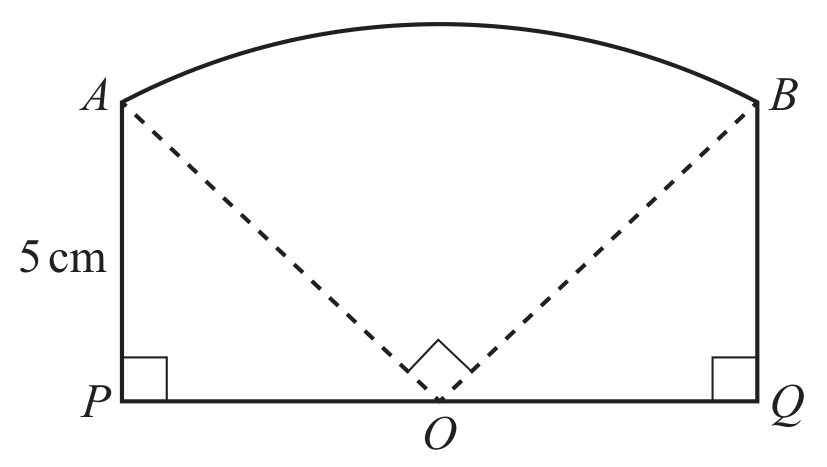
The diagram shows a shape ABQP made from three straight lines and an arc of a sector of a circle. The sector has centre O and angle 90∘. POQ is a straight line and AP=PO=OQ=QB=5cm. Find the area of ABQP. Give your answer in the form a+kπ. cm2
25+225π M2 for 36090×π×(52+52)2 or M1 for radius2=52+52 M1 for triangle area [2×]21×5×5 oe
E5.5 Compound shapes and parts of shapes question 2
[Maximum number: 6]
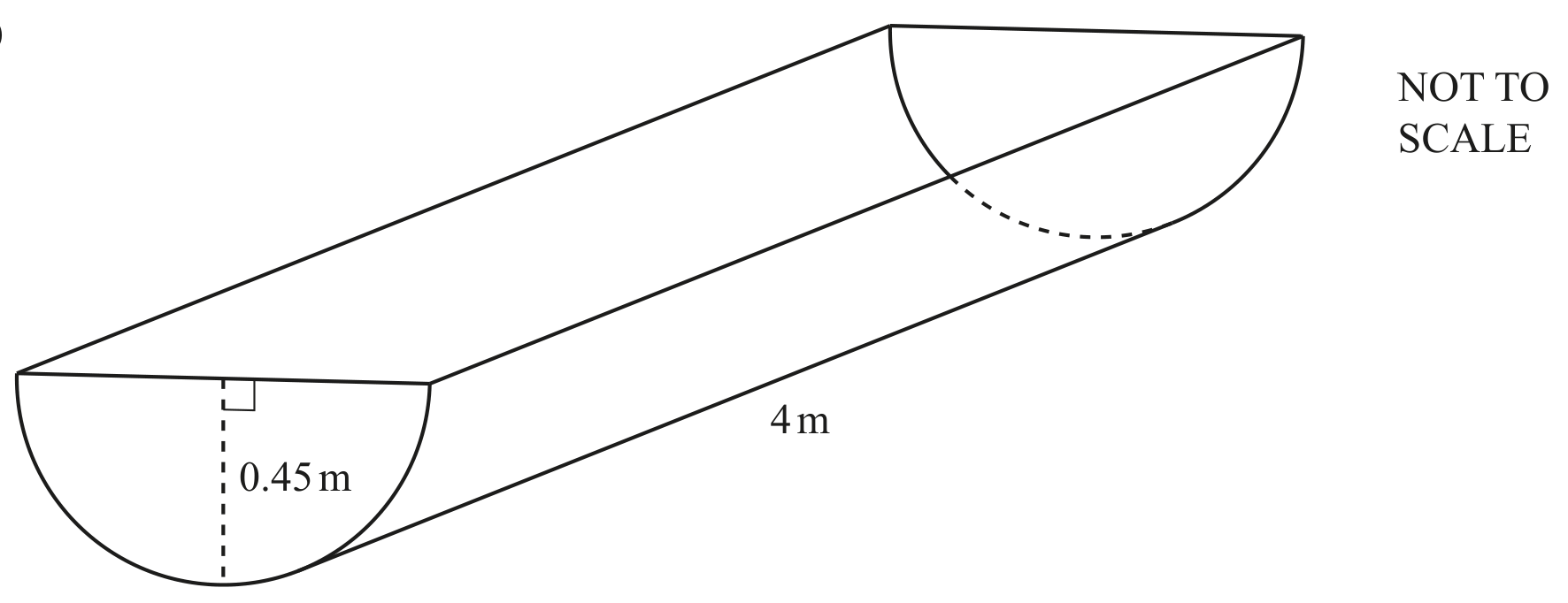
The diagram shows a horizontal container for water with a uniform cross-section. The cross-section is a semicircle. The radius of the semicircle is 0.45 m and the length of the container is 4 m .
NOT TO SCALE
6
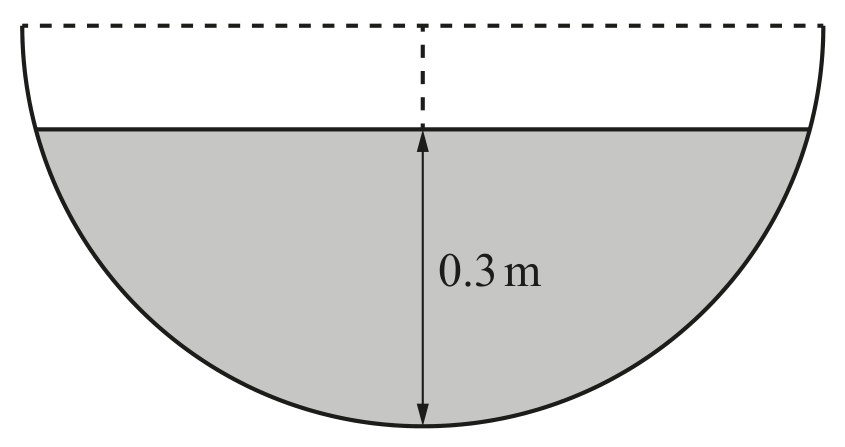
The greatest depth of the water in the container is $0.3\,\mathrm{m}$. The diagram shows the cross-section. Calculate the number of litres of water in the container. Give your answer correct to the nearest integer.
742 or 743 M5 for a method leading to the volume of water, e.g. 4{2×360invcos(0.15/0.45)×π×0.452−21×0.452×sin(2invcos(0.15/0.45))} OR M2 for a correct sector area expression and M2 for a correct triangle area expression If 0 scored, SC1 for invcos(0.15/0.45), invsin(0.15/0.45), or 0.452−0.152 soi