
EduNinja

5.2 Calculus - AHL content Topic Practice

5.2 Calculus - AHL content Topic Practice
IB Maths AI syllabusMaths AI SL/HLFirst assessment 2025

Students practise advanced calculus techniques including chain/product rules, differential equations, volumes of revolution, and numerical methods.

Exam points

  • use product and chain rules together to differentiate composite functions like x√(3x−2)
  • separate variables in dy/dx = k(1−y) and integrate both sides to derive exponential model y = 1−e⁻ᵏᵗ
  • apply Euler’s method with step h=0.1: iterate xₙ₊₁ = xₙ + h·f(xₙ,yₙ) for given differential equation

Question 2

[Maximum number: 18]

In this question researchers are trying to find the most accurate model to use when modelling a population of wolves.
Historically, a population of wolves in an area had a stable size of 200 . After some years of disruption, the population was reduced to 40 wolves. At this point, the area became a protected space and the population began to grow again.
Researchers in the area wish to model the size of the wolf population, x, as a function of t, where t is the time, in years, since the area became protected.

Question 2(b)

(a)

An alternative model for population growth is called the Gompertz model. When applied by the researchers to the wolf population, this model satisfies the differential equation

dx dt=axln(200x),aR+.\frac{\mathrm{d} x}{\mathrm{~d} t}=a x \ln \left(\frac{200}{x}\right), a \in \mathbb{R}^{+} .
[ 13 ]

Question 2(b)(i)

(i)

Write down the value of dx dt\frac{\mathrm{d} x}{\mathrm{~d} t} when x=200.

[ 1 ]

Question 2(b)(ii)

(ii)

Interpret your answer to part (b)(i) in context.

Consider the function f(x)=ln(ln200lnx)f(x)=\ln (\ln 200-\ln x), where 0<x<200.

[ 1 ]

Question 2(b)(iii)

(iii)

Show that f(x)=1xln(200x)f^{\prime}(x)=\frac{-1}{x \ln \left(\frac{200}{x}\right)}.

[ 2 ]

Question 2(b)(iv)

(iv)

Hence, use separation of variables to show that the general solution of

dx dt=axln(200x), where 0<x<200\frac{\mathrm{d} x}{\mathrm{~d} t}=a x \ln \left(\frac{200}{x}\right), \text { where } 0<x<200

can be written as

lnx=ln200Aeat\ln x=\ln 200-A \mathrm{e}^{-a t}

where A is an arbitrary positive constant.

[ 5 ]

Question 2(b)(v)

(v)

Use the size of the wolf population at t=0 to find the value of A. Give your answer in the form A=lnpA=\ln p, where pZ+p \in \mathbb{Z}^{+}.

[ 2 ]

Question 2(b)(vi)

(vi)

Use the size of the wolf population at t=5, given in part (a), to show that a=0.0855, correct to three significant figures.

[ 2 ]

Question 2(d)(i)

(b)

Use Euler's method, with a step size of 0.5 years and an initial value of x0=70x_{0}=70 when t=5, to find an estimate for the size of the wolf population when t=10. Give your answer correct to the nearest whole number.

[ 4 ]

Question 2(d)(ii)

(c)

Comment on your answer.

[ 1 ]

Question 10(b)

[Maximum number: 3]

The function f is defined by f(x)=62x2+5x+4f(x)=\frac{6}{2 x^{2}+5 x+4}.

Hence or otherwise, find the x-coordinates of the points of inflexion of f.

Question 6

[Maximum number: 17]

A financial analyst models the change in value of one share, x dollars at time t minutes, after a report is released. She uses the differential equation

d2x dt2+4 dx dt+3x=0\frac{\mathrm{d}^{2} x}{\mathrm{~d} t^{2}}+4 \frac{\mathrm{~d} x}{\mathrm{~d} t}+3 x=0

This equation can be written as the coupled differential equations

dx dt=y\frac{\mathrm{d} x}{\mathrm{~d} t}=y
dy dt=3x4y\frac{\mathrm{d} y}{\mathrm{~d} t}=-3 x-4 y

Question 6(a)

(a)

Find the general solution for x.

Initially x=0 and dx dt=1\frac{\mathrm{d} x}{\mathrm{~d} t}=-1.

[ 5 ]

Question 6(b)(i)

(b)

Find an expression for x in terms of t.

[ 6 ]

Question 6(d)

(c)

Use Euler's method with a t-interval of 0.1 to predict the value of x when t=1.

[ 6 ]

Question 6

[Maximum number: 14]

Rea is investigating how the number of healthy skin cells changes following infection by a virus. At the beginning of the investigation, she inserts 27000 virus particles into a sample of 1350 healthy skin cells.
Let h be the number of healthy skin cells at time t, where t is the number of hours after the investigation has begun. Let v be the number of virus particles, in thousands, at time t.
Rea finds that the rate of change, dh dt\frac{\mathrm{d} h}{\mathrm{~d} t}, is proportional to hv\frac{h}{v}.

Question 6(a)

(a)

Given that dh dt=5\frac{\mathrm{d} h}{\mathrm{~d} t}=-5 at time t=0, show that dh dt=h10v\frac{\mathrm{d} h}{\mathrm{~d} t}=-\frac{h}{10 v}.

Rea models the number of virus particles, in thousands, after t hours as v=27+0.3 t.

[ 3 ]

Question 6(b)

(b)

Find an expression for the number of healthy skin cells at time t.

Rea asks her colleague Artem to attempt the same investigation. Artem's models differ from those of Rea.

Artem models the number of virus particles, in thousands, after t hours as v=27+0.28 t and finds that h=4380(27+0.28t)0.36h=4380(27+0.28 t)^{-0.36}.

[ 7 ]

Question 6(c)

(c)

Using Artem's models, predict how many hours it will take for the number of virus particles to be at least 100 times the number of healthy skin cells.

[ 4 ]

Question 14

[Maximum number: 6]

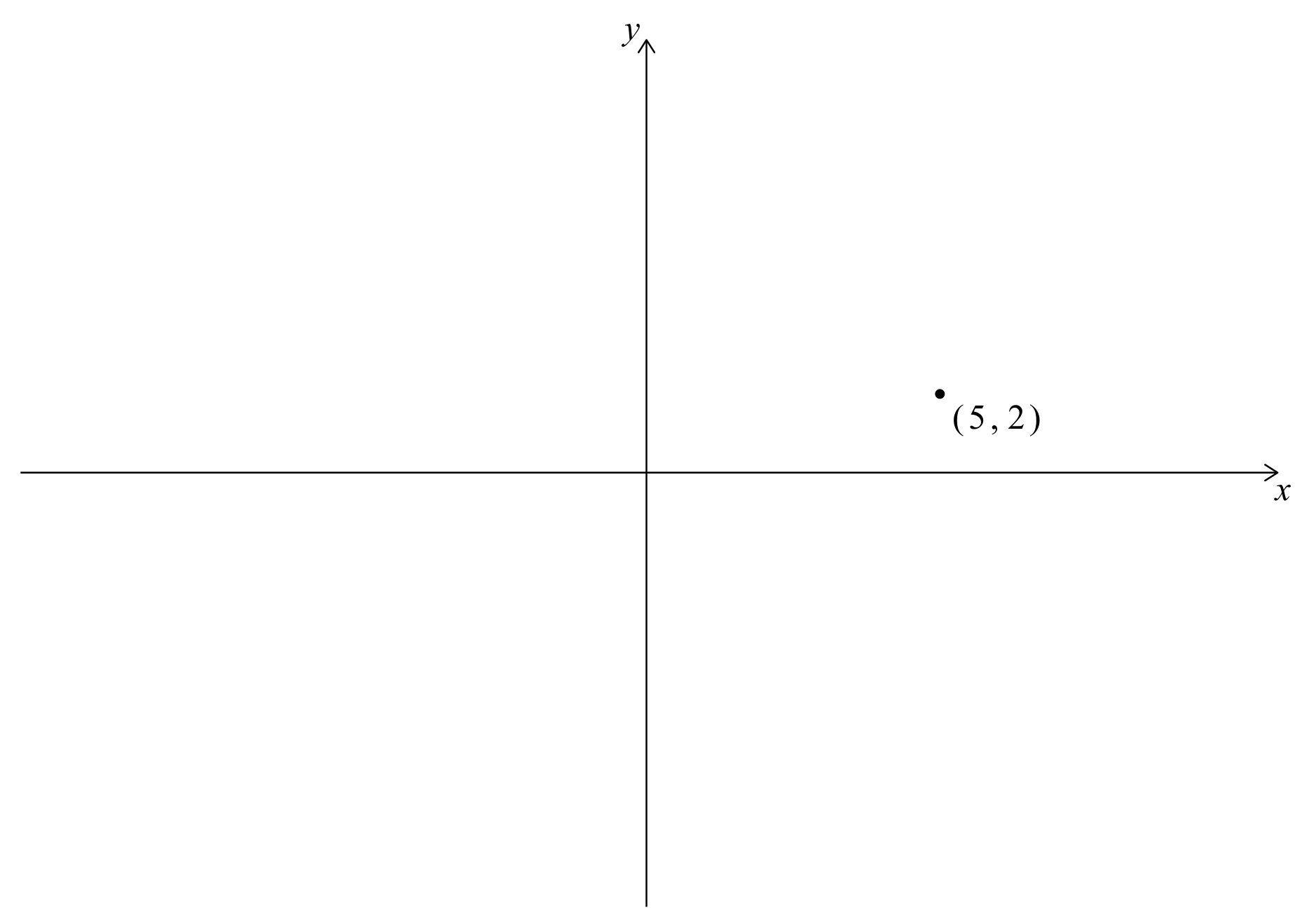
Consider the system of coupled differential equations given by

dx dt=2.2x2.6y dy dt=3.4x2.2y.\begin{aligned} & \frac{\mathrm{d} x}{\mathrm{~d} t}=2.2 x-2.6 y \\ & \frac{\mathrm{~d} y}{\mathrm{~d} t}=3.4 x-2.2 y . \end{aligned}

When t=0, x=5 and y=2.

Question 14(a)

(a)

Find the value of dy dx\frac{\mathrm{d} y}{\mathrm{~d} x} at t=0.

The eigenvalues for this system are ±2i\pm 2 \mathrm{i}.

[ 3 ]

Question 14(b)

(b)

On the following phase portrait, sketch the trajectory that passes through the point (5,2). Clearly indicate the direction of this trajectory.

Question image
[ 3 ]

Question 15

[Maximum number: 8]

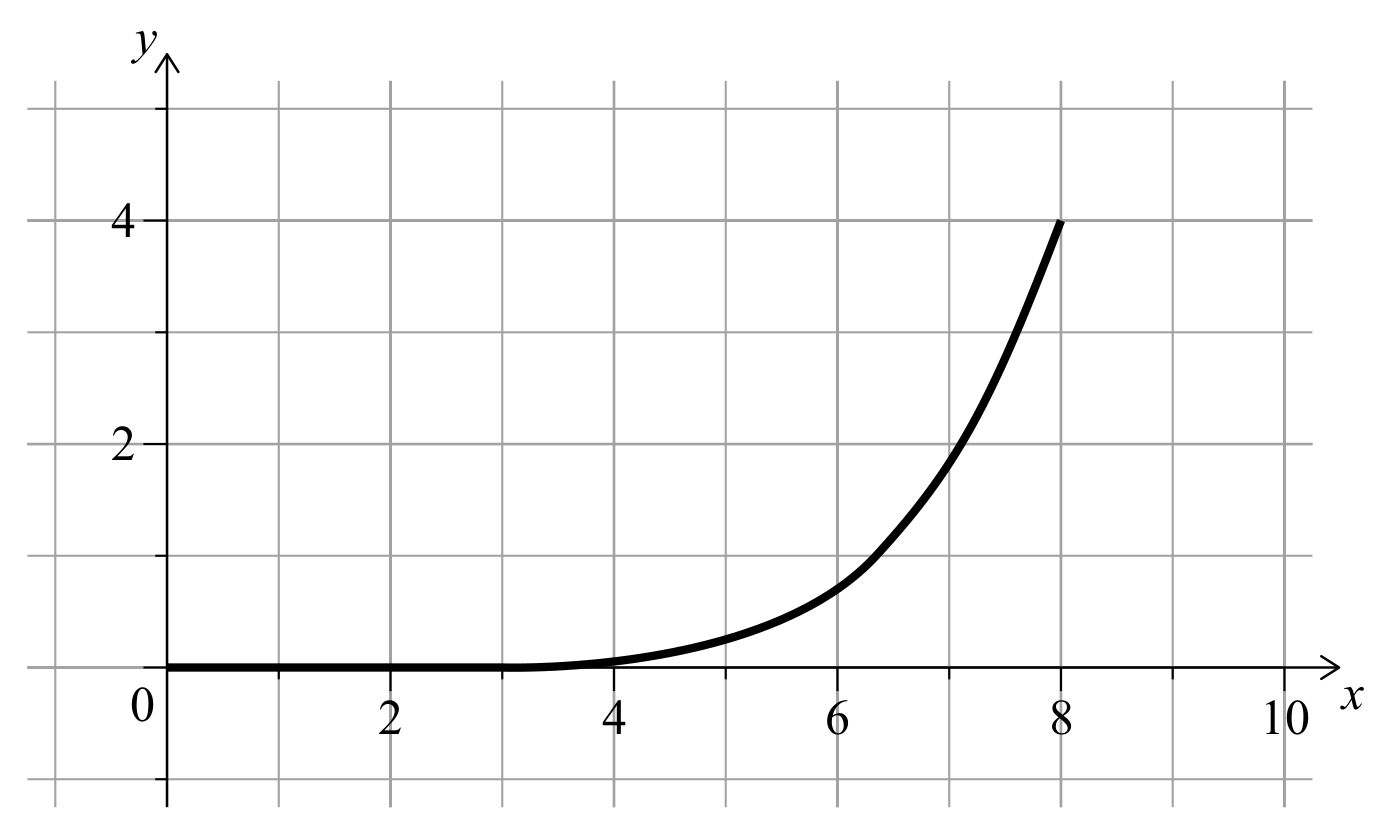
Jun Ho models the cross-section of a bowl, in order to calculate its volume.
His model for part of the cross-section is y=x665536y=\frac{x^{6}}{65536}, where 0x80 \leq x \leq 8, as shown in the following graph. One unit represents one centimetre.

Question image

Let R be the region enclosed by this graph, the line y=4 and the line x=0.
He obtains the volume of the bowl by rotating R,2πR, 2 \pi radians about the y-axis.

Question 15(a)

(a)

Find the volume of the bowl.

Jun Ho pours 250 cm3250 \mathrm{~cm}^{3} of water into the bowl.

[ 5 ]

Question 15(b)

(b)

Find the depth of the water in the bowl.

[ 3 ]

Question 17

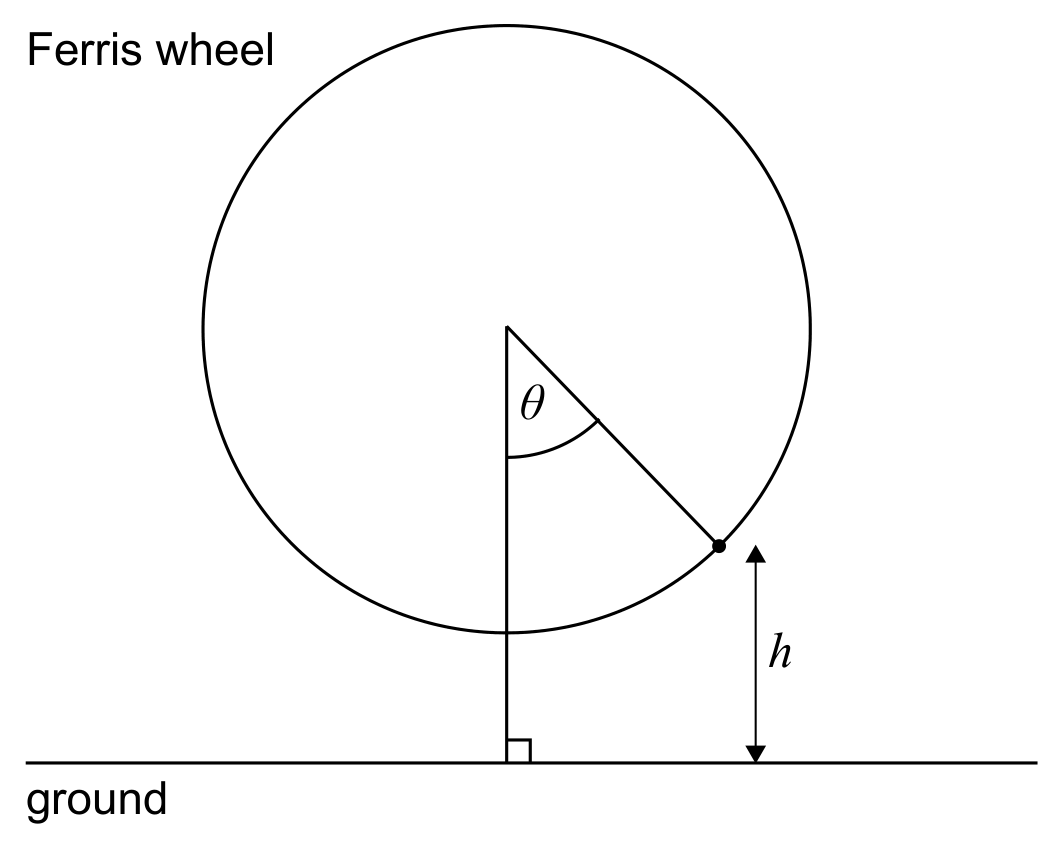
Younsue rides on a Ferris wheel. As the wheel rotates, her height above the ground, h metres, can be modelled in terms of the angle, θ\theta radians, that the wheel has rotated, using h=1615cosθh=16-15 \cos \theta. The value of θ\theta is measured from Younsue's starting position at the bottom of the wheel.

Question image

Question 17(b)(i)

(a)

Find the angle rotated by the Ferris wheel between t=0 and t=4.5.

Question 17(b)(ii)

(b)

Find the value of dh dt\frac{\mathrm{d} h}{\mathrm{~d} t}, when t=4.5.

0 selected