Question 1
A suitable site for the landing of a spacecraft on the planet Mars is identified at a point, A. The shortest time from sunrise to sunset at point A must be found.
Radians should be used throughout this question. All values given in the question should be treated as exact.
Mars completes a full orbit of the Sun in 669 Martian days, which is one Martian year.

On day t, where , the length of time, in hours, from the start of the Martian day until sunrise at point A can be modelled by a function, R(t), where
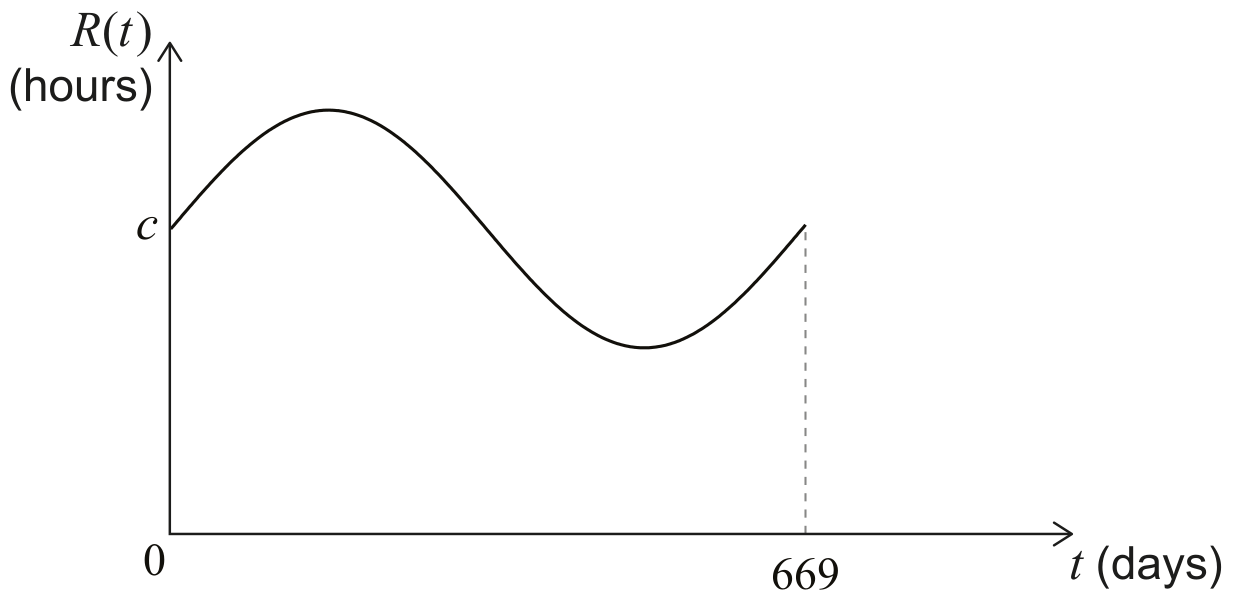
The graph of R is shown for one Martian year.
Question 1(d)
Use your answers to parts (b) and (c) to find
Question 1(d)(i)
the maximum value of R(t);
Question 1(d)(ii)
the minimum value of R(t).
Question 1(f)
Find the value of c.
Let S(t) be the length of time, in hours, from the start of the Martian day until sunset at point A on day t . S(t) can be modelled by the function
The length of time between sunrise and sunset at point A, L(t), can be modelled by the function
Question 1(g)
Find the value of d.
Let and hence L(t)=f(t)+d.
f(t) can be written in the form , where and are complex functions of t.
Question 1(h)
Question 1(h)(iii)
Find, in hours, the shortest time from sunrise to sunset at point A that is predicted by this model.