Question 1
This question considers whether it is reasonable to go on all the rides in a theme park and get back to the entrance in two and a half hours.
Martin is visiting a theme park. He will enter the park at 09:00 and must leave the park by 11:30. He uses information available on the internet to calculate whether he will be able to go on all of the rides in the two and a half hours.
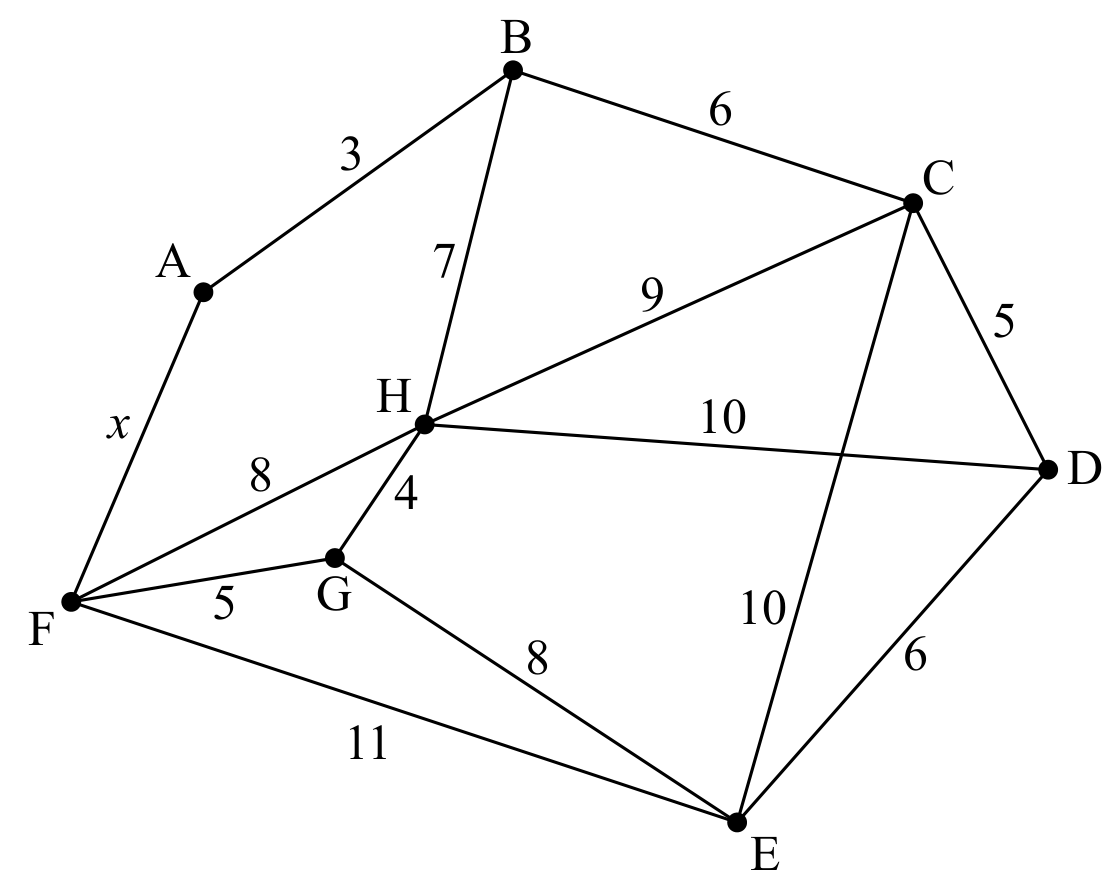
He begins by constructing a graph which shows the main paths between the rides and the route of the cable car between the entrance/exit A and ride D.
His graph and the names of the rides are shown in the following diagram.
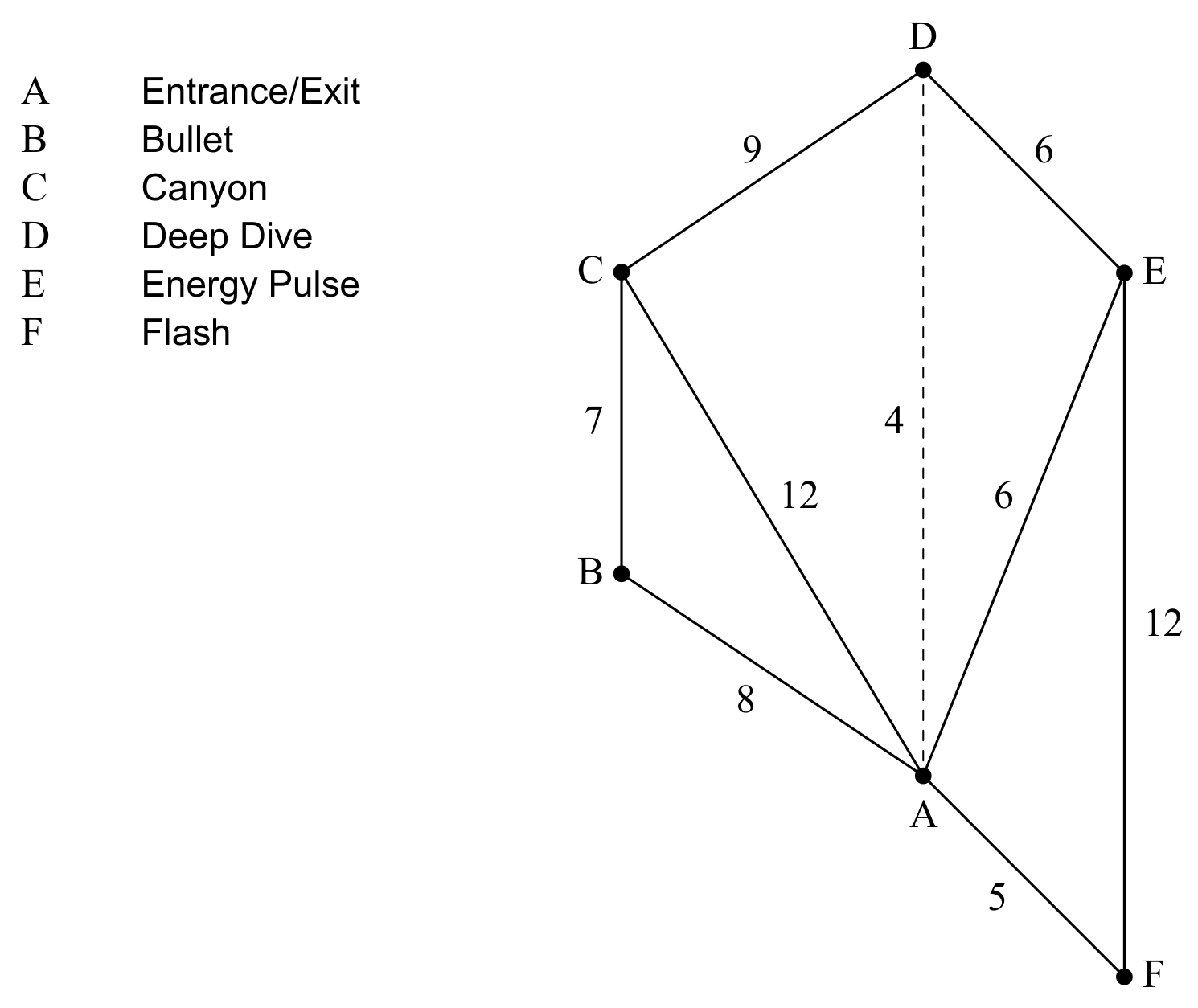
The weights on the edges of the graph represent the times, in minutes, to walk between the rides and the time to travel by cable car between A and D.
Let T be the shortest possible time, in minutes, taken to visit all the rides, beginning and ending at A .
Martin notices that the graph contains a Hamiltonian cycle. He decides to use the weight of the Hamiltonian cycle as an upper bound for T.
Question 1(a)
Find the weight of this Hamiltonian cycle.
Question 1(b)
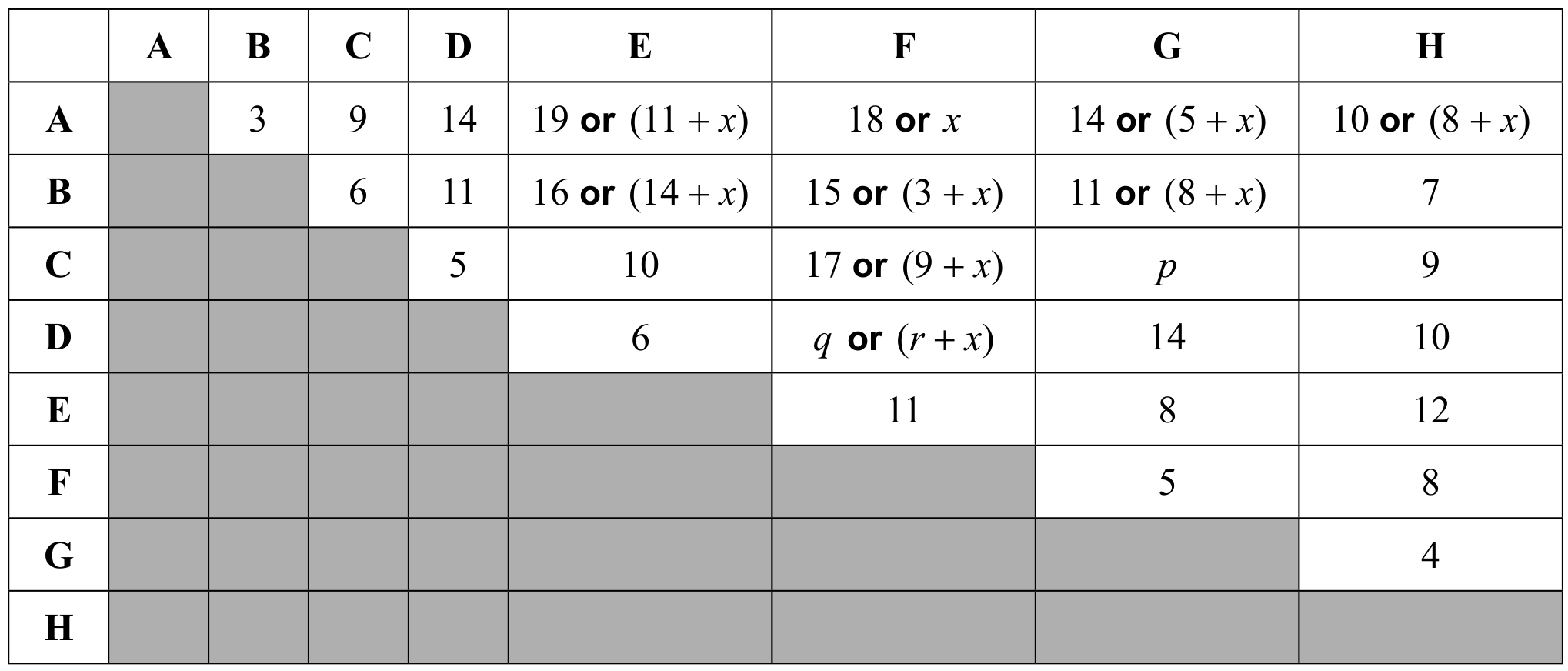
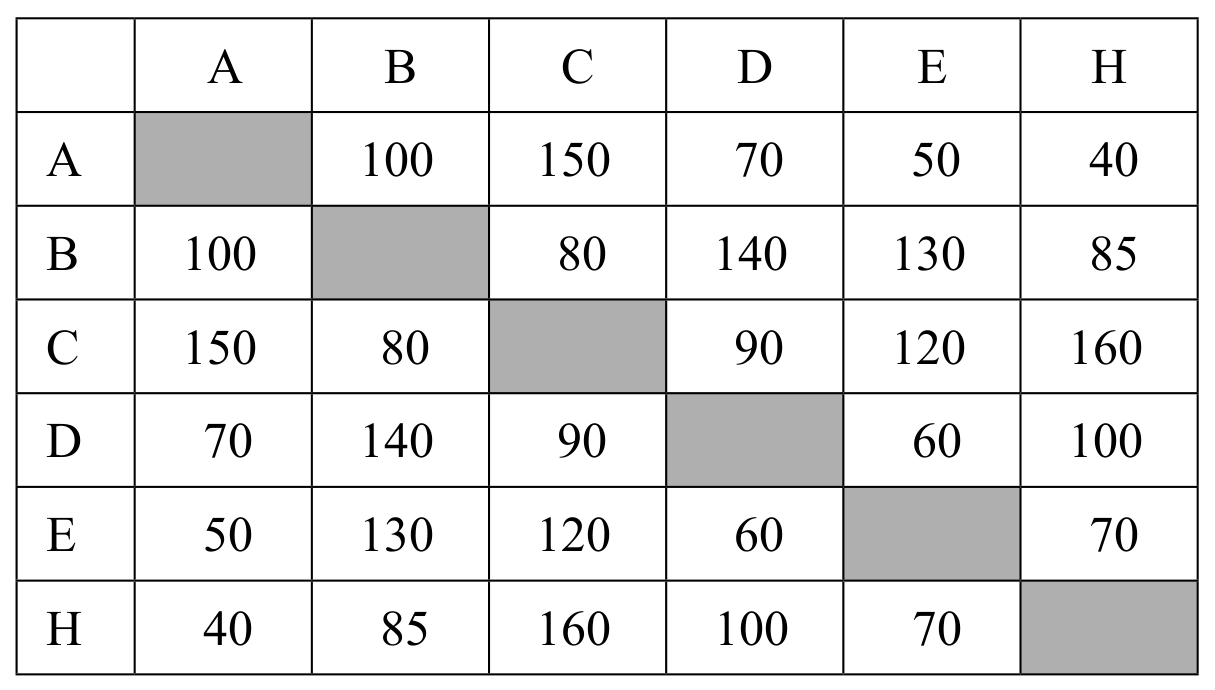
Martin constructs Table 1 to show the shortest possible time it takes to travel between any two rides and between the entrance and any ride.
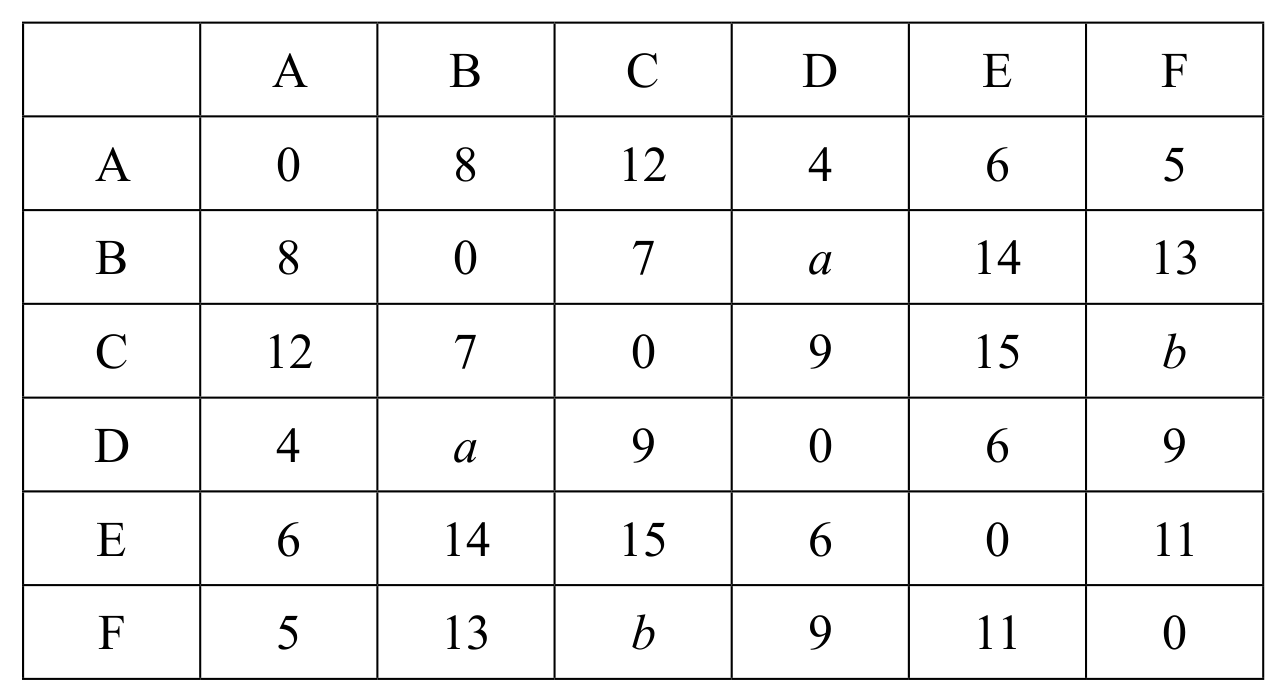
Table 1
Write down the value of
Question 1(b)(i)
a;
Question 1(b)(ii)
b.
Question 1(c)
Use the nearest neighbour algorithm on Table 1 to find an upper bound for T.
Question 1(d)
Martin decides to use the deleted vertex algorithm to find a lower bound for T by first deleting vertex A. The shortest possible time to travel between each ride, with vertex A deleted, is given in Table 2.
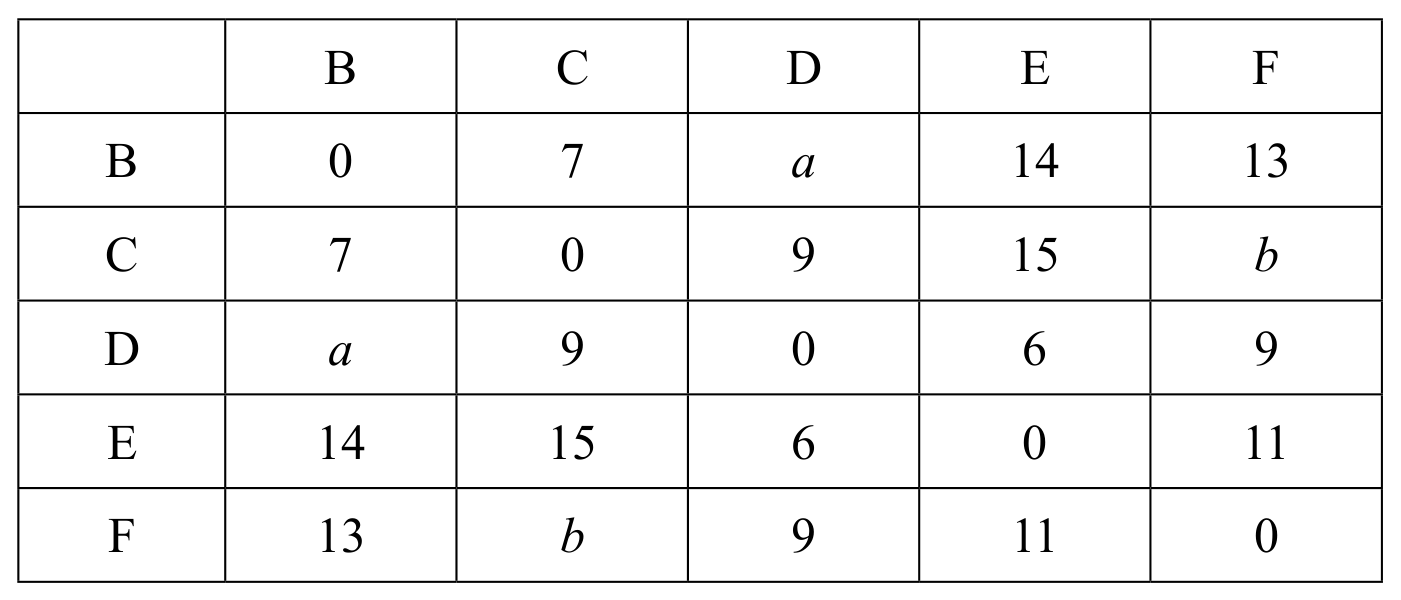
Table 2
Question 1(d)(i)
Use Prim's algorithm on Table 2 to find the weight of the minimum spanning tree for the graph with vertices B, C, D, E and F.
Start at vertex B and write down the order in which the edges are selected.
Question 1(d)(ii)
Hence find a lower bound for T.
Martin finds more lower bounds for T, by deleting each vertex in turn. The results are shown in the following table.
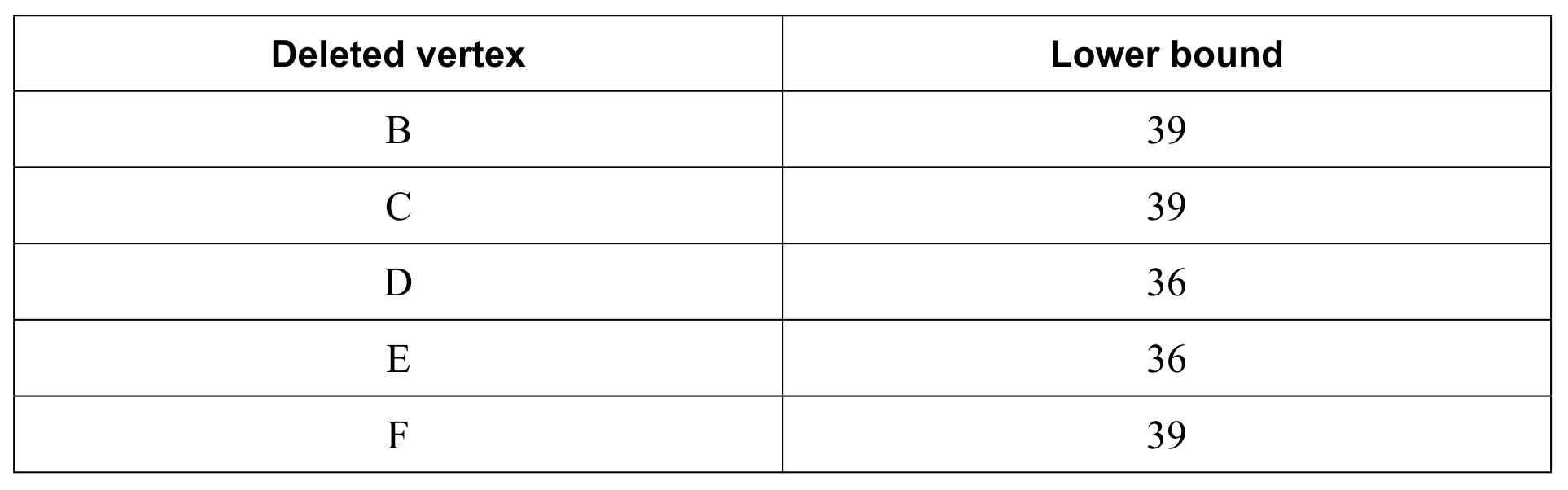
Martin finds the smallest possible interval within which T lies, based on his calculated values for upper and lower bounds. He writes his answer in the form .
Question 1(e)
Write down the value of
Question 1(e)(i)
p;
Question 1(e)(ii)
q.
Martin's favourite ride is Energy Pulse (E), so he decides to go there first. He plans to begin at A and visit the rides in the order E, D, C, B, F before returning to A . For the rest of the question, assume that Martin is taking this route.
Question 1(f)
Question 1(f)(i)
Find the shortest possible time it would take to complete this route.
Question 1(f)(ii)
State the edge which would need to be repeated.
Each of the rides takes 2 minutes to complete.
Let the time spent waiting in the queue for ride B be written as the random variable and similarly for the other rides.
The following distributions model the times spent waiting in the queues. Each waiting time is independent of all other waiting times and the time of day.