

Question 9
[Maximum number: 8]
An airplane lands on a runway 100 metres in front of a stationary car. At the instant the airplane lands, the car begins to travel in the same direction towards the airplane.
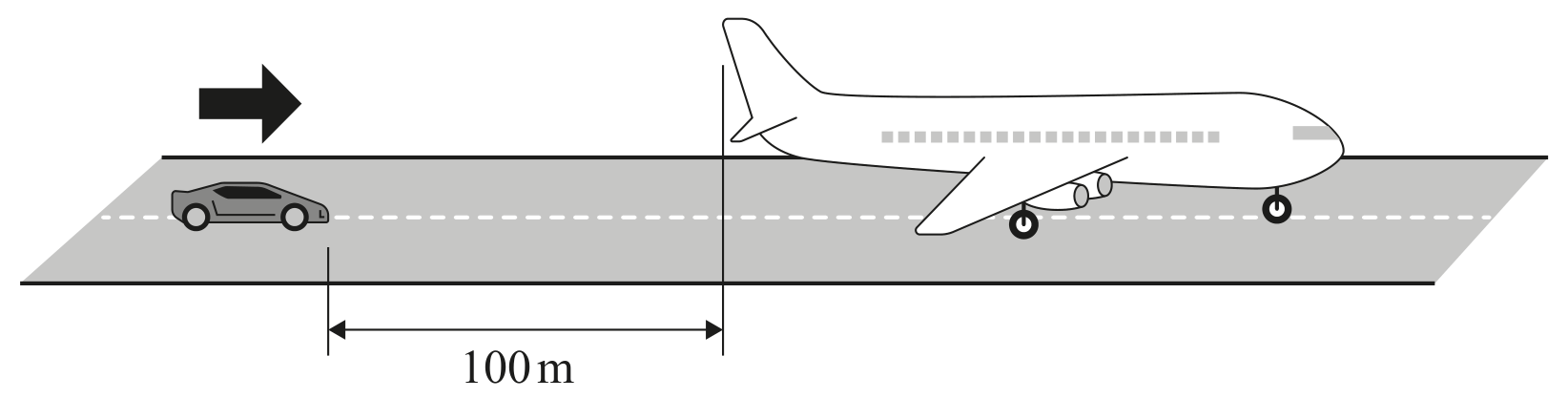
diagram not to scale
Let t represent the number of seconds after the airplane lands. For , the velocities of the airplane and the car in , can be modelled by the following equations:
Question 9(a)
(a)
When the airplane lands, write down the speed of
[ 2 ]
Question 9(a)(i)
(i)
the airplane;
Question 9(a)(ii)
(ii)
the car.
[ 2 ]
Question 9(b)
(b)
Find
[ 3 ]
Question 9(b)(i)
(i)
the value of t when the airplane and the car have the same speed;
Question 9(b)(ii)
(ii)
the speed at this time.
Let d(t) represent the distance, in metres, between the car and the back of the airplane after t seconds.
[ 3 ]
Question 9(e)
(c)
Find the distance travelled by the car when it reaches the back of the airplane.
[ 3 ]