
EduNinja

IB Maths AA SL 5.6 Differentiation Rules

IB Maths AA SL 5.6 Differentiation Rules
IB Mathematics: analysis and approaches guide, first assessment 2021

Practise selecting and combining power, trigonometric, exponential, chain, product and quotient rules before applying the derivative to gradients or contextual rates.

How this is tested

  • identify the composite, product or quotient structure before differentiating each component
  • simplify the derivative and substitute a point or tangent gradient only after differentiating
  • interpret a derivative as the requested rate and retain the variables and units of the context

Question 9(c)

[Maximum number: 3]

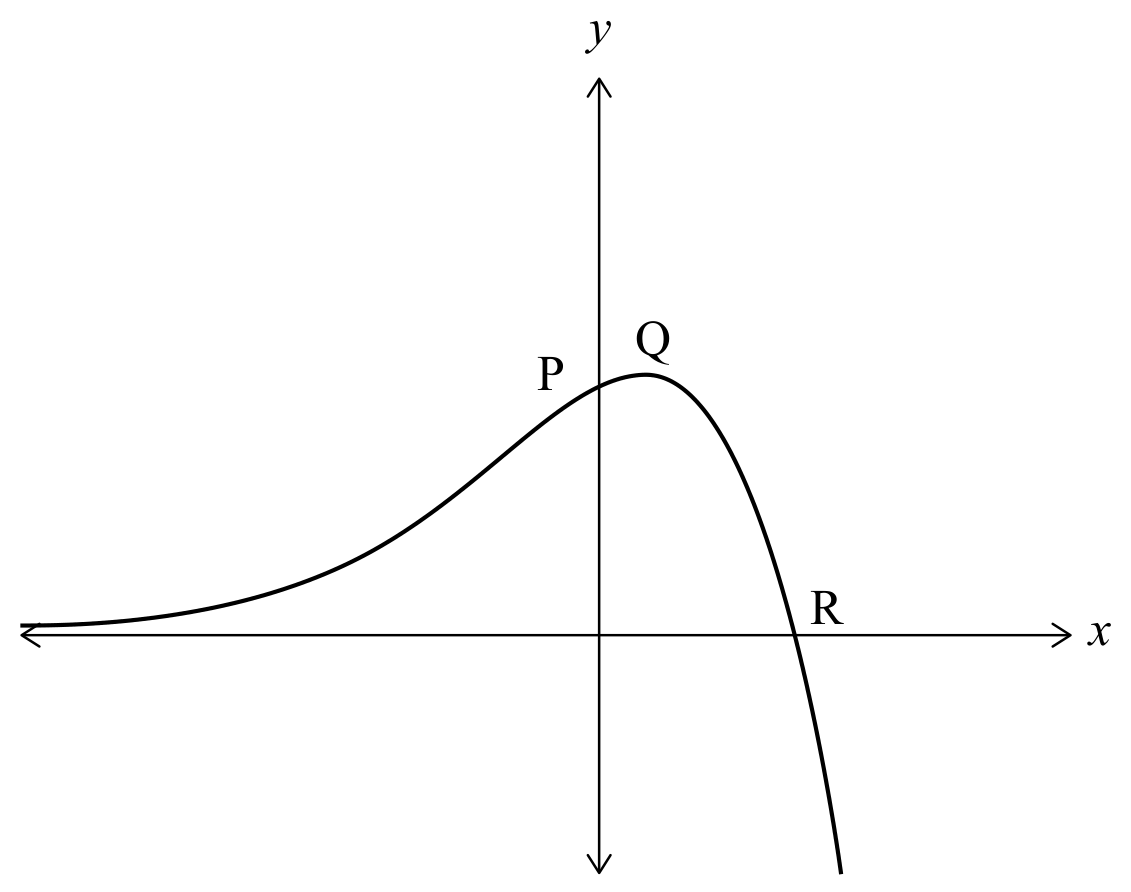
The function f is defined by f(x)=5exe2xex+1f(x)=\frac{5 \mathrm{e}^{x}-\mathrm{e}^{2 x}}{\mathrm{e}^{x}+1}. The following diagram shows part of the graph of f. The graph intersects the y-axis at point P and intersects the x-axis at point R . Point Q is a local maximum point with coordinates (q,726)(q, 7-2 \sqrt{6}).

Figure for Question 9(c) — IB Maths AA SL

Show that f(x)=e3x2e2x+5ex(ex+1)2f^{\prime}(x)=\frac{-\mathrm{e}^{3 x}-2 \mathrm{e}^{2 x}+5 \mathrm{e}^{x}}{\left(\mathrm{e}^{x}+1\right)^{2}}.