EduNinja

IB Maths AA SL4.1 Statistics and probability - SL contentQuestion Bank

Question 1

[Maximum number: 6]

In a study, the mobile phone usage of a random sample of ten students was examined on a particular day.
The length of time, t hours, that the ten students used their phones for are listed below.
0.71.21.94.04.44.54.95.76.511.7\begin{array}{llllllllll}0.7 & 1.2 & 1.9 & 4.0 & 4.4 & 4.5 & 4.9 & 5.7 & 6.5 & 11.7\end{array}

Question 1(a)

(a)

For these data, find the

[ 3 ]

Question 1(a)(i)

(i)

median;

Question 1(a)(ii)

(ii)

interquartile range.

An outlier is a value that is less than Q11.5×Q_{1}-1.5 \times IQR or greater than Q3+1.5×Q_{3}+1.5 \times IQR .

[ 3 ]

Question 1(b)

(b)

Show that 11.7 is an outlier.

[ 3 ]

Question 1

[Maximum number: 6]

In a group of 35 students, some take art class (A) and some take music class (M) .5 of these students do not take either class. This information is shown in the following Venn diagram.

Question image

Question 1(a)

(a)

Write down the number of students in the group who take art class.

[ 2 ]

Question 1(b)

(b)

One student from the group is chosen at random. Find the probability that

[ 4 ]

Question 1(b)(i)

(i)

the student does not take art class;

Question 1(b)(ii)

(ii)

the student takes either art class or music class, but not both.

[ 4 ]

Question 1

[Maximum number: 6]

A bag contains 5 green balls and 3 white balls. Two balls are selected at random without replacement.

Question 1(a)

(a)

Complete the following tree diagram.

Question image
[ 3 ]

Question 1(b)

(b)

Find the probability that exactly one of the selected balls is green.

[ 3 ]

Question 1

[Maximum number: 9]

Consider the following frequency table.

Table

Question 1(a)

Question 1(a)(i)

(a)
(i)

Write down the mode.

[ 1 ]

Question 1(a)(ii)

(ii)

Find the value of the range.

[ 3 ]

Question 1(b)

Question 1(b)(i)

(b)
(i)

Find the mean.

[ 1 ]

Question 1(b)(ii)

(ii)

Find the variance.

[ 4 ]

Question 1

[Maximum number: 7]

The following table gives the examination grades for 120 students.

Table

Question 1(a)

(a)

Find the value of

[ 4 ]

Question 1(a)(i)

(i)

p;

Question 1(a)(ii)

(ii)

q.

[ 4 ]

Question 1(b)

(b)

Find the mean grade.

[ 2 ]

Question 1(c)

(c)

Write down the standard deviation.

[ 1 ]

Question 1

[Maximum number: 4]

The scores achieved by 80 golfers in a competition are summarized in the following box and whisker diagram.

Question image

Question 1(a)

(a)

Find the interquartile range.

[ 2 ]

Question 1(b)

(b)

Find the number of golfers that scored between 70 and 74 .

[ 2 ]

Question 1

[Maximum number: 7]

Janie claims that rabbits in Australia have longer ears than rabbits in Spain.
To test her claim, a randomly selected sample of rabbits was collected in each country.
The length of one ear of each rabbit was measured and the value recorded correct to the nearest millimetre (mm).
In the Australian sample, the median recorded value was 80 mm and the interquartile range was 11 mm .
The recorded values for the Spanish sample are shown in the following box and whisker diagram.

Question image

Question 1(a)

(a)

Complete the following table for the recorded values of the lengths of the rabbits' ears in each sample.

Table
[ 3 ]

Question 1(b)

(b)

Justifying your answers, compare the distributions of the lengths of rabbits' ears in Australia and Spain using

[ 4 ]

Question 1(b)(i)

(i)

the median;

Question 1(b)(ii)

(ii)

the interquartile range.

[ 4 ]

Question 1

[Maximum number: 6]

1.
A standard die is rolled 36 times. The results are shown in the following table.

Table

Question 1(a)

(a)

Write down the standard deviation.

[ 2 ]

Question 1(b)

(b)

Write down the median score.

[ 1 ]

Question 1(c)

(c)

Find the interquartile range.

[ 3 ]

Question 1

[Maximum number: 5]

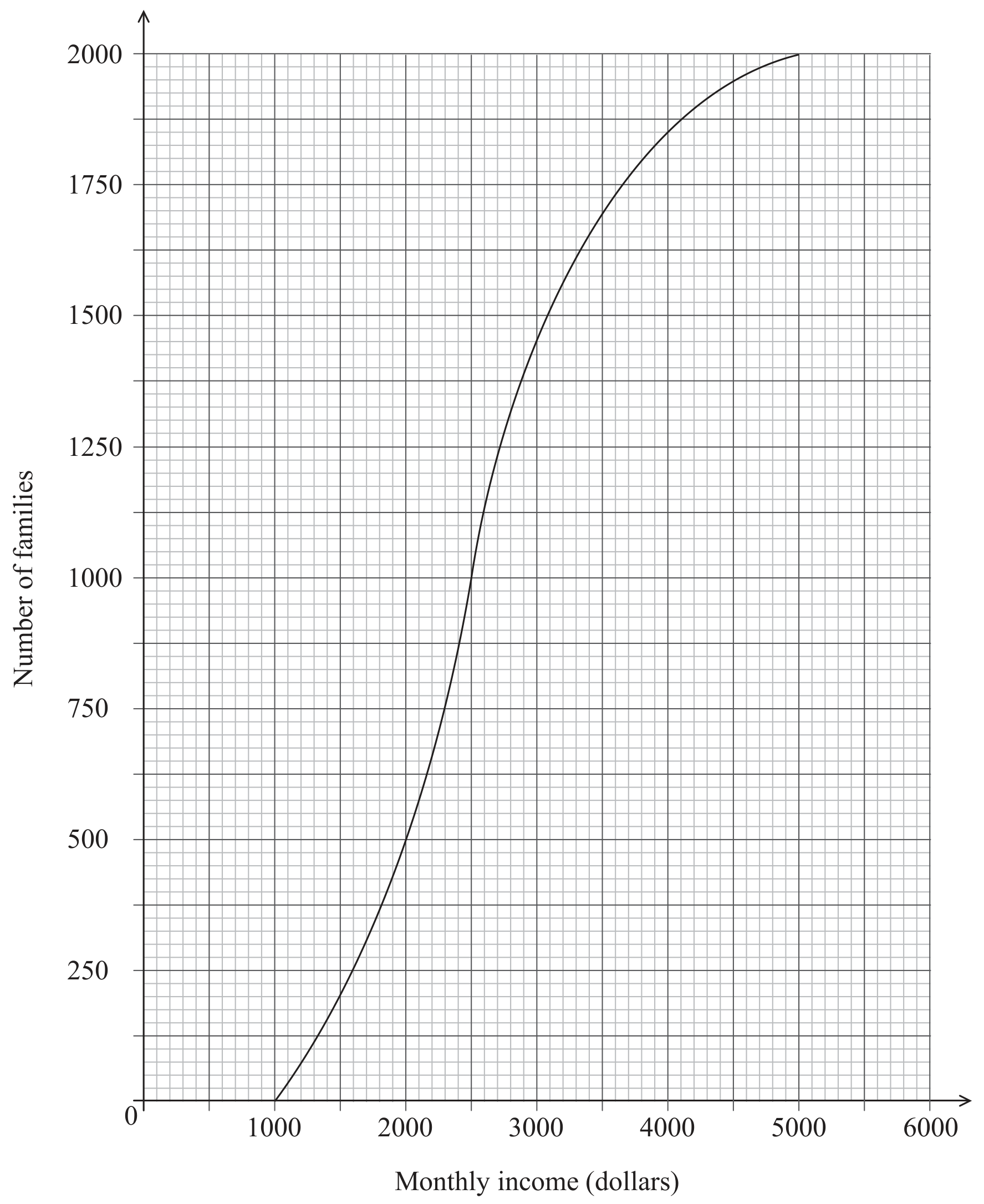
The cumulative frequency curve below represents the marks obtained by 100 students.

Question image

Question 1(a)

(a)

Find the median mark.

[ 2 ]

Question 1(b)

(b)

Find the interquartile range.

[ 3 ]

Question 1

[Maximum number: 7]

The ages of people attending a music concert are given in the table below.

Table

Question 1(a)

(a)

Find p.

The cumulative frequency diagram is given below.

Question image
[ 2 ]

Question 1(b)

(b)

Use the diagram to estimate

[ 5 ]

Question 1(b)(i)

(i)

the 80th 80^{\text {th }} percentile;

Question 1(b)(ii)

(ii)

the interquartile range.

[ 5 ]
0 selected