IB Maths AA SL 2 Functions Question Bank
Practise interpreting functions through equations, graphs, intercepts, inverses, asymptotes and model values in algebraic contexts.
- Syllabus
- First assessment 2021
- Topic
- 2
- Level
- SL
Practise interpreting functions through equations, graphs, intercepts, inverses, asymptotes and model values in algebraic contexts.
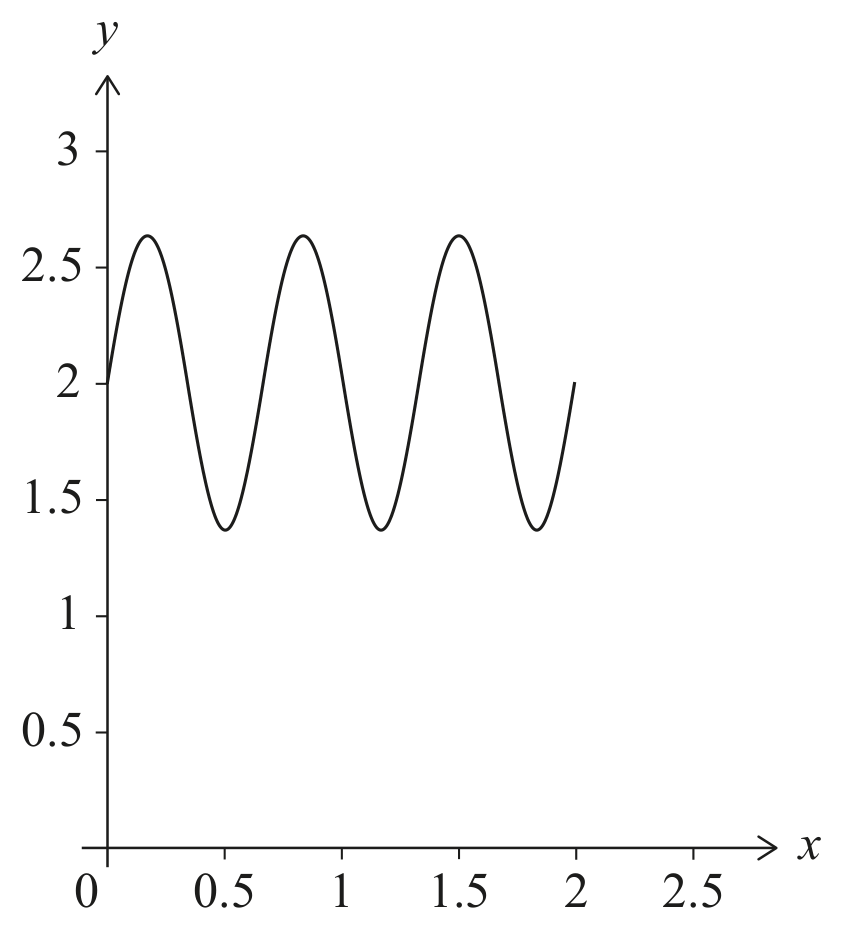
Consider the function , where . The following diagram shows the graph of f.
Write down the gradient of the line .
The line is normal to the graph of f at point A(1,2).
The line is tangent to the graph of f at A .
Find the coordinates of B.
The shaded region is enclosed by the graph of f and the line between A and B .
Let and .
Find .
Find .
The velocity of a particle in is given by , for .
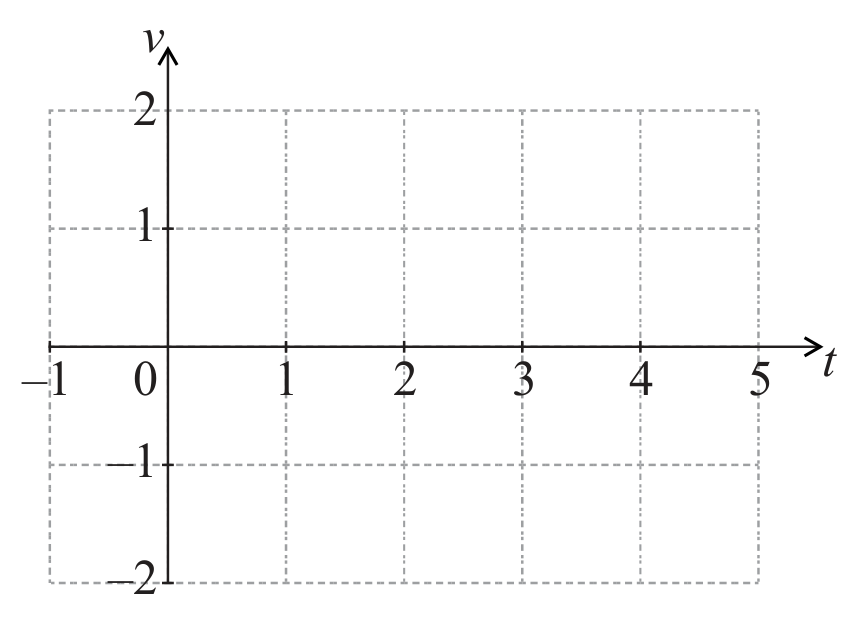
On the grid below, sketch the graph of v.
Write down the positive t-intercept.
Let . The equation f(x)=0 has two equal roots.
Write down the value of the discriminant.
Hence, show that p=3.
The graph of f has its vertex on the x-axis.
Find the coordinates of the vertex of the graph of f.
Write down the solution of f(x)=0.
The function can be written in the form . Write down the value of
a;
h;
k.
The graph of a function g is obtained from the graph of f by a reflection of f in the x-axis, followed by a translation by the vector . Find g, giving your answer in the form .