Question 1
[Maximum number: 5]
Consider the functions f(x)=x-3 and , where k is a real constant.
Question 1(a)
(a)
Write down an expression for .
[ 2 ]
Question 1(b)
(b)
Given that , find the possible values of k.
[ 3 ]
 EduNinja
Consider the functions f(x)=x-3 and , where k is a real constant.
Write down an expression for .
Given that , find the possible values of k.
The functions f and g are both defined for by
The graphs of f and g intersect at x=a and x=b, where a<b.
Find the value of a and the value of b.
The graph of y=f(x) for is shown in the following diagram.
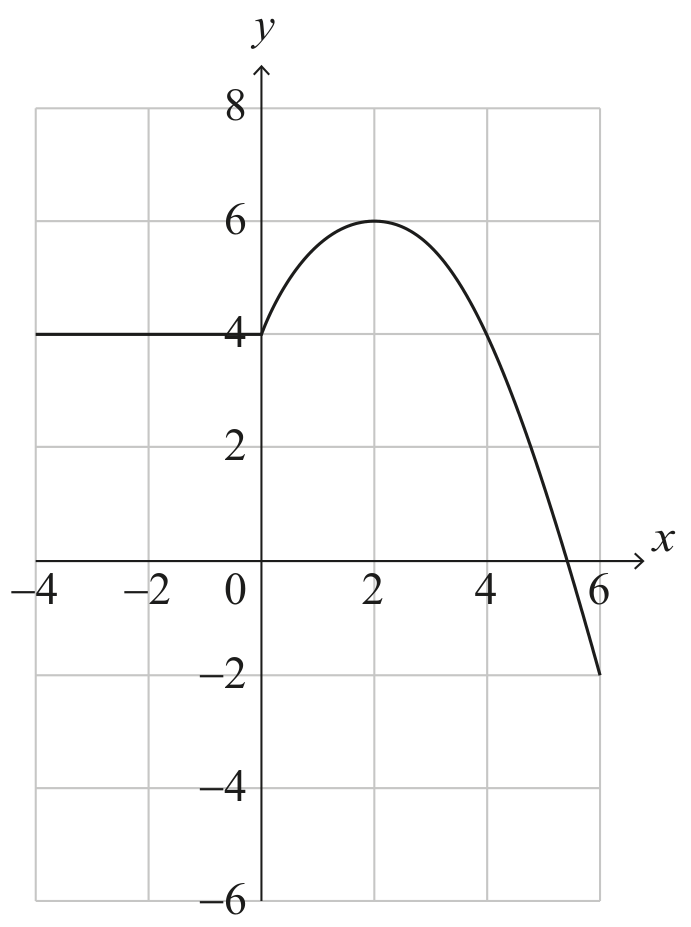
Write down the value of
f(2);
.
Let for . On the axes above, sketch the graph of g.
Consider the graph of .
Sketch the graph, clearly labelling the x and y intercepts with their values.
This question asks you to explore properties of a family of curves of the type for various values of a and b, where .
On the same set of axes, sketch the following curves for and , clearly indicating any points of intersection with the coordinate axes.
By considering each curve from part (a), identify two key features that would distinguish one curve from the other.
Now, consider curves of the form , for , where .
By varying the value of b, suggest two key features common to these curves.
Next, consider the curve .
The point S(-1,1) also lies on C. The line intersects C at a further point. Determine the coordinates of this point.
Consider the function , where .
Find the value of
f(0);
f(20).
Find the two roots of f(x)=0.
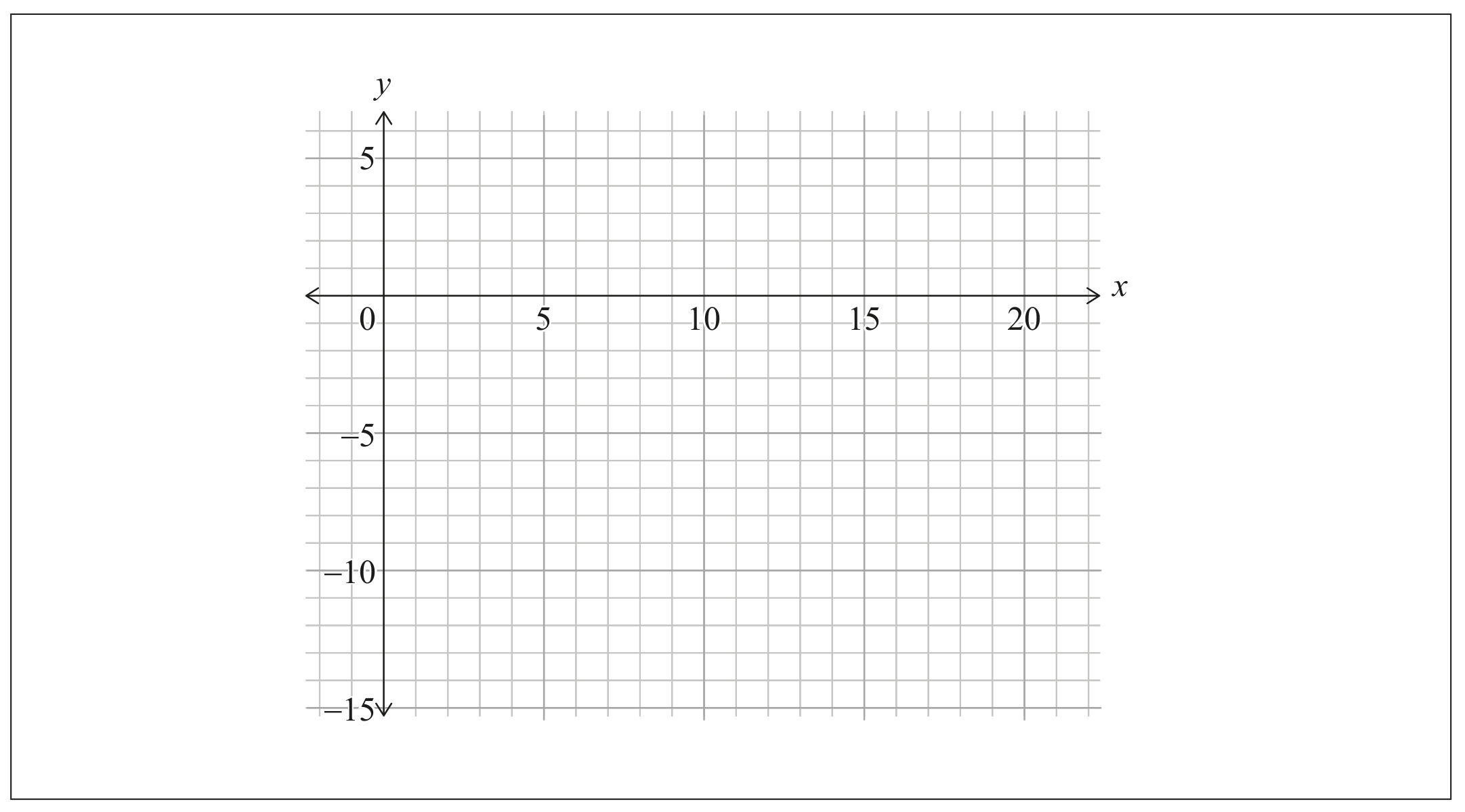
Sketch the graph of y=f(x) on the following grid.
In this question you will investigate series of the form
and use various methods to find polynomials, in terms of n, for such series.
When q=1, the above series is arithmetic.
The following table gives values of and for n=1,2,3.
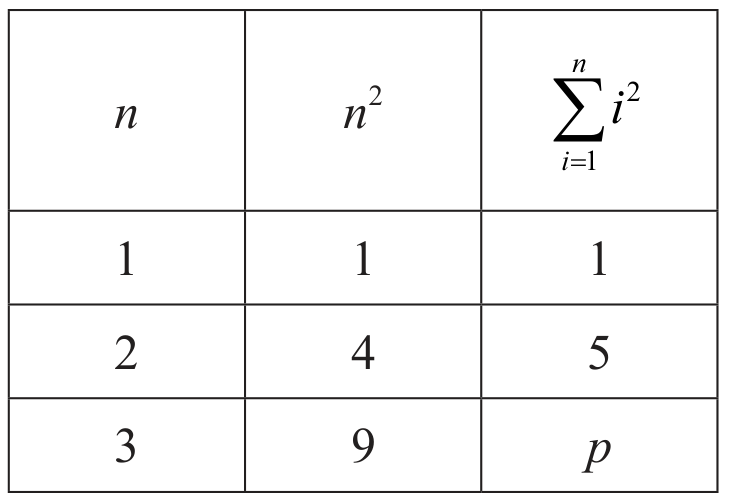
Write down the value of p.
The quadratic function has a maximum value of 5 when x=3.
Find the value of p and the value of q.
The graph of f(x) is translated 3 units in the positive direction parallel to the x-axis. Determine the equation of the new graph.
This question asks you to explore self-composite linear functions, of the form f(x)=m x+c, for varying values of m.
A function composed with itself is called a self-composite function.
For a function f, the function composition with itself is given by .
Let denote the nth composition of f with itself where .
Hence, for example, and .
Consider the linear function f(x)=m x+c, where and .
Show that
;
.
Write down an expression for .
Suggest a similar expression for .
By using your expression from part (b)(ii), or otherwise, find an expression in terms of n for when m=1.
The following question explores features of a family of curves. The family is then linked to a homogeneous differential equation.
Consider the curve given by .
Sketch the curve of y for .
State the coordinates of the points where the curve crosses the x-axis.