EduNinja

IB Maths AA HL2.2 Functions - AHL contentQuestion Bank

Question 1

[Maximum number: 6]

This question asks you to explore the behaviour and key features of cubic polynomials of the form x33cx+dx^{3}-3 c x+d.
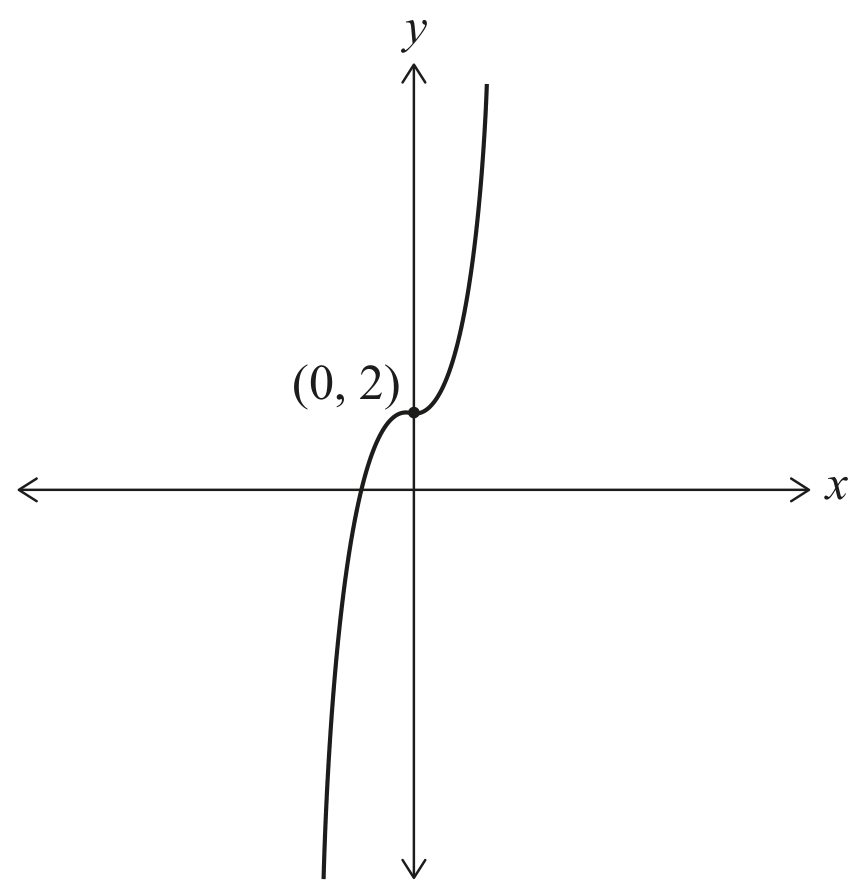
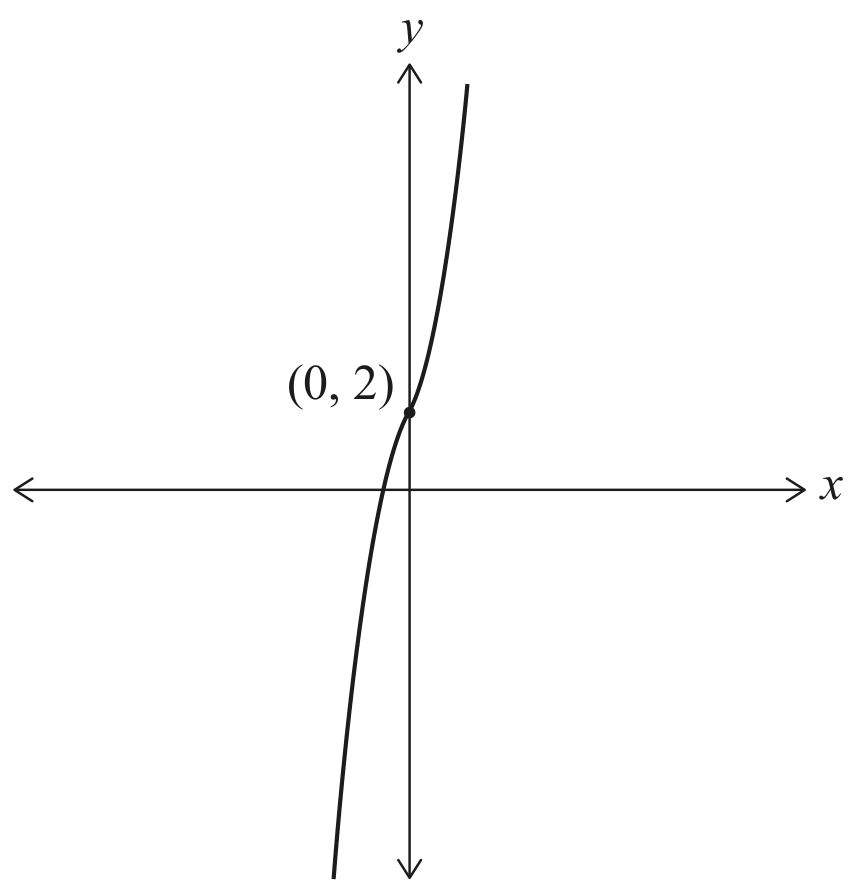
Consider the function f(x)=x33cx+2f(x)=x^{3}-3 c x+2 for xRx \in \mathbb{R} and where c is a parameter, cRc \in \mathbb{R}.
The graphs of y=f(x) for c=-1 and c=0 are shown in the following diagrams.

c=-1
Question image
c=0
Question image

Question 1(a)

(a)

On separate axes, sketch the graph of y=f(x) showing the value of the y-intercept and the coordinates of any points with zero gradient, for

[ 6 ]

Question 1(a)(i)

(i)

c=1\quad c=1;

[ 3 ]

Question 1(a)(ii)

(ii)

c=2\quad c=2.

[ 3 ]

Question 1

[Maximum number: 5]

Let f(x)=x4+px3+qx+5f(x)=x^{4}+p x^{3}+q x+5 where p, q are constants.
The remainder when f(x) is divided by (x+1) is 7 , and the remainder when f(x) is divided by ( x-2 ) is 1 . Find the value of p and the value of q.

Question 1

[Maximum number: 11]

This question asks you to investigate lines normal to curves of the form y=k2xy=\frac{k^{2}}{x}.
The curve H has equation y=1xy=\frac{1}{x} where xR,x0x \in \mathbb{R}, x \neq 0.

Question 1(b)

(a)

The equation for N given in part (a)(ii) is of the form y=m x+c.

[ 5 ]

Question 1(b)(i)

(i)

Show that either c=1m(1m2)c=\frac{1}{\sqrt{m}}\left(1-m^{2}\right) or c=1m(m21)c=\frac{1}{\sqrt{m}}\left(m^{2}-1\right).

[ 4 ]

Question 1(b)(ii)

(ii)

Determine the set of values of m for which there exists at least one line normal to H.

[ 1 ]

Question 1(c)

(b)

Hence, or otherwise, determine the set of values of m for which there exists exactly

[ 3 ]

Question 1(c)(i)

(i)

one line normal to H;

[ 1 ]

Question 1(c)(ii)

(ii)

two lines normal to H.

[ 2 ]

Question 1(e)

(c)

The equation of the line normal to F at A is given by y=t2xkt3+kty=t^{2} x-k t^{3}+\frac{k}{t}.

[ 3 ]

Question 1(e)(i)

(i)

Show that the x-coordinates of A and B satisfy the quadratic equation

x2k(t1t3)xk2t2=0x^{2}-k\left(t-\frac{1}{t^{3}}\right) x-\frac{k^{2}}{t^{2}}=0

Question 1(e)(ii)

(ii)

Hence, by considering either the sum or product of the roots of this quadratic equation, or otherwise, determine the coordinates of B.

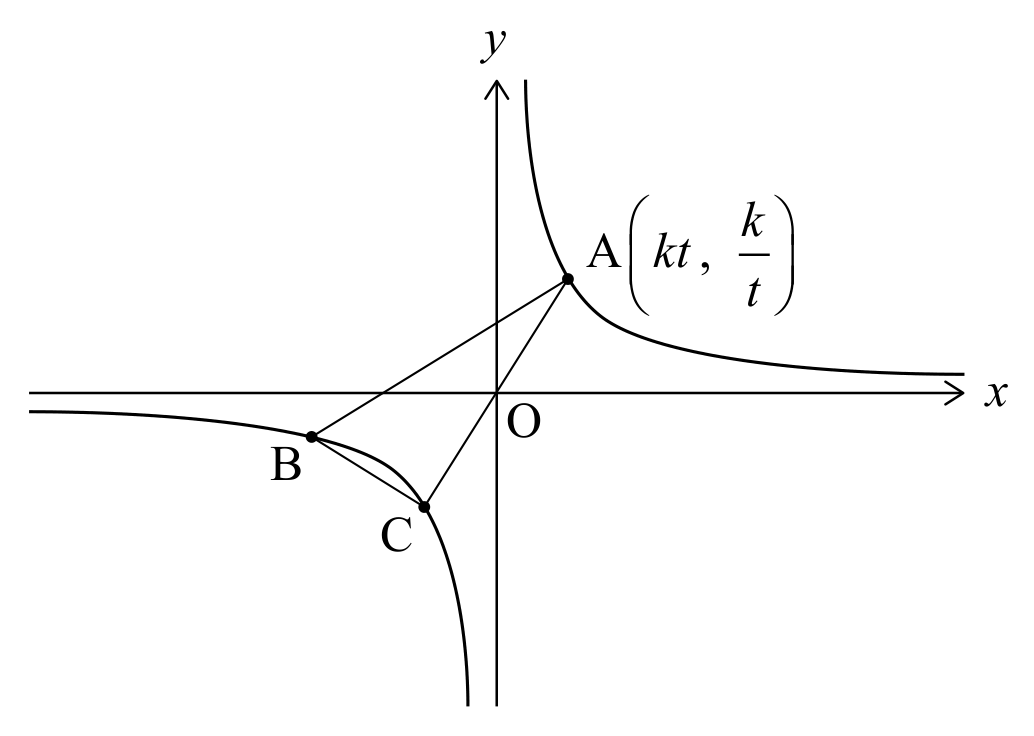
From A , the line passing through the origin O intersects F again at point C .
Points A, B and C form triangle ABC as shown in the following diagram.

Question image
[ 3 ]

Question 1

[Maximum number: 4]

Find the set of values of x for which |x-1|>|2 x-1|.

Question 1

[Maximum number: 5]

Given that Ax3+Bx2+x+6A x^{3}+B x^{2}+x+6 is exactly divisible by (x+1)(x-2), find the value of A and the value of B.

Question 1

[Maximum number: 4]

This question asks you to explore self-composite linear functions, of the form f(x)=m x+c, for varying values of m.
A function composed with itself is called a self-composite function.
For a function f, the function composition with itself is given by (ff)(x)=f(f(x))(f \circ f)(x)=f(f(x)).
Let fnf^{n} denote the nth composition of f with itself where fn(x)=(fff)n times (x)f^{n}(x)=\underbrace{(f \circ f \circ \cdots \circ f)}_{n \text { times }}(x).
Hence, for example, f2(x)=(ff)(x)f^{2}(x)=(f \circ f)(x) and f3(x)=(fff)(x)=f(f(f(x)))f^{3}(x)=(f \circ f \circ f)(x)=f(f(f(x))).
Consider the linear function f(x)=m x+c, where xRx \in \mathbb{R} and m,cRm, c \in \mathbb{R}.

Question 1(e)

Question 1(e)(i)

(a)
(i)

Show that fn(x)=x+cf^{n}(x)=-x+c when n is odd.

[ 2 ]

Question 1(e)(ii)

(ii)

Find an expression for fn(x)f^{n}(x) when n is even.

[ 2 ]

Question 1

[Maximum number: 4]

The following question explores features of a family of curves. The family is then linked to a homogeneous differential equation.
Consider the curve given by y=x(x216)x2+16y=\frac{x\left(x^{2}-16\right)}{x^{2}+16}.

Question 1(b)

(a)

State whether the function f(x)=x(x216)x2+16f(x)=\frac{x\left(x^{2}-16\right)}{x^{2}+16} is odd, even or neither. Justify your answer. [2]

Now consider the general curve given by y=x(x2A)x2+Ay=\frac{x\left(x^{2}-A\right)}{x^{2}+A}, where A is a positive constant
and xRx \in \mathbb{R}. and xRx \in \mathbb{R}.

[ 2 ]

Question 1(d)

Question 1(d)(ii)

(b)
(i)

Hence, determine the equation of the oblique asymptote to the curve.

[ 1 ]

Question 1(d)(iii)

(ii)

Write down the coordinates of a point on the curve where the oblique asymptote is parallel to the tangent to the curve at that point.

Now consider the differential equation x2 dy dx=x(x+y)y2x^{2} \frac{\mathrm{~d} y}{\mathrm{~d} x}=x(x+y)-y^{2}, where x0,y±xx \neq 0, y \neq \pm x.
Using the substitution y=v x, the differential equation can be written as x dv dx=1v2x \frac{\mathrm{~d} v}{\mathrm{~d} x}=1-v^{2}.

[ 1 ]

Question 1

[Maximum number: 5]

The cubic polynomial 3x3+px2+qx23 x^{3}+p x^{2}+q x-2 has a factor ( x+2 ) and leaves a remainder 4 when divided by (x+1). Find the value of p and the value of q.

Question 1

[Maximum number: 4]

The function f:RRf: \mathbb{R} \rightarrow \mathbb{R} is defined by

f(x)=2exexf(x)=2 \mathrm{e}^{x}-\mathrm{e}^{-x}

Question 1(a)

(a)

Show that f is a bijection.

[ 4 ]

Question 1

[Maximum number: 6]

The same remainder is found when 2x3+kx2+6x+322 x^{3}+k x^{2}+6 x+32 and x46x2k2x+9x^{4}-6 x^{2}-k^{2} x+9 are divided by x+1. Find the possible values of k.

0 selected