EduNinja

IB Maths AA HL1.2 Number and algebra - AHL contentQuestion Bank

Question 1

[Maximum number: 18]

The binary operator multiplication modulo 14, denoted by *, is defined on the set S={2,4,6,8,10,12}S=\{2,4,6,8,10,12\}.

Question 1(a)

(a)

Copy and complete the following operation table.
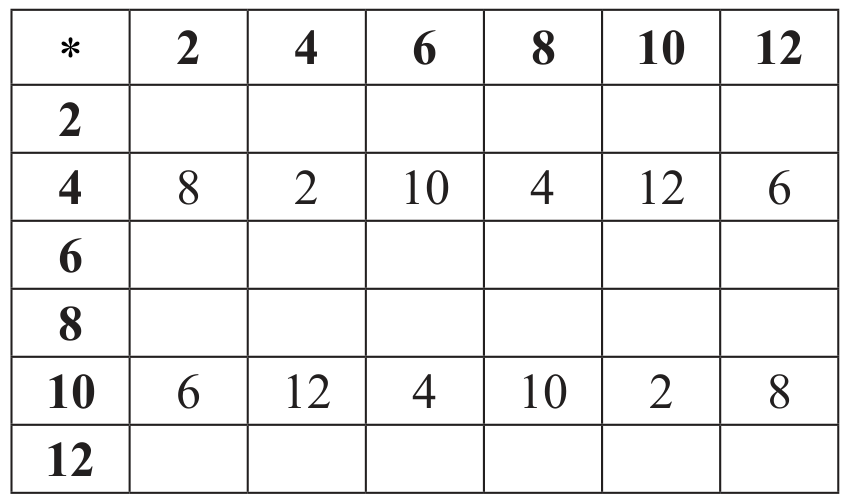
Table
[ 4 ]

Question 1(b)

Question 1(b)(i)

(b)
(i)

Show that {S,}\{S, *\} is a group.

Question 1(b)(ii)

(ii)

Find the order of each element of {S,}\{S, *\}.

Question 1(b)(iii)

(iii)

Hence show that {S,}\{S, *\} is cyclic and find all the generators.

[ 11 ]

Question 1(c)

(c)

The set T is defined by {xx:xS}\{x * x: x \in S\}. Show that {T,}\{T, *\} is a subgroup of {S,}\{S, *\}.

[ 3 ]

Question 1

[Maximum number: 4]

1.
One root of the equation x2+ax+b=0x^{2}+a x+b=0 is 2+3 i where a,bRa, b \in \mathbb{R}. Find the value of a and the value of b.

Question 1

[Maximum number: 5]

When the polynomial 3x3+ax+b3 x^{3}+a x+b is divided by ( x-2 ), the remainder is 2 , and when divided by ( x+1 ), it is 5 . Find the value of a and the value of b.

Question 1

Question 1(a)

(a)

If w=2+2 i, find the modulus and argument of w.

[ 2 ]

Question 1(b)

(b)

Given z=cos(5π6)+isin(5π6)z=\cos \left(\frac{5 \pi}{6}\right)+\mathrm{i} \sin \left(\frac{5 \pi}{6}\right), find in its simplest form w4z6w^{4} z^{6}.

[ 4 ]

Question 1

Question 1(a)

(a)

Use the Euclidean algorithm to find the greatest common divisor of the numbers 56 and 315.

[ 4 ]

Question 1(b)

Question 1(b)(i)

(b)
(i)

Find the general solution to the diophantine equation 56 x+315 y=21.

[ 9 ]

Question 1(b)(ii)

(ii)

Hence or otherwise find the smallest positive solution to the congruence 315x21315 x \equiv 21 (modulo 56).

[ 9 ]

Question 1

[Maximum number: 8]

In this question, you will be investigating the family of functions of the form f(x)=xnexf(x)=x^{n} \mathrm{e}^{-x}.
Consider the family of functions fn(x)=xnexf_{n}(x)=x^{n} \mathrm{e}^{-x}, where x0x \geq 0 and nZ+n \in \mathbb{Z}^{+}.
When n=1, the function f1(x)=xexf_{1}(x)=x \mathrm{e}^{-x}, where x0x \geq 0.

Question 1(f)

(a)

Use mathematical induction to prove your conjecture from part (e). You may assume that, for any value of m,limxxmex=0m, \lim _{x \rightarrow \infty} x^{m} \mathrm{e}^{-x}=0.

[ 8 ]

Question 1

Question 1(a)

(a)

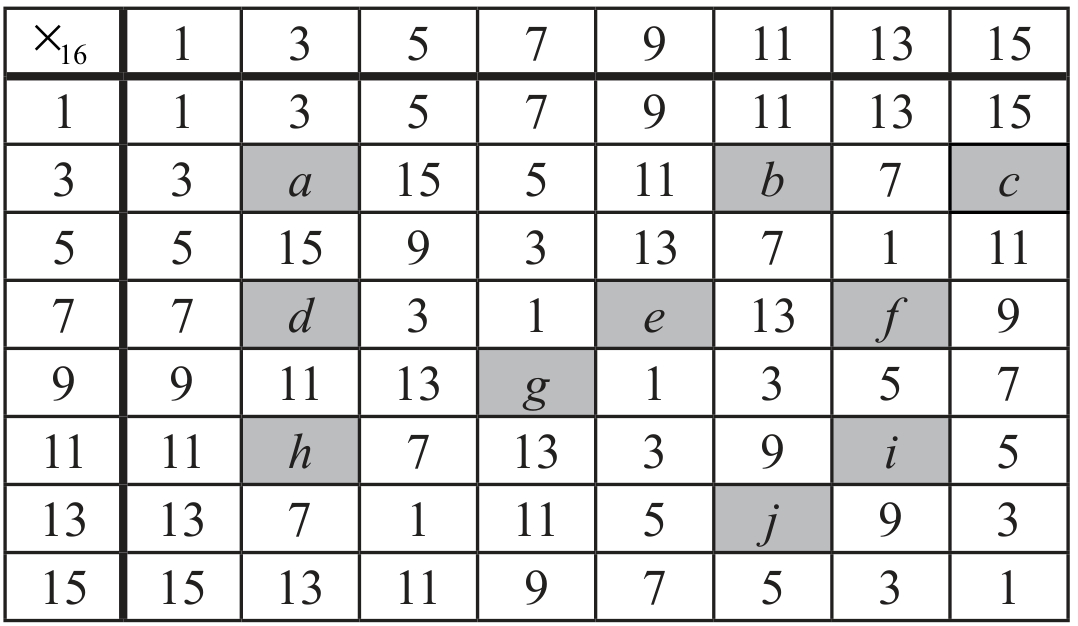
Consider the following Cayley table for the set G={1,3,5,7,9,11,13,15}G=\{1,3,5,7,9,11,13,15\} under the operation ×16\times_{16}, where ×16\times_{16} denotes multiplication modulo 16 .

Table
[ 7 ]

Question 1(a)(i)

(i)

Find the values of a, b, c, d, e, f, g, h, i and j.

Question 1(a)(ii)

(ii)

Given that ×16\times_{16} is associative, show that the set G, together with the operation ×16\times_{16}, forms a group.

[ 7 ]

Question 1(b)

(b)

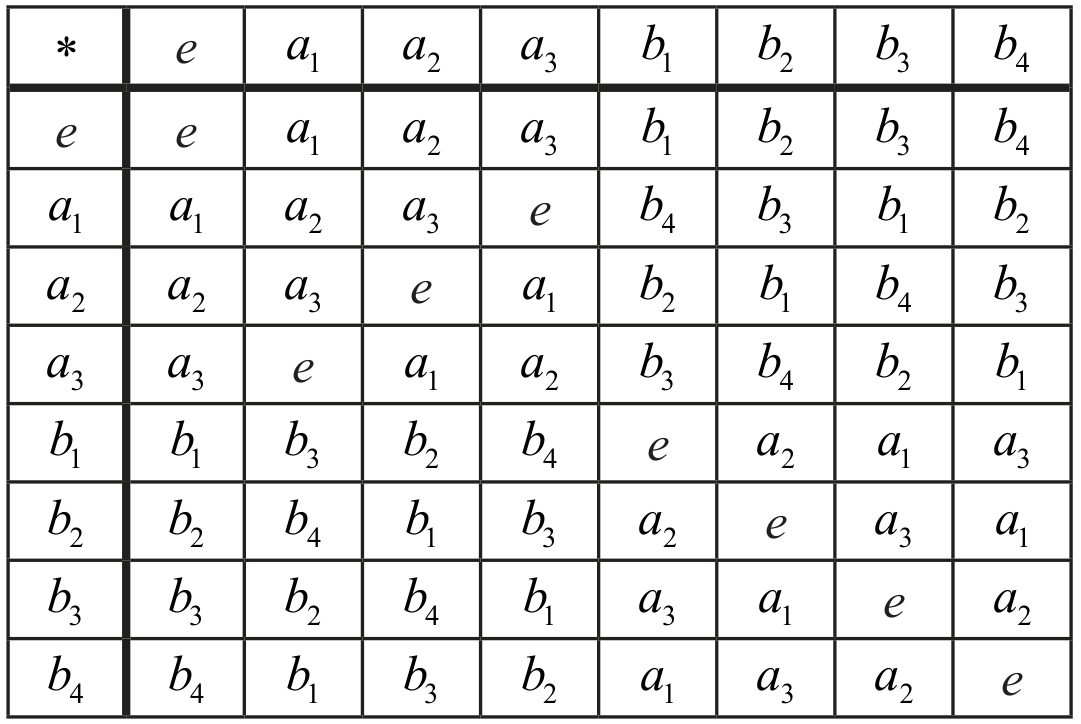
The Cayley table for the set H={e,a1,a2,a3,b1,b2,b3,b4}H=\left\{e, a_{1}, a_{2}, a_{3}, b_{1}, b_{2}, b_{3}, b_{4}\right\} under the operation *, is shown below.

Table
[ 8 ]

Question 1(b)(i)

(i)

Given that * is associative, show that H together with the operation * forms a group.

Question 1(b)(ii)

(ii)

Find two subgroups of order 4.

[ 8 ]

Question 1(c)

(c)

Show that {G,×16}\left\{G, \times_{16}\right\} and {H,}\{H, *\} are not isomorphic.

[ 2 ]

Question 1(d)

(d)

Show that {H,}\{H, *\} is not cyclic.

[ 3 ]

Question 1

[Maximum number: 6]

In this question you will investigate series of the form

i=1niq=1q+2q+3q++nq where n,qZ+\sum_{i=1}^{n} \boldsymbol{i}^{q}=1^{q}+2^{q}+3^{q}+\ldots+n^{q} \text { where } n, q \in \mathbb{Z}^{+}

and use various methods to find polynomials, in terms of n, for such series.
When q=1, the above series is arithmetic.

Question 1(d)

Question 1(d)(ii)

(a)
(i)

Prove by mathematical induction that fq(x)=i=1niqxi,qZ+f_{q}(x)=\sum_{i=1}^{n} i^{q} x^{i}, q \in \mathbb{Z}^{+}.

[ 6 ]

Question 1

Question 1(a)

Question 1(a)(i)

(a)
(i)

One version of Fermat's little theorem states that, under certain conditions,

ap11(modp)a^{p-1} \equiv 1(\bmod p)

Show that this result is not valid when a=4, p=9 and state which condition is not satisfied.

Question 1(a)(ii)

(ii)

Given that 564n(mod7)5^{64} \equiv n(\bmod 7), where 0n60 \leq n \leq 6, find the value of n.

[ 8 ]

Question 1(b)

(b)

Find the general solution to the simultaneous congruences

x3(mod4)3x2(mod5).\begin{aligned} x & \equiv 3(\bmod 4) \\ 3 x & \equiv 2(\bmod 5) . \end{aligned}
[ 6 ]

Question 1

[Maximum number: 19]

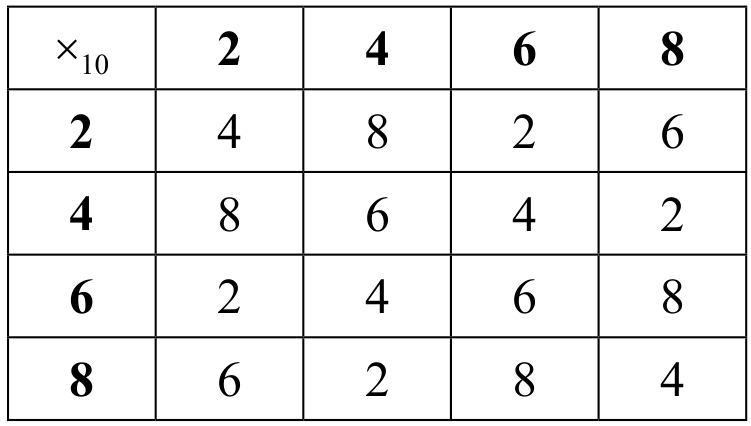
The binary operation multiplication modulo 10 , denoted by x10\mathrm{x}_{10}, is defined on the set T={2,4,6,8}T=\{2,4,6,8\} and represented in the following Cayley table.

Table

Question 1(a)

(a)

Show that {T,x10}\left\{T, x_{10}\right\} is a group. (You may assume associativity.)

[ 4 ]

Question 1(b)

(b)

By making reference to the Cayley table, explain why T is Abelian.

[ 1 ]

Question 1(c)

Question 1(c)(i)

(c)
(i)

Find the order of each element of {T,×10}\left\{T, \times_{10}\right\}.

[ 6 ]

Question 1(c)(ii)

(ii)

Hence show that {T,×10}\left\{T, \times_{10}\right\} is cyclic and write down all its generators.

The binary operation multiplication modulo 10 , denoted by x10x_{10}, is defined on the set V={1,3,5,7,9}V=\{1,3,5,7,9\}.

[ 6 ]

Question 1(d)

(d)

Show that {V,×10}\left\{V, \times_{10}\right\} is not a group.

[ 2 ]
0 selected