Question 3
Question 3(a)
(a)
Explain how poverty may have a negative impact on sustainability.
[ 10 ]
 EduNinja
Explain how poverty may have a negative impact on sustainability.
Read the extracts and answer the questions that follow.
Text D - Overview of Indonesia and palm oil production
(1) Indonesia is the largest economy in Southeast Asia and its gross domestic product (GDP) has grown strongly. The proportion of those living in absolute poverty in Indonesia decreased from 37.4 \% in 1999 to 2.7\% in 2019.
(2) The palm oil industry is a major contributor to the Indonesian economy, accounting for 4.5 % of GDP and providing employment for over three million Indonesians. Palm oil production is technologically simple and profit margins are large. As a low-cost producer, Indonesia produces over 50 % of the world's output. Palm oil is the most widely used vegetable oil in the global market. It is an ingredient in many products (including foods, cosmetics, cleaning products and biofuel) and demand continues to increase.
(3) In 2015, despite a widening budget deficit, the Indonesian government began subsidizing biodiesel (a type of renewable fuel) made from palm oil to make it more price competitive with conventional diesel. The subsidies were aimed at reducing Indonesia's dependence on fossil fuel imports and at increasing exports of high-value refined palm oil products.
(4) In Indonesia, 80\% of the palm oil produced is exported, contributing substantially to export revenue and to government tax revenue. However, palm oil prices are volatile, due to changes in supply, making planning difficult and causing fluctuations in the exchange rate. For example, studies show that, due to the low price elasticity of demand (PED) for primary commodities, an increase in the price of palm oil results in greater export revenue. Consequently, the rupiah (Indonesia's currency) may appreciate.
(5) In 2019, the European Union (EU) decided to impose an 18 % tariff on imports of palm oil based biodiesel from Indonesia, partly due to concerns that palm oil production damages the environment. The EU also claimed the tariff was necessary to offset the effects of the biodiesel subsidy.
Text E - Sustainable Development Goal (SDG) 12 and concerns about palm oil production in Indonesia
(1) In the past, the Indonesian government supported the rapid growth of palm oil production in order to increase GDP and employment. This policy often resulted in an inefficient use of land and high carbon emissions, as a result of deforestation.
(2) Sustainable Development Goal (SDG) 12 (responsible consumption and production) requires resources to be used more efficiently and sustainably through changes in production methods. Unsustainable use of Indonesia's natural resources will probably reduce long-term economic growth. Forests are necessary for food security, fuel, shelter and jobs. They also reduce the carbon in the atmosphere and protect against floods.
(3) Rates of deforestation in Indonesia have decreased recently. The World Bank's Forest Carbon Partnership Facility is providing US$110 million in aid to help reduce deforestation. Protecting forests from agricultural expansion will significantly reduce emissions. Profits will be lower, but the reputation of the palm oil industry will be improved and its long-term future made more secure.
(4) More than 50 multinational companies (MNCs) which use palm oil in their products have pledged to ensure that their suppliers do not contribute to deforestation. Pressure from the MNCs is encouraging Indonesian producers to use natural resources more sustainably.
Text F - Small-scale farmers and the Indonesian Sustainable Palm Oil (ISPO) certificate
(1) Small-scale farmers manage approximately 40 % of Indonesian plantations, but produce only 30 % of Indonesia's palm oil, because of poor farming techniques, low quality seeds, and a weak banking system, which limits their access to finance. In addition, land disputes occur due to a lack of property rights. To make up for their low productivity, farmers sometimes illegally clear more land for planting.
(2) The Indonesian Sustainable Palm Oil (ISPO) certification system requires that palm oil producers only occupy land legally, that they do not plant in areas designated as forest, and that they use sustainable agricultural practices. Initially, only large plantations had to get certification. However, the system was extended in 2020 and now small-scale farmers also have to obtain certification. Participating in the system should improve the productivity of small-scale farmers and reduce deforestation.
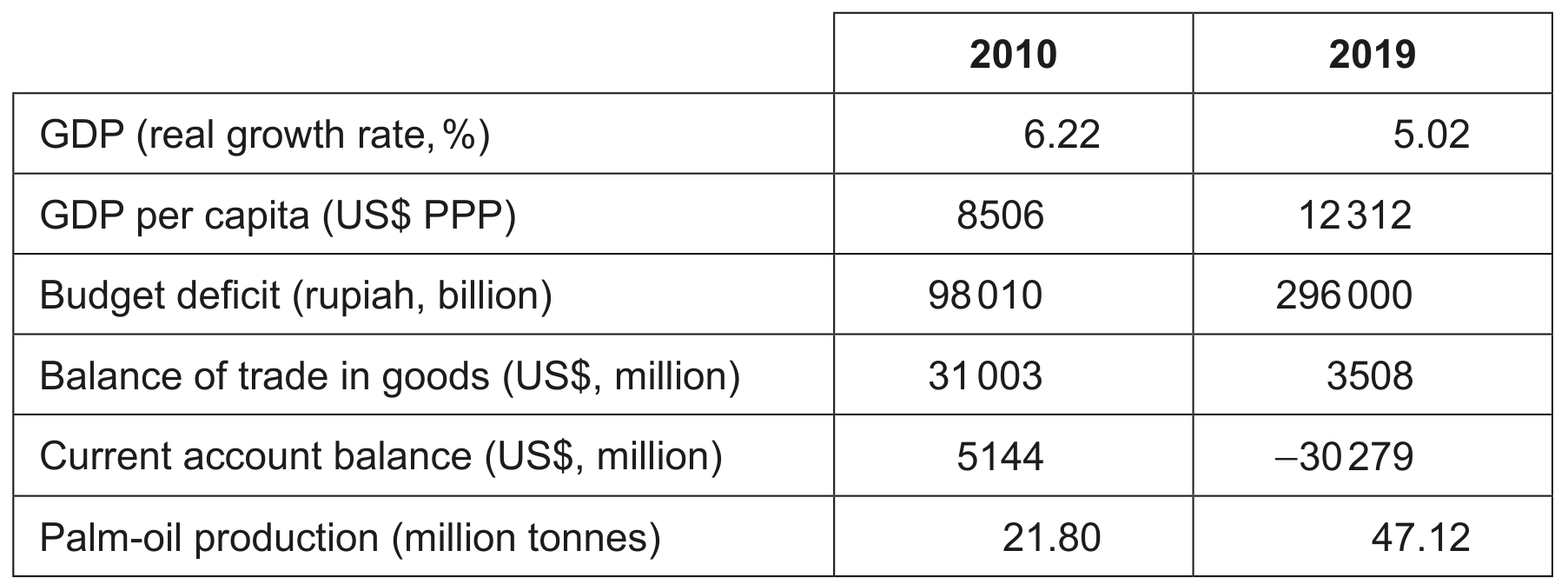
Table 3: Economic data for Indonesia
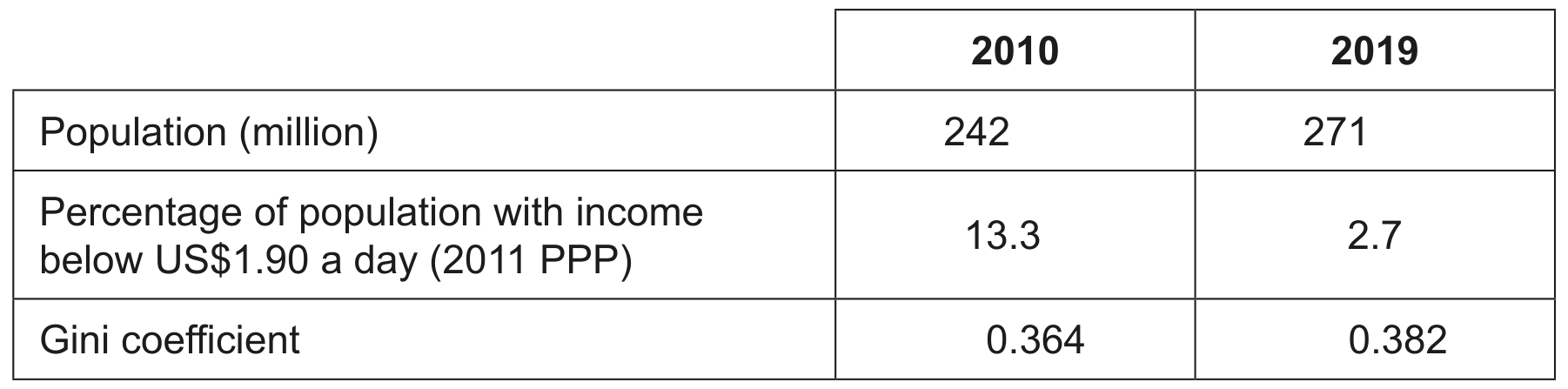
Table 4: Development data for Indonesia
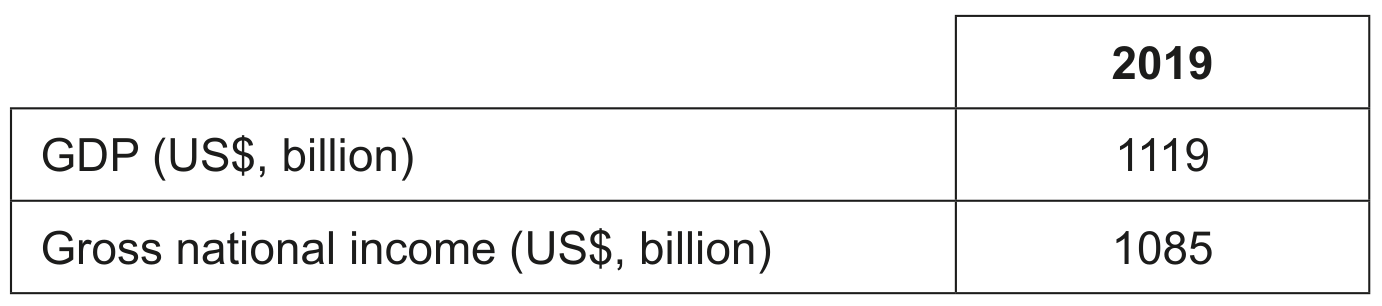
Table 5: National income statistics for Indonesia
Using information from the texts/data and your knowledge of economics, discuss whether there is a conflict between meeting Sustainable Development Goal 12 (responsible consumption and production) and the objective of economic growth in Indonesia.
Read the extracts and answer the questions that follow.
Text D - Overview of Malawi
(1) Malawi is a landlocked country in southern Africa. Its development plans contain 169 targets, based on the Sustainable Development Goals. Ineffective institutions and inequalities, however, make it difficult to reach every target. Although poverty in urban areas has declined, the level of absolute poverty has been increasing in rural areas where 85 % of the population lives. Causes of poverty include land degradation ( 80 % of the land is eroded or lacks nutrients), poor healthcare and rapid population growth. There is also a lack of human capital, which is often due to the difficulties that households have in obtaining loans for education or training. Approximately 75 % of households do not have access to formal banking services.
(2) Aid agencies are providing assistance. The World Bank's Human Capital Project will increase investment and encourage reforms, such as promoting the education of teenage girls. In 2020, the World Bank also approved US $ 157 million ( 50 % as a loan and 50 % as a grant) for a government project. This project aims to increase sustainable land management practices and build water-related infrastructure, such as small dams and irrigation schemes.
(3) The government has encouraged the establishment of microfinance groups that act as rural banks. They provide some finance and guidance for programmes that introduce new types of crops and techniques in order to improve agricultural efficiency.
(4) Although 2019 was a difficult year due to drought, insect infestations, and a tropical cyclone, Malawi's real gross domestic product (GDP) grew by 4.5 %. There is a large budget deficit and the amount of government debt (at approximately 60 % of GDP) is considered to be too high. Therefore, the government has announced plans to reduce its spending. Inflation had been forecast to increase to 14 % in 2020. Due to the planned contractionary fiscal policies, however, inflation may fall below 10\% from 2021 onwards.
(5) Export revenues account for over 30 % of GDP. Malawi aims to increase its exports of cotton, nuts, tea and sugar. Rising exports and lower fuel import prices could reduce the current account deficit. Despite the persistent trade deficit, Malawi is resisting calls for further trade protection. It has signed bilateral trade agreements with both South Africa and Zimbabwe. Tariffs are gradually being reduced, while other indirect and direct taxes are being raised.
Text E - Agricultural Production
(1) Approximately 80 % of the labour force is employed in agriculture, with few job opportunities available in manufacturing and services. Agricultural productivity is low for many reasons. The government promotes manufacturing industries and cultivation of crops for export by large-scale farms. However, small-scale and subsistence farmers have received little support in the past. Farmers use less fertilizer and irrigation than is typical in other countries. Only 3 % of cultivated land is irrigated, compared to the global average of 21 %. Other challenges are the inadequate road and rail links to markets and the limited availability of electricity and fuel.
(2) Maize is the most important staple food in Malawi. The government uses price controls when trying to ensure that maize is available at affordable prices for low-income households. However, the maximum price set by the government is often too low to persuade farmers to supply the maize or to provide them with sufficient revenue. In 2020 , the maximum price was raised from 250 to 310 kwacha per kilogram. Even at the higher price, shortages remain.
(3) The government is planning to invest in commercial agriculture to improve productivity and promote diversification. The 2020 budget includes subsidies on fertilizer for 4.3 million small-scale farmers, which could possibly double maize output but may also pollute waterways. The support given to farmers will improve the nutrition of Malawians and stimulate the rural economy.
Text F - Tobacco Exports
Tobacco is Malawi's major export, providing over 50 % of foreign currency earnings. Due to lower global demand and the purchasing policies of multinational tobacco firms, prices paid to farmers in Malawi are low and falling. To reduce costs, farmers resort to using child labour. Following allegations of labour exploitation, the United States has restricted tobacco imports from Malawi. There is concern that other importing countries might also impose restrictions.
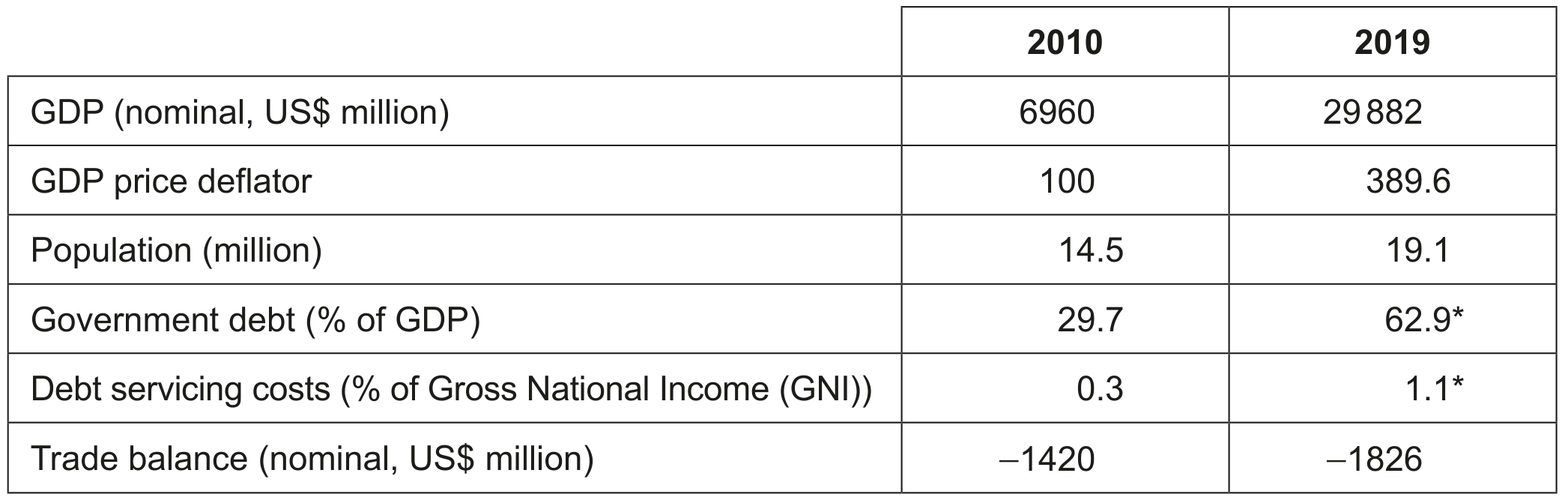
Table 3: Economic data for Malawi
* 2018 figure
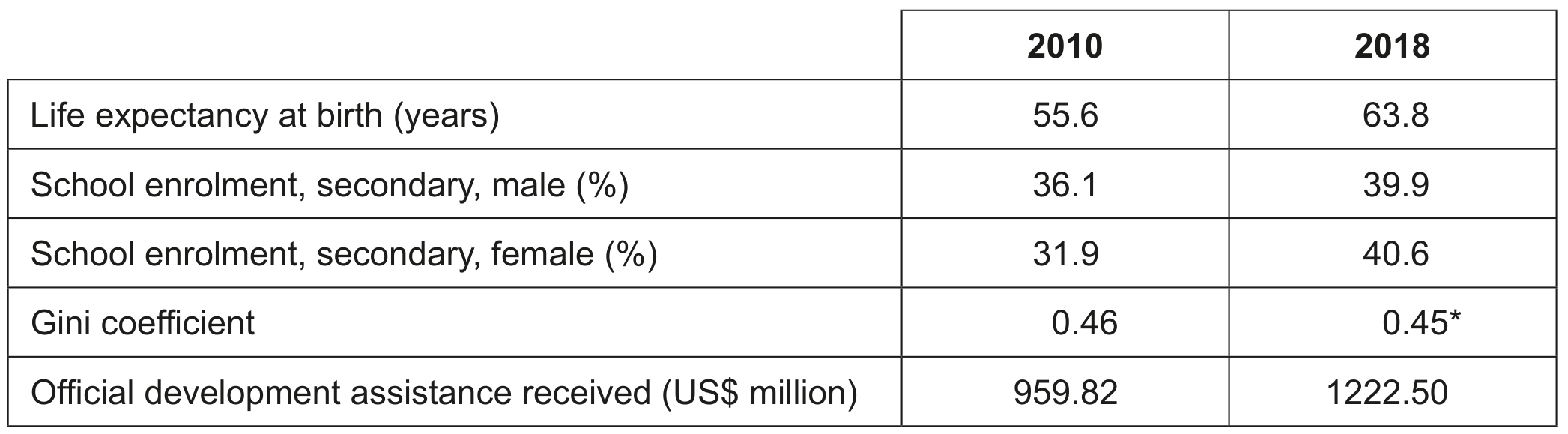
Table 4: Development data for Malawi
* 2016 figure
List two of the Sustainable Development Goals (Text D, paragraph 1).
Study the extract and data below and answer the questions that follow.
Removed for copyright reasons
Removed for copyright reasons
Figure 1 - Economic data for Botswana - 2011
Removed for copyright reasons
List two Millennium Development Goals other than universal primary education (paragraph 4).
Define the term sustainability indicated in bold in the text (paragraph 7).
Study the following extract and answer the questions that follow.
Removed for copyright reasons
Define the term sustainability indicated in bold in the text (paragraph (5).
Study the extracts and data below and answer the questions that follow.
Nigeria
(1) Nigeria is the largest country in Africa and accounts for 47 % of West Africa's population. It is also the biggest oil exporter in Africa. With these large reserves of human and natural resources, Nigeria is in a position to build a healthy economy, significantly reduce poverty, and provide health, education and infrastructure services to its population.
(2) Resources from saved oil-export revenues proved important to Nigeria during the global financial crisis of 2008-2009, and financed a fiscal stimulus that maintained strong growth in domestic demand and gross domestic product (GDP) throughout this period, but can also be associated with Nigeria's high inflation of 13.8 %.
(3) Despite Nigeria's strong economic performance, poverty is significant, and reducing it will require strong non-oil growth and a focus on human development. Challenges to growth and development have been identified, and include the investment climate; infrastructure; incentives and policies affecting agricultural productivity; and the quality of university education. Perhaps the greatest challenge is the core issue of governance. Despite some successful initiatives in human development, Nigeria may not be on track for meeting most of the Millennium Development Goals (MDGs).
Senegal
(4) Senegal is part of the West African Economic and Monetary Union, and its economy is dominated by a few strategic sectors, including groundnuts, fisheries and services. High rural poverty and limited access to rural infrastructure and basic services have encouraged migration to urban areas. The capital city, Dakar, accounts for one-quarter of the population of Senegal and over 60 % of the country's economic activity. The country's informal sector accounts for about 60 % of GDP.
(5) Senegal's economy has started to recover from the economic slowdown of the past few years, with real GDP growth of 4.25 % in 2010. All the main sectors, agriculture, construction, telecommunication, and transport, contributed positively to the GDP growth. Growth was expected to further improve to 4.5 % in 2011. However, this may not be achieved due to a crisis in the electricity sector, and weak performance in the services sector. Export volume declined somewhat in the first half of 2011, but this was more than compensated for by higher world prices for Senegal's main exports. Current transfers and tourism have grown in 2011. www.worldbank.org/terms.]
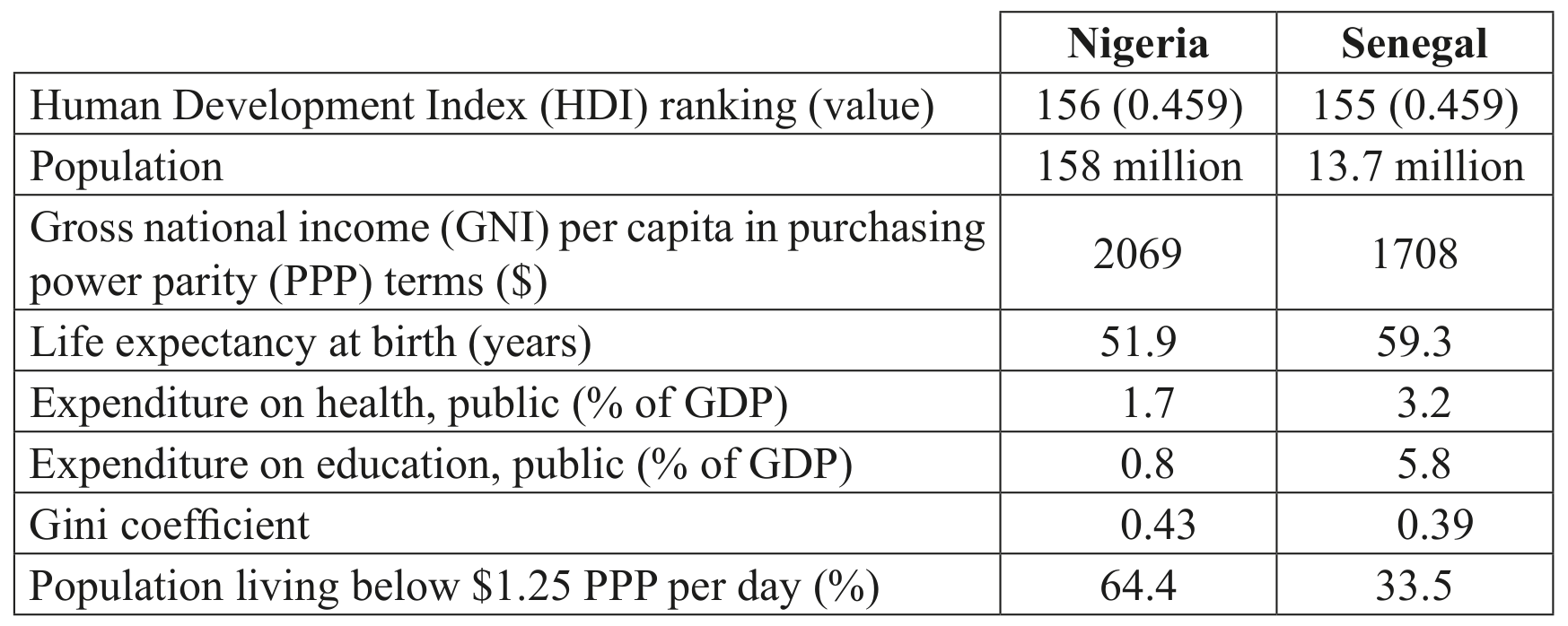
Figure 1: Economic data for Nigeria and Senegal - 2011
www.worldbank.org/terms.]
List two of the Millennium Development Goals (MDGs) (paragraph (3).