
EduNinja

IB Economics HL4.4 Economic integrationQuestion Bank

Question 1

[Maximum number: 14]

Study the following extract and data and answer the questions that follow.
South Sudan joins the East African Community

(1) The East African Community (EAC) is the most integrated trading bloc in Africa. In 2005, the members established a customs union, and then in 2010 it became a common market. There are ambitious plans to establish a monetary union by 2024.

(2) According to a recent report, the region is wealthier and more peaceful as a result of the increased integration. Economic models suggest that bilateral trade between member countries was 213 % higher in 2011 than it would have been without the integration. This is despite the fact that progress on fully eliminating trade barriers has been rather slow and there are still a large number of non-tariff barriers.

(3) Until recently the customs union was made up of Burundi, Kenya, Rwanda, Tanzania and Uganda. Very recently, South Sudan joined the bloc. This presents a tremendous opportunity for South Sudan, which was recently recognized as an independent country.

(4) South Sudan is one of many developing countries that are dependent on oil exports for the majority of its export revenues and oil prices have been falling due to increased supply of oil in the market. The deteriorating terms of trade have resulted in a worsening of the current account and lower government revenues. Regional economic integration might help South Sudan to diversify its economy.

(5) Agriculture is one potential area that South Sudan could focus on to diversify its economy. According to some estimates, 70 % of land is suitable for agriculture, but less than 4 % is currently being cultivated. The large flood plains in the country are suitable for rice production and the hope is that South Sudan can develop a comparative advantage in this essential food.

(6) South Sudan is landlocked and most of its road network is unpaved. This is just one example of its poor infrastructure. Since infrastructure is an expensive investment, regional cooperation will be vital for improving its road systems. Furthermore, effective transport links to sea ports in Kenya and Tanzania will allow for greater trade and therefore economies of scale.

(7) In the short term, there will be challenges for South Sudan associated with joining the common market. For example, before Rwanda joined the EAC in 2007, there were lower tariffs on many imported inputs. However, the cost of living for the poor population rose because of trade diversion that occurred after joining the EAC. South Sudan is likely to face the same problem.

(8) Labour costs in South Sudan are higher than those of other member countries and years of conflict have left the population with low levels of education and skills. This may present a barrier for South Sudan in attracting foreign direct investment, despite being part of the common market.
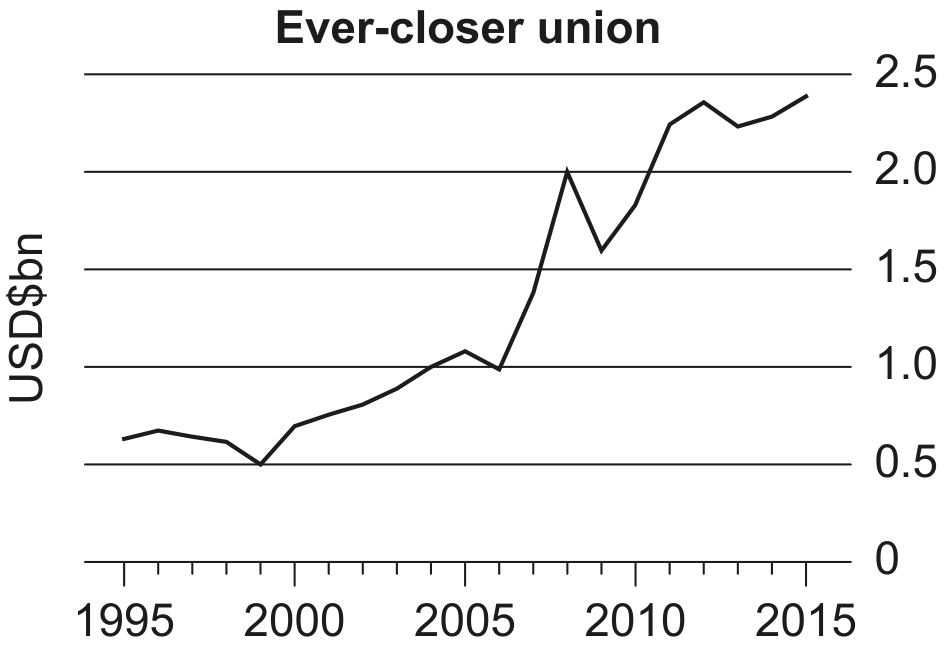
Figure 1: Intra-East African Community* trade in goods (USD\$bn)

Figure 1: Intra-East African Community* trade in goods (USD\$bn)

*Burundi, Kenya, Rwanda, Tanzania and Uganda.
Not including South Sudan, which acceded to the treaty in 2016. London (June 9, 2016); paragraphs 4-8 adapted from a paper/article written by Astrid R.N. Haas (and co-authors) with funding from the International Growth Centre.
Graph: IMF, www.eacgermany.org, accessed 3 May 2018]

Question 1(a)

Question 1(a)(i)

(a)
(i)

Define the term monetary union indicated in bold in the text (paragraph (1)).

[ 2 ]

Question 1(c)

(b)

Using a cost diagram, explain how membership in the common market may allow producers in South Sudan to gain economies of scale (paragraph 6).

[ 4 ]

Question 1(d)

(c)

Using information from the text/data and your knowledge of economics, evaluate the likely impact on South Sudan of its membership of the EAC common market.
[ 8 ]

Question 1

[Maximum number: 15]

Read the extracts and answer the questions that follow.
Text A - Overview of Mexico

(1) Mexico, with its abundant natural resources, is the second largest economy in Latin America. However, compared to other Latin American countries, Mexico has underperformed. Its annual economic growth rate averaged 2.5 % between 1994 and 2019. Per capita income rose more slowly, at an average rate of less than 1 % annually.

(2) Government expenditure has been rising, while taxation revenue has been stable or falling. Therefore, there is concern about the increasing government debt. If there is a recession, automatic stabilizers will increase the budget deficit, further raising the level of government debt. However, the International Monetary Fund (IMF) forecasts that government debt will stabilize in the mid-2020s, at around 65 % of gross domestic product (GDP).

(3) The oil sector makes an important contribution to Mexico's economy. Earnings from this sector were about 30 % of total government revenue in 2019. However, as countries increase their use of alternative energy sources, the long-term trend of falling oil prices will probably continue.
4

Paragraph removed for copyright reasons


(5) Since 1994, the exchange rate for the peso (Mexico's currency) has been floating. In March 2020, the rate changed from 18 pesos per United States (US) dollar to 25 pesos per US dollar. During 2020, the deficit on the balance of trade in goods continued to widen. However, by April 2021 the trade balance had changed to a surplus as exports of manufactured goods rose strongly. The deficit on the current account has also been narrowed by rising net remittances.
Text B - Free trade agreements

(1) The North American Free Trade Agreement (NAFTA) was a three-country accord negotiated by the governments of Canada, Mexico, and the United States that entered into force in January 1994. NAFTA eliminated most tariffs on products traded between the three countries, with a major focus on liberalizing trade in agriculture, textiles, and automobile manufacturing. The deal also sought to protect intellectual property, establish dispute resolution mechanisms, and through side agreements, implement labor and environmental safeguards. Trade among the NAFTA members tripled over the following 25 years, partly due to trade disputes between the US and China.

(2) Following the establishment of NAFTA, productivity increased in Mexico. US and Canadian firms viewed Mexico as a low-cost location for factories, which could improve their competitiveness. Therefore, foreign direct investment (FDI) into Mexico grew significantly throughout the 1990s and early 2000s. In the industrial north of Mexico, high-tech manufacturing factories were established and wages increased. However, the agricultural south did not benefit from the FDI. Agricultural exports from Mexico did increase, but Mexican farmers, especially corn producers, faced competition from subsidized US agriculture.

(3) The wage differential between the US and Mexico was predicted to decrease significantly, but a large wage gap remains. NAFTA's effect on employment has been mixed. Some workers became unemployed when their firms lost market share due to increased competition, while others gained from the creation of new market opportunities.

(4) In 2020, NAFTA was renegotiated as the US-Mexico-Canada Agreement, which kept elements of NAFTA, while adding provisions regarding digital trade and financial services. The requirement that a high proportion of the inputs used in exported goods must come from member countries may mean that the cheapest inputs cannot be used. There are also additional rules to protect the environment and support labour rights. For example, 40 % of the value of the components in each vehicle exported from Mexico must come from factories paying a wage of at least US$16 per hour. As a result, the incomes of Mexicans who find industrial employment are raised.
Text C - Access to banking and finance in rural areas

(1) The persistence of income inequality in Mexico is partly due to domestic factors, such as underdeveloped financial institutions and low productivity in the large informal sector. Improving access to banking and finance could significantly benefit low-income households and small firms.

(2) The Expanding Rural Finance Project aims to provide finance for women, young people, and small firms in rural areas where there are no commercial banks. Over 170000 loans (averaging US$1850 per loan) were provided from 2016 to 2020. Among the recipients, 76 % lived in rural areas and 81 % were women.

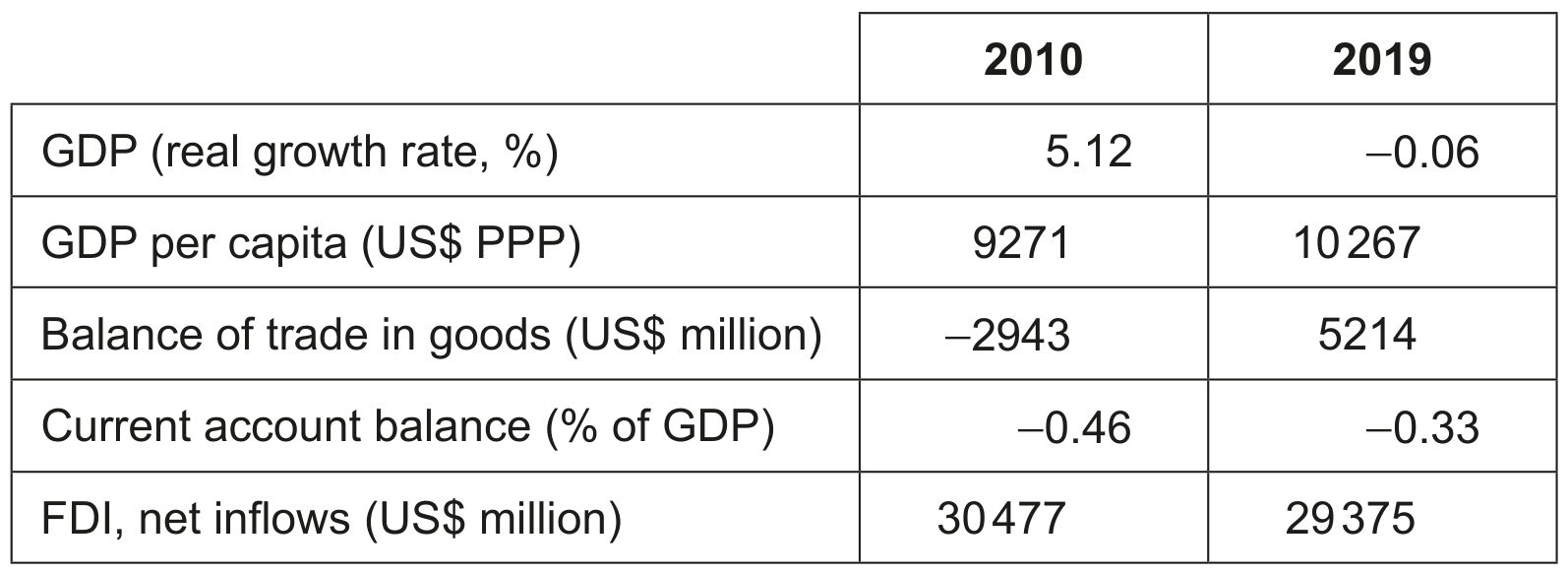
Table 1: Economic data for Mexico

Table 1: Economic data for Mexico

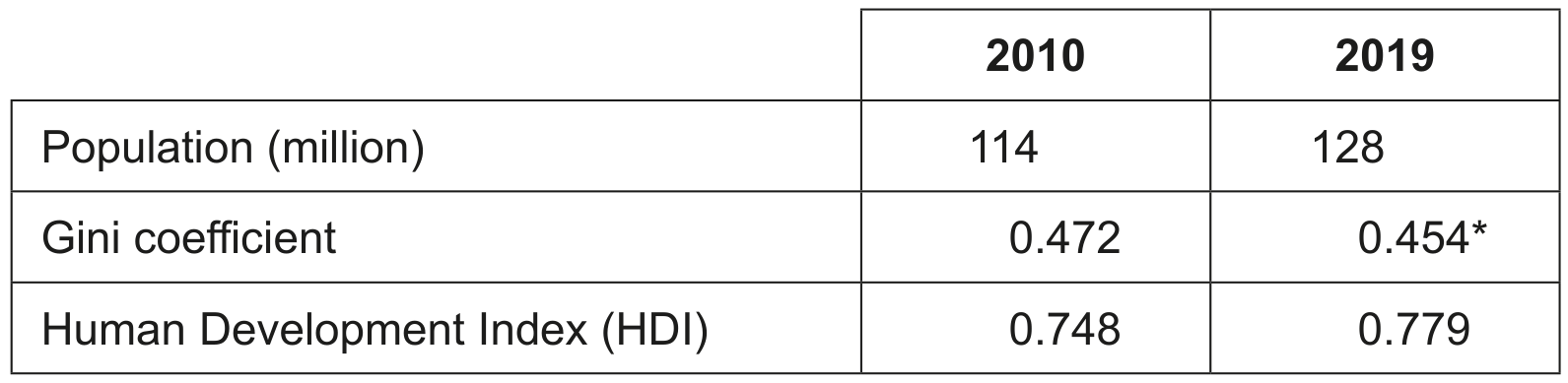
Table 2: Development data for Mexico

Table 2: Development data for Mexico

*estimate

Question 1(g)

(a)

Using information from the texts/data and your knowledge of economics, discuss the costs and benefits for Mexico of participation in the free trade agreement with the US and Canada.

[ 15 ]

Question 1

[Maximum number: 2]

Study the following extract and data and answer the questions that follow.
Filipino rice farmers prepare for trade liberalization

(1) To meet its obligations under World Trade Organization (WTO) rules, the president of the Philippines has asked the government to eliminate the current quota system for rice imports. As an important part of food security measures, the government wants to achieve self-sufficiency in the production of rice. To support this goal, the WTO allowed the Philippines to extend its rice quota until June 2017 to allow more time for local farmers to prepare for free trade.

(2) The current quota system for rice imports makes domestic prices rise dramatically during periods of low domestic supply.

(3) Eliminating the quota on rice aims to make the rice market more competitive, which could reduce the price of rice by as much as 7 Philippine pesos (PHP)\left(\mathrm{PH}^{\mathrm{P}}\right) per kilogram (kg). The National Economic and Development Authority has estimated that lower rice prices could save Filipino households as much as PH 2362 per year. However, if the rice quota is eliminated, economists have warned that the government must prepare local rice producers so that they can either compete with rice imports or move to producing other crops. "Currently Filipino farmers cannot compete with Vietnamese farmers who may enjoy economies of scale" declared one economist. "The solution is to bring down the cost of production of rice."

(4) To help Filipino farmers to adjust to competition from lower-priced rice imports, the government has allocated funds to the Rice Competitiveness Enhancement Fund. This fund will provide support to farmers in order to increase productivity by supplying high-yield seeds and fertilizer. It will also provide subsidies to encourage the use of agricultural machinery and will offer support services and training to farmers.

(5) Apart from being an essential food for many Filipinos, rice is also an important input for the food industry. The plan to remove the import quota will reduce the inflation rate in the Philippines by up to 0.4 %. In July 2018, the central bank governor reported that inflation had reached 5.7 %, well above the government's target range of 2 % to 4 %. He stated that "supply-side factors are the main drivers of the present inflation. These factors include rising international oil prices, higher indirect taxes and poor weather conditions that have affected food supply". The president stated that the removal of the rice quota was one solution to ease the rising inflation.

Table 1: Average economic costs and prices of rice in the Philippines and Vietnam

Table 1: Average economic costs and prices of rice in the Philippines and Vietnam

Question 1(a)

Question 1(a)(i)

(a)
(i)

State two functions of the World Trade Organization (WTO) (paragraph (1)).

[ 2 ]

Question 4

[Maximum number: 10]

With the aid of a diagram, explain the potential trade gains and trade losses arising from the formation of a customs union.

Question 5

[Maximum number: 10]

Explain possible disadvantages that may be associated with the adoption of a single currency.

Question 3

Question 3(a)

(a)

Explain how a free trade area is different from a common market.

[ 10 ]

Question 3(b)

(b)

Using real-world examples, evaluate the decision of a country to remain a member of a trading bloc.

[ 15 ]

Question 3

Question 3(b)

(a)

Using real-world examples, discuss whether a country would benefit from joining other countries in a monetary union.

[ 15 ]

Question 2

[Maximum number: 14]

Study the extract below and answer the questions that follow.
India-Malaysia trade agreement to double trade by 2015

(1) An India-Malaysia trade agreement is expected to almost double trade between the two countries by 2015, allowing the two nations to reduce dependence on traditional trade partners such as China and the United States. The preferential trade agreement will be signed by 31 January 2011 and come into force six months later. The agreement is predicted to increase the level of trade to US $ 15 billion by 2015.

(2) The deal will further strengthen trade ties between India and Malaysia. Malaysia is India's 19th 19^{\text {th }} largest trading partner, with bilateral trade totaling US $ 6.5 billion between January and August 2010 after growing at an average of 14.9 % between 2004 and 2009. The deal will support a trade pact that came into effect in January 2010 between India and the 10 -member Association of Southeast Asian Nations (ASEAN)*, which became a free trade area in 2003. However, this agreement between India and Malaysia will be more extensive, covering services, investments, trade protection and other areas.

(3) Malaysia exports electrical and electronic products, crude petroleum, palm oil and chemical goods to India, its main export destination in South Asia. However, some tariffs have been imposed by India on these products. India, meanwhile, has invested US $ 1.11 billion in nearly 100 manufacturing projects in Malaysia. Malaysia and India will also bolster defence cooperation through frequent talks between their defence ministers, senior officials and chiefs of the armed services, according to a joint statement. prohibited without the prior written consent of Thomson Reuters. Thomson Reuters and its logo are registered trademarks or trademarks of the Thomson Reuters group of companies around the world. © 2010 Thomson Reuters. Thomson Reuters journalists are subject to an Editorial Handbook, which requires fair presentation and disclosure of relevant interests.]
}
* ASEAN: is a free trade area comprising Brunei Darussalan, Cambodia, Indonesia, Laos, Malaysia, Myanmar, Philippines, Singapore, Thailand and Vietnam.

Question 2(a)

Question 2(a)(i)

(a)
(i)

Define the term preferential trade agreement indicated in bold in the text (paragraph (1)).

[ 2 ]

Question 2(c)

(b)

Distinguish between a free trade area (such as ASEAN), a customs union and a common market.

[ 4 ]

Question 2(d)

(c)

Using information from the text/data and your knowledge of economics, evaluate the possible effects of this agreement on trade between India and Malaysia.

Answer one question from this section.

[ 8 ]

Question 2

[Maximum number: 10]

Study the following extract and answer the questions that follow.
Free Trade Agreement between the European Union and Indonesia

(1) The European Union (EU) and Indonesia are currently negotiating a free trade agreement (FTA). The agreement will aim to increase trade, avoid trade protection and expand foreign direct investment (FDI). Indonesia has the largest economy and population in Southeast Asia. The EU is Indonesia's third-largest trading partner.

(2) The FTA could see the clothing and footwear industry in Indonesia increase by over 10 %. However, the labour-intensive manufacturing industry has historically been known for poor working conditions and low wages. On the other hand, increased output could decrease the high unemployment in Indonesia (currently at 12 % ). The EU expects its car industry to benefit from the FTA. The agreement would encourage the EU to specialize in cars, and Indonesia to specialize in clothing, therefore both countries could benefit from comparative advantage.

(3) Since Indonesia's main competitors already have trade agreements with the EU, establishing an FTA is a priority for the Indonesian government. The EU has a potential market of 510 million consumers, and may offer areas for growth during a time of lower global trade and uncertainty due to the trade war between the United States and China.

(4) However, recent trade issues between the EU and Indonesia have slowed down negotiations. The EU announced that palm oil biodiesel is unsustainable and will phase these fuels out by 2030. Experts say that palm oil causes excessive deforestation and contributes to climate change. Indonesia is the world's largest exporter of palm oil.

(5) The EU has imposed tariffs on biodiesel exports from Indonesia, which may result in Indonesia losing a market worth over US$450 million. Palm oil represents 12\% of Indonesia's total exports, contributes approximately 2.6 % to gross domestic product (GDP), and the industry employs more than 15 million people. The EU is Indonesia's largest palm oil customer. Additionally, some EU manufacturing businesses are unhappy with the tariffs as they rely on palm oil to produce their products, such as processed foods.

(6) In response, Indonesia filed a lawsuit with the World Trade Organization (WTO), stating that the EU's policy on biodiesel is unfair and is damaging the international image of palm oil. Indonesia claims it is committed to sustainable production practices and to protecting its forests.

(7) To make up for losing the EU's market, Indonesia is actively exploring other markets to boost its exports of palm oil. Other countries like China, India and Russia have a more relaxed policy on palm oil and have growing demand for it. Indonesia has also retaliated to the tariff through an investigation into whether EU dairy products exported to Indonesia benefited from subsidies, and has recommended a 20 %-25 % tariff on EU dairy products.

(8) However, the EU has tried to lower tensions by offering a US$17 million grant to improve trade conditions and capacity in preparation for the FTA. Experts have said that the FTA could support the development of legal and sustainable palm oil production through supporting good governance and capacity building. Indonesia has stated it would welcome help to decrease any market failure caused by palm oil.

Question 2(a)

Question 2(a)(ii)

(a)
(i)

State two functions of the World Trade Organization (WTO) (paragraph 6).

[ 2 ]

Question 2(d)

(b)

Using information from the text/data and your knowledge of economics, discuss the economic effects on Indonesia of establishing a free trade agreement with the EU.

[ 8 ]

Question 2

[Maximum number: 2]

Study the following extract and answer the questions that follow.
The Comprehensive and Progressive Agreement for Trans-Pacific Partnership (CPTPP), Australia and Japan

(1) In 2018, Australia signed the Comprehensive and Progressive Agreement for Trans-Pacific Partnership (CPTPP)*. The agreement creates the third largest free trade area in the world, covers nearly 500 million people and is worth more than US $ 12 trillion. The members of the agreement have stated that economic integration and free trade is important to help foster good political relations and inclusive growth for all nations.

(2) The trade agreement will aim to gradually eliminate most trade protection within the member countries. The agreement will see tariffs eliminated for Australian cheese and beef exports to Japan, and increased quotas for the export of rice to Japan from 4400 to 8400 tonnes. Nikkei Asian Review reported that "Fast-food restaurants in particular are embracing the import as a way to cut costs to cope with rising wages." Additionally, Japanese food manufacturers will be able to lower production costs for rice-based meals and benefit from increased stability of input prices. The benefits from the agreement for Japan's economy are projected to exceed US$70 billion, but some industries would be negatively affected.

(3) Japanese farmers are worried about the increase in imported food from Australia. Furthermore, the Japanese government is concerned about the effects of the CPTPP on Japan's food self-sufficiency-Japan relies on other countries for over 60 % of its food. In response to these concerns the Japanese government has offered support for domestic farmers to diversify production into other crops. The government also plans to subsidize the rice farmers through the initial phase of lowering trade barriers.

(4) The agreement is said to be worth more than US $ 37 billion to Australian agricultural exports. It is hoped that CPTPP and the falling value of the Australian dollar will help Australia to reduce its current account deficit, but some economists have argued that this can take a long time. According to some estimations, the short-run price elasticity of demand (PED) for Australian exports is 0.2 and the short-run PED for imports in Australia is 0.4 . However, the long-run PED for Australian exports is 1.1 and the long-run PED for imports in Australia is 1.3.

(5) There have also been concerns about the CPTPP from trade unions in Australia. They argue that it deregulates the labour markets and gives corporations from other countries an ability to take legal action against governments for implementing laws that raise wages or protect the environment, if the foreign corporation can prove that the law hurt their commercial interests. One university lecturer said that the future costs to the taxpayer could be significant if foreign companies take the Australian government to court.

(6) The trade agreement would allow workers from other countries to work in Australia without employers being required to check if Australian citizens are available to fill the jobs before the migrant workers are employed. It is estimated this may risk 39000 jobs in Australia. Furthermore, environmental activists have expressed concerns that the negative environmental and social effects of the agreement have not been well considered. This may lead to conflicts with Australia's commitment to the United Nations' Sustainable Development Goals.
* The CPTPP includes eleven member countries: Australia, Brunei, Canada, Chile, Japan, Malaysia, Mexico, New Zealand, Peru, Singapore and Vietnam.

Question 2(a)

Question 2(a)(i)

(a)
(i)

Define the term free trade area indicated in bold in the text (paragraph 1).

[ 2 ]
0 selected
