
EduNinja

IB Economics HL4.2 Types of trade protectionQuestion Bank

Question 1

[Maximum number: 4]

Read the extracts and answer the questions that follow.
Text A - Overview of Tanzania

(1) Tanzania is one of Africa's fastest growing economies with an average of 7 % annual economic growth since 2000. It is a politically stable country, rich in wildlife and natural resources. However, the growth has been concentrated in urban manufacturing, using capital intensive production. The benefits from this growth have not reached all people and significant inequalities exist between urban and rural areas. Although the relative poverty rate has fallen over the last 15 years, the number of people living in absolute poverty has increased.

(2) Most people are employed in the slow-growing agricultural sector that relies on unskilled labour. Although incomes increased from 2008 to 2018, the demand for agricultural goods only increased by 21 % during this time period. Over 70 % of Tanzania's population lives in rural areas, relying on subsistence farming with limited tradable crops. Only 30 % of land is being used for agricultural production. With investment, the remaining unused land could be developed and generate income for farmers.

(3) The rural sector struggles to meet Tanzania's food requirements due to low levels of skilled labour and productivity. Additionally, high youth unemployment leads to large numbers of unskilled rural youth migrating to the cities, often finding employment in the informal sector where wages and working conditions are poor. Insufficient investment and lack of government support for diversifying the agriculture sector have been blamed for the persistent inequalities and poverty.

(4) Tanzania's cities have experienced a growing middle class with strong purchasing power and political influence who have placed demands on the government for cheaper electricity, better infrastructure, and more imported goods. In response, the government provided subsidies for electricity in city centres and tax benefits to foreign companies operating in Tanzania. There is concern that these measures may worsen inequality and lead to social unrest.

(5) The growth of Tanzania's manufacturing and service sector was funded through aid and large government borrowing, resulting in high national debt. Most of the government borrowing was from foreign sources and in US dollars (US$), which is a concern due to a recent depreciation of the Tanzanian shilling (Tanzania's currency) against the US$. Some of the debt was borrowed domestically and placed upward pressure on interest rates. Higher interest rates have resulted in crowding out but helped keep inflation under control.
Text B - Strategies and opportunities for Tanzania

(1) Previous governments have used interventionist supply-side policies to improve access to water, education, and health services. However, the health service improvements are not keeping up with population growth and many young people are still not completing secondary school. Infrastructure has improved, but it is still insufficient as producers in the rural sector find it difficult to reach markets and access supplies.

(2) Aid organizations are currently supporting new sustainable businesses in rural areas through training programmes, especially for women and young people, who make up most of the unemployed in rural areas. Economists have advised the government to improve access to credit through microfinance organizations and to simplify regulations to make it easier to start new businesses.

(3) The government is establishing property rights in rural areas to provide security for farmers. Historically, farmers could easily lose their land, which reduced their incentive to invest in productive farming methods. The government wants to develop Tanzania's land resources and lower its reliance on imported food. To reduce food imports, a subsidy will be granted to dairy farmers to allow them to compete against imported dairy products.

(4) Tanzania is a member of the East African Community (EAC) customs union and common market. However, Tanzania needs to improve human capital and encourage diversification so that the benefits of regional integration can reach the poor. These policies can also help attract foreign direct investment (FDI). Opportunities for growth through trade will expand as the EAC works towards becoming a monetary union in 2024.
Text C - Oil pipeline to be constructed
Tanzania and Uganda plan to construct a major oil pipeline from Uganda through Tanzania, ending at a port in Tanzania. This will attract FDI which could help fund infrastructure and generate jobs. However, environmentalists are concerned about potential ecological damage due to the waste created during the construction of the pipeline. Economists have suggested the waste could be avoided through a circular economy approach in the planning and construction stage.
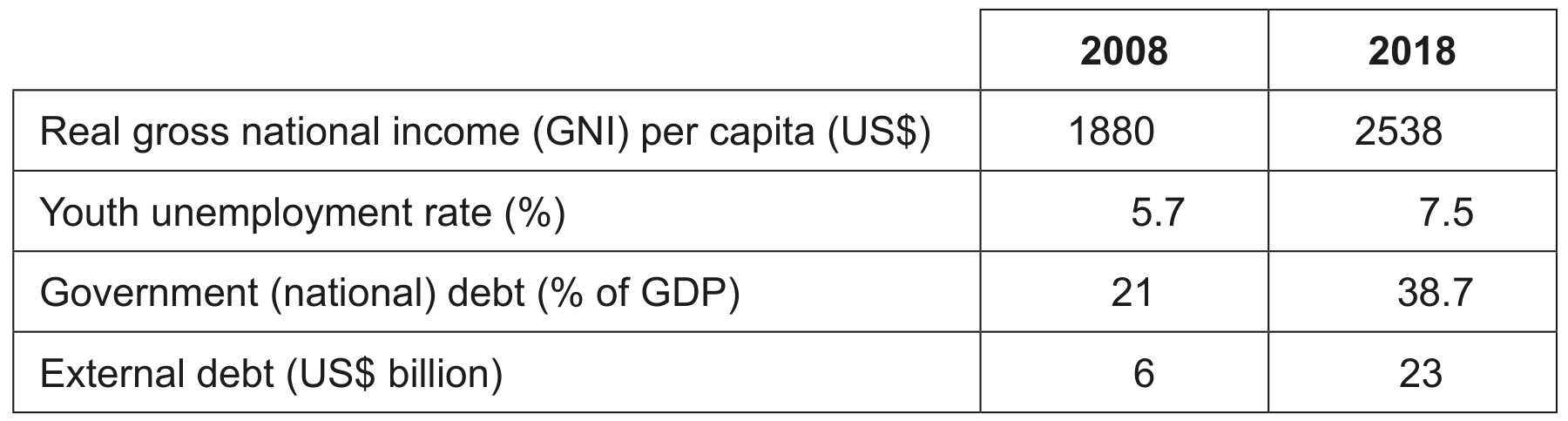
Table 1: Economic data for Tanzania
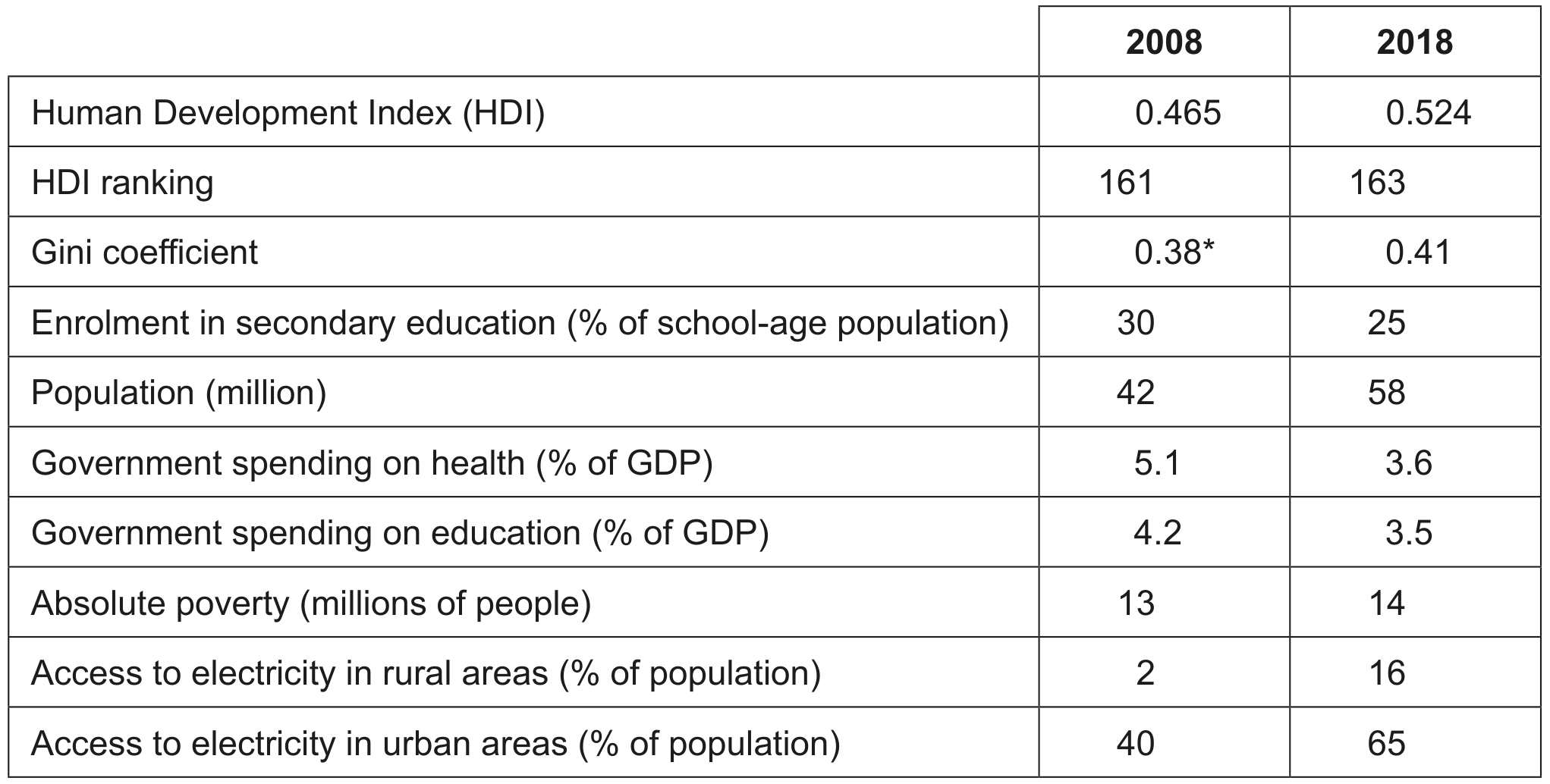
Table 1: Economic data for Tanzania

Table 2: Development data for Tanzania

Table 2: Development data for Tanzania

* Estimate

Question 1(d)

(a)

Using an international trade diagram, explain how a subsidy could help Tanzanian dairy farmers compete against imported dairy products (Text B, paragraph 3 ).

[ 4 ]

Question 1

Question 1(a)

Question 1(a)(vii)

(a)
(i)

Using Figure 3, calculate the change in total expenditures on soybeans after the 4 % tariff was imposed by the Egyptian government.

The following information relates to Egypt's economy:
- Net current transfers for Egypt have increased by more than 25 % since 2019 and reached US $ 31449.2 million. A large proportion of these current transfers are migrants' remittances.
- In 2019, according to the World Inequality Database (WID), the top 1 % of Egyptians with the highest incomes received 19 % of the total national income, while the bottom 50 % of Egyptians with the lowest incomes received only 17.2 %.

[ 3 ]

Question 1

[Maximum number: 6]

Study the extract below and answer the questions that follow.
Relief as Kenya raises tariff for steel and iron imports

(1) Steel manufacturers in Kenya are set to benefit as the government moves to protect the local manufacturing industry from cheap steel and iron imports.

(2) In 2014 a government official announced an increased tariff on steel and iron imports. "Our steel mills are closing down due to unfair competition from cheaper imported iron and steel products," he explained. "To protect and create more jobs in the iron and steel industries, tariffs on a wide range of imported iron and steel products will be increased from 0 % and 10 % to 25 %," he said. The government official further stated that as well as protecting the local industries from cheaper imports, the protectionist measures would raise an additional 2.6 billion Kenyan shillings (Kenya's currency) annually in government revenue and support economic growth.

(3) The potential of local industries to expand and create jobs through trade has been held back by a number of administrative barriers. The government remains focused on improving the business environment. Over the past six months, the government has made it easier to register a company and trade across borders. The time taken to move goods out of the main harbour has fallen sharply; non-tariff barriers such as roadblocks have also been reduced. Importers of refined industrial sugar and wheat are also pleased after the government scrapped requirements to pay unnecessary administrative charges.

(4) However, there is a belief among manufacturers that there is a need for more deregulation to lower their costs of production and in effect reduce the cost of doing business.
Kenya sees gross domestic product (GDP) growth picking up but current account a concern

(5) Good economic growth rates in neighbouring countries like Uganda help to boost Kenyan exports, particularly for agriculture that makes up nearly a quarter of the Kenyan economy. The government suggests that the main risks to growth are the slow performance of developed economies that are key export markets for Kenyan goods and services, and Kenya's large and persistent current account deficit of over 10 % of gross domestic product (GDP) in the last three years. This is a major concern for sustained economic growth and the value of the Kenyan shilling.
[Sources: adapted from www.standardmedia.co.ke, 13 June 2014; www.af.reuters.com, 25 July 2014 and www.cnbcafrica.com, 25 November 2013]

Question 1(a)

Question 1(a)(i)

(a)
(i)

Define the term tariff indicated in bold in the text (paragraph 2).

[ 2 ]

Question 1(b)

(b)

Using an international trade diagram, explain the impact on the Kenyan government of implementing a tariff on steel imports.

[ 4 ]

Question 1

[Maximum number: 8]

Study the following extract and data and answer the questions that follow.
Filipino rice farmers prepare for trade liberalization

(1) To meet its obligations under World Trade Organization (WTO) rules, the president of the Philippines has asked the government to eliminate the current quota system for rice imports. As an important part of food security measures, the government wants to achieve self-sufficiency in the production of rice. To support this goal, the WTO allowed the Philippines to extend its rice quota until June 2017 to allow more time for local farmers to prepare for free trade.

(2) The current quota system for rice imports makes domestic prices rise dramatically during periods of low domestic supply.

(3) Eliminating the quota on rice aims to make the rice market more competitive, which could reduce the price of rice by as much as 7 Philippine pesos (PHP)\left(\mathrm{PH}^{\mathrm{P}}\right) per kilogram (kg). The National Economic and Development Authority has estimated that lower rice prices could save Filipino households as much as PH 2362 per year. However, if the rice quota is eliminated, economists have warned that the government must prepare local rice producers so that they can either compete with rice imports or move to producing other crops. "Currently Filipino farmers cannot compete with Vietnamese farmers who may enjoy economies of scale" declared one economist. "The solution is to bring down the cost of production of rice."

(4) To help Filipino farmers to adjust to competition from lower-priced rice imports, the government has allocated funds to the Rice Competitiveness Enhancement Fund. This fund will provide support to farmers in order to increase productivity by supplying high-yield seeds and fertilizer. It will also provide subsidies to encourage the use of agricultural machinery and will offer support services and training to farmers.

(5) Apart from being an essential food for many Filipinos, rice is also an important input for the food industry. The plan to remove the import quota will reduce the inflation rate in the Philippines by up to 0.4 %. In July 2018, the central bank governor reported that inflation had reached 5.7 %, well above the government's target range of 2 % to 4 %. He stated that "supply-side factors are the main drivers of the present inflation. These factors include rising international oil prices, higher indirect taxes and poor weather conditions that have affected food supply". The president stated that the removal of the rice quota was one solution to ease the rising inflation.

Table 1: Average economic costs and prices of rice in the Philippines and Vietnam

Table 1: Average economic costs and prices of rice in the Philippines and Vietnam

Question 1(d)

(a)

Using information from the text/data and your knowledge of economics, evaluate the impact on the economy in the Philippines of removing the rice quota.

[ 8 ]

Question 1

[Maximum number: 12]

Study the following extract and answer the questions that follow.
Canadian drywall tariffs will continue

(1) Recently imposed Canadian tariffs on drywall imports have pushed up the cost of building a new home by thousands of Canadian dollars (CA$) in the last four months. Drywall is a pre-made wall section that is used in the construction industry for building houses. Doubt as to whether the tariffs will remain is causing uncertainty for building firms, drywall manufacturers and homeowners.

(2) For now, higher prices will continue following a ruling by the Canadian International Trade Tribunal (CITT) this week. The tribunal found that United States (US) firms had been dumping drywall products into Western Canada over the past few years, harming the Canadian drywall industry.

(3) The ruling will end preliminary tariffs of up to 276 % imposed by Canada on imports of drywall from the US. However, they will be replaced by permanent, variable tariffs that would be imposed on imported drywall products whose prices fall below the minimum prices determined by the CITT.

(4) "The preliminary tariff was very damaging to homebuilding," said a building industry spokesperson. "Not just homebuilding, but hospitals, commercial buildings, indeed any new construction," he said. "It's a cost that someone had to pay for. It lowered the profits of house builders." It has been estimated that the immediate sharp increase in variable costs, following the imposition of the preliminary tariff, resulted in an extra CA$3000 to CA$5000 on the cost of building some homes.

(5) The preliminary tariffs were imposed after a dumping complaint by CertainTeed Gypsum Canada (CTGC), the last drywall manufacturer in Western Canada. CTGC has three major production sites and two gypsum quarries. Gypsum is a main component of drywall.

(6) A CTGC spokesperson had said previously that its plants and quarries could be closed, at the cost of 200 jobs, if the dumping of US drywall products continued. However, since the preliminary tariffs were imposed, the firm has announced that it has hired 30 new employees.

(7) In a separate report, the CITT found that the preliminary tariffs had been "substantially reducing competition" in Western Canada, to the detriment of Canada's homebuilders. In response, supporters of the tariff have suggested that revenue from the tariffs may be used to help areas that lost large numbers of homes and other structures in devastating forest fires.

Question 1(b)

(a)

Using a tariff diagram, explain the effect of the "preliminary tariffs" on Canadian consumers of drywall (paragraph (3).

[ 4 ]

Question 1(d)

(b)

Using information from the text/data and your knowledge of economics, evaluate the effect of the tariff on drywall on different stakeholders.

[ 8 ]

Question 1

[Maximum number: 8]

Study the extract below and answer the questions that follow.
Canada takes US paper fight to the World Trade Organization (WTO)

(1) Canada has filed a complaint against the United States (US) over anti-dumping tariffs imposed on imports of "specialty paper", which is paper used in glossy magazines and catalogues. Canada said that the tariffs were inconsistent with World Trade Organization (WTO) rules.

(2) Four Canadian companies supply about 60 % of the specialty paper market in the United States. The tariff was imposed after the US Department of Commerce decided that Canada has been providing its paper companies with subsidies and that this had been damaging American manufacturers.

(3) Many US manufacturers have initiated trade disputes on a range of products including steel and paper, as the US dollar has gained in strength against the Canadian dollar. As one Canadian analyst has noted, "Producers can't do anything about the exchange rate, which is determined by market forces, so they are fighting back using trade rules".

(4) Revenues of US paper manufacturers have also been harmed because demand for the specialty paper has fallen by 5 % annually over the past three years as magazine readers have switched to digital (on-line) products.

(5) The highest tariff of 20 % is being placed on paper from the Canadian company, Port Hawkesbury. The US government said that the company arranged a favourable electricity supply contract that was approved by the Canadian government. They argued that this is equivalent to a subsidy. However, the company argued that the electricity was negotiated with a private power company, and so this is not the same as a government subsidy.

(6) Two other companies, JD Irving Paper Ltd and Catalyst Paper Corporation are fighting the tariff, saying that not only did they not receive any subsidies, but also that they weren't even part of the investigation following the complaint by the US producers.

(7) Politicians from Maine, which is the US state where the American producers operate, are pleased with the tariff. They say that it will help to "level the playing field". However, they are not happy with the decision to put the tariff on JD Irving Paper Ltd and Catalyst Paper Corporation because they have not been investigated.

(8) The governor of Maine has written a letter to the national government and the International Trade Commission asking for separate investigations for the two other companies, JD Irving Paper Ltd and Catalyst Paper Corporation, which also have operations in Maine. In the letter, the governor wrote: "Both JD Irving Paper Ltd and Catalyst Paper Corporation have significant investments in our state, and together employ more than 1200 people in Maine and support thousands of indirect jobs".
[Sources: adapted from www.theglobeandmail.com, 17 November 2015; www.theglobeandmail.com, 30 March 2016; www.pressherald.com, 16 October 2015 and http://ca.reuters.com, 31 March 2016]

Question 1(d)

(a)

Evaluate the consequences of the US decision to impose tariffs on Canadian glossy paper.

[ 8 ]

Question 1

[Maximum number: 6]

Study the extract below and answer the questions that follow.
Relief as Kenya raises tariff for steel and iron imports

(1) Steel manufacturers in Kenya are set to benefit as the government moves to protect the local manufacturing industry from cheap steel and iron imports.

(2) In 2014 a government official announced an increased tariff on steel and iron imports. "Our steel mills are closing down due to unfair competition from cheaper imported iron and steel products," he explained. "To protect and create more jobs in the iron and steel industries, tariffs on a wide range of imported iron and steel products will be increased from 0 % and 10 % to 25 %," he said. The government official further stated that as well as protecting the local industries from cheaper imports, the protectionist measures would raise an additional 2.6 billion Kenyan shillings (Kenya's currency) annually in government revenue and support economic growth.

(3) The potential of local industries to expand and create jobs through trade has been held back by a number of administrative barriers. The government remains focused on improving the business environment. Over the past six months, the government has made it easier to register a company and trade across borders. The time taken to move goods out of the main harbour has fallen sharply; non-tariff barriers such as roadblocks have also been reduced. Importers of refined industrial sugar and wheat are also pleased after the government scrapped requirements to pay unnecessary administrative charges.

(4) However, there is a belief among manufacturers that there is a need for more deregulation to lower their costs of production and in effect reduce the cost of doing business.
Kenya sees gross domestic product (GDP) growth picking up but current account a concern

(5) Good economic growth rates in neighbouring countries like Uganda help to boost Kenyan exports, particularly for agriculture that makes up nearly a quarter of the Kenyan economy. The government suggests that the main risks to growth are the slow performance of developed economies that are key export markets for Kenyan goods and services, and Kenya's large and persistent current account deficit of over 10 % of gross domestic product (GDP) in the last three years. This is a major concern for sustained economic growth and the value of the Kenyan shilling.
[Sources: adapted from www.standardmedia.co.ke, 13 June 2014; www.af.reuters.com, 25 July 2014 and www.cnbcafrica.com, 25 November 2013]

Question 1(a)

Question 1(a)(i)

(a)
(i)

Define the term tariff indicated in bold in the text (paragraph 2).

[ 2 ]

Question 1(b)

(b)

Using an international trade diagram, explain the impact on the Kenyan government of implementing a tariff on steel imports.

[ 4 ]

Question 1

[Maximum number: 4]

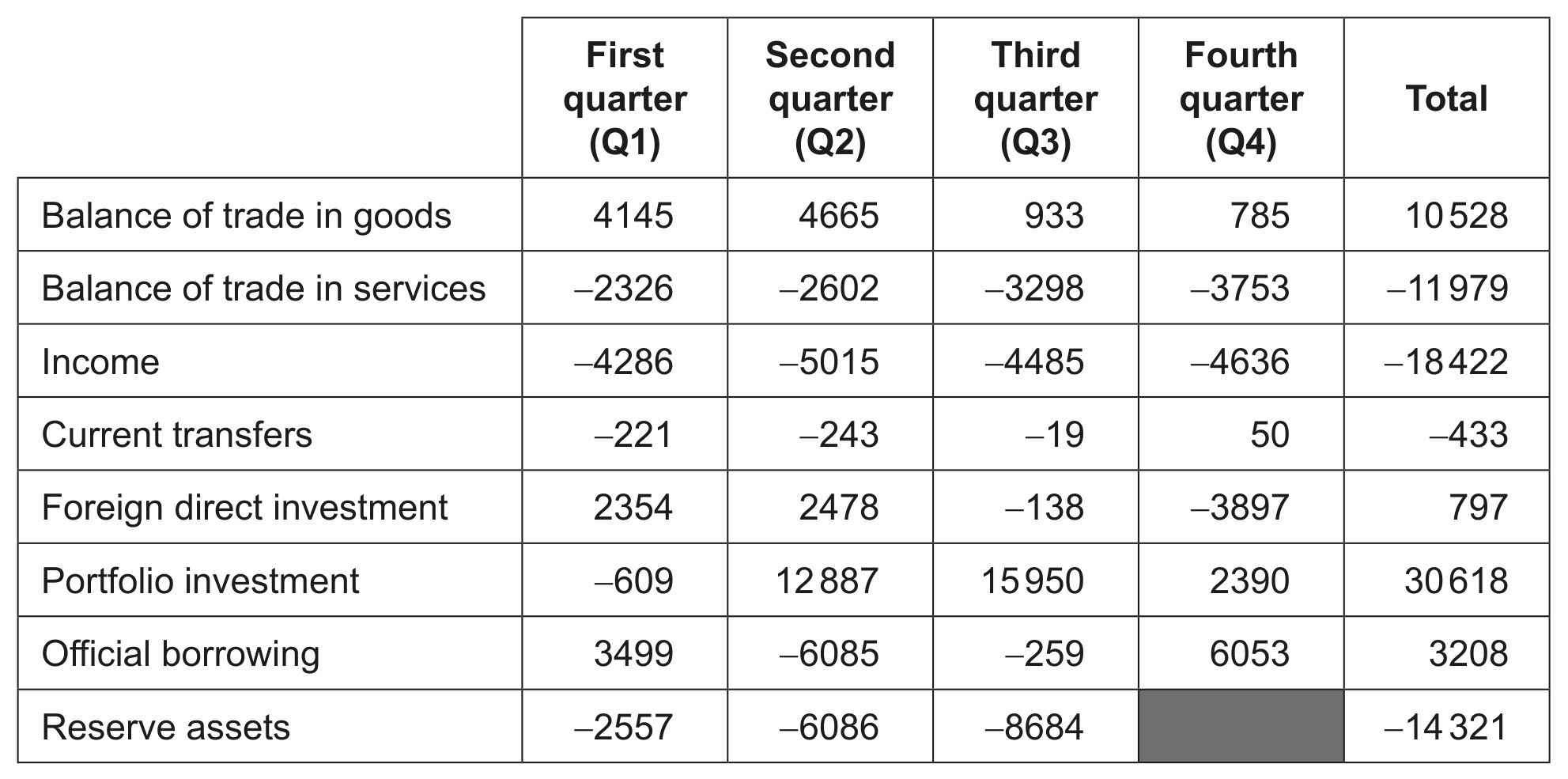
Table 1 shows information from the balance of payments for Chile for each quarter (3-month period) of 2021.

Table 1: Balance of payments for Chile in millions of US dollars (US\$) in 2021

Table 1: Balance of payments for Chile in millions of US dollars (US\$) in 2021

Question 1(a)

Question 1(a)(vi)

(a)
(i)

Using an international trade diagram, explain how an export subsidy could be used to increase the quantity of salmon exports from Chile.

Salmon in Chile are bred in fish farms. Some of these farms have been criticised for using large amounts of antibiotics. Although the fish are kept in ocean-based farms, chemicals and other salmon by-products can spread. This threatens marine life in areas near the fish farms and can lead to antibiotic-resistant strains of bacteria which can infect humans, causing them to seek medical attention.

Some indigenous fishing communities are fighting for their traditional way of life. Salmon farms use the ocean, a common access resource, so intensively that there are far fewer fish available for local communities who rely on small-scale fishing for their livelihood.

[ 4 ]

Question 3

Question 3(a)

(a)

Explain two types of trade protection.

[ 10 ]

Question 3

Question 3(a)

(a)

Explain how the removal of a quota on imports by a country could lead to a current account deficit.

[ 10 ]
0 selected