EduNinja

IB Economics HL3.5 Demand management - monetary policyQuestion Bank

Question 1

[Maximum number: 2]

Study the extract below and answer the questions that follow.
South Korea quietly intervenes on the won to support economy

(1) South Korea's foreign exchange authorities have been engaged in a quiet war in the foreign exchange market in recent months. This has been in order to hold down the value of the country's currency, the won, against the US dollar to support exports and help keep the economy on its fragile recovery track.

(2) The government has been keen to stimulate domestic consumption and reduce the country's reliance on trade. However, domestic demand has been damaged by a ferry accident that killed more than 200 passengers earlier this year. The accident damaged consumer confidence and harmed economic activity in a number of sectors, including retail and travel. Exports have also suffered from slow growth in China, South Korea's biggest export market.

(3) South Korea's central bank reduced its growth forecast for the coming year noting that economic growth is below the economy's potential rate. The finance minister has said that the country needs to implement fresh policies to stimulate the economy. He promised to look into "all possible steps" across fiscal and monetary policies. Low inflation gives the central bank room to support the economy. Consumer prices rose 1.7 % in June from a year earlier, below the central bank's target range of 2.5 % to 3.5 %.

(4) The rapid increase in the value of the won is a concern to producers in the country. Both Hyundai Motor Company and Samsung Electronics Limited blame the stronger currency for threatening their profits in the last year. They also complain that many countries, including China and Japan, have engineered weaker currencies to help make their goods more competitive. A spokesperson from Hyundai Motor Company said that Japanese rivals had benefited from a 30 % depreciation of the Japanese yen over the past two years.

(5) Many analysts have downplayed manufacturers' concerns about the strengthening won arguing that Hyundai Motor Company and Samsung Electronics Limited both manufacture most of their products outside South Korea. They also note the positive impact on South Korea's steel and chemical manufacturers of cheaper raw material imports in a country that has almost no oil and iron ore.

(6) Despite a commitment to free markets, South Korean authorities have often intervened in currency markets, which has caused tension with the United States (US) and the International Monetary Fund (IMF). The IMF has warned against excessive intervention. It said that the won is still undervalued after falling sharply following the global financial crisis. The IMF argues that movements in the won should be determined by the market and that South Korea holds enough reserves of US dollars. www.ft.com, 24 July 2014 and www.bloomberg.com, 10 July 2014]

Question 1(a)

Question 1(a)(i)

(a)
(i)

List two responsibilities of a country's central bank (paragraph (3).
[ 2 ]

Question 1

[Maximum number: 2]

Study the following extract and answer the questions that follow.
South Korea's current account surplus

(1) South Korea, Asia's fourth-largest economy, has experienced a current account surplus since 2012. South Korea's large working-age population, which tends to save a large portion of its income for retirement, contributes to the surplus. The South Korean government has expressed concerns about the impact of the high savings on domestic demand and the level of imports. However, it has been predicted that as the population ages the surplus will gradually disappear by 2042 .

(2) The South Korean won (South Korea's currency) recorded the second highest appreciation against the United States dollar (US$) in 2017 among currencies of the G20* nations. The current account surplus, the improved economic conditions and the expectations of an interest rate rise have all helped increase the South Korean won's value.

(3) The South Korean won officially operates under a floating exchange rate system, but the central bank would intervene if there were major fluctuations in the market that needed to be managed. The US is monitoring the exchange rate policy of South Korea due to the significant trade imbalance between the two countries. If the US identifies that a major trading partner like South Korea tries to limit an appreciation of its currency, then the US may consider tariffs to reduce the imbalance.

(4) South Korea's financial account in the balance of payments recorded a deficit of US$13 billion in 2018, as Koreans have invested extensively in other countries. Furthermore, foreigners have been reluctant to invest in South Korea due to the trade disputes and the potential of a trade war erupting between the US and China. The US and China are South Korea's largest trading partners, and South Korea, with its export-oriented economy (exports amount to 43 % of gross domestic product [GDP]), is sensitive to external demand shocks.

(5) South Korea's domestic investment in key areas (such as manufacturing, construction and machinery) fell during 2018, and GDP grew by less than expected. Additionally, private consumption increased only by 0.3 % in 2018 , the slowest growth for 4 years. There is also concern about the level of unemployment, especially the high rates of youth unemployment.

(6) Normally, in a situation of low growth, the central bank would implement expansionary monetary policy. However, the US Federal Reserve (the central bank of the US) and the European central bank are considering monetary tightening. If the South Korean central bank does not raise interest rates in line with the US and the European Union it runs the risk that the South Korean won may depreciate. Therefore, the South Korean government has begun discussions on using fiscal policy to help revive the job market and support domestic demand.
* G20 members include: Argentina, Australia, Brazil, Canada, China, France, Germany, India, Indonesia, Italy, Japan, Republic of Korea (South Korea), Mexico, Russia, Saudi Arabia, South Africa, Turkey, the United Kingdom, the US and the EU

Question 1(a)

Question 1(a)(i)

(a)
(i)

Define the term interest rate indicated in bold in the text (paragraph 2).

[ 2 ]

Question 1

[Maximum number: 9]

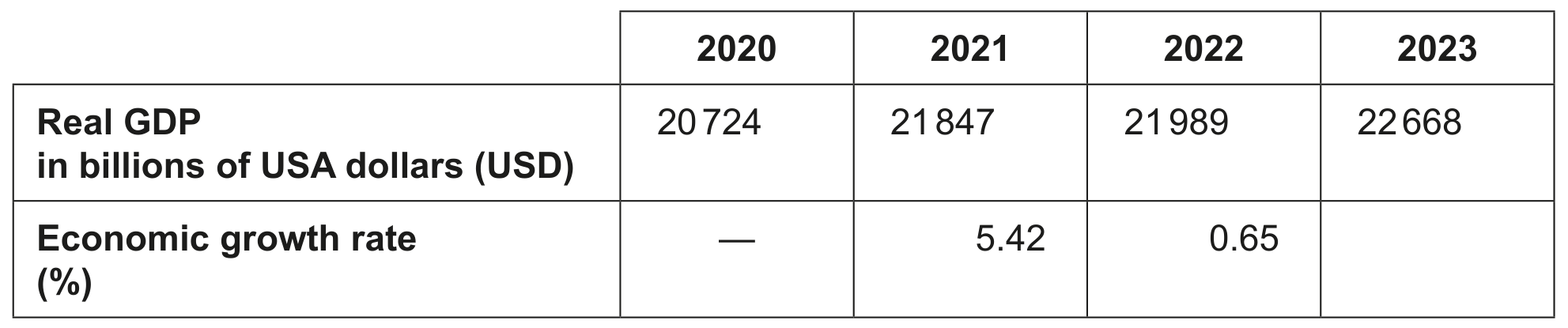
Table 1 shows the gross domestic product (GDP) of the United States of America (USA) economy from 2020 to 2023. The USA is not the fastest growing economy in the world, but it is the largest. It also has the largest budget deficit and the largest current account deficit in the world. As a result, the actions of its central bank, the Federal Reserve, always make news.

Table 1

Table 1

Question 1(a)

Question 1(a)(ii)

(a)
(i)

Calculate the real interest rate for households between January 2023 and January 2024.

[ 1 ]

Question 1(a)(iii)

(ii)

Explain how commercial banks create money.

To try and achieve the macroeconomic goals of monetary policy, the Federal Reserve significantly increased the money supply in the USA between 2008 and 2023. It also conducted four rounds of quantitative easing from 2008, totalling USD8900 billion.

[ 4 ]

Question 1(a)(iv)

(iii)

Outline what is meant by the term quantitative easing.

[ 2 ]

Question 1(a)(v)

(iv)

Sketch a diagram to show how an increase in the money supply is expected to affect the equilibrium interest rate.

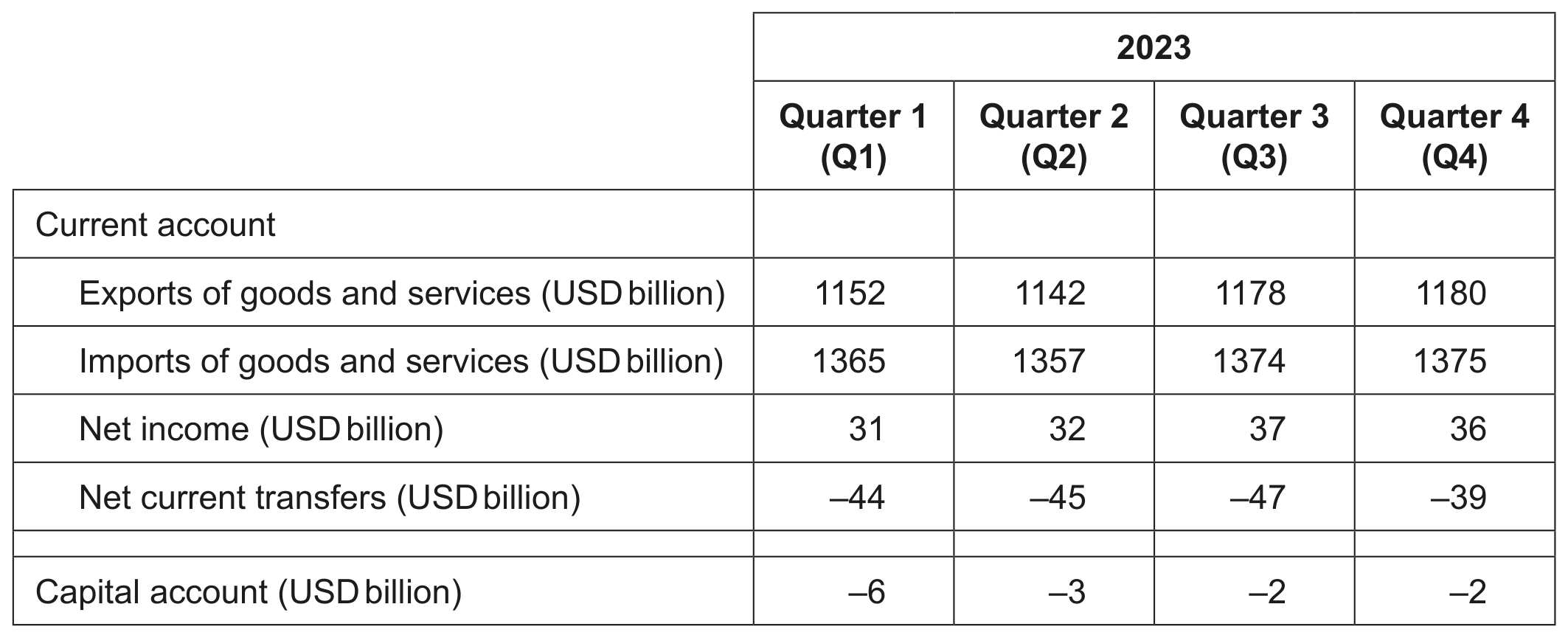
Table 2 shows the current account and capital account of the balance of payments, quarterly, for the USA in 2023. It shows that the USA has a persistent current account deficit, and that the main component of that deficit is the balance of trade in goods and services. The country's relatively high labour costs, labour unions and skills shortages in STEM (science, technology, engineering and mathematics) all contribute to the trade deficit.

Table 2

Table 2

[ 2 ]

Question 1

[Maximum number: 4]

Text A - Overview of Vietnam

(1) Economic reforms in Vietnam during the past 30 years have led to rapid economic growth, which has transformed a poor nation into a lower middle-income economy. The percentage of the population with an income of less than US$1.90 a day declined from 38\% in 2002 to below 2 % in 2018.

(2) Vietnam used to be a food-insecure nation, in which many people sometimes lacked access to affordable food, but it is now a leading exporter of basic food commodities. It also aims to become an exporter of high quality and processed food products. However, agricultural production only accounts for 18 % of gross domestic product (GDP), although it uses 40 % of the land and employs 43 % of the labour force. Due to the growing rural population, land is often divided up between a greater number of farmers, causing some farms to become smaller. These farms have fewer opportunities to benefit from economies of scale and lower average costs of production.

(3) Vietnam's rapid growth and industrialization, focused on export-oriented manufacturing, have had a harmful impact on the environment. Electricity consumption has tripled since 2010, growing faster than GDP. Electricity generation, which mainly uses fossil fuels, accounts for approximately 60 % of Vietnam's carbon emissions. Demand for water continues to increase. Unsustainable exploitation of natural resources, such as land, fisheries, and timber, could negatively affect prospects for long-term growth. In addition, Vietnam's primary sector is highly vulnerable to the climate and is therefore subject to supply shocks.

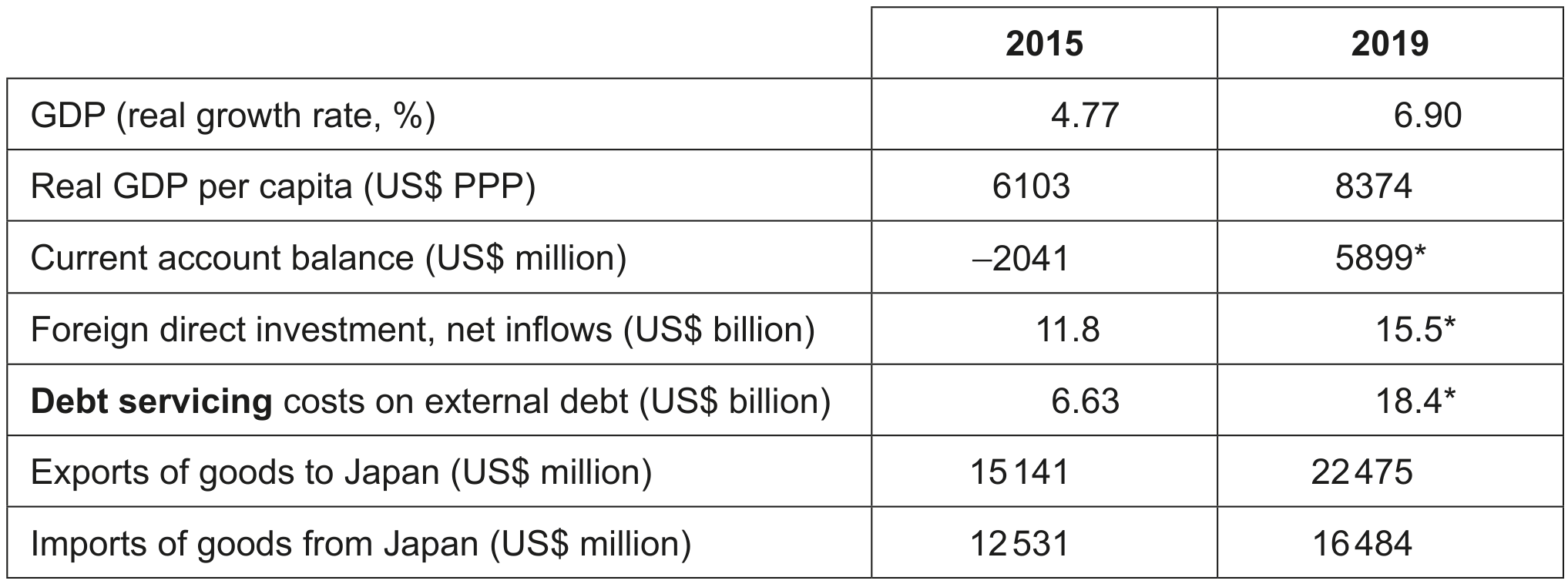
(4) Vietnam has signed several free trade agreements (FTAs). Its first FTA was a partnership with Japan in 2008. Both Vietnam and Japan are members of the Comprehensive and Progressive Agreement for Trans-Pacific Partnership (CPTPP), which took effect at the beginning of 2019. These FTAs also promote inward foreign direct investment (FDI). In addition, Vietnam has introduced policies to attract foreign investment, such as tax incentives and spending on infrastructure.

(5) Japan is the biggest provider of foreign aid to Vietnam and the largest source of FDI. Japanese firms and aid agencies are jointly financing large-scale projects, including port infrastructure and a high-speed railway, which will reduce the Hanoi to Ho Chi Minh journey time from about 35 hours to under six hours. Other Japanese-funded aid projects are in the areas of health care, education, and the environment.
Text B - Trade and investment flows between Vietnam and Japan

(1) Japan imports seafood and consumer products such as textiles, leather shoes and processed foods from Vietnam, because Vietnam has a comparative advantage in such items. Conversely, Vietnam imports machinery, technology, and raw materials for production from Japan. Gradually barriers to trade are being removed. In 2020, Vietnam began exporting lychees (a luxury fruit) to Japan after five years of negotiations on quality standards. The improved access to the Japanese market has increased the number of consumers and the revenue earned by Vietnamese lychee farmers.

(2) Japanese firms invest in Vietnam, particularly in urban areas, because wages are low and they can export from Vietnam to other CPTPP members and to China and Indonesia. Panasonic, a Japanese multinational company (MNC), relocated a major factory, which manufactures refrigerators and washing machines, from Thailand to Vietnam in 2020. The construction of a coal-fired power plant is mainly funded by Japanese firms. The Japanese government is promoting further investment by subsidizing over 30 firms that are relocating from China to Vietnam. Most of these firms are food processors or producers of manufactured goods (for example, medical equipment).
Text C - Roles of the central bank in Vietnam

(1) The central bank in Vietnam has been lowering interest rates since mid-2019. However, it has kept the minimum reserve requirement at 3 % of commercial bank deposits, despite suggestions that this requirement could be lowered.

(2) The central bank also regulates the exchange rate of the dong (Vietnam's currency). It actively intervenes in the foreign exchange market to stabilize the rate when necessary. In April 2020, there was downward pressure on the dong due to the lower interest rates and fewer foreign tourists. However, the central bank has a large amount of reserve assets, which were used to prevent the dong from depreciating.

Table 1: Economic data for Vietnam

Table 1: Economic data for Vietnam

* 2018 figure

Table 2: Development data for Vietnam

Table 2: Development data for Vietnam

* 2018 figure

Question 1(e)

(a)

Using a demand and supply of money diagram, explain the likely effect on interest rates of a reduction in the minimum reserve requirement for banks (Text C, paragraph 1).

[ 4 ]

Question 2

Question 2(b)

(a)

Using real-world examples, evaluate the effectiveness of monetary policy in reducing a large deflationary (recessionary) gap.

[ 15 ]

Question 3

Question 3(a)

(a)

Explain how expansionary monetary policy might lead to a rise in inflation.

[ 10 ]

Question 3

Question 3(a)

(a)

Using a diagram, describe how expansionary monetary policy might be used to close a deflationary (recessionary) gap.

[ 10 ]

Question 3

Question 3(a)

(a)

Explain how equilibrium interest rates are determined in an economy.

[ 10 ]

Question 3(b)

(b)

Discuss whether an increase in interest rates is the most effective way of reducing the rate of inflation in an economy.

[ 15 ]

Question 3

Question 3(b)

(a)

"The rate of inflation can be most effectively reduced through the use of monetary policy." To what extent do you agree with this statement?

[ 15 ]

Question 3

Question 3(b)

(a)

Evaluate the effectiveness of monetary policy to increase aggregate demand during a recession.

[ 15 ]
0 selected