Question 1
Question 1(f)
Question 1(f)(ii)
(a)
(i)
Outline why purchasing this surplus implies an opportunity cost for the government of Nissos.
[ 2 ]
 EduNinja
Outline why purchasing this surplus implies an opportunity cost for the government of Nissos.
Study the extract below and answer the questions that follow.
EU court rules minimum price for cigarettes illegal
(1) The European Court of Justice has ruled that Ireland cannot impose a minimum price on cigarettes. It said that member countries would have to find other ways to combat smoking. This could be achieved by increasing indirect tax on tobacco, but imposing a minimum price would distort fair competition in the market. The ruling is designed to maintain the freedom of manufacturers and importers to benefit from lower costs and greater efficiency.
(2) The judgment said the aim of ensuring that tobacco prices are high can be "adequately" achieved by increasing tax, since any indirect tax rises are, sooner or later, reflected in an increased retail price, without removing the freedom of manufacturers to set prices.
(3) The Irish government had claimed that it needed to fix a high minimum price to discourage smoking. This followed government legislation to ban tobacco advertising and promotion in July 2009. According to a spokesperson from the anti-smoking group ASH (Action on Smoking and Health), this measure helped to prevent retail outlets from making young people feel attracted to buying cigarettes. "Close to 30 % of our population still smoke and 7000 die from tobacco-related disease each year," he said.
(4) It has been argued that increasing the price of cigarettes is one of the most effective ways of curbing harmful smoking and there is a need to make cigarettes less appealing, particularly to young people. The evidence is that banning advertising, introducing minimum pricing and increasing health warnings can all work.
(5) The head of a major retail organization has attacked the idea of minimum pricing for cigarettes. He argued that artificially fixing a minimum price would not be effective. Also, since the demand for tobacco is inelastic, raising the price would not work. Moreover, it was against the free market for a government to set prices for any product available to consumers, limiting their freedom to choose.
Define the following terms indicated in bold in the text:
free market (paragraph (5).
Study the following extract and data and answer the questions that follow.
The strong Thai baht
(1) Thailand's currency, the Thai baht, ended 2019 at its highest value in more than six years. With a 7.8 % gain against the United States dollar (US$), it was the currency that appreciated the most among major Asian currencies.
(2) The Thai baht's appreciation was caused by several factors. Many foreign investors are attracted by Thailand's economic stability, high levels of foreign reserves, low inflation rate and low unemployment (Table 1). However, the inflation rate is below the central bank's target.
(3) Initially, the central bank of Thailand (BoT) was not too concerned, as the strong Thai baht was helping Thai importers and those who had foreign debts. Additionally, Thai producers could afford to import new technology and capital equipment. An appreciating currency could also help improve the country's terms of trade.
(4) However, a strong currency can have severe consequences on an export-oriented country like Thailand. Exports account for 65 % of gross domestic product (GDP), and in 2019 exports declined by 7 %. Additionally, the tourism industry, which makes up approximately 20 % of GDP and accounts for 16 % of employment, started to express concern. Economic growth in 2019 was 3 %, down from 4.1 % in 2018.
(5) Therefore, towards the end of 2019, the BoT implemented measures to prevent further appreciation of the Thai baht. The BoT reduced controls on capital outflows to make it easier for Thai citizens to move money abroad. Additionally, restrictions were placed on the amount of money foreigners could hold in Thai bank accounts.
(6) The BoT is considering further measures including the use of foreign reserves, a decrease in the interest rate, and imposing controls on capital inflows, to prevent speculative inflows. However, these controls may impact the country's credibility and financial markets. Expansionary monetary policy may also increase household debt which, at 78.6 % of GDP, is among the highest in Asia.
(7) The BoT is concerned about using foreign reserves, as this may result in Thailand being labelled a currency manipulator* by the US. Currently, Thailand's overall large current account surplus is the only requirement it meets to be labelled a currency manipulator. However, Thailand's bilateral trade surplus with the US is currently US$19 billion, which means it is close to meeting a second requirement. Thailand wants to avoid being labelled a currency manipulator as the US may use trade protection in retaliation.
* currency manipulator: the US will label a country as a currency manipulator if the following three requirements are met (a country will be placed on a watchlist if they meet two of the requirements):
1. The country is using its foreign reserves to change the value of its currency to gain an advantage
2. The country has a bilateral trade surplus with the US of over US $ 20 billion
3. The country has a current account surplus of more than 2 % of its GDP.
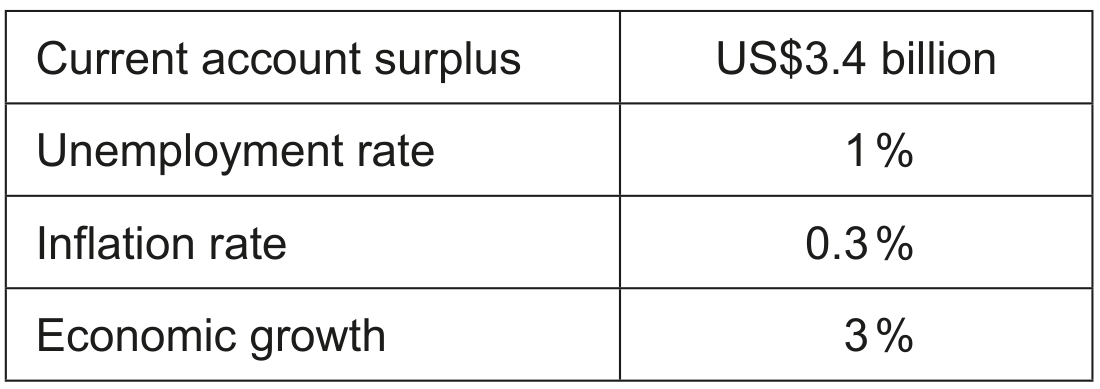
Table 1: Thailand macroeconomic indicators 2019
Using a production possibilities curve (PPC) diagram, explain how the importing of "new technology and capital equipment" might affect Thailand's production possibilities (paragraph 3).
Figure 1 illustrates the production possibilities for rice and pencils in Country H. Resources in Country H are fully employed.
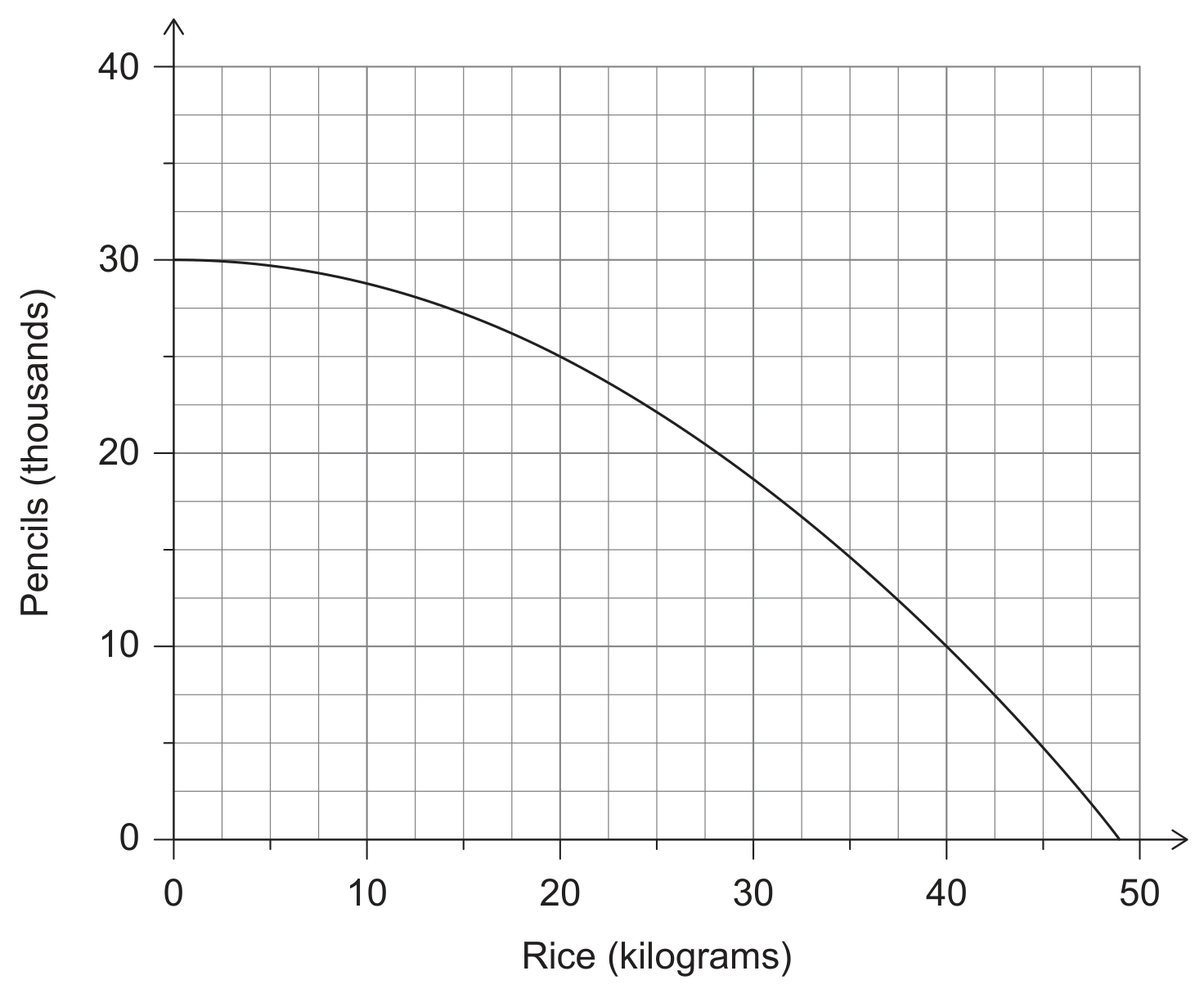
Figure 1
Assuming that 25000 pencils are produced initially, identify the opportunity cost for Country H if the production of rice is to be increased by 100 %.
State one reason why the production possibility curve (frontier) for Country H might shift outwards.
Using a production possibility curve, explain the problem of scarcity faced by all societies.
Read the extracts and answer the questions that follow.
Text D - Overview of Lebanon
(1) Lebanon is in the Middle East, bordering the Mediterranean Sea, and is home to nearly 7 million people. Lebanon is in an economic crisis, facing a recession, huge government debt and rising income inequality, poverty and inflation. Corruption and poor governance have been blamed for misallocation of funds that has led to low levels of investment and extensive capital flight. Additionally, Lebanon has one of the most unequal distributions of wealth in the world. In 2019, the top 10 % of income earners owned over 70 % of personal wealth in Lebanon.
(2) Infrastructure in Lebanon is poor, water and sewerage systems are basic, and roads are inadequate. Electricity supply is unreliable with people going without power for much of the day. In 2020, major buildings including food storage buildings, schools and hospitals were damaged in Beirut (the capital city of Lebanon). This was concerning as 85 % of the country's food arrives through Beirut. Fortunately, humanitarian aid was given by the international community to help rebuild the damaged buildings.
(3) Despite a history of inflows from luxury tourism and remittances (money sent by a foreign worker to their home country), there is a persistent current account deficit. To help with this, the Lebanese central bank has used high interest rates to attract financial inflows. Additionally, the government has borrowed funds from overseas. However, the misuse of these funds and overspending have contributed to one of the highest foreign debts in the world. Lebanon recently defaulted on foreign debt repayments worth 1.2 billion euros, which damaged its international credit rating, making it difficult to access loans needed to help solve its current economic problems.
Text E - Further challenges facing Lebanon
(1) Social unrest is prevalent and intensified when the government suggested raising revenue by imposing an indirect tax on social media applications such as WhatsApp. As the government struggles to pay its debts, people are concerned that subsidies on necessities such as wheat, medicine and fuel will be removed.
(2) Mismanagement of the state-run electricity and telecommunications sectors has resulted in unreliable services and high telecommunication prices. The state-run monopoly firms make losses, and the electricity sector relies heavily on government subsidies, putting pressure on the budget deficit.
(3) Lebanon currently has a managed exchange rate system with the Lebanese pound (Lebanon's currency) linked to the US dollar (US$). However, the government is finding it difficult to maintain the exchange rate at the desired level due to insufficient reserve assets. Recent falling remittances, low levels of exports and lack of foreign direct investment (FDI) are placing downward pressure on the Lebanese pound. Lebanon has limited natural resources and a small manufacturing industry, thus relies heavily on imports. As a consequence, the gradual depreciation of the Lebanese pound has led to cost-push inflation.
Text F - Reforms and strategies for economic recovery
(1) The Lebanese government is seeking help from the International Monetary Fund (IMF) to restructure the government debt and develop its infrastructure. However, loans from the IMF will require the following conditions to be met:
- procedures and processes established to ensure good governance, including enforcement of anti-corruption laws
- financial sector reforms implemented to build confidence in the banking system and laws to control capital flight
- government spending reduced and revenue increased through higher corporate, wealth and personal income taxes for high-income earners. Introduction of a tax on imported luxury goods and an increase of indirect taxes
- partially privatizing the electricity and telecommunications sectors to increase efficiency and encourage the exploration of new energy sources
- transitioning from a managed to a floating exchange rate system.
(2) Other organizations are offering development aid to rebuild infrastructure and support small to medium-sized businesses to develop the manufacturing sector and attract FDI. Currently, the manufacturing sector accounts for only 12.5 % of gross domestic product (GDP). Some experts recommend that Lebanon decreases its reliance on food imports by developing its own food industry. However, Lebanon must commit to establishing good governance systems before aid organizations will provide their support.
(3) Lebanon has resisted seeking help from the IMF and other agencies in the past due to concerns about high levels of interference and imposed conditions that may conflict with their own government objectives.
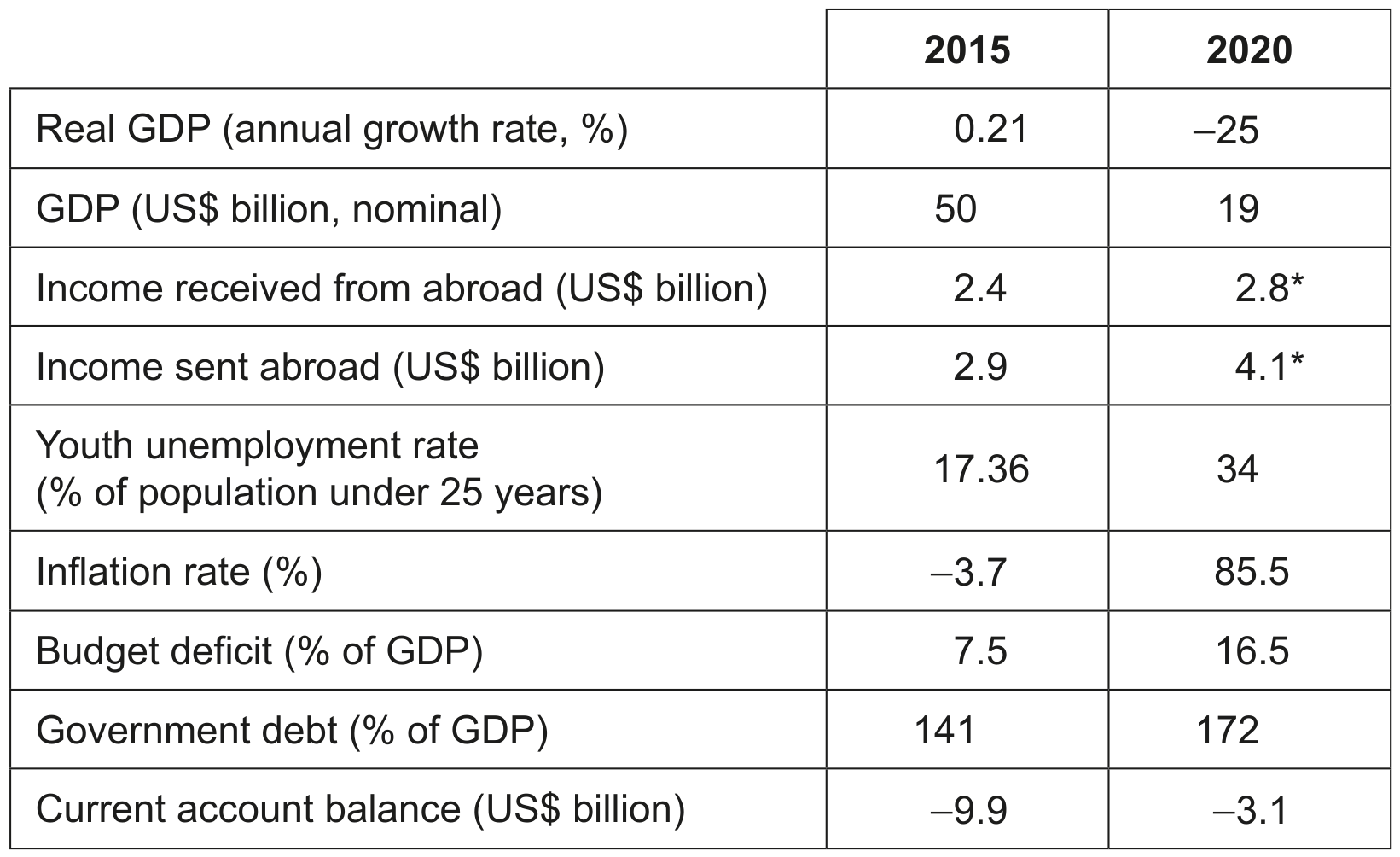
Table 3: Economic data for Lebanon
* 2019
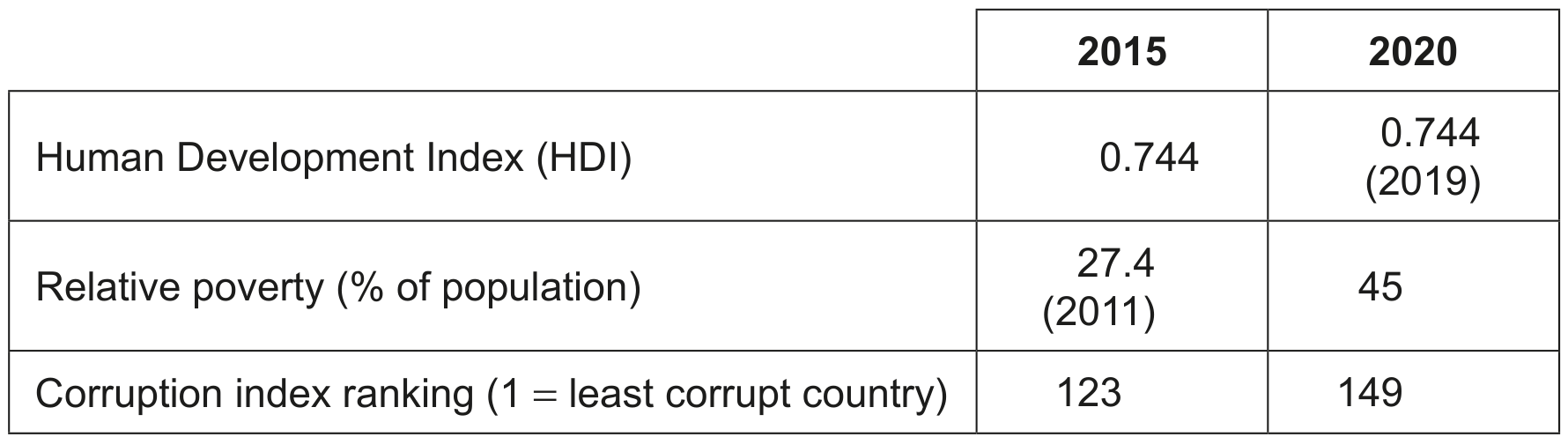
Table 4: Development data for Lebanon
Using a PPC diagram, explain the impact of the damage to the major buildings in Beirut on Lebanon's productive capacity (Text D, paragraph 2).
Read the extracts and answer the questions that follow.
Text D — Overview of Cambodia
(1) Between 2010 and 2019 Cambodia had one of the fastest growing economies in Southeast Asia. Most of the growth was driven by tourism, exports of garments and improved consumer confidence.
(2) However, despite high economic growth, rural poverty has persisted, and inequality has grown within rural populations. Approximately 90 % of workers are employed in the informal sector and access to quality healthcare and education remain a challenge for Cambodia. Youth (under 25 years old) make up a large proportion of the labour force, but many do not complete secondary school. As a result, those entering work are under-skilled and human capital is low. Access to clean water and sanitation facilities is still lacking. Export-driven growth is being threatened as the European Union (EU), which accounts for 30 % of Cambodia's export market, recently ended a preferential trade agreement and will now impose tariffs on Cambodian products, such as garments.
(3) Experts state that the focus on growth through garment manufacturing is unsustainable. The garment industry, which is the largest informal employment sector, has been criticised for poor working conditions and pay. Even workers who are formally employed can barely meet basic needs, despite the recent minimum wage increase and introduction of a price ceiling on rents for housing in cities. Additionally, there are reports of pollution and water waste generated by garment factories, damaging the health of those who live nearby.
(4) To help solve the market failure in the garment industry, economists recommend that the government should support projects that encourage garment factories to adopt a circular economy approach, either in partnership with worldwide clothing brands or by forming social enterprises (SEs) locally. The circular economy approach can help reduce environmental waste that occurs during production by encouraging the recycling and reusing of materials. Developing ecotourism has also been recommended to support sustainability and provide new job opportunities for the youth and the rural population. Furthermore, ecotourism could help Cambodia benefit from growing world income levels.
(5) Reforms in the garment and tourism industries are needed, along with improvements in infrastructure, to maintain sustainable growth and competitiveness. Promoting entrepreneurship, developing new skills and increasing the use of technology would help solve current labour market needs.
Text E - Social Enterprise (SE) in Cambodia
(1) When Cambodia's status changed from low income to lower middle-income in 2015, the inflow of foreign aid decreased dramatically. As a result, SEs became increasingly more important in promoting Cambodia's economic development. Furthermore, SEs were seen as a key factor in breaking the poverty cycle and providing opportunities for its young labour force. SEs may also encourage local investment, which has experienced very slow growth compared to foreign direct investment (FDI).
(2) Many SEs focus on addressing issues of poverty, child rights, education, disability, health and environmental concerns. The main beneficiaries are children, youth, women and people with disabilities. Successful Cambodian examples include Phare Performing Social Enterprise (PPSE), which is a performing arts school targeting underprivileged children. Most graduates become full time workers at PPSE. Another example is Hydrologic, which provides affordable safe water options to rural households. New SEs are currently being established to ensure sustainability within the growing ecotourism industry.
(3) However, challenges exist within the SE sector. Less than 8 % of SEs are formally registered due to bureaucracy and high taxes. This limits access to potential investors and markets and encourages businesses to stay in the informal sector. New SE start-ups often fail due to lack of sufficient funding and the inability to attract skilled labour.
Text F - Microfinance in Cambodia
Since 1991, Cambodia has had one of the fastest growing microfinance sectors in the world. Microfinance has helped decrease poverty in rural areas and solve asymmetric information in the market for loans. However, key issues have persisted, including low success rates of some businesses due to inadequate financial literacy and expertise. Additionally, microfinance has become increasingly dependent on funding from international banks and investors, resulting in higher interest rates. Some borrowers have been forced to sell their land as they could not meet their debt repayment obligations. Recently the government implemented a price ceiling on the interest rate for loans in rural areas to help prevent increasing household indebtedness.
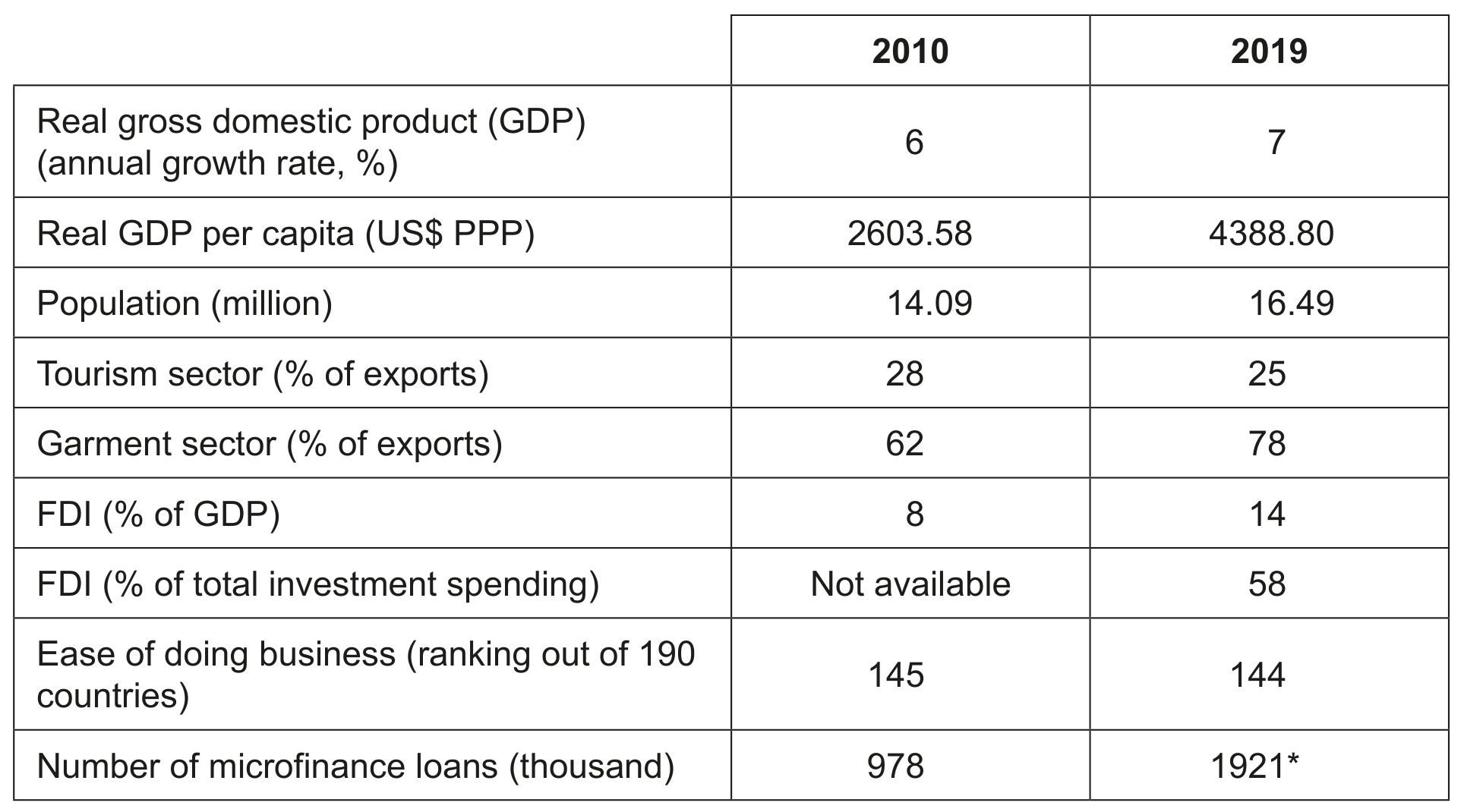
Table 3: Economic data for Cambodia
*2016 figure
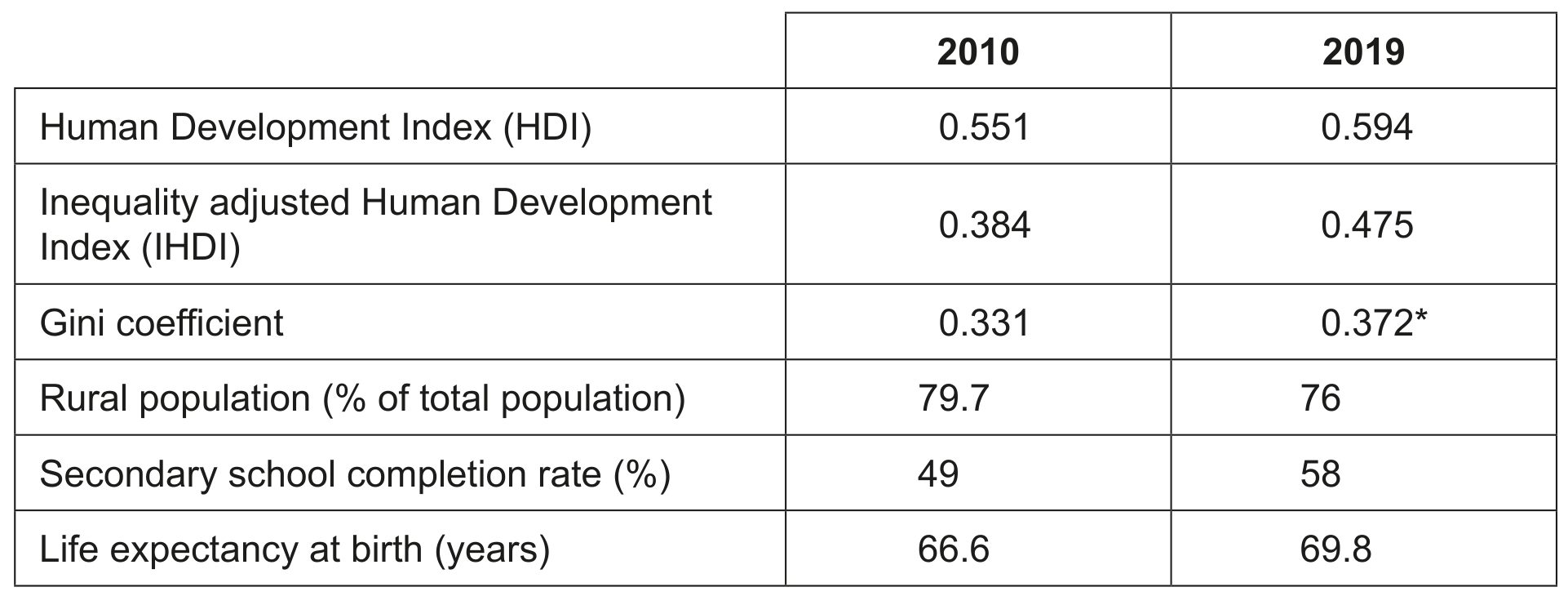
Table 4: Development data for Cambodia
*estimate
Using a circular flow of income diagram, explain the impact increased microfinance could have on the Cambodian economy (Text F).
Study the following extract and answer the questions that follow.
Can the Democratic Republic of the Congo achieve its economic potential?
(1) The Democratic Republic of the Congo (DRC) is a nation of great potential. It has large mineral resources and an abundance of fertile land. The mining and export of cobalt, copper and gold are the main source of government revenue. However, the abundance of natural resources causes devastating conflicts as rebel groups fight for control of the DRC's resources. With a population of 80 million and gross domestic product (GDP) per capita of only US$457, the DRC is one of the world's poorest nations. It is ranked 176 in the world in terms of the Human Development Index (HDI).
(2) The government has been accused of relying too much on tariffs, but to improve living standards, the government needs revenue to spend on agriculture, electricity and roads. Furthermore, business owners in the DRC complain of corruption and increasing "red tape" (excessive regulations).
(3) The government believes that a strong agricultural sector could boost economic growth but only 10 % of the land is used for farming. Rice, maize and other crops grow well in the tropical climate and yet the government spends US$1 billion per year importing basic foods. According to a government spokesperson, the lack of infrastructure is a major barrier to the processing and transporting of agricultural products. The DRC's road network is so bad that farmers and traders often make a two-week trip in small boats down the Congo River to sell their produce. The DRC has just 27877 kilometres ( km ) of roads. It is estimated that 90000 km of national roads and 150000 km of rural roads must be built.
(4) In addition, the World Bank reports that only 17 % of the DRC's population has access to electricity, despite the capacity of the Congo River to generate enough electricity to satisfy the needs of the region.
(5) To make matters worse, the regional conflicts have affected the availability of healthcare services. It is estimated that half of the health centres have been looted*, burnt or destroyed. Government expenditure on healthcare per capita remains one of the lowest in the world. Non-governmental organizations (NGOs) are relied on to protect the health and wellbeing of citizens. NGOs help to achieve this by distributing medicine and teaching families about hygiene and proper sanitation.
* looted: goods stolen from a place, typically during a war or riot
Using a production possibilities curve (PPC) diagram, explain how the production possibilities (potential output) of the DRC might be affected if there were greater access to electricity (paragraph (4).
Study the extract and data below and answer the questions that follow.
Indonesia's economy
(1) Indonesians hope that their new president will be able to speed up reforms to stimulate economic growth and economic development. These reforms include upgrading infrastructure, reducing red tape (excessive regulations) and reducing corruption. It is also hoped that he will increase Indonesia's global competitiveness, create new jobs and educate one of the world's youngest workforces.
(2) Some government policies are already being implemented. These include a large power plant construction programme, tax incentives to infant industries and tax cuts for industries like transport, telecommunications, metal production and agricultural processing. In addition, there has been a decision to reduce fuel subsidies in order to contribute funds towards the government's record US $ 22 billion investment in infrastructure projects. The subsidies had kept fuel prices low in a country where millions of people live in poverty.
(3) Despite the policies, Indonesia is struggling. Economic growth is slow and consumer confidence has deteriorated. Indonesia's main export commodities are coal, gold and palm oil, for which prices have fallen. The inflation rate is 7.26 %, which is above the central bank's target range of 3 to 5 %. Slower growth in the world economy makes the situation even worse for Indonesia's struggling economy.
(4) Economists have said that the president must put his efforts into improving export competitiveness by making investments in education and training.
5 The costs of doing business in Indonesia are high due to paperwork and confusing regulations. The government has adopted policies to improve this. These policies aim to create certainty and transparency for foreign investors and to empower small businesses, which play a critical part in Indonesia's economy. Other policies, such as obtaining loans and encouraging micro-credit institutions, make it easier to gain access to credit.
(6) Trade protection and intervention are increasing as policymakers look to reduce imports, manage markets and promote domestic industries.
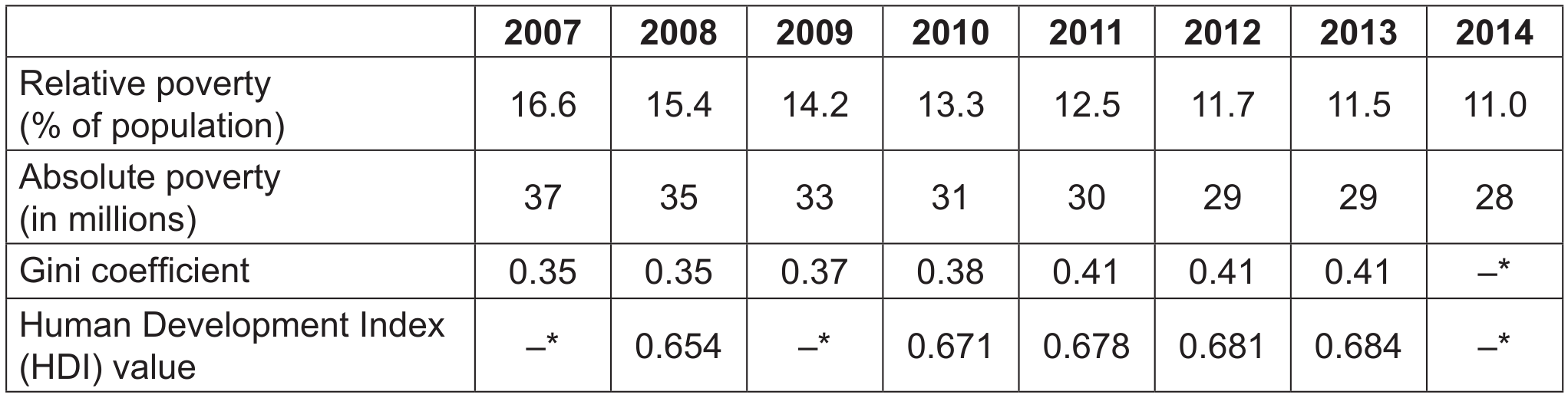
Figure 1 - Indonesian development statistics
[Sources: adapted from World Bank and Statistics Indonesia; www.legalbusinessonline.com, accessed 18 September 2015; www.indonesia-investments.com, accessed 23 August 2015; www.hdr.undp.org, accessed 23 August 2015; www.bloombergview.com, accessed 9 August 2015; www.reuters.com, accessed 9 August 2015; www.lowyinterpreter.org, accessed 23 August 2015 and www.data.worldbank.org, accessed 23 August 2015]
\footnotetext{
* signifies no data available
}
Using a production possibilities curve (PPC) diagram, explain how "the government's record US$22 billion investment in infrastructure projects" will affect Indonesia's production possibilities (paragraph (2).
Study the extract and data below and answer the questions that follow.
Indonesia's economy
(1) Indonesians hope that their new president will be able to speed up reforms to stimulate economic growth and economic development. These reforms include upgrading infrastructure, reducing red tape (excessive regulations) and reducing corruption. It is also hoped that he will increase Indonesia's global competitiveness, create new jobs and educate one of the world's youngest workforces.
(2) Some government policies are already being implemented. These include a large power plant construction programme, tax incentives to infant industries and tax cuts for industries like transport, telecommunications, metal production and agricultural processing. In addition, there has been a decision to reduce fuel subsidies in order to contribute funds towards the government's record US $ 22 billion investment in infrastructure projects. The subsidies had kept fuel prices low in a country where millions of people live in poverty.
(3) Despite the policies, Indonesia is struggling. Economic growth is slow and consumer confidence has deteriorated. Indonesia's main export commodities are coal, gold and palm oil, for which prices have fallen. The inflation rate is 7.26 %, which is above the central bank's target range of 3 to 5 %. Slower growth in the world economy makes the situation even worse for Indonesia's struggling economy.
(4) Economists have said that the president must put his efforts into improving export competitiveness by making investments in education and training.
5 The costs of doing business in Indonesia are high due to paperwork and confusing regulations. The government has adopted policies to improve this. These policies aim to create certainty and transparency for foreign investors and to empower small businesses, which play a critical part in Indonesia's economy. Other policies, such as obtaining loans and encouraging micro-credit institutions, make it easier to gain access to credit.
(6) Trade protection and intervention are increasing as policymakers look to reduce imports, manage markets and promote domestic industries.
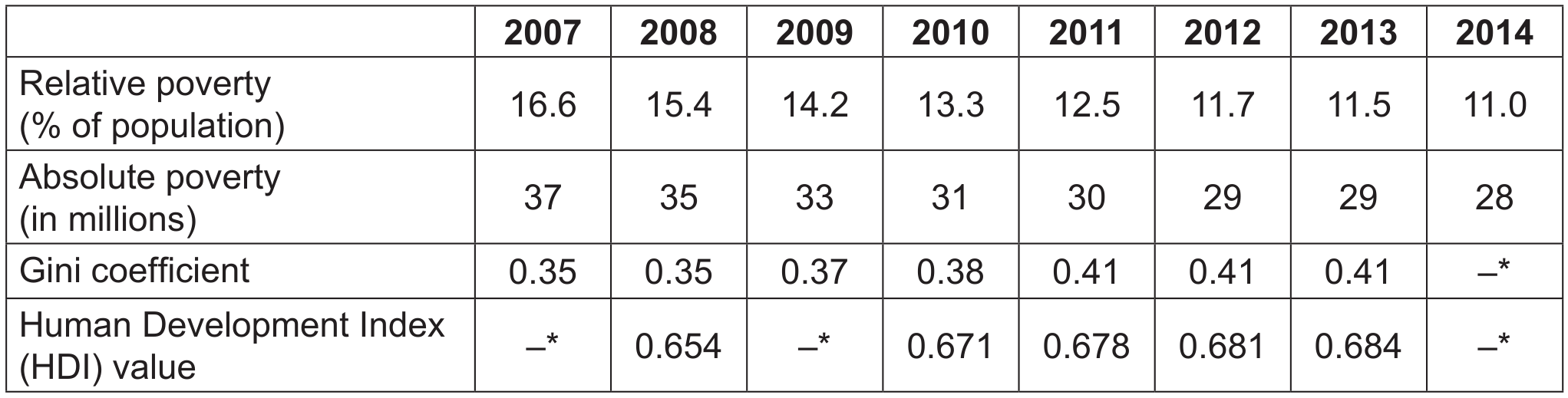
Figure 1 - Indonesian development statistics
[Sources: adapted from World Bank and Statistics Indonesia; www.legalbusinessonline.com, accessed 18 September 2015; www.indonesia-investments.com, accessed 23 August 2015; www.hdr.undp.org, accessed 23 August 2015; www.bloombergview.com, accessed 9 August 2015; www.reuters.com, accessed 9 August 2015; www.lowyinterpreter.org, accessed 23 August 2015 and www.data.worldbank.org, accessed 23 August 2015]
\footnotetext{
* signifies no data available
}
Using a production possibilities curve (PPC) diagram, explain how "the government's record US$22 billion investment in infrastructure projects" will affect Indonesia's production possibilities (paragraph (2).