EduNinja

IB Economics HL2.7 Role of government in microeconomicsQuestion Bank

Question 1

[Maximum number: 2]

Study the extract and data below and answer the questions that follow.
American shrimp farmers taste victory

(1) American shrimp farmers have received good news from a United States (US) ruling that could lead to tariffs being imposed on imports from competing countries.

(2) US producers in the Gulf Coast were suffering from a significant oil spill in 2010. The higher fuel costs as a result of the spill have made it hard to compete with foreign shrimp farms, which they say receive government subsidies. The US producers claim such subsidies threaten to destroy the domestic shrimp business. The US imported 1200 million pounds (lb) of shrimp last year and produced 100 million pounds (lb) of shrimp domestically.

(3) The US Department of Commerce ruled that five countries - China, Ecuador, India, Malaysia and Vietnam - improperly subsidized shrimp that were exported to the American market. The department rejected accusations of improper subsidies by Thailand and Indonesia, two of the biggest US shrimp suppliers.

(4) The US International Trade Commission will now have to decide whether the subsidies harmed the American industry. If so, the US would impose tariffs on shrimp imports from the five countries. The proposed US tariffs could be as much as 54.5 %.

(5) The US shrimp farmers claim that the Indian government pays extra to cover shipping costs on shrimp going to the US and that China provides subsidized loans to its shrimp farmers. They argue that these violate World Trade Organization (WTO) rules.

(6) The five countries disputed the US Department of Commerce's decision. The Vietnamese producers state that, "This is an unfair decision affecting the lives of more than 600000 shrimp farmers and processors in Vietnam". Chinese officials have said that there was no evidence of improper Chinese subsidies and that US tariffs on Chinese shrimp would violate WTO rules.

(7) The US shrimp farmers say they need tariffs to allow them to compete fairly with Asian farmers, noting that high fuel prices are keeping some shrimp boats at the dock. "The price received by our farmers is not enough to cover their variable costs," said a lawyer, who represents the US shrimp farmers.

(8) Large US retailers and food distributors oppose the tariffs saying that the US shrimp industry had support from the oil company, BP, which has paid billions of US dollars to those affected by its 2010 oil spill.

(9) US politicians and shrimp farmers commented on problems they are facing, saying that, "not only is shrimping an industry, but it is a way of life".
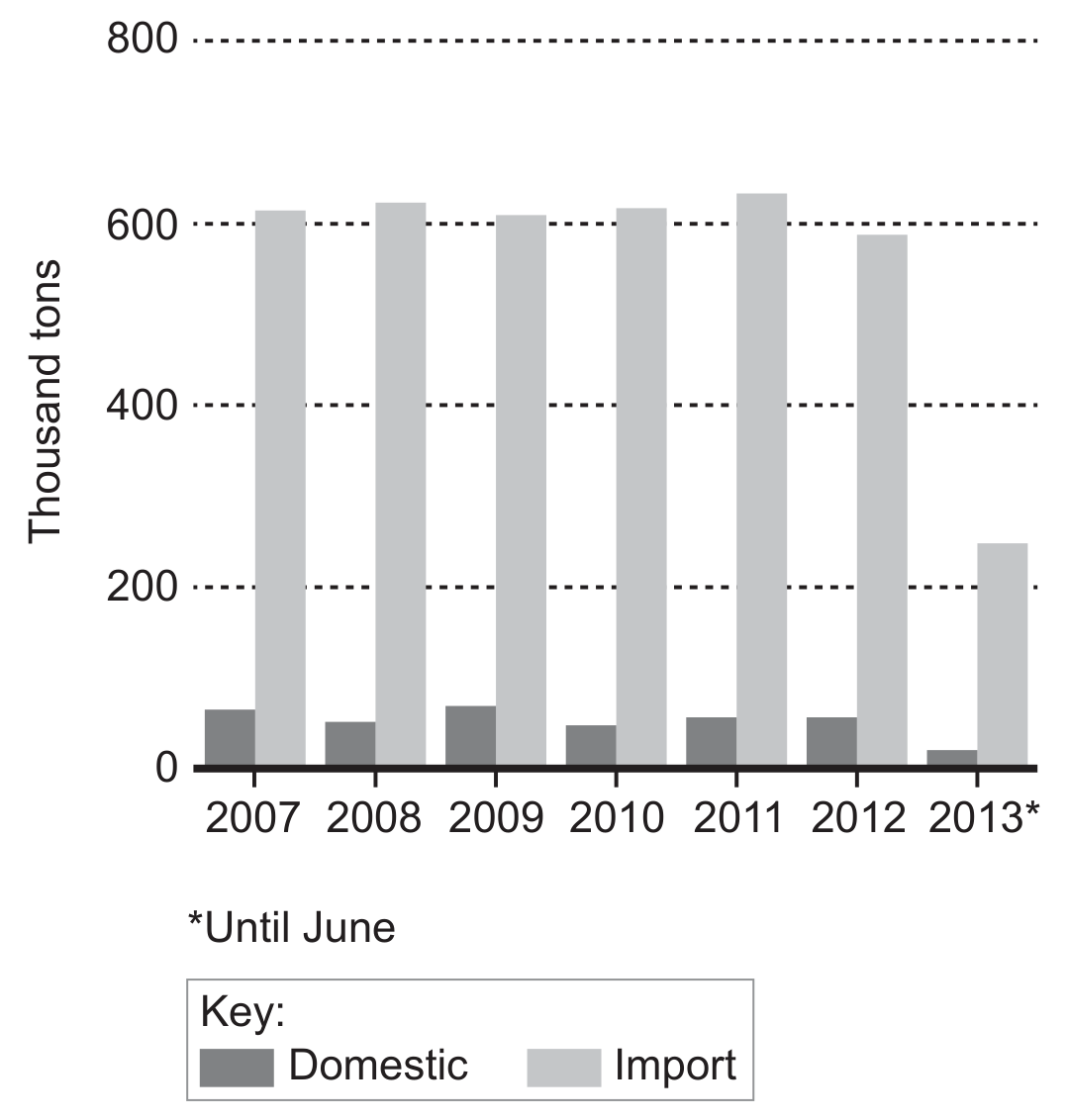
Figure 1: Amount of shrimp imported to the US compared with domestic catch (thousands of tons)

Figure 1: Amount of shrimp imported to the US compared with domestic catch (thousands of tons)

Question 1(a)

Question 1(a)(i)

(a)
(i)

Define the term subsidies indicated in bold in the text (paragraph (2)).
[ 2 ]

Question 1

Question 1(e)

Question 1(e)(i)

(a)
(i)

Explain one possible advantage and one possible disadvantage of governments setting a price floor in agricultural markets.

[ 4 ]

Question 1(e)(ii)

(ii)

Draw and label on Figure 1 a curve that illustrates the price floor in Nissos that leads to a monthly surplus of 3 million kg of corn.

The monthly corn surplus created must be purchased by the government of Nissos.

[ 2 ]

Question 1(f)

Question 1(f)(i)

(b)
(i)

State one measure that the government of Nissos might take to deal with this corn surplus, following the imposition of the price floor.

[ 1 ]

Question 1(f)(iii)

(ii)

Using Figure 1, determine the size of the decrease in monthly corn consumption following the imposition of the price floor.

[ 1 ]

Question 1(f)(iv)

(iii)

Using Figure 1, calculate the change in consumer expenditure on corn in Nissos.

[ 2 ]

Question 1

Question 1(b)

(a)

A government decides to impose an indirect tax on unhealthy drinks. Discuss the consequences for the stakeholders in these markets.

[ 15 ]

Question 1

[Maximum number: 2]

Study the extract below and answer the questions that follow.
Canada takes US paper fight to the World Trade Organization (WTO)

(1) Canada has filed a complaint against the United States (US) over anti-dumping tariffs imposed on imports of "specialty paper", which is paper used in glossy magazines and catalogues. Canada said that the tariffs were inconsistent with World Trade Organization (WTO) rules.

(2) Four Canadian companies supply about 60 % of the specialty paper market in the United States. The tariff was imposed after the US Department of Commerce decided that Canada has been providing its paper companies with subsidies and that this had been damaging American manufacturers.

(3) Many US manufacturers have initiated trade disputes on a range of products including steel and paper, as the US dollar has gained in strength against the Canadian dollar. As one Canadian analyst has noted, "Producers can't do anything about the exchange rate, which is determined by market forces, so they are fighting back using trade rules".

(4) Revenues of US paper manufacturers have also been harmed because demand for the specialty paper has fallen by 5 % annually over the past three years as magazine readers have switched to digital (on-line) products.

(5) The highest tariff of 20 % is being placed on paper from the Canadian company, Port Hawkesbury. The US government said that the company arranged a favourable electricity supply contract that was approved by the Canadian government. They argued that this is equivalent to a subsidy. However, the company argued that the electricity was negotiated with a private power company, and so this is not the same as a government subsidy.

(6) Two other companies, JD Irving Paper Ltd and Catalyst Paper Corporation are fighting the tariff, saying that not only did they not receive any subsidies, but also that they weren't even part of the investigation following the complaint by the US producers.

(7) Politicians from Maine, which is the US state where the American producers operate, are pleased with the tariff. They say that it will help to "level the playing field". However, they are not happy with the decision to put the tariff on JD Irving Paper Ltd and Catalyst Paper Corporation because they have not been investigated.

(8) The governor of Maine has written a letter to the national government and the International Trade Commission asking for separate investigations for the two other companies, JD Irving Paper Ltd and Catalyst Paper Corporation, which also have operations in Maine. In the letter, the governor wrote: "Both JD Irving Paper Ltd and Catalyst Paper Corporation have significant investments in our state, and together employ more than 1200 people in Maine and support thousands of indirect jobs".
[Sources: adapted from www.theglobeandmail.com, 17 November 2015; www.theglobeandmail.com, 30 March 2016; www.pressherald.com, 16 October 2015 and http://ca.reuters.com, 31 March 2016]

Question 1(a)

Question 1(a)(ii)

(a)
(i)

Define the term subsidy indicated in bold in the text (paragraph (5).

[ 2 ]

Question 1

[Maximum number: 7]

The demand for a product in a perfectly competitive market is given by the function

Q d=64-2 P

while market supply is given by the function

Q s=4 P-8

where P is the price per unit in dollars ($), Qd is the monthly quantity demanded and Qs is the monthly quantity supplied in thousands of units.

Question 1(e)

Question 1(e)(i)

(a)
(i)

State the type of indirect tax under consideration.

[ 1 ]

Question 1(e)(ii)

(ii)

Outline the reason for your answer to part (e)(i).

Question image
[ 2 ]

Question 1(f)

Question 1(f)(i)

(b)
(i)

The government decides to impose a $ 3 per unit tax on this perfectly competitive market. Plot and label the market supply curve following the imposition of this tax in the grid on page 3.

[ 1 ]

Question 1(f)(ii)

(ii)

Calculate the resulting consumer expenditure and producer revenue and government tax revenue following the imposition of the $3 per unit tax.

The questions below refer to a different perfectly competitive market.

[ 3 ]

Question 1

[Maximum number: 10]

Study the extract below and answer the questions that follow.
EU court rules minimum price for cigarettes illegal

(1) The European Court of Justice has ruled that Ireland cannot impose a minimum price on cigarettes. It said that member countries would have to find other ways to combat smoking. This could be achieved by increasing indirect tax on tobacco, but imposing a minimum price would distort fair competition in the market. The ruling is designed to maintain the freedom of manufacturers and importers to benefit from lower costs and greater efficiency.

(2) The judgment said the aim of ensuring that tobacco prices are high can be "adequately" achieved by increasing tax, since any indirect tax rises are, sooner or later, reflected in an increased retail price, without removing the freedom of manufacturers to set prices.

(3) The Irish government had claimed that it needed to fix a high minimum price to discourage smoking. This followed government legislation to ban tobacco advertising and promotion in July 2009. According to a spokesperson from the anti-smoking group ASH (Action on Smoking and Health), this measure helped to prevent retail outlets from making young people feel attracted to buying cigarettes. "Close to 30 % of our population still smoke and 7000 die from tobacco-related disease each year," he said.

(4) It has been argued that increasing the price of cigarettes is one of the most effective ways of curbing harmful smoking and there is a need to make cigarettes less appealing, particularly to young people. The evidence is that banning advertising, introducing minimum pricing and increasing health warnings can all work.

(5) The head of a major retail organization has attacked the idea of minimum pricing for cigarettes. He argued that artificially fixing a minimum price would not be effective. Also, since the demand for tobacco is inelastic, raising the price would not work. Moreover, it was against the free market for a government to set prices for any product available to consumers, limiting their freedom to choose.

Question 1(a)

(a)

Define the following terms indicated in bold in the text:

[ 2 ]

Question 1(a)(i)

(i)

minimum price (paragraph (1)

[ 2 ]

Question 1(d)

(b)

Using information from the text/data and your knowledge of economics, evaluate the economic effects of the imposition of a minimum price for cigarettes.

[ 8 ]

Question 1

Question 1(b)

(a)

Discuss the consequences for different stakeholders in the economy of the government providing subsidies on goods, such as renewable energy.

[ 15 ]

Question 1

Question 1(b)

(a)

Discuss the consequences of providing a subsidy on the production of rice for producers, consumers and the government.

[ 15 ]

Question 1

Question 1(c)

(a)

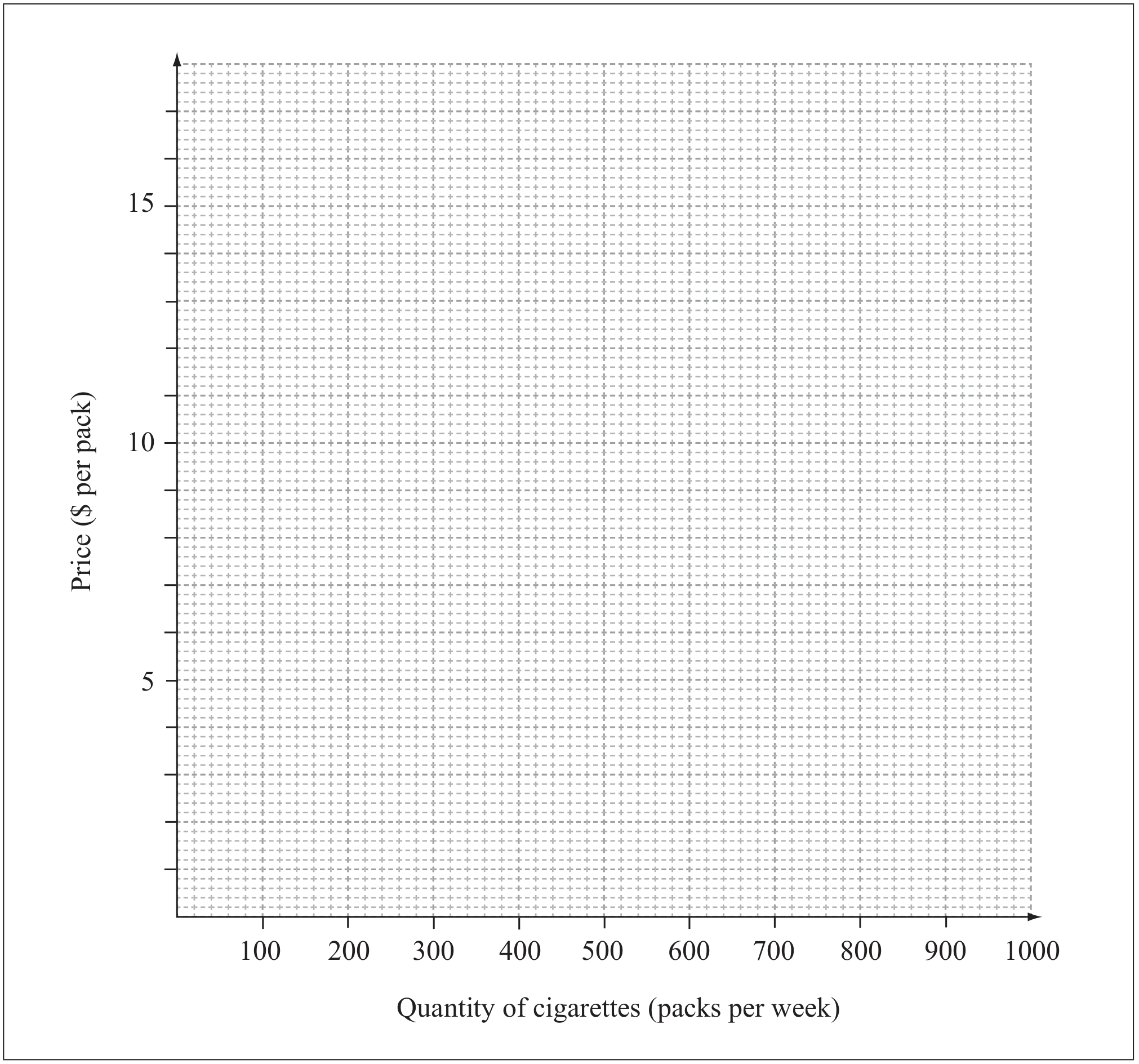
In order to discourage the consumption of cigarettes, the government imposes a specific indirect tax of $6 per pack.

On the above graph, plot the new supply curve to illustrate the effect of the indirect tax.

[ 2 ]

Question 1(d)

(b)

On the axes below, sketch a diagram and use it to explain how the new supply curve would have been different if the government had imposed an ad valorem tax on cigarettes.

Question image
[ 4 ]

Question 1(e)

(c)

Calculate the total weekly revenue earned by the government from the specific tax.

[ 2 ]

Question 1(f)

(d)

Calculate the change in weekly consumer spending on cigarettes in Burbia as a result of the tax.

[ 3 ]

Question 1

[Maximum number: 2]

1. Study the extract below and answer the questions that follow.
Taxes on junk food and sugary drinks

(1) Some countries are considering indirect taxes on junk food or sugary drinks to reduce their consumption and increase government tax revenues. Over-consumption of goods with a high fat or sugar content has negative externalities, because it leads to obesity, serious health problems and additional health care costs. The principle behind such taxes is the same as taxes imposed on cigarettes and alcohol. These taxes are known as "fat taxes".

(2) In the United Kingdom (UK), discussions focus on a tax on processed foods, snacks and sugary drinks. Another possibility would be to impose a tax on full-fat milk, butter and cheese, in order to induce consumers to switch to less fattening substitute products with a lower fat content. Foods with a high fat content are linked to heart disease and premature death.

(3) In the United States, some states are considering imposing a tax on sugary drinks to raise funds for health care. Denmark already has a tax on these drinks and is planning a new tax on some high-fat dairy products.

(4) However, research indicates that such taxes would have a disproportionately large effect on low income households. One reason is that low income individuals tend to consume a larger amount of foods with a high fat content because these are cheaper. This is an important reason why low income individuals tend to be less healthy than wealthier people. It has also been argued that low income individuals respond to higher food prices by eating smaller quantities of healthy food.

(5) Food manufacturers have been angered by the idea of a "fat tax", arguing that the public would rebel against it.

(6) Studies have shown that the demand for most categories of foods and beverages is price inelastic. According to a representative of the Food and Drink Federation in the UK, "the fat tax may be a perfectly sensible issue to debate, but such a regressive taxation policy would reduce the purchasing power of consumers". He argues that it would be better if food manufacturers voluntarily improved their products. of food prices on consumption: a systematic review of research on the price elasticity of demand for food.' (2010) American Journal of Public Health, 1 February 2010; and 'Hard truths about soda taxes.' Human Events, 6 July 2010.]

Question 1(a)

(a)

Define the following terms indicated in bold in the text:

[ 2 ]

Question 1(a)(i)

(i)

indirect taxes (paragraph (1)

[ 2 ]
0 selected