EduNinja

IB Economics HL2.3 Competitive market equilibriumQuestion Bank

Question 1

[Maximum number: 2]

1. Capsicum prices reach NZ $ 24 per kilogram
The price of capsicums, a common vegetable in New Zealand, reached an all-time high of NZ$24 per kilogram (kg) in 2021. Vegetable prices in New Zealand rose 15\% in 2021, driven by higher prices for cucumbers, lettuce, capsicums and broccoli.
A consumer prices analyst said "prices for many vegetables typically rise in winter. However, we are seeing larger rises than usual for this time of the year and for a greater number of vegetables." It has been suggested that price increases are larger than usual because of the market power of the supermarkets in New Zealand.
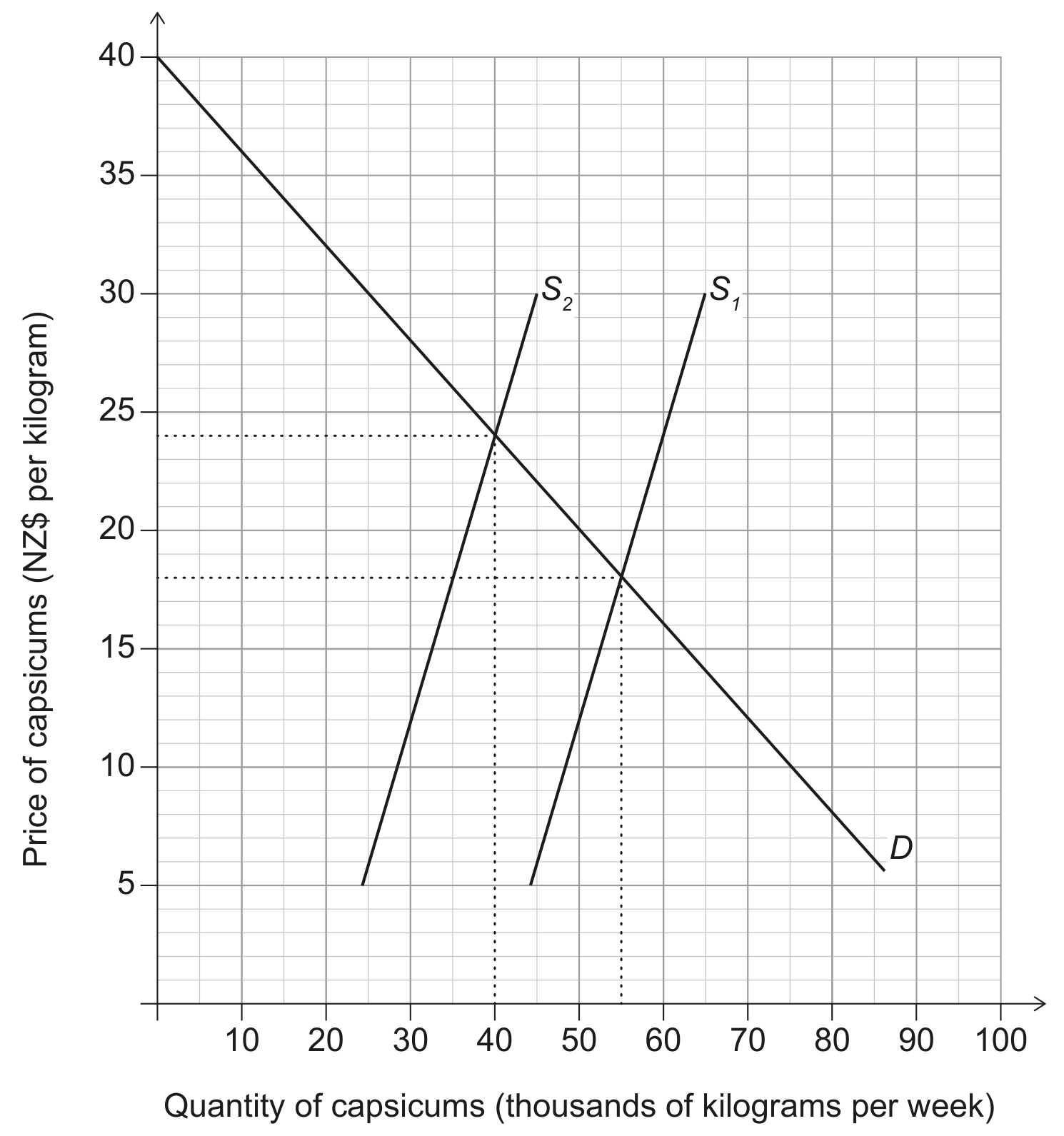
Figure 1 illustrates a decrease in supply in the market for capsicums in New Zealand.

Figure 1

Figure 1

Question 1(a)

Question 1(a)(ii)

(a)
(i)

Calculate the loss in consumer surplus resulting from the increase in the price of capsicums from NZ$18 per kg to NZ$24 per kg.

Assume that the rate of indirect tax on capsicums in New Zealand is 20 %. The price of capsicums includes the indirect tax.

[ 2 ]

Question 1

[Maximum number: 4]

Study the extract below and answer the questions that follow.
EU court rules minimum price for cigarettes illegal

(1) The European Court of Justice has ruled that Ireland cannot impose a minimum price on cigarettes. It said that member countries would have to find other ways to combat smoking. This could be achieved by increasing indirect tax on tobacco, but imposing a minimum price would distort fair competition in the market. The ruling is designed to maintain the freedom of manufacturers and importers to benefit from lower costs and greater efficiency.

(2) The judgment said the aim of ensuring that tobacco prices are high can be "adequately" achieved by increasing tax, since any indirect tax rises are, sooner or later, reflected in an increased retail price, without removing the freedom of manufacturers to set prices.

(3) The Irish government had claimed that it needed to fix a high minimum price to discourage smoking. This followed government legislation to ban tobacco advertising and promotion in July 2009. According to a spokesperson from the anti-smoking group ASH (Action on Smoking and Health), this measure helped to prevent retail outlets from making young people feel attracted to buying cigarettes. "Close to 30 % of our population still smoke and 7000 die from tobacco-related disease each year," he said.

(4) It has been argued that increasing the price of cigarettes is one of the most effective ways of curbing harmful smoking and there is a need to make cigarettes less appealing, particularly to young people. The evidence is that banning advertising, introducing minimum pricing and increasing health warnings can all work.

(5) The head of a major retail organization has attacked the idea of minimum pricing for cigarettes. He argued that artificially fixing a minimum price would not be effective. Also, since the demand for tobacco is inelastic, raising the price would not work. Moreover, it was against the free market for a government to set prices for any product available to consumers, limiting their freedom to choose.

Question 1(b)

(a)

Using an appropriate diagram, explain the possible effect on the market for cigarettes of the ban on tobacco advertising in Ireland.

[ 4 ]

Question 1

Question 1(a)

(a)

With reference to the concept of excess demand, explain how a decrease in supply of a good would lead to a new market equilibrium.

[ 10 ]

Question 1

Question 1(a)

(a)

With reference to demand and supply in competitive markets, explain how the economic question "what to produce" is answered.

[ 10 ]

Question 1

Question 1(a)

(a)

Explain how changes in price work to reallocate resources in a market.

[ 10 ]

Question 1

Question 1(a)

(a)

Using diagram(s), explain the signalling and incentive functions of price.

[ 10 ]

Question 1

[Maximum number: 2]

A report into fitness levels in the United States of America (USA) says that only about 23 % of all USA adults get the recommended amount of exercise. Walking, cycling, swimming, playing sports or doing domestic jobs such as gardening can all contribute to personal fitness. The following information is a cause for concern:
- Only one in three children are physically active every day.
- Less than 5 % of adults participate in 30 minutes of physical activity each day.
- Children now spend more than seven hours per day in front of a screen (for example, televisions, video game devices, computers).

At the same time, there has been a significant increase in demand for memberships at gyms (fitness centres), causing the fitness industry to grow by 8.7 % in the past few years.

Despite the increase in gym memberships, there is still concern about the lack of exercise in the USA. This is particularly important, as physical inactivity is estimated to result in USD 130 billion in annual healthcare spending and causes a significant reduction in the productivity of labour.

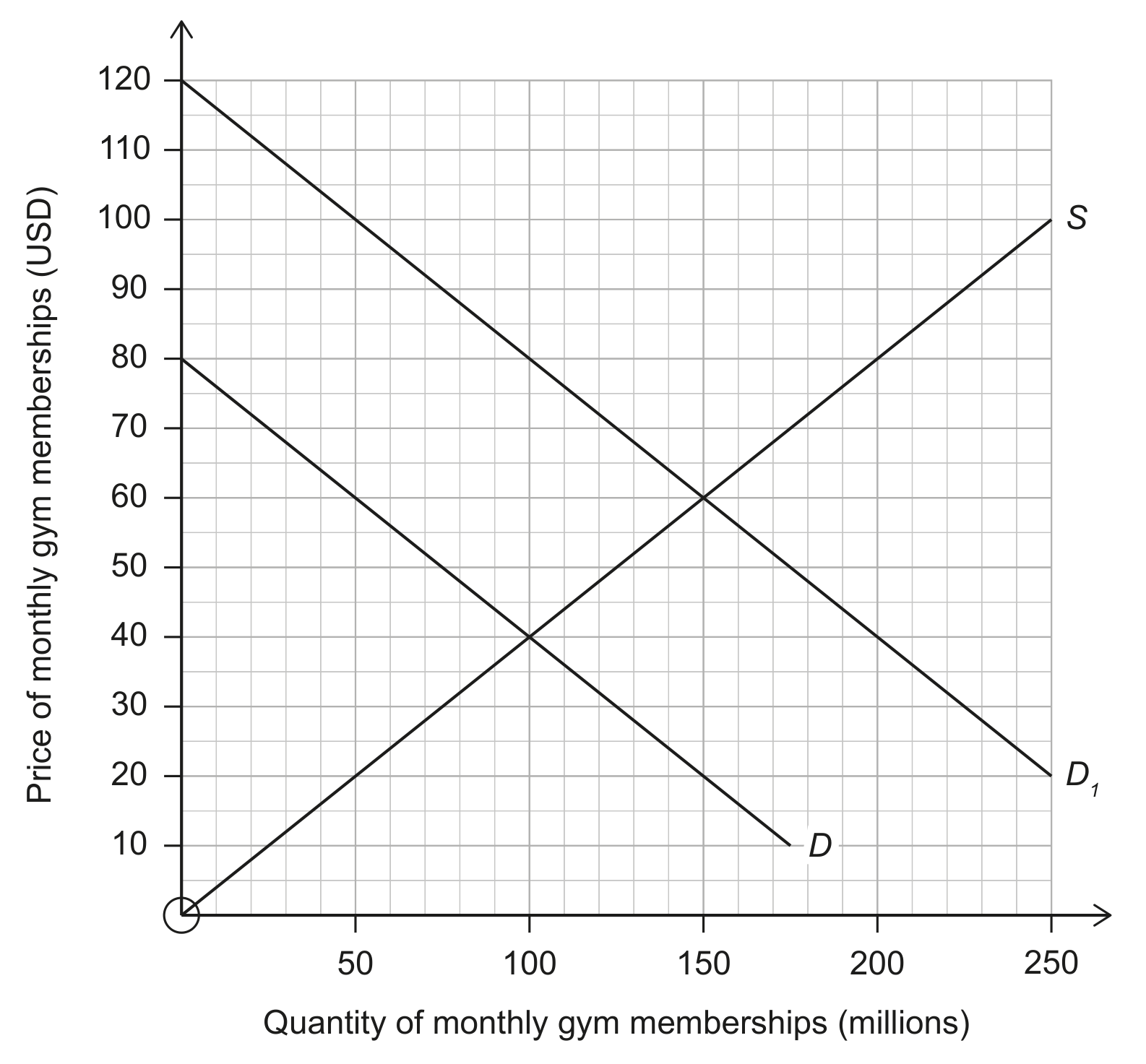
Figure 1 illustrates the market for gym memberships in the USA. D represents the demand for and S represents the supply of gym memberships. D1D_{1} represents the increased demand for gym memberships in recent years.

Figure 1

Figure 1

Question 1(a)

Question 1(a)(i)

(a)
(i)

Using Figure 1, calculate the change in consumer surplus resulting from the increased demand for gym memberships.

[ 2 ]

Question 1

[Maximum number: 4]

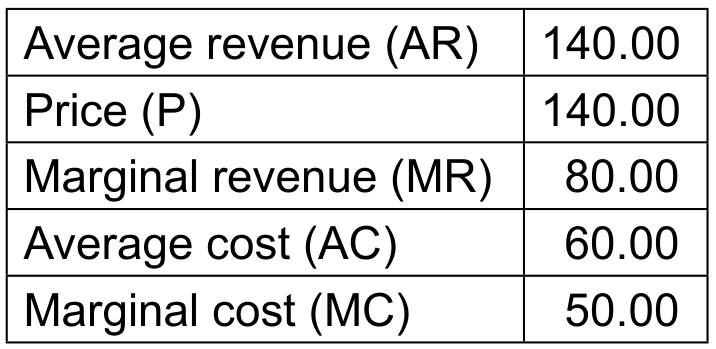
Firm A, a firm with monopoly power, is producing at a level of output Q' equal to 150000 units per month for which the following are true (all figures are in dollars ($)):

Table 1

Table 1

The values in Table 1 imply the following:

P=AR>MR>AC>MC\mathrm{P}=\mathrm{AR}>\mathrm{MR}>\mathrm{AC}>\mathrm{MC}

Question 1(d)

(a)

Explain why allocative efficiency is achieved, in the absence of externalities, at a level of output where price (average revenue) is equal to marginal cost.

[ 4 ]

Question 1

[Maximum number: 2]

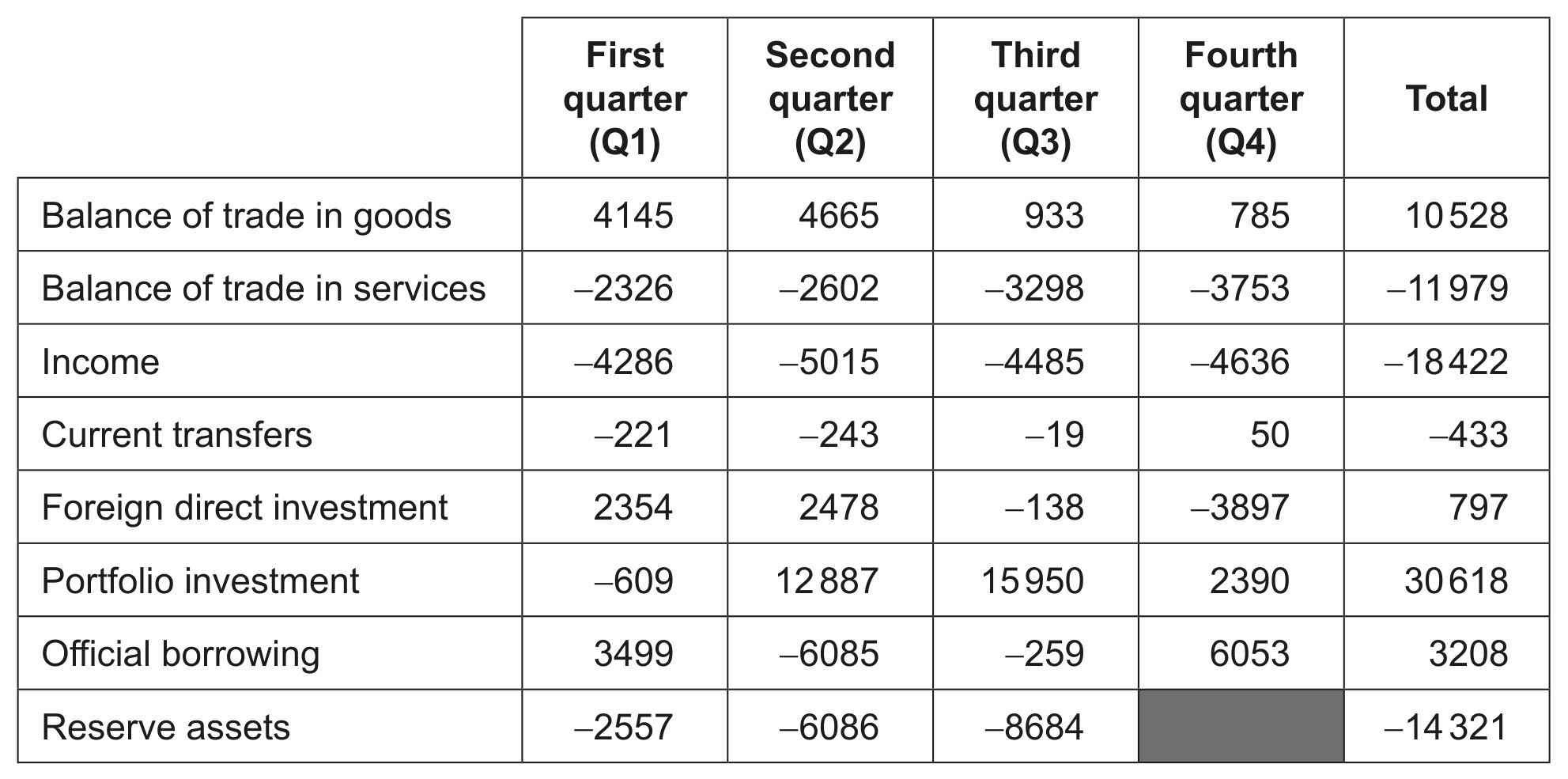
Table 1 shows information from the balance of payments for Chile for each quarter (3-month period) of 2021.

Table 1: Balance of payments for Chile in millions of US dollars (US\$) in 2021

Table 1: Balance of payments for Chile in millions of US dollars (US\$) in 2021

Question 1(a)

Question 1(a)(v)

(a)
(i)

Using Figure 1, calculate the social/community surplus in the salmon market in Chile after the increase in the price of salmon from US$5.20 to US$8.40 per kg.

[ 2 ]

Question 1

[Maximum number: 2]

The demand for a product in a perfectly competitive market is given by the function

Q d=64-2 P

while market supply is given by the function

Q s=4 P-8

where P is the price per unit in dollars ($), Qd is the monthly quantity demanded and Qs is the monthly quantity supplied in thousands of units.

Question 1(b)

(a)

Calculate the equilibrium price and the equilibrium quantity in this market.

[ 2 ]
0 selected