
EduNinja

IB Economics HL2.1 DemandQuestion Bank

Question 1

[Maximum number: 2]

Read the extracts and answer the questions that follow.
Text A - Overview of Tanzania

(1) Tanzania is one of Africa's fastest growing economies with an average of 7 % annual economic growth since 2000. It is a politically stable country, rich in wildlife and natural resources. However, the growth has been concentrated in urban manufacturing, using capital intensive production. The benefits from this growth have not reached all people and significant inequalities exist between urban and rural areas. Although the relative poverty rate has fallen over the last 15 years, the number of people living in absolute poverty has increased.

(2) Most people are employed in the slow-growing agricultural sector that relies on unskilled labour. Although incomes increased from 2008 to 2018, the demand for agricultural goods only increased by 21 % during this time period. Over 70 % of Tanzania's population lives in rural areas, relying on subsistence farming with limited tradable crops. Only 30 % of land is being used for agricultural production. With investment, the remaining unused land could be developed and generate income for farmers.

(3) The rural sector struggles to meet Tanzania's food requirements due to low levels of skilled labour and productivity. Additionally, high youth unemployment leads to large numbers of unskilled rural youth migrating to the cities, often finding employment in the informal sector where wages and working conditions are poor. Insufficient investment and lack of government support for diversifying the agriculture sector have been blamed for the persistent inequalities and poverty.

(4) Tanzania's cities have experienced a growing middle class with strong purchasing power and political influence who have placed demands on the government for cheaper electricity, better infrastructure, and more imported goods. In response, the government provided subsidies for electricity in city centres and tax benefits to foreign companies operating in Tanzania. There is concern that these measures may worsen inequality and lead to social unrest.

(5) The growth of Tanzania's manufacturing and service sector was funded through aid and large government borrowing, resulting in high national debt. Most of the government borrowing was from foreign sources and in US dollars (US$), which is a concern due to a recent depreciation of the Tanzanian shilling (Tanzania's currency) against the US$. Some of the debt was borrowed domestically and placed upward pressure on interest rates. Higher interest rates have resulted in crowding out but helped keep inflation under control.
Text B - Strategies and opportunities for Tanzania

(1) Previous governments have used interventionist supply-side policies to improve access to water, education, and health services. However, the health service improvements are not keeping up with population growth and many young people are still not completing secondary school. Infrastructure has improved, but it is still insufficient as producers in the rural sector find it difficult to reach markets and access supplies.

(2) Aid organizations are currently supporting new sustainable businesses in rural areas through training programmes, especially for women and young people, who make up most of the unemployed in rural areas. Economists have advised the government to improve access to credit through microfinance organizations and to simplify regulations to make it easier to start new businesses.

(3) The government is establishing property rights in rural areas to provide security for farmers. Historically, farmers could easily lose their land, which reduced their incentive to invest in productive farming methods. The government wants to develop Tanzania's land resources and lower its reliance on imported food. To reduce food imports, a subsidy will be granted to dairy farmers to allow them to compete against imported dairy products.

(4) Tanzania is a member of the East African Community (EAC) customs union and common market. However, Tanzania needs to improve human capital and encourage diversification so that the benefits of regional integration can reach the poor. These policies can also help attract foreign direct investment (FDI). Opportunities for growth through trade will expand as the EAC works towards becoming a monetary union in 2024.
Text C - Oil pipeline to be constructed
Tanzania and Uganda plan to construct a major oil pipeline from Uganda through Tanzania, ending at a port in Tanzania. This will attract FDI which could help fund infrastructure and generate jobs. However, environmentalists are concerned about potential ecological damage due to the waste created during the construction of the pipeline. Economists have suggested the waste could be avoided through a circular economy approach in the planning and construction stage.
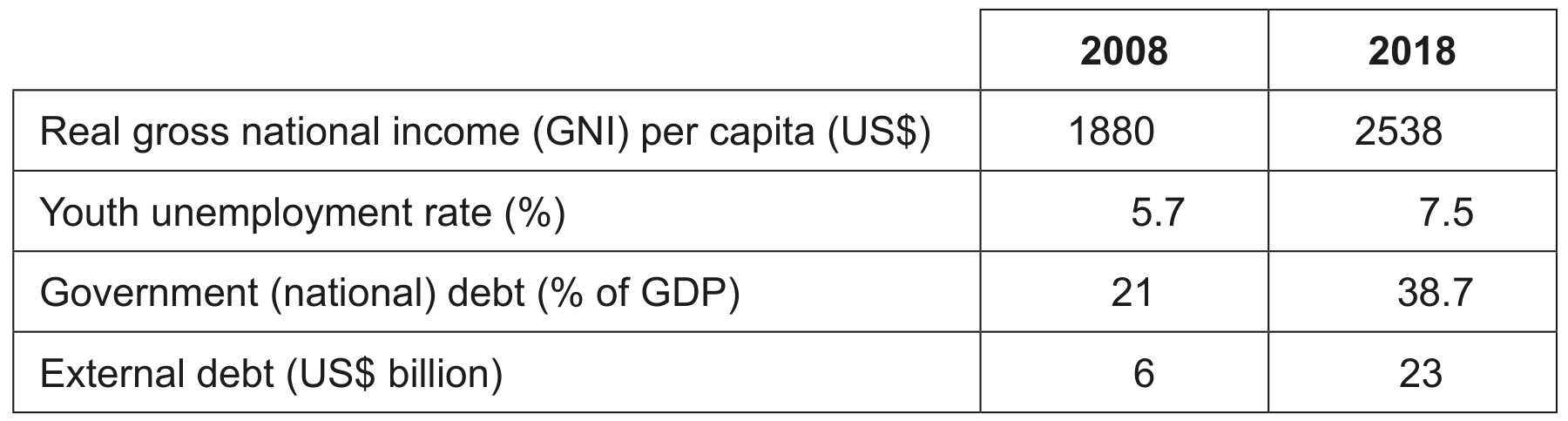
Table 1: Economic data for Tanzania
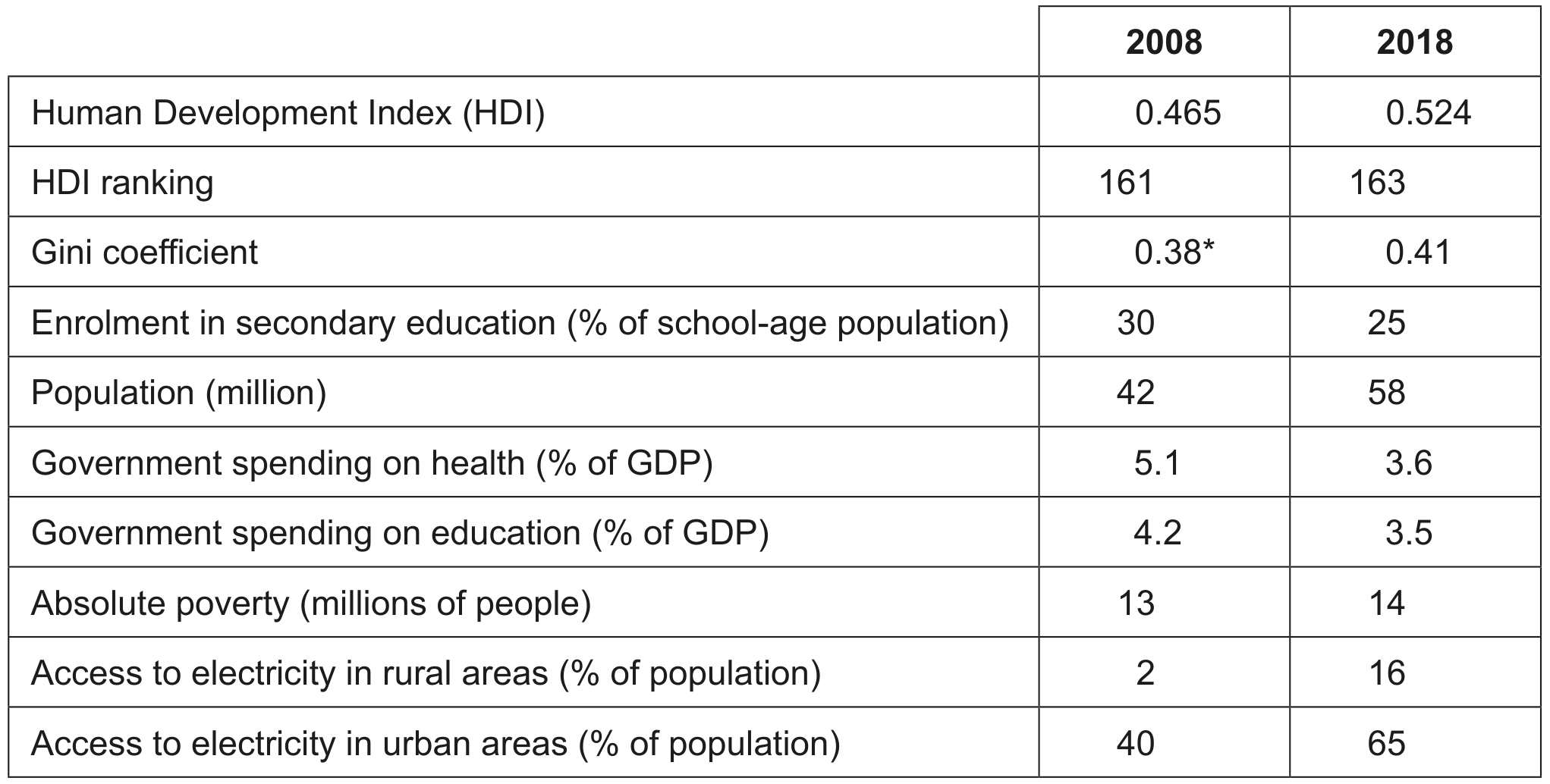
Table 1: Economic data for Tanzania

Table 2: Development data for Tanzania

Table 2: Development data for Tanzania

* Estimate

Question 1(a)

Question 1(a)(i)

(a)
(i)

Define the term demand indicated in bold (Text A, paragraph 2).
[ 2 ]

Question 1

Question 1(a)

(a)

In the small town of Burbia, the weekly demand and supply functions for a pack of cigarettes are as follows

QD=700−25PQS=100+50PQ_{D}=700-25 P \quad Q_{S}=100+50 P

Where QDQ_{D} and QSQ_{S} are quantities in packs per week and P is the price per pack in dollars.

[ 2 ]

Question 1(a)(ii)

(i)

Calculate the price which would result in a demand of 475 packs per week.

[ 2 ]

Question 1

[Maximum number: 4]

Note that widgets and pidgets are imaginary products.

In the country of Burbia, the demand and supply of widgets are given by the functions

Qd=249−4PQs=150+14P\begin{aligned} & Q d=249-4 P \\ & Q s=150+14 P \end{aligned}

where Qd is the quantity demanded per month, Qs is the quantity supplied per month and P is the price per widget in dollars ($).

Question 1(d)

(a)

Using an example, outline why the assumption of ceteris paribus is necessary when analysing the effect of a change in price on the quantity demanded of a product.

[ 2 ]

Question 1(e)

(b)

Widgets and Pidgets have negative cross price elasticity of demand (XED).

Explain how the demand function for Widgets, Qd=249-4 P, is likely to change as a result of an increase in the price of Pidgets.

The demand for widgets is considered to be unit elastic at the current price.

[ 2 ]

Question 1

[Maximum number: 1]

The demand for a product in a perfectly competitive market is given by the function

Q d=64-2 P

while market supply is given by the function

Q s=4 P-8

where P is the price per unit in dollars ($), Qd is the monthly quantity demanded and Qs is the monthly quantity supplied in thousands of units.

Question 1(c)

(a)

Using the functions, plot the following in the grid below:

[ 1 ]

Question 1(c)(i)

(i)

a fully labelled market demand curve.

[ 1 ]

Question 1

[Maximum number: 2]

In Ruritania, the demand for butter is given by the function

Qd=420-19P

where Qd is the quantity of butter demanded per year, in millions of kilogrammes (kg), and P is the price of butter in dollars ($) per kg.

Question 1(a)

(a)

Calculate the quantity of butter demanded per year when price per kg is:

[ 2 ]

Question 1(a)(i)

(i)

$ 7;

[ 1 ]

Question 1(a)(ii)

(ii)

$ 10.

[ 1 ]

Question 1

[Maximum number: 4]

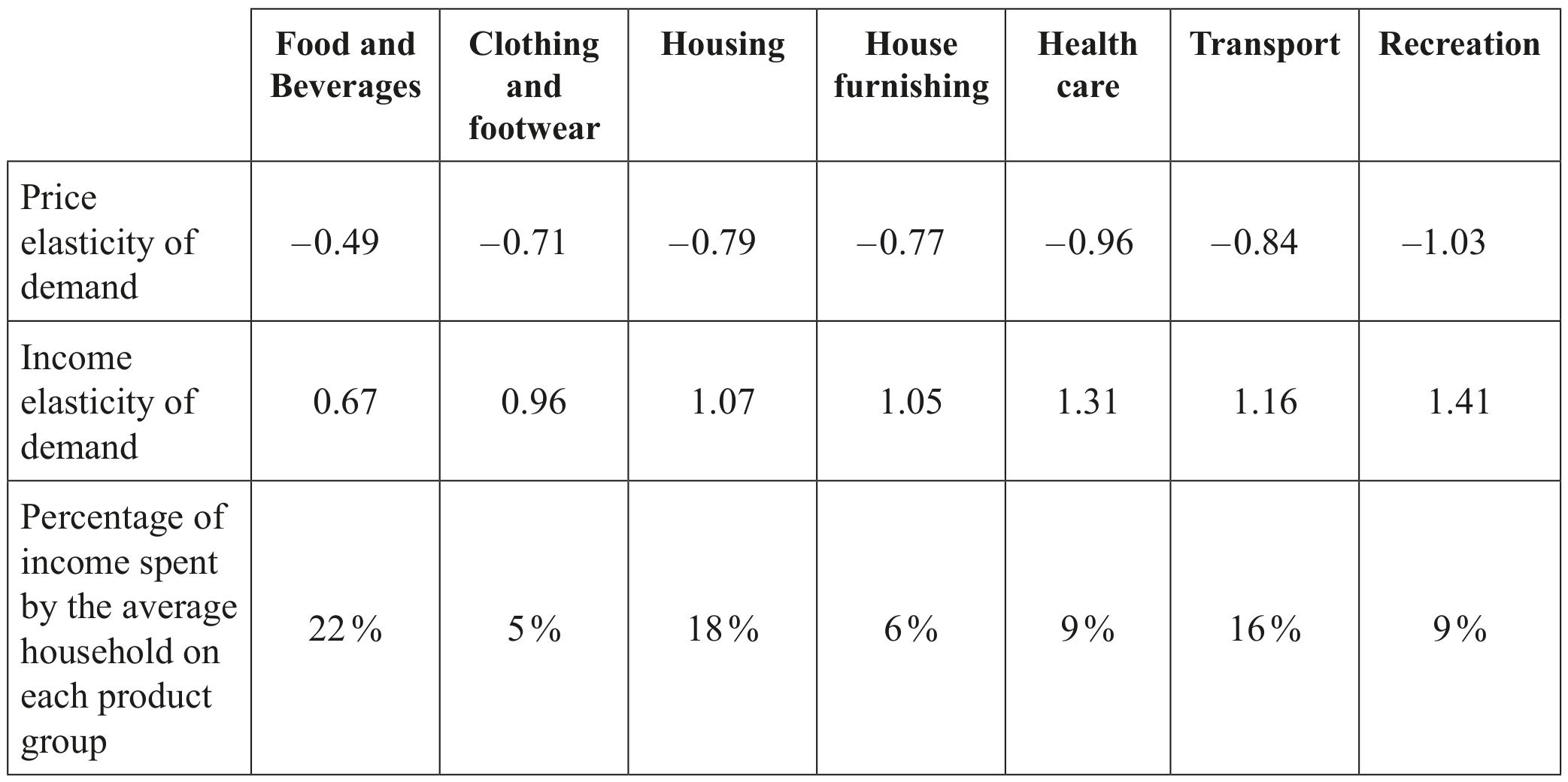
The table below shows data for price elasticity of demand and income elasticity of demand for seven product groups in Argentina in 2008.

Table

There are concerns about rising food prices and their impact on households. Economists have forecast that rising food prices may have a negative effect on the demand for goods in other product groups.

Question 1(c)

(a)

The cross price elasticity between housing and house furnishing was estimated to be equal to -0.4 . Using this cross price elasticity data, explain the possible impact that an increase in house prices might have on the demand for house furnishing.

[ 4 ]

Question 1

[Maximum number: 4]

1. Study the extract below and answer the questions that follow.
Taxes on junk food and sugary drinks

(1) Some countries are considering indirect taxes on junk food or sugary drinks to reduce their consumption and increase government tax revenues. Over-consumption of goods with a high fat or sugar content has negative externalities, because it leads to obesity, serious health problems and additional health care costs. The principle behind such taxes is the same as taxes imposed on cigarettes and alcohol. These taxes are known as "fat taxes".

(2) In the United Kingdom (UK), discussions focus on a tax on processed foods, snacks and sugary drinks. Another possibility would be to impose a tax on full-fat milk, butter and cheese, in order to induce consumers to switch to less fattening substitute products with a lower fat content. Foods with a high fat content are linked to heart disease and premature death.

(3) In the United States, some states are considering imposing a tax on sugary drinks to raise funds for health care. Denmark already has a tax on these drinks and is planning a new tax on some high-fat dairy products.

(4) However, research indicates that such taxes would have a disproportionately large effect on low income households. One reason is that low income individuals tend to consume a larger amount of foods with a high fat content because these are cheaper. This is an important reason why low income individuals tend to be less healthy than wealthier people. It has also been argued that low income individuals respond to higher food prices by eating smaller quantities of healthy food.

(5) Food manufacturers have been angered by the idea of a "fat tax", arguing that the public would rebel against it.

(6) Studies have shown that the demand for most categories of foods and beverages is price inelastic. According to a representative of the Food and Drink Federation in the UK, "the fat tax may be a perfectly sensible issue to debate, but such a regressive taxation policy would reduce the purchasing power of consumers". He argues that it would be better if food manufacturers voluntarily improved their products. of food prices on consumption: a systematic review of research on the price elasticity of demand for food.' (2010) American Journal of Public Health, 1 February 2010; and 'Hard truths about soda taxes.' Human Events, 6 July 2010.]

Question 1(c)

(a)

Using an appropriate diagram, explain how a tax on foods with a high fat content is expected to impact on the market for substitute products with a lower fat content (paragraph 2).

[ 4 ]

Question 3

[Maximum number: 10]

Explain why demand curves may not always slope downward from left to right.

Question 2

Question 2(a)

(a)

Explain the factors which might influence the cross price elasticity of demand between different products.

[ 10 ]

Question 3

Question 3(b)

(a)

State the new equation for demand.

[ 1 ]
0 selected