
EduNinja

Edexcel IAL Biology A2 Topic 6 Microbiology and immunity

Edexcel IAL Biology A2 Topic 6 Microbiology and immunity
Pearson Edexcel IAL Biology syllabusBiology YBI11First assessment 2019

Choose the correct culture or measurement method, interpret microbial and immune data and connect pathogen structures or transmission routes to host defence outcomes.

Exam points

  • Justify aseptic culture, dilution plating and microbial measurement methods.
  • Interpret growth curves, colony counts or turbidity and calculate growth constants.
  • Link pathogen structure and transmission evidence to barriers and immune responses.

Question 1

[Maximum number: 5]

Skin flora provide a barrier, protecting the body from infection by bacteria.

Question 1(a)

(a)

Which of the following also act as barriers, protecting the body from infection by bacteria?

A

antigens and stomach acid

B

antigens and interferon

C

interferon and skin

D

skin and stomach acid

[ 1 ]

Question 1(b)

(b)

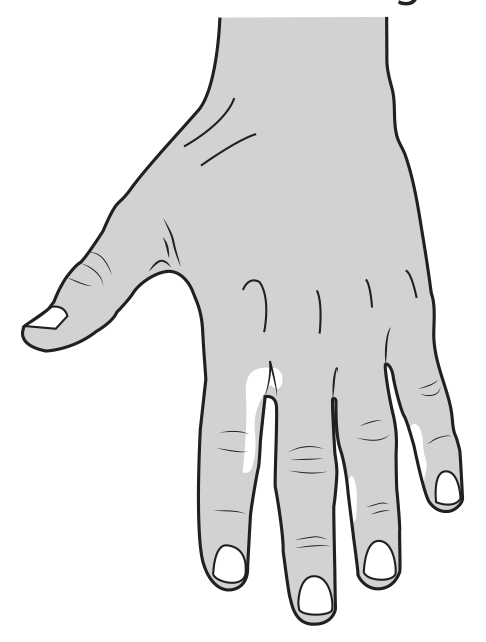
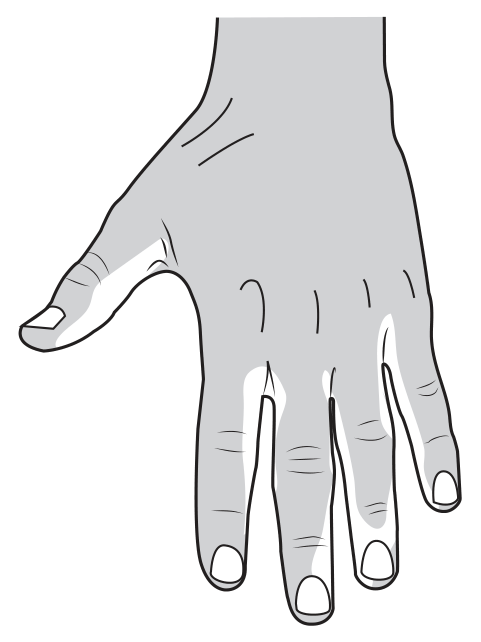
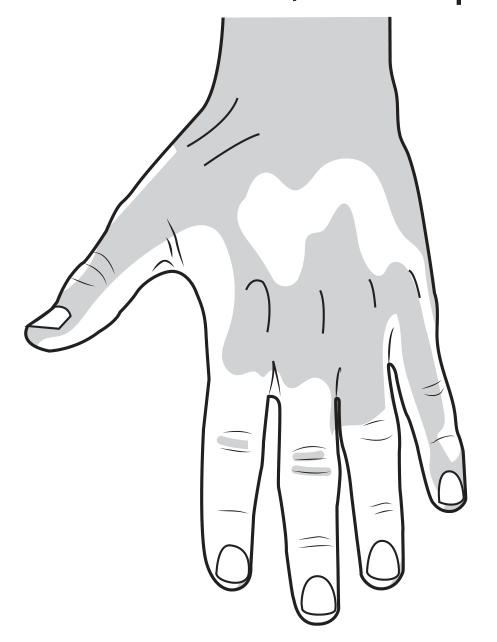
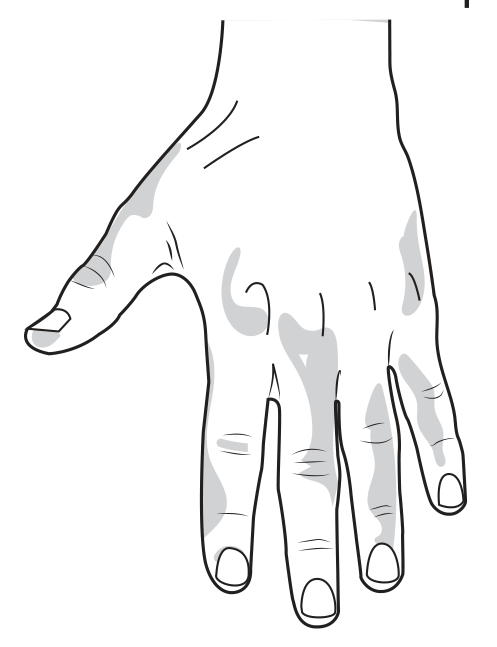
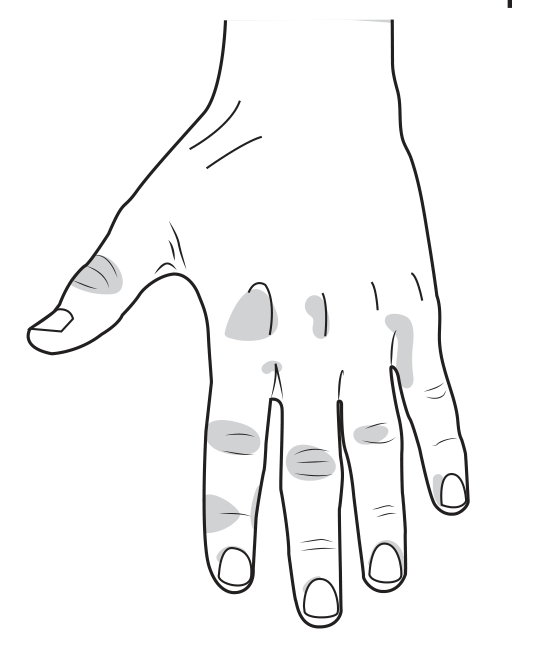
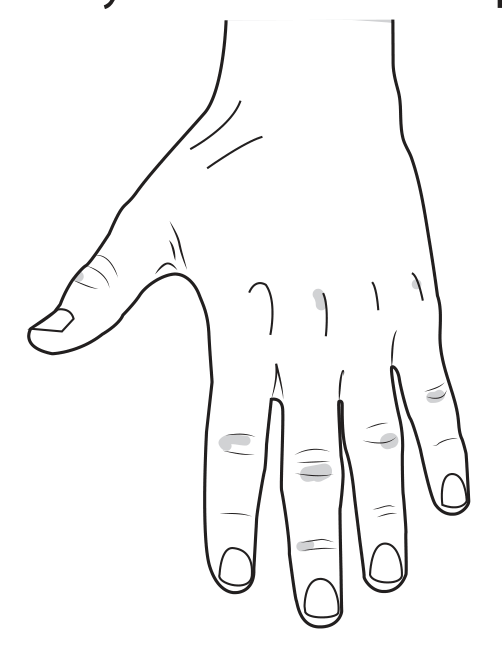
The diagrams show the effects of different methods of washing hands on skin flora.

The dark areas show the presence of microorganisms and the light areas show clean areas.
1. before washing
1. before washing

2. "rinse and shake"
2. "rinse and shake"

3. six seconds, no soap
3. six seconds, no soap

4. six seconds with soap
4. six seconds with soap

5. fifteen seconds with soap
5. fifteen seconds with soap

6. thirty seconds with soap

6. thirty seconds with soap

[ 4 ]

Question 1(b)(i)

(i)

Describe two conclusions that can be made about the different methods of washing hands.
(2)

[ 2 ]

Question 1(b)(ii)

(ii)

Explain the differences in the effects that these methods of washing hands have on the skin flora.
(2)
[ 2 ]

Question 1

[Maximum number: 4]

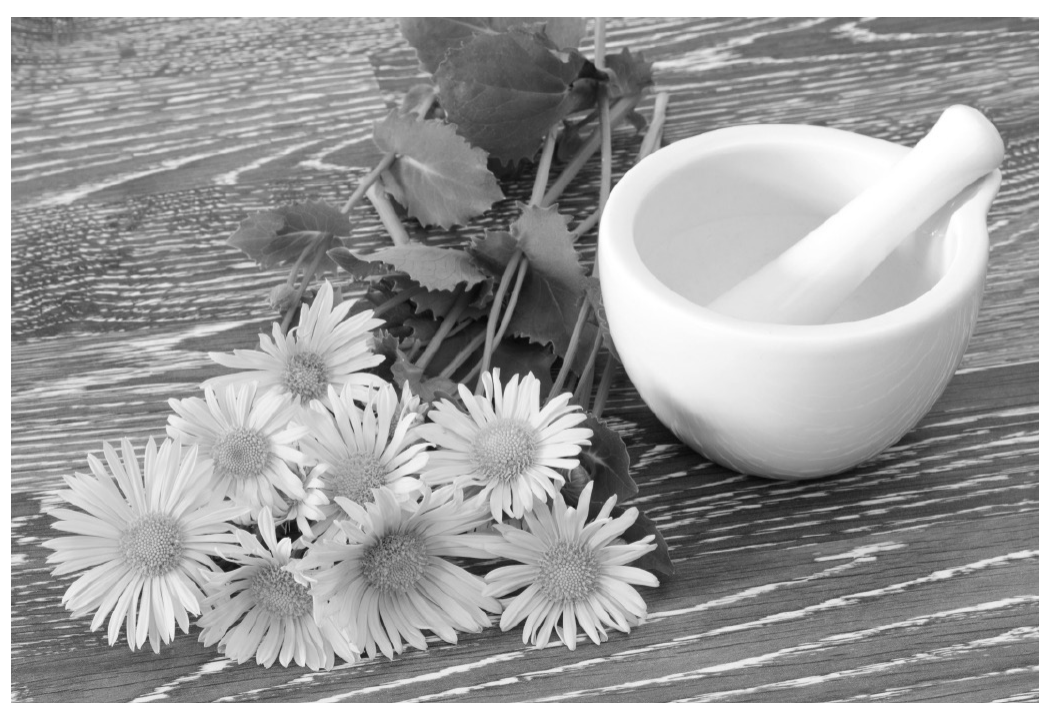
The photograph shows parts of Tussilago farfara. This is a native species of plant that grows in North Africa and Central Asia.

Figure for Question 1 — Edexcel A-Level Biology A2

© Zoonar GmbH / Alamy Stock Photo
This plant can be used as a medicine.

Question 1(b)

(a)

Scientists have isolated antibacterial compounds from plants such as Tussilago farfara.

[ 4 ]

Question 1(b)(i)

(i)

State what is meant by the terms bacteriostatic and bactericidal antibiotics.
(2)

[ 2 ]

Question 1(b)(ii)

(ii)

Explain how the code of practice for prescribing antibiotics helps to control infections.
(2)

[ 2 ]

Question 2

[Maximum number: 8]

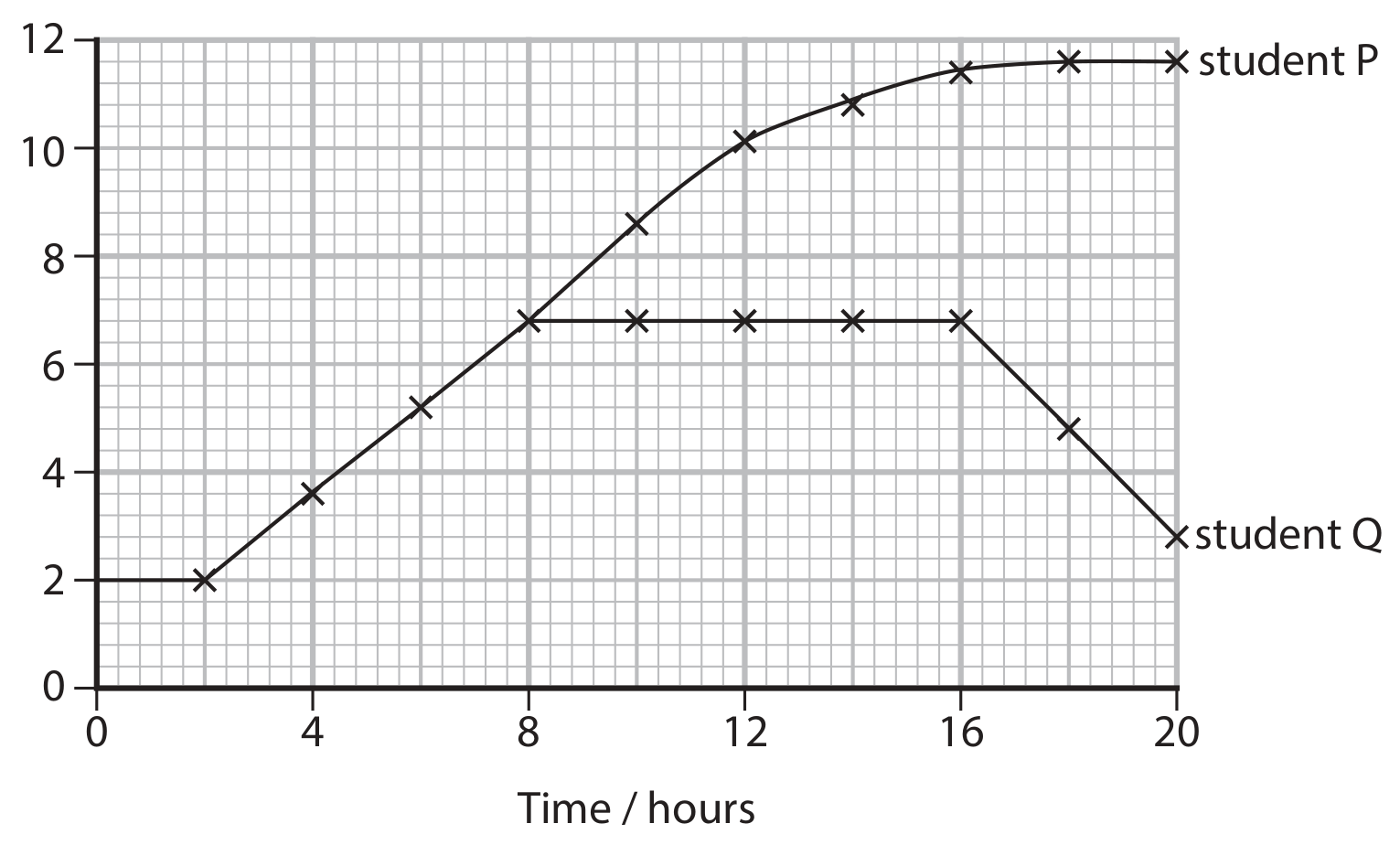
Two students, student P and student Q, each cultured bacteria in a liquid medium for 20 hours.

The culture conditions used by both students were identical.
Every two hours, each student removed a sample of the culture to count the number of bacteria.

Each student used a different method to count the number of bacteria in the samples.

The graph shows the bacterial growth curve that each student drew using their results.
log10\log _{10} number of bacteria per cm3\mathrm{cm}^{3}

Figure for Question 2 — Edexcel A-Level Biology A2

Question 2(a)

(a)

Both students used aseptic techniques to culture the bacteria.

[ 4 ]

Question 2(a)(i)

(i)

Explain the importance of using aseptic techniques to culture bacteria.

[ 2 ]

Question 2(a)(ii)

(ii)

Explain one aseptic technique that should be used when culturing bacteria.
(2)

[ 2 ]

Question 2(b)

(b)

Calculate the growth rate constant ( k ) of these bacteria between 2 hours and 6 hours of culture.

Use the equation: k=log10Ntlog10N00.301×t\quad k=\frac{\log _{10} N_{t}-\log _{10} N_{0}}{0.301 \times t}
where:
log10Nt=log10\log _{10} N_{t}=\log _{10} number of cells at 6 hours
log10N0=log10\log _{10} N_{0}=\log _{10} number of cells at 2 hours.

Answer

[ 2 ]

Question 2(c)

(c)

The number of bacteria in the samples taken after 10 hours were:

398107171 in the culture of student P
6309573 in the culture of student Q.

[ 2 ]

Question 2(c)(ii)

(i)

Student P and student Q used different methods for determining the number of bacteria.

State which method each student used.
Give a reason for your answer.
(2)

Student P

Student Q

[ 2 ]

Question 5

[Maximum number: 10]

Herpes simplex is a virus that causes sores around the nose and mouth.
A modified form of this virus has been developed to infect and kill cancer cells in humans.

Question 5(b)

(a)

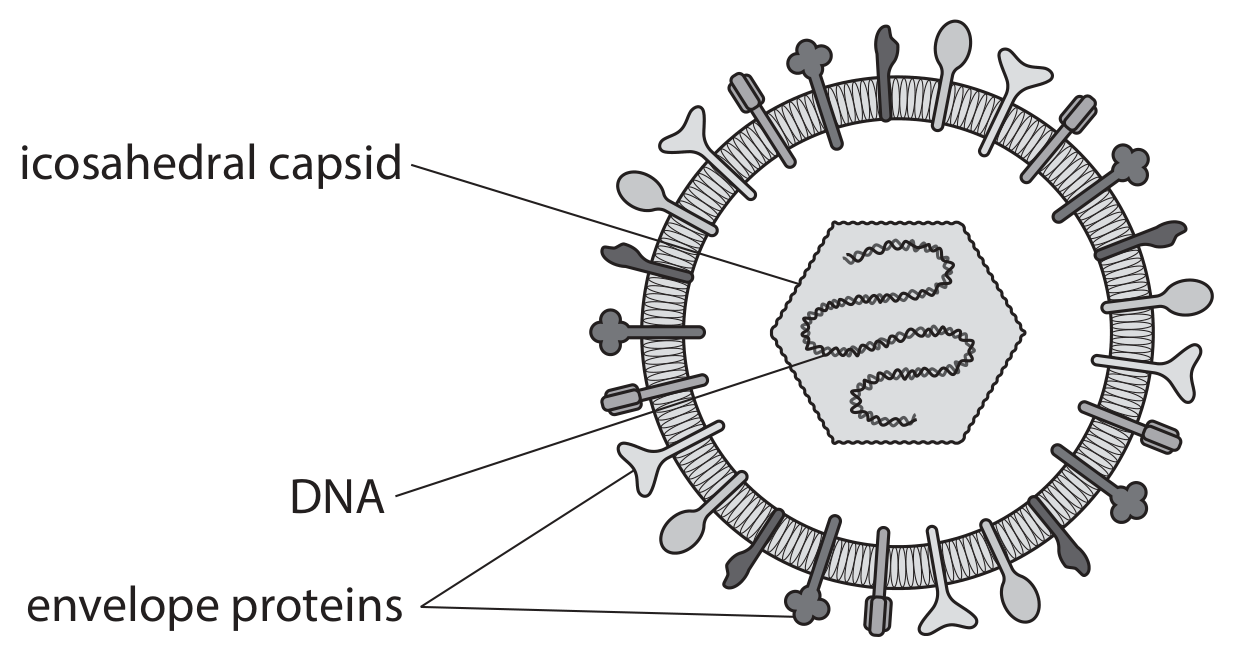
The diagram shows a herpes simplex virus.

Figure for Question 5(b) — Edexcel A-Level Biology A2
[ 6 ]

Question 5(b)(i)

(i)

Which of the following statements are true?

1 Ebola virus has the same type of genetic material as herpes simplex virus
2 Both Ebola virus and human immunodeficiency virus (HIV) have envelope proteins

3 HIV has an icosahedral capsid

A

Statements 1 and 2 only

B

Statements 1 and 3 only

C

Statements 2 and 3 only

D

Statements 1, 2 and 3

[ 1 ]

Question 5(b)(ii)

(ii)

State the function of the envelope proteins.
(1)

[ 1 ]

Question 5(b)(iii)

(iii)

Explain why the herpes simplex virus has to be modified before it can be used to infect cancer cells.
(2)

[ 2 ]

Question 5(b)(iv)

(iv)

Explain how the infection of a cancer cell with herpes simplex virus can result in the death of this cell.
(2)

[ 2 ]

Question 5(c)

(b)

Using a modified herpes simplex virus activates the immune system.

Explain why activation of the immune system would result in destruction of the cancer cells.
(4)

[ 4 ]

Question 6

[Maximum number: 3]

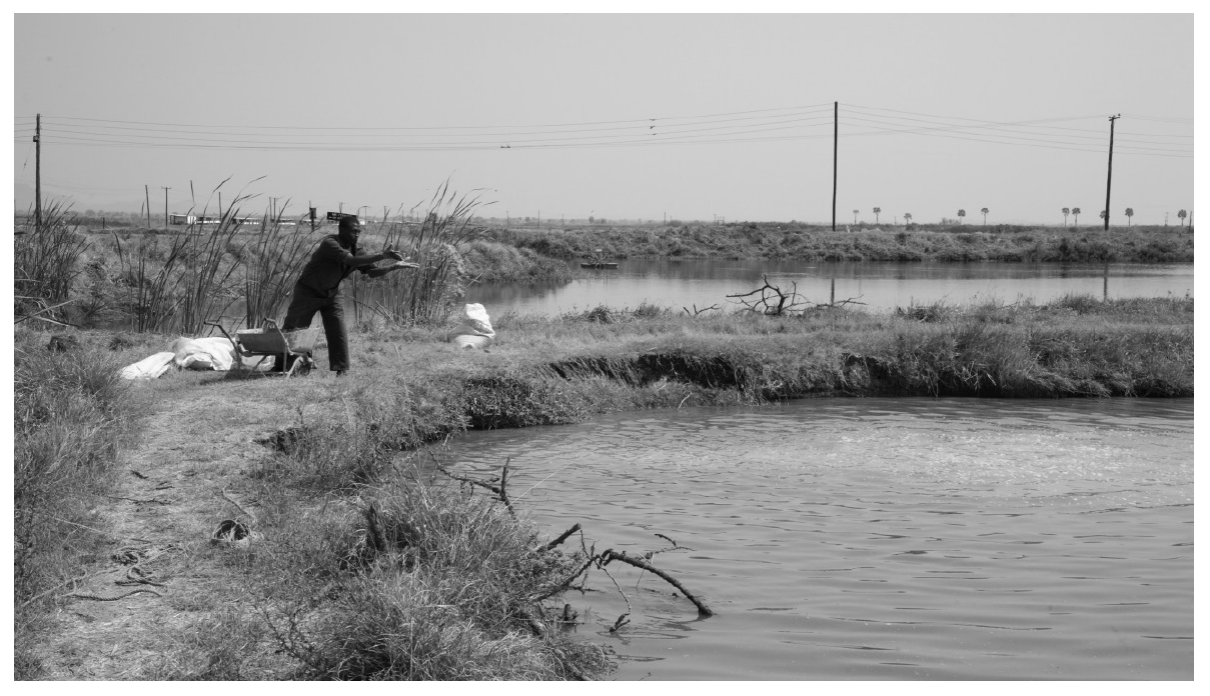
Aquaculture is the controlled cultivation of aquatic organisms such as fish, shellfish and plants. It is an important source of food in many countries of the world.

The photograph shows freshwater aquaculture ponds in Africa.

Figure for Question 6 — Edexcel A-Level Biology A2

Vibrio are bacteria that are common in aquatic habitats. They cause diarrhoea and cholera and are also pathogenic to shellfish.

The resistance of Vibrio to antibiotics and to heavy metals in aquaculture ponds in Nigeria was investigated.

Question 6(c)

(a)

The samples of Vibrio taken from each pond were spread on agar containing different antibiotics.

[ 3 ]

Question 6(c)(ii)

(i)

Some of the antibiotics used were bacteriostatic and some were bactericidal.

State the difference between a bacteriostatic antibiotic and a bactericidal antibiotic.

[ 1 ]

Question 6(c)(iii)

(ii)

The method did not distinguish between bacteriostatic and bactericidal antibiotics because no colonies grew.

Suggest how the method would need to be modified to show which antibiotics were bacteriostatic and which were bactericidal.

Give a reason for your answer.
(2)

[ 2 ]

Question 7

[Maximum number: 8]

Yeast are single-celled eukaryotic microorganisms.

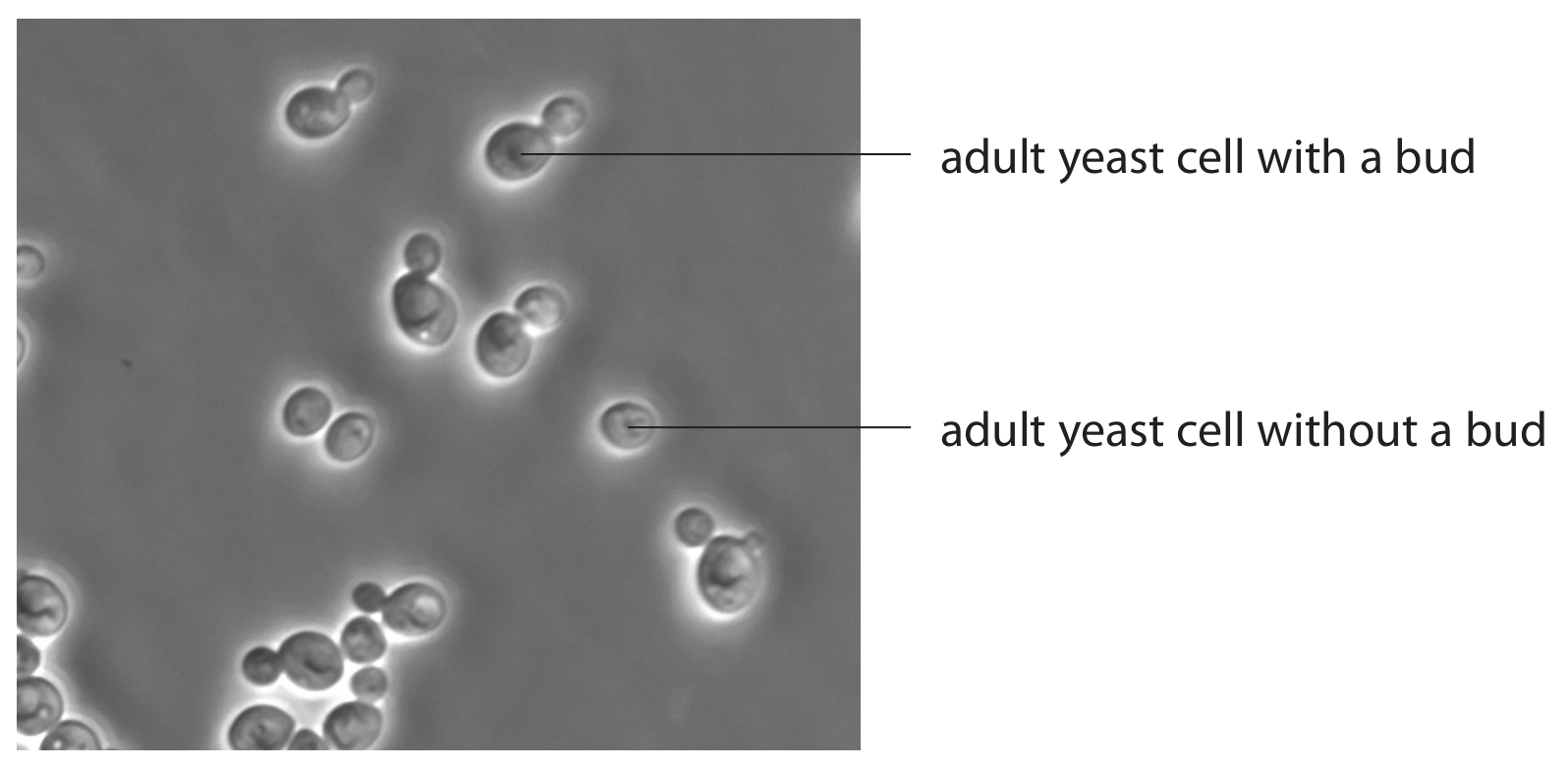
They reproduce asexually by budding. The new yeast cell (bud) grows out of the cell of an adult yeast cell following mitosis.

The photograph shows some yeast cells.

Figure for Question 7 — Edexcel A-Level Biology A2

Question 7(b)

(a)

Yeast cells can be cultured and the rate of growth determined using a haemocytometer (counting chamber / Neubauer chamber).

[ 8 ]

Question 7(b)(i)

(i)

A student had a suspension of yeast cells in a liquid culture and wanted to determine the concentration of yeast cells in this culture.

A sample of this culture was added to the haemocytometer and observed under a light microscope.

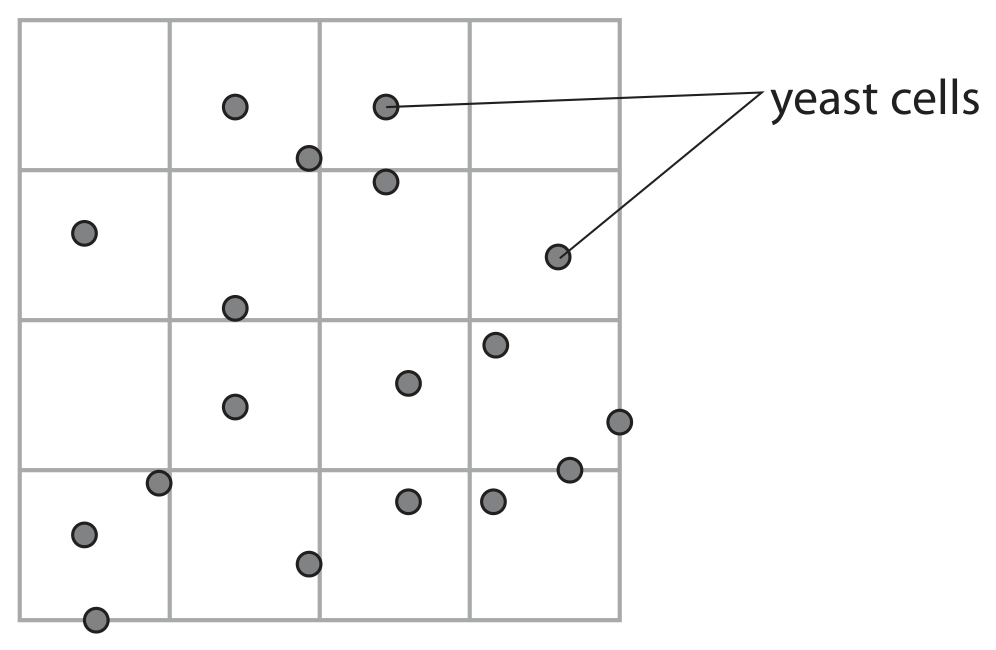
The diagram shows yeast cells in part of the haemocytometer.

Figure for Question 7(b)(i) — Edexcel A-Level Biology A2

The volume of the sample covering this part of the haemocytometer is 0.00625μl0.00625 \mu \mathrm{l}.

1μl=106dm31 \mu \mathrm{l}=10^{-6} \mathrm{dm}^{3}

Explain how to calculate the concentration of yeast cells, in cells per cm3\mathrm{cm}^{3}, in the culture. Include in your answer an explanation of how the number of cells was determined from the diagram of a haemocytometer.
(3)

Explanation

Answer cells per cm3\mathrm{cm}^{3}

Question 7(b)(ii)

(ii)

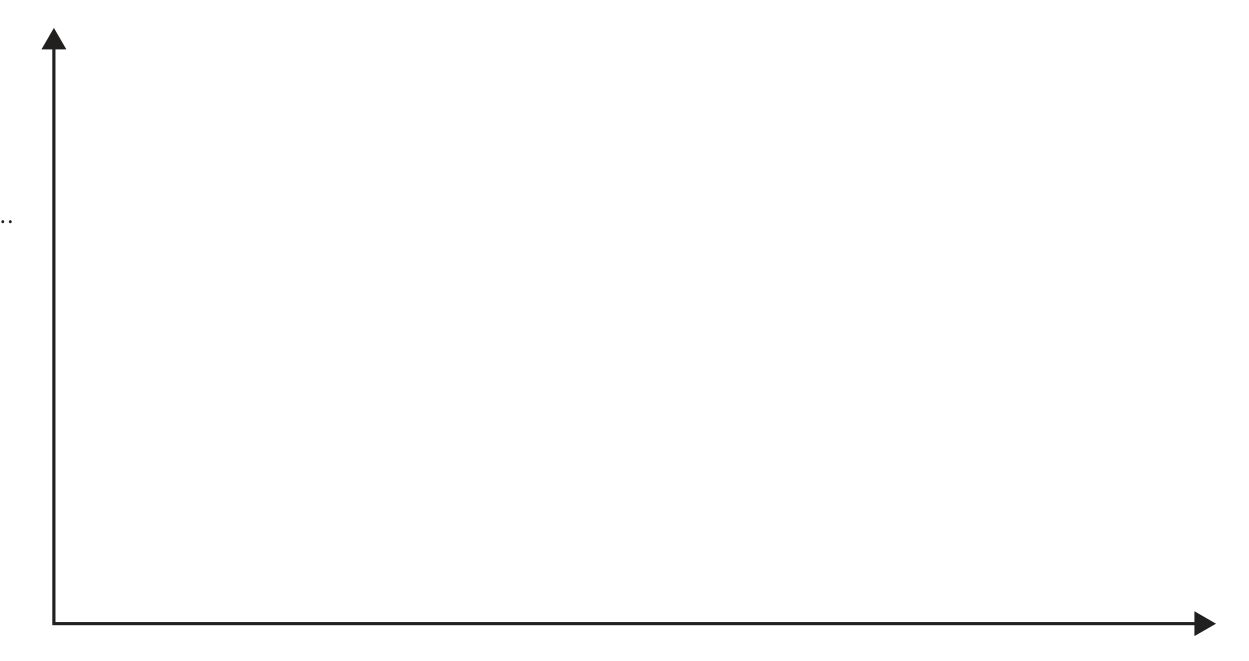
The growth curve for yeast grown in culture has four phases, similar to bacteria grown in culture.

Sketch a growth curve on the axes drawn below.
Label the axes and the four phases of the growth curve.
(4)

Figure for Question 7(b)(ii) — Edexcel A-Level Biology A2
[ 4 ]

Question 7(b)(iii)

(iii)

Describe how the student could use a growth curve to determine the exponential growth rate constant for the yeast.

DO NOT WRITE IN THIS AREADO NOT WRITE IN THIS AREADO NOT WRITE IN THIS AREA
[ 4 ]

Question 8

[Maximum number: 11]

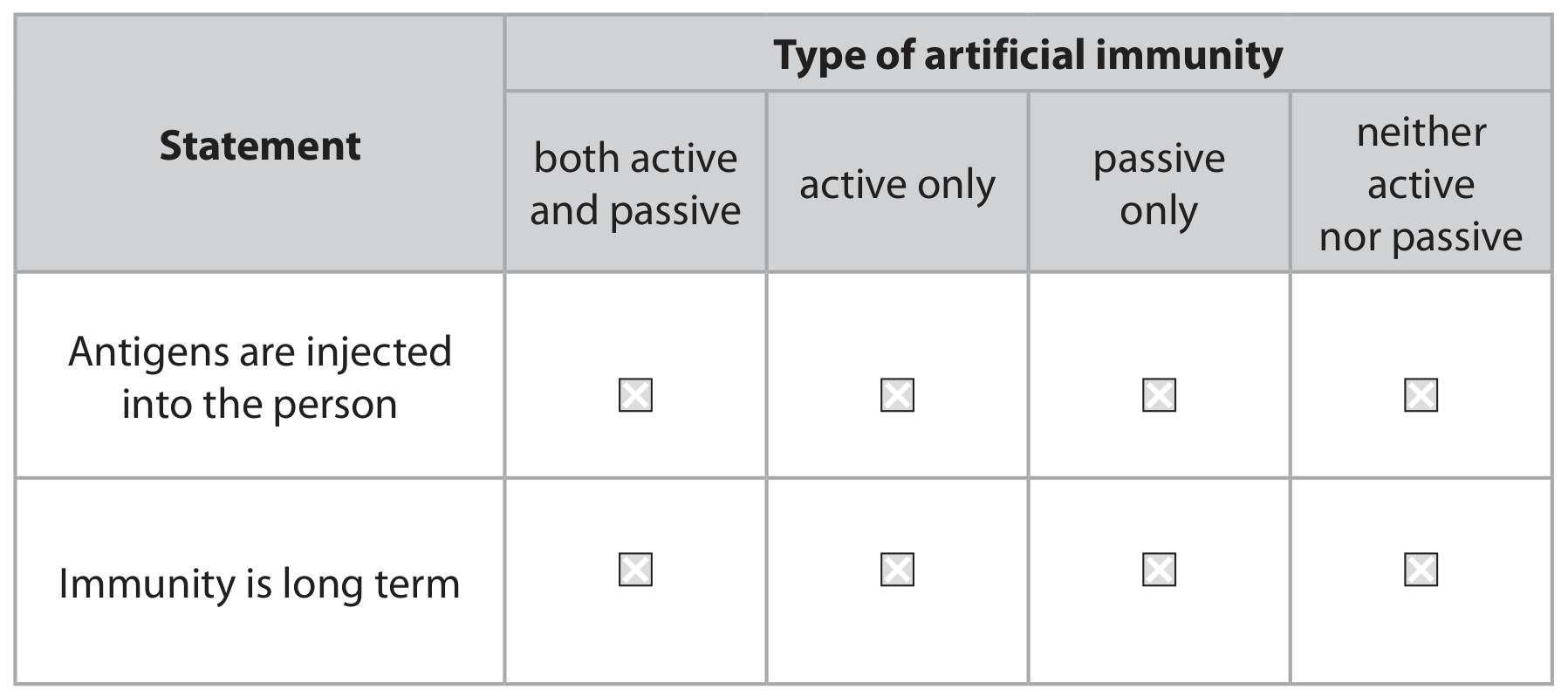
Individuals develop artificial immunity either actively or passively.

Question 8(a)

(a)

The table gives some statements about immunity.

For each statement, put one cross ⊠ in the appropriate box, in each row, to show whether these statements are true for these types of immunity.
(2)

Table for Question 8(a) — Edexcel A-Level Biology A2
[ 2 ]

Question 8(b)

(b)

Vaccination against a virus results in the production of antibodies.

Describe how antibodies are produced following activation of T cells.

[ 2 ]

Question 8(c)

(c)

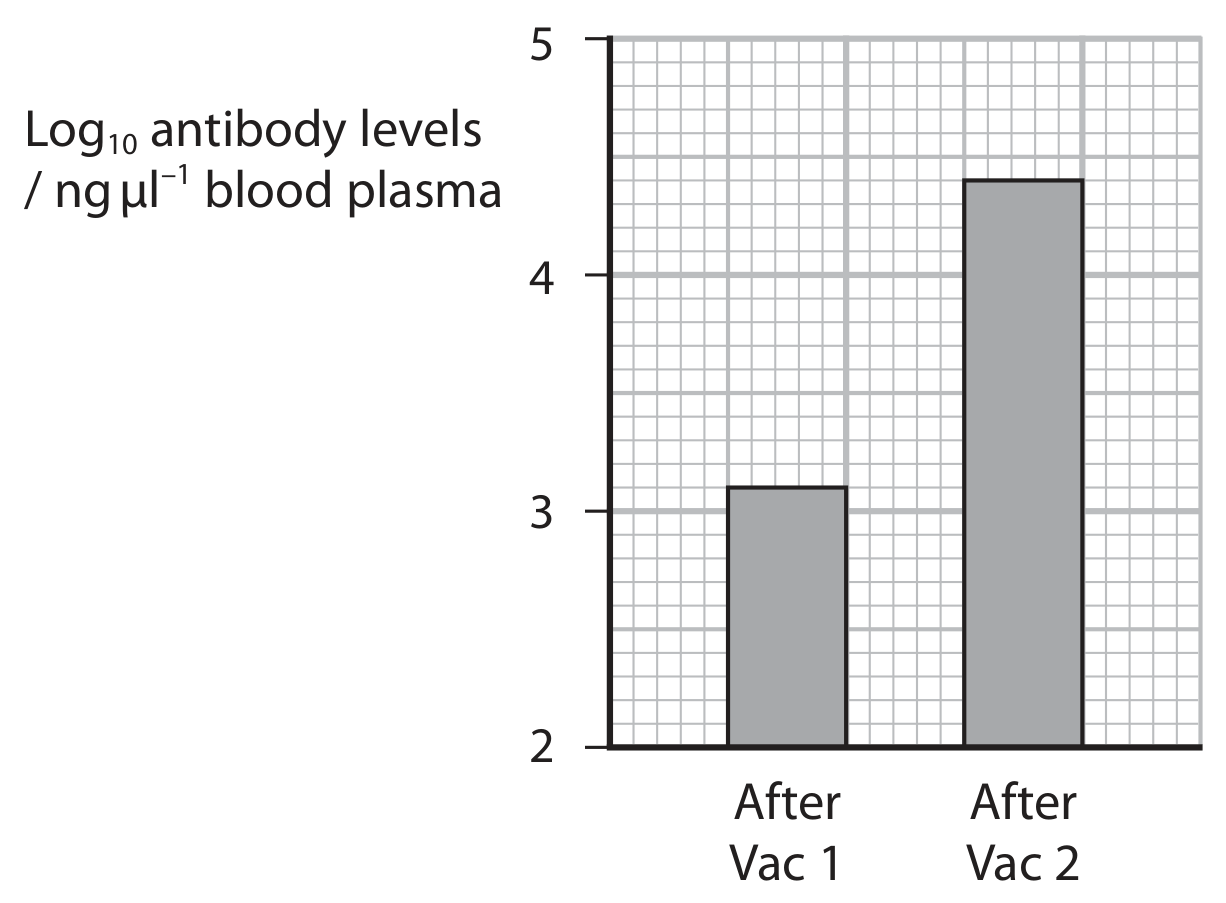
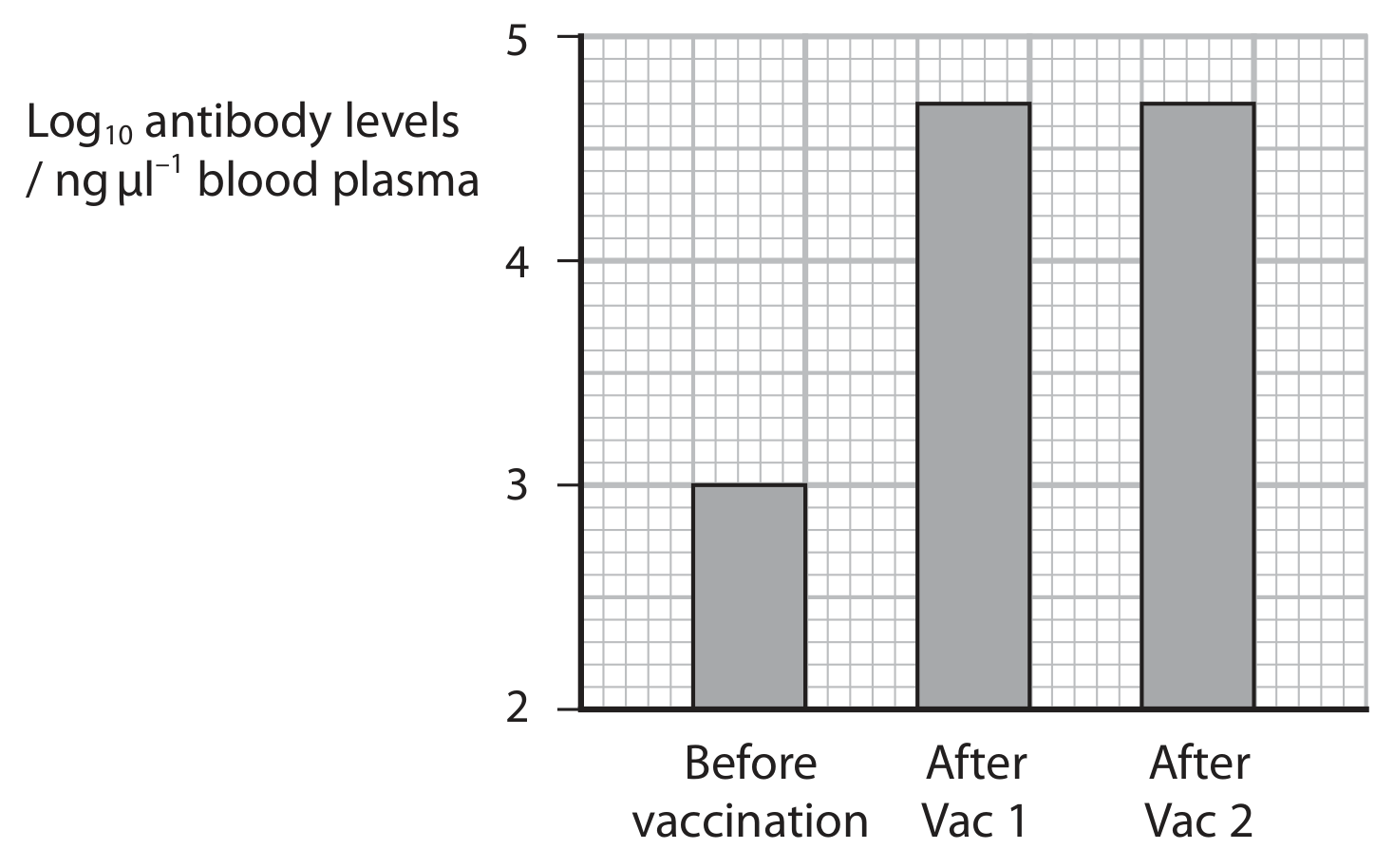
The levels of antibodies following vaccinations were investigated.

There were two groups of people. Group 1 had not been infected with the virus, before the vaccine was given. Group 2 had been infected with the virus before the vaccine was given.

Both groups of people received two vaccinations, Vac 1 and Vac 2.
The graphs show the results of this investigation.

Figure for Question 8(c) — Edexcel A-Level Biology A2

Group 1:

People who had not been infected before the vaccine was given

Figure for Question 8(c) — Edexcel A-Level Biology A2

Group 2:

People who had been infected with the virus before the vaccine was given

[ 7 ]

Question 8(c)(iii)

(i)

Suggest why there is no data on the graph for group 1 before vaccination.
(1)

[ 1 ]

Question 8(c)(iv)

(ii)

*(iv) Explain the results of this investigation.

[ 6 ]