Question 4
Question 4(a)
(a)
State what is meant by the diffraction of a wave.
(b) A laser produces a narrow beam of coherent light of wavelength 632 nm . The beam is incident normally on a diffraction grating, as shown in Fig. 4.1.
[ 2 ]
 EduNinja
State what is meant by the diffraction of a wave.
(b) A laser produces a narrow beam of coherent light of wavelength 632 nm . The beam is incident normally on a diffraction grating, as shown in Fig. 4.1.
A loudspeaker is playing music in a room. The door to the room is open and has a width of 0.80 m .
Sound waves of many different frequencies pass through the doorway and diffract. The speed of sound in air is .
Which frequency of sound wave diffracts the most as it passes through the doorway?
The width of each slit in (b) is decreased by the same amount. There is no change to the separation of the slits.
Describe and explain the effect, if any, of this change on the appearance of the interference pattern.
Diagram 1 shows a ripple tank experiment in which plane waves are diffracted through a narrow slit in a metal sheet.
Diagram 2 shows the same tank with a slit of greater width.
In each case, the pattern of the waves incident on the slit and the emergent pattern are shown.
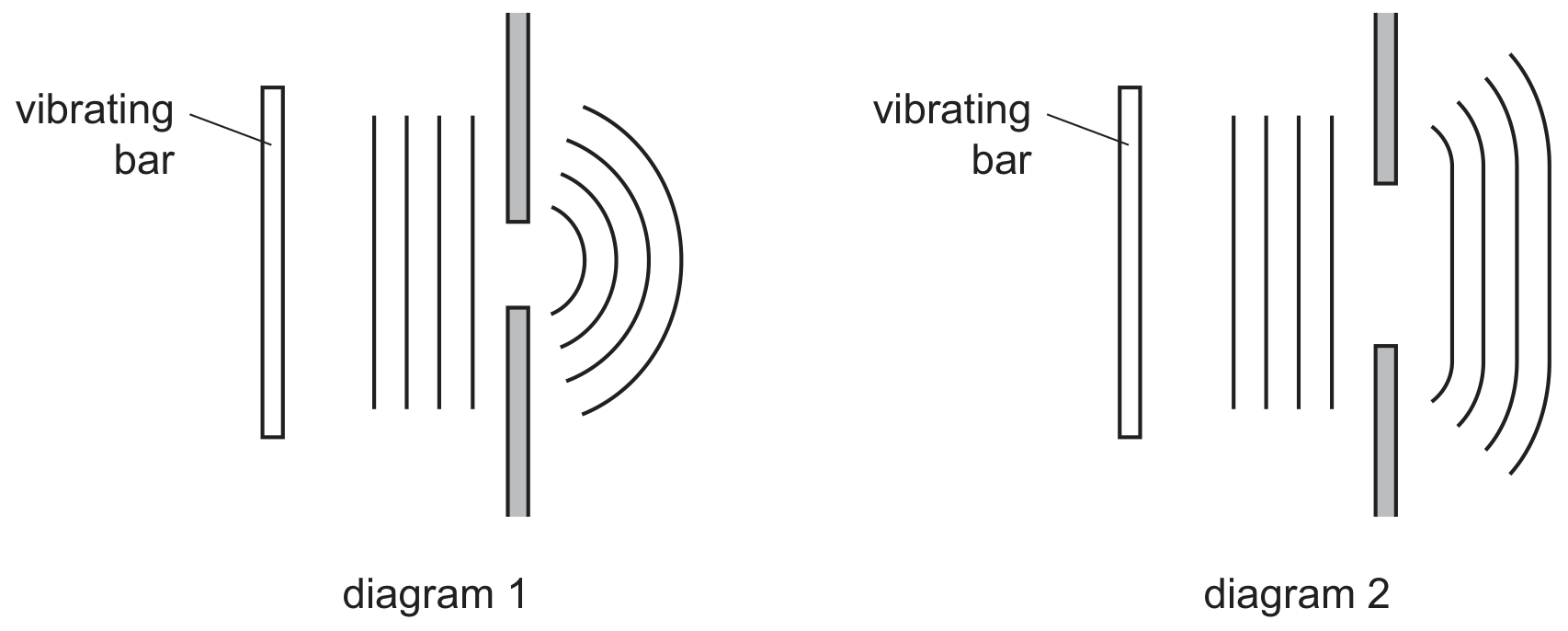
Which action would cause the waves in diagram 1 to be diffracted less and so produce an emergent pattern closer to that shown in diagram 2?
increasing the frequency of vibration of the bar
increasing the speed of the waves by making the water in the tank deeper
reducing the amplitude of vibration of the bar
reducing the length of the vibrating bar
Diagram 1 shows a ripple tank experiment in which plane waves are diffracted through a narrow slit in a metal sheet.
Diagram 2 shows the same tank with a slit of greater width.
In each case, the pattern of the waves incident on the slit and the emergent pattern are shown.
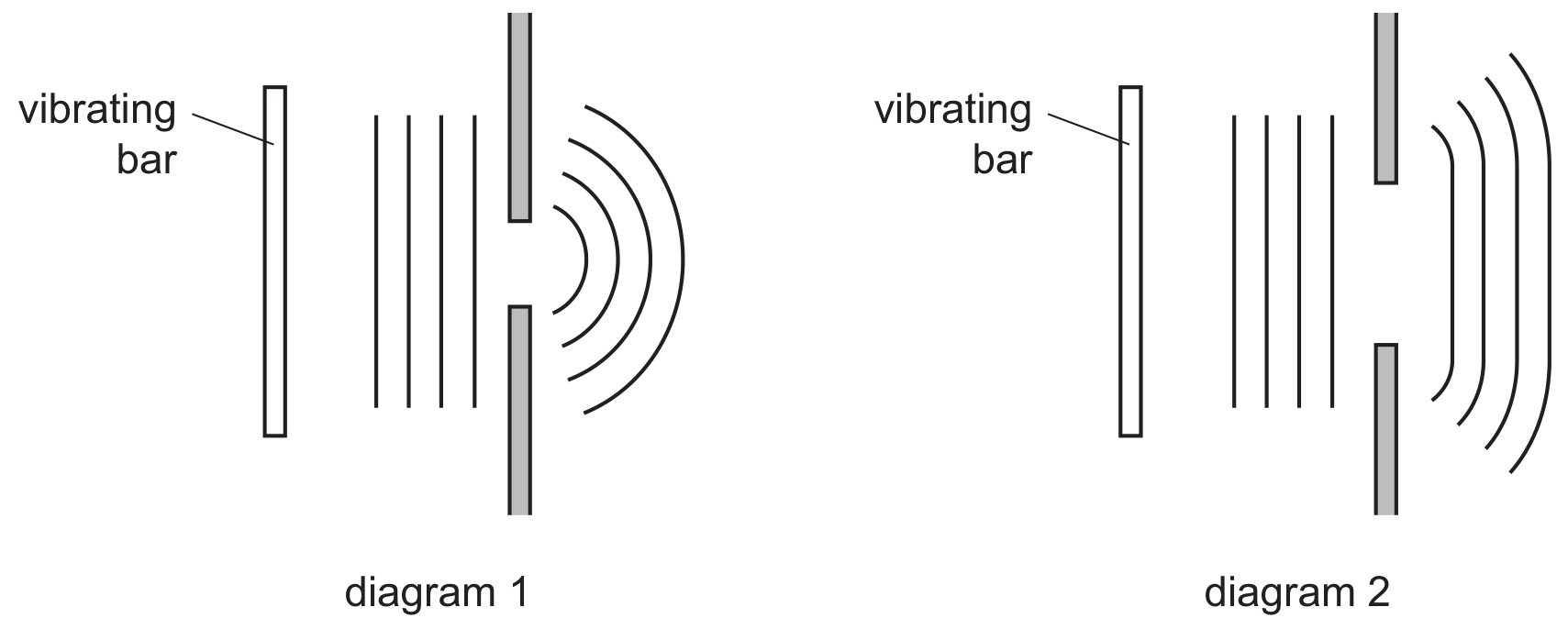
Which action would cause the waves in diagram 1 to be diffracted less and so produce an emergent pattern closer to that shown in diagram 2?
increasing the frequency of vibration of the bar
increasing the speed of the waves by making the water in the tank deeper
reducing the amplitude of vibration of the bar
reducing the length of the vibrating bar
Which statement gives a condition that enables diffraction to occur?
A source of waves moves towards a stationary observer.
A wave is partially blocked by an obstacle.
Two coherent waves are superposed.
Two waves are travelling through the same part of a medium in opposite directions.
Water waves of wavelength are formed in a ripple tank. The waves are diffracted as they pass through a narrow gap of width d ( d is greater than ).
Which gap width and which wavelength will cause the largest decrease in the amount of diffraction?
gap width
wavelength
2 d
2 d
A continuous progressive water wave in a ripple tank passes through a gap in a barrier and diffracts.
The width of the gap is greater than the wavelength of the wave.
Which change causes the wave to spread over a larger angle as it passes through the gap?
a small decrease in the wavelength of the wave
a small decrease in the width of the gap
a small increase in the frequency of the wave
a small increase in the height of the barrier
In an experiment, water waves in a ripple tank are incident on a gap, as shown.
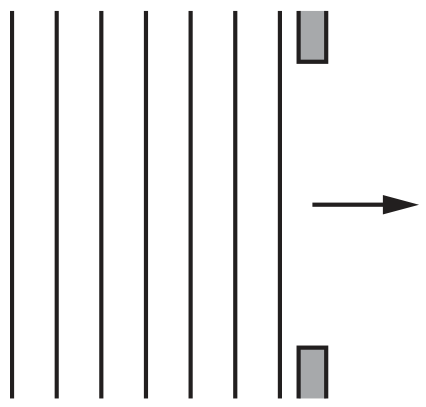
Some diffraction of the water waves is observed.
Which change to the experiment would provide a better demonstration of diffraction?
Increase the amplitude of the waves.
Increase the frequency of the waves.
Increase the wavelength of the waves.
Increase the width of the gap.
An experiment is set up to demonstrate the diffraction of water waves in a ripple tank.
The waves pass through a gap of width w and some diffraction of the waves is observed.
The wavelength of the waves is now doubled.
What is the new gap width needed to cause the same amount of diffraction as before?
0.5 w
w
2 w
4 w