EduNinja

A-Level CAIE Physics AS4.3 Density and pressureQuestion Bank

Question 1

Question 1(b)

(a)

A square solar panel with sides of length 1300 mm is shown in Fig. 1.1.
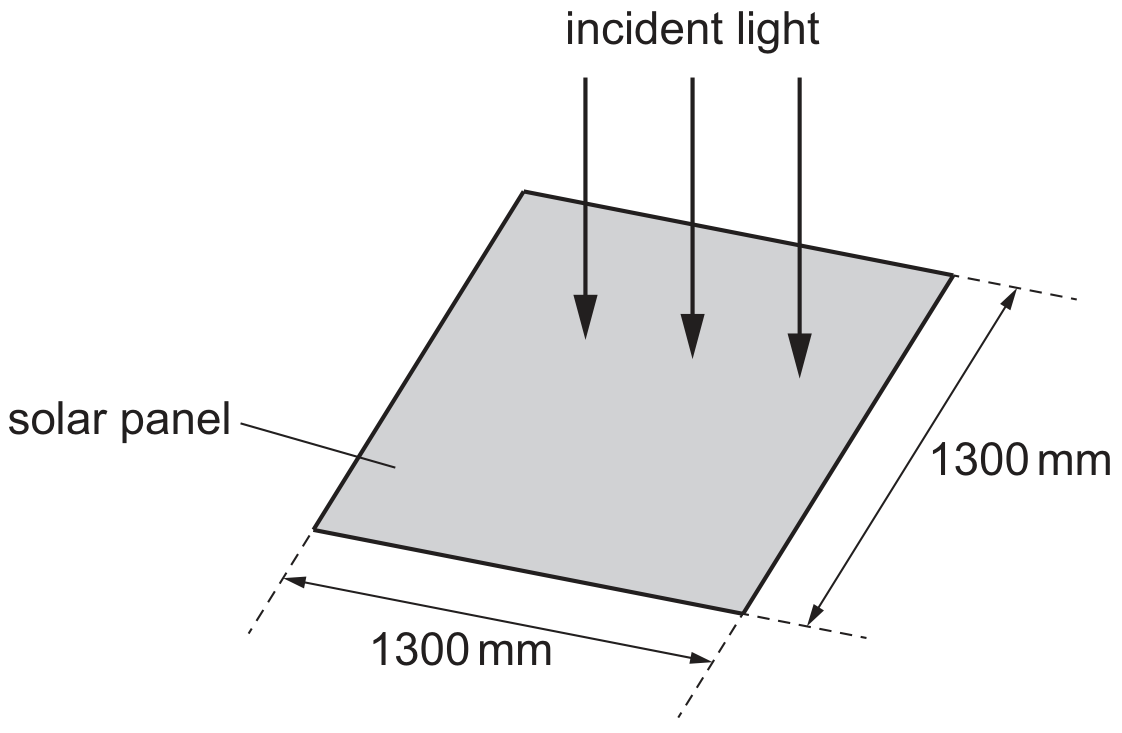
Fig. 1.1 (not to scale)

Fig. 1.1 (not to scale)

Light is incident normally on the solar panel.

[ 2 ]

Question 1(b)(i)

(i)

The power of the light incident on the solar panel is 750 W .

Calculate the intensity of the light.

\text { intensity = \mathrm{Wm}^{-2}
[ 2 ]
Question 1

[Maximum number: 4]

The drag force FDF_{\mathrm{D}} acting on a sphere falling through a liquid is given by

FD=6πηrvF_{\mathrm{D}}=6 \pi \eta r v

where r is the radius of the sphere,
v is the speed of the sphere in the liquid and
η\eta is a property of the liquid called the viscosity.

Question 1(d)

Question 1(d)(i)

(a)
(i)

The density of the liquid is 920 kg m3920 \mathrm{~kg} \mathrm{~m}^{-3}.

Show that the upthrust acting on the sphere is 1.0 N .

[ 2 ]

Question 1(d)(ii)

(ii)

Calculate the mass of the sphere.
mass = kg

[ 2 ]

Question 1

Question 1(a)

Question 1(a)(i)

(a)
(i)

Define pressure.

[ 1 ]

Question 1(a)(ii)

(ii)

Use the answer to (a)(i) to show that the SI base units of pressure are kgm1 s2\mathrm{kg} \mathrm{m}^{-1} \mathrm{~s}^{-2}.

[ 1 ]

Question 1

[Maximum number: 1]

A0.10 kg mass is taken to Mars and then weighed on a spring balance and on a lever balance. The acceleration due to gravity on Mars is 38\% of its value on Earth.

What are the readings on the two balances on Mars? (Assume that on Earth g=10 m s2g=10 \mathrm{~m} \mathrm{~s}^{-2}.)

spring

balance/N

lever

balance/kg

0.38

0.038

0.38

0.10

1.0

0.038

1.0

0.10

Question 1

[Maximum number: 2]

Calculate, using Newton's law of gravitation, the gravitational force on the stone.
gravitational force = N [2]
2. Determine the force required to maintain the stone in its circular path.
force = N

Question 1(a)

(a)

The Earth may be considered to be a uniform sphere of radius 6.37×10³ km6.37 \times 10^{3} \mathrm{~km} with its mass of 5.98×1024 kg5.98 \times 10^{24} \mathrm{~kg} concentrated at its centre. The Earth spins on its axis with a period of 24.0 hours.

Question 1(a)(ii)

(i)

The stone is now hung from a newton-meter.

Use your answers in (i) to determine the reading on the meter. Give your answer to three significant figures.

Question 1

[Maximum number: 3]

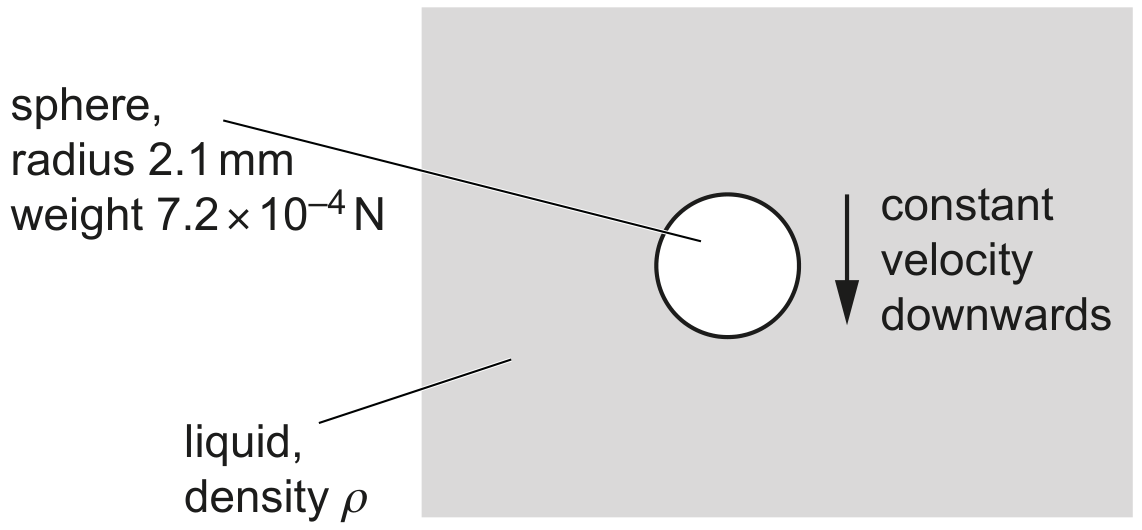
A sphere of radius 2.1 mm falls with terminal (constant) velocity through a liquid, as shown in Fig. 1.1.

Fig. 1.1

Fig. 1.1

Three forces act on the moving sphere. The weight of the sphere is 7.2×10⁴ N7.2 \times 10^{-4} \mathrm{~N} and the upthrust acting on it is 4.8×10⁴ N4.8 \times 10^{-4} \mathrm{~N}. The viscous force FVF_{\mathrm{V}} acting on the sphere is given by

FV=krvF_{\mathrm{V}}=k r v

where r is the radius of the sphere, v is its velocity and k is a constant. The value of k in SI units is 17 .

Question 1(b)

(a)

Use the value of the upthrust acting on the sphere to calculate the density ρ\rho of the liquid.
ρ=\rho=kgm3\mathrm{kg} \mathrm{m}^{-3}

[ 3 ]

Question 1

[Maximum number: 1]

A stone sinks in water.
What is a possible value for the density of the stone?

A

8×10² kg m38 \times 10^{2} \mathrm{~kg} \mathrm{~m}^{-3}

B

2×10³ kg m32 \times 10^{3} \mathrm{~kg} \mathrm{~m}^{-3}

C

8×10³Nm38 \times 10^{3} \mathrm{Nm}^{-3}

D

2×10⁴Nm32 \times 10^{4} \mathrm{Nm}^{-3}

Question 1

Question 1(a)

(a)

Define density.

[ 1 ]

Question 1(b)

(b)

Explain how the difference in the densities of solids, liquids and gases may be related to the spacing of their molecules.

[ 2 ]

Question 1(c)

(c)

A paving slab has a mass of 68 kg and dimensions 50 mm×600 mm×900 mm50 \mathrm{~mm} \times 600 \mathrm{~mm} \times 900 \mathrm{~mm}.

[ 5 ]

Question 1(c)(i)

(i)

Calculate the density, in kgm3\mathrm{kg} \mathrm{m}^{-3}, of the material from which the paving slab is made.
density = kgm3\mathrm{kg} \mathrm{m}^{-3}

[ 2 ]

Question 1(c)(ii)

(ii)

Calculate the maximum pressure a slab could exert on the ground when resting on one of its surfaces.
pressure = Pa

[ 3 ]

Question 1

Question 1(b)

(a)

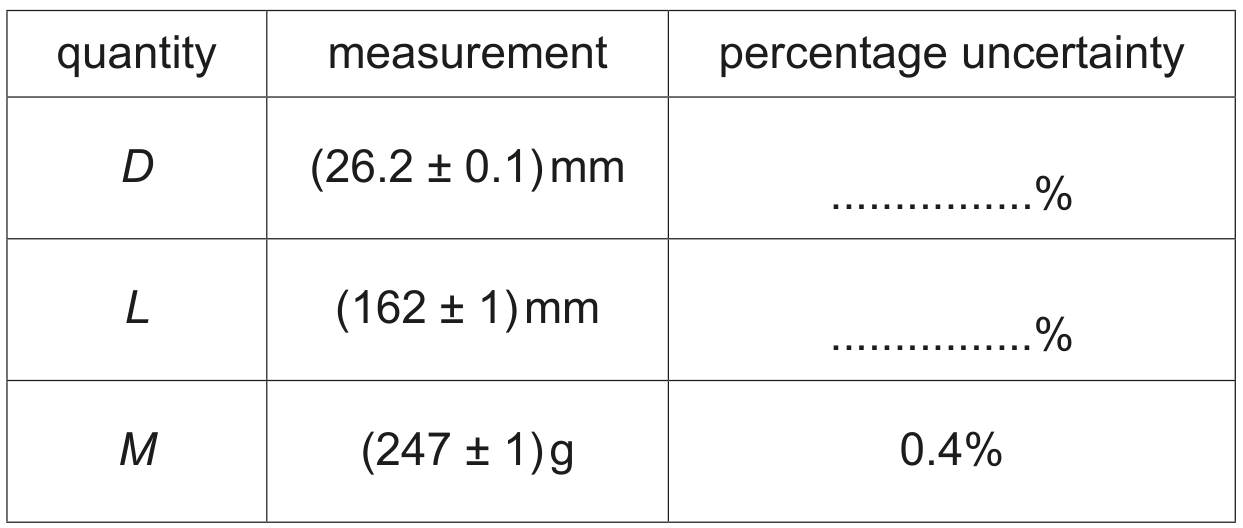
A uniform cylinder has diameter D, length L and mass M.

The density ρ\rho of the cylinder is given by

ρ=4MπD2L.\rho=\frac{4 M}{\pi D^{2} L} .

Table 1.2 shows the data obtained from an experiment to determine the density of the cylinder.

Table 1.2

Table 1.2

[ 2 ]

Question 1(b)(ii)

(i)

Calculate the density of the cylinder. Give your answer to three significant figures.
density = kgm3\mathrm{kg} \mathrm{m}^{-3}

[ 2 ]

Question 1

[Maximum number: 3]

A solid metal sphere has a diameter of (3.42±0.02)cm(3.42 \pm 0.02) \mathrm{cm} and a mass of (67±2)g(67 \pm 2) \mathrm{g}.

Question 1(a)

(a)

Calculate the density, in gcm3\mathrm{g} \mathrm{cm}^{-3}, of the metal.

 density =g cm 3 [3] \text { density =g cm }{ }^{-3} \text { [3] }
[ 3 ]
0 selected