EduNinja

A-Level CAIE Physics AS7.3 Doppler effect for sound wavesQuestion Bank

Question 2

[Maximum number: 3]

A student investigates the sound from a horn attached to a car, as shown in Fig. 2.1.
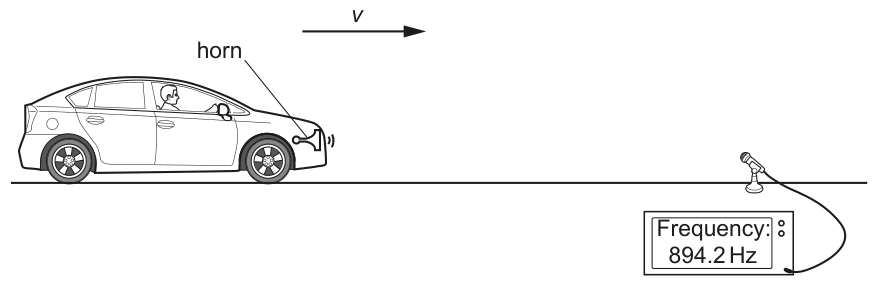
Fig. 2.1 (not to scale)

Fig. 2.1 (not to scale)

A microphone is placed at the side of the road and connected to a frequency meter. The car travels towards the microphone. The frequency f of the sound detected by the microphone is read from the frequency meter.

The speed of the car is measured by two speed detectors. The two measurements of speed are v1v_{1} and v2v_{2}. The average speed v of the car is determined from v1v_{1} and v2v_{2}.

The experiment is repeated for different speeds of the car.
It is suggested that f and v are related by the equation

f=fskkvf=\frac{f_{\mathrm{s}} k}{k-v}

where fsf_{\mathrm{s}} is the frequency of the sound emitted by the horn and k is a constant.

Question 2(a)

(a)

A graph is plotted of 1f\frac{1}{f} on the y-axis against v on the x-axis.

Determine expressions for the gradient and y-intercept.

 gradient =y-intercept =\begin{array}{r} \text { gradient }= \\ y \text {-intercept }= \end{array}
[ 1 ]

Question 2(d)

Question 2(d)(i)

(b)
(i)

Using your answers to (a), (c)(iii) and (c)(iv), determine the values of fsf_{\mathrm{s}} and k. Include appropriate units.

fs=k=\begin{gathered} f_{\mathrm{s}}= \\ k= \end{gathered}
[ 2 ]

Question 21

[Maximum number: 1]

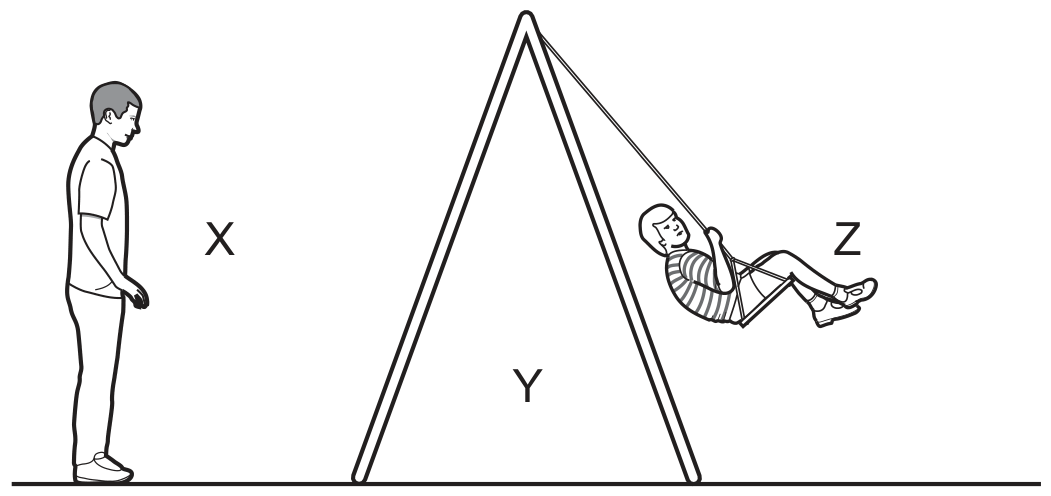
A man stands stationary in front of a swing. A child sits and swings.

Question image

The child blows a whistle that emits a sound at a constant frequency.
The man observes the frequency of the sound when the swing is at positions X, Y and Z .
When will the man hear the highest frequency?

A

when the swing is at X

B

when the swing is at Y and moving away from the man

C

when the swing is at Y and moving towards the man

D

when the swing is at Z

Question 22

[Maximum number: 1]

A vehicle moves with constant velocity along a road directly towards an observer. The observed frequency of the sound from the vehicle changes as the vehicle moves past the observer.

Which phenomenon explains the change in frequency?

A

diffraction

B

interference

C

polarisation

D

the Doppler effect

Question 22

[Maximum number: 1]

A vehicle emits sound of a constant frequency. A stationary observer hears the sound.
The vehicle moves directly towards the observer at constant speed. The observer hears sound of frequency fof_{\mathrm{o}}.

The vehicle then accelerates, still moving towards the observer, travels at a higher steady speed for a time and then decelerates until it stops.

What is the variation in the frequency of the sound that is heard by the observer?

A

The observed frequency will fall, then remain steady then return to the frequency fof_{\mathrm{o}}.

B

The observed frequency will fall, then remain steady then rise to a higher frequency than fof_{\mathrm{o}}.

C

The observed frequency will rise, then remain steady then fall to a lower frequency than fof_{\mathrm{o}}.

D

The observed frequency will rise, then remain steady then return to the frequency fof_{\mathrm{o}}.

Question 22

[Maximum number: 1]

An observer hears a sound wave emitted from a moving source.
The observed frequency is less than the frequency of sound emitted from the source.
What could be the reason for this?

A

The source is moving away from the observer.

B

The source is moving towards the observer.

C

The speed of the sound wave in air decreases due to the movement of the source.

D

The speed of the sound wave in air increases due to the movement of the source.

Question 22

[Maximum number: 1]

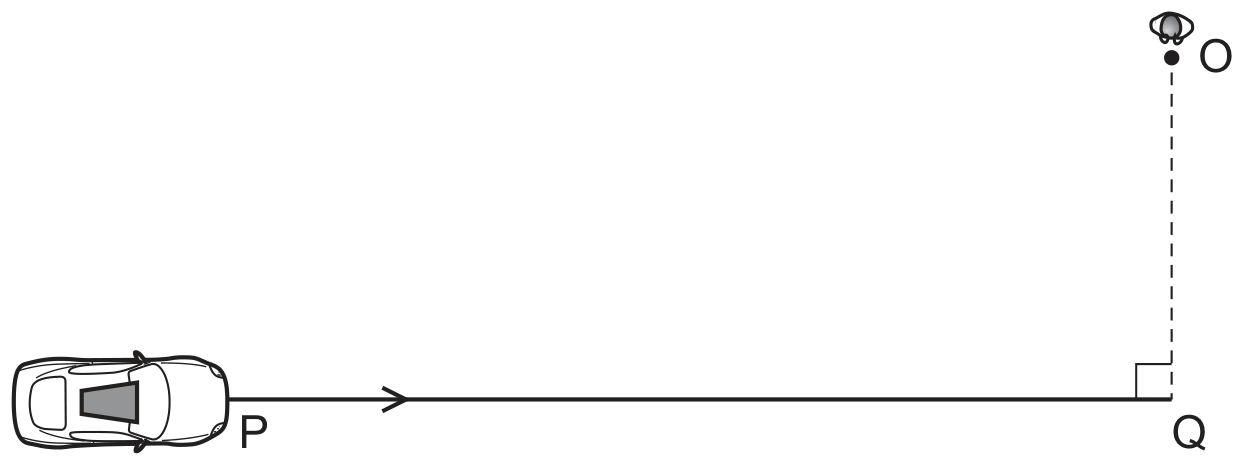
A car travels at a constant speed along a straight line PQ .
A loudspeaker attached to the car emits sound of constant frequency f. A stationary observer is at point O.

Question image

What does the observer hear as the car moves from P towards Q ?

A

a frequency less than f that decreases as the car moves from P towards Q

B

a frequency less than f that increases as the car moves from P towards Q

C

a frequency more than f that decreases as the car moves from P towards Q

D

a frequency more than f that increases as the car moves from P towards Q

Question 22

[Maximum number: 1]

A source X emits a sound wave of constant frequency f.
The wave is subsequently received at a stationary detector Y .
The frequency of the wave that is detected by Y is less than f.
What could be the reason for this?

A

Between X and Y, the wave undergoes diffraction.

B

Between X and Y, the wave undergoes reflection.

C

X is moving away from Y .

D

X is moving towards Y .

Question 22

[Maximum number: 1]

A loudspeaker emits sound of frequency fsf_{\mathrm{s}}. The loudspeaker is attached to a car that moves with increasing speed directly towards a stationary observer.

Which statement describes the frequency of the sound heard by the observer?

A

a frequency greater than fsf_{\mathrm{s}} and increasing

B

a frequency greater than fsf_{\mathrm{s}} but decreasing

C

a frequency less than fsf_{\mathrm{s}} and decreasing

D

a frequency less than fsf_{\mathrm{s}} but increasing

Question 22

[Maximum number: 1]

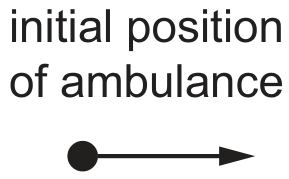
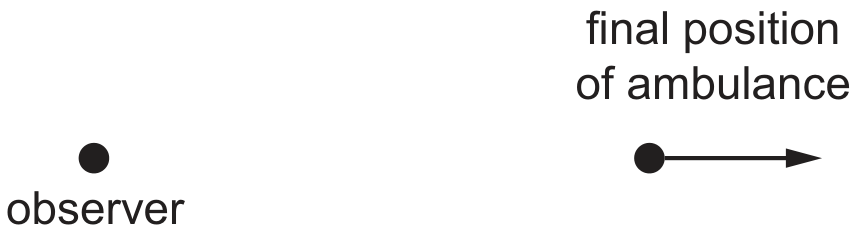
The warning signal on an ambulance has a frequency of 600 Hz . The speed of sound is 330 ms1330 \mathrm{~ms}^{-1}. The ambulance is travelling with a constant velocity of 25 ms125 \mathrm{~ms}^{-1} towards an observer. The ambulance passes, and then moves away from the observer with no change in velocity.

Question image
Question image

Which overall change in observed frequency takes place between the times at which the ambulance is a long way behind the observer and when it is a long way in front of the observer?

A

49 Hz

B

84 Hz

C

91 Hz

D

98 Hz

Question 22

[Maximum number: 1]

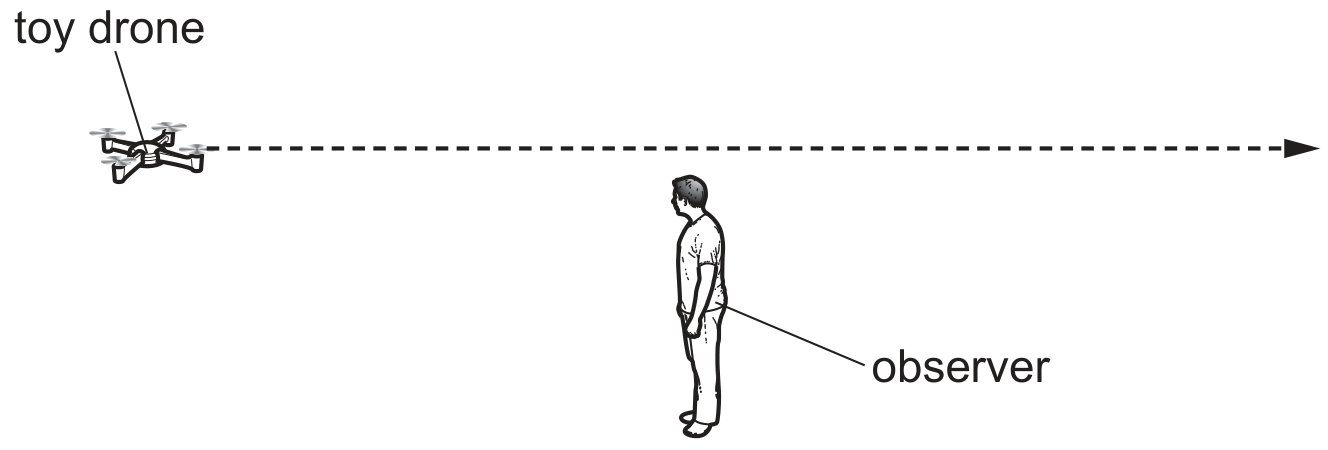
A toy drone emits a sound of constant frequency 800 Hz . The speed of the sound in the air is 330 m s1330 \mathrm{~m} \mathrm{~s}^{-1}.

The drone moves along a straight path directly towards an observer and then continues in a straight line directly away from the observer. The speed of the drone is constant.

Question image

What is the velocity of the drone when the frequency of the sound heard by the observer is 850 Hz ?

magnitude of

velocity /ms1/ \mathrm{m} \mathrm{s}^{-1}

direction of velocity

19

away from the observer

21

away from the observer

19

towards the observer

21

towards the observer

0 selected