EduNinja

A-Level CAIE Physics AS3.3 Linear momentum and its conservationQuestion Bank

Question 2

[Maximum number: 1]

A ball is thrown vertically down towards the ground with an initial velocity of 4.23 ms14.23 \mathrm{~ms}^{-1}. The ball falls for a time of 1.51 s before hitting the ground. Air resistance is negligible.

Question 2(c)

(a)

State and explain whether the collision the ball makes with the ground is elastic or inelastic.

[ 1 ]
Question 2

[Maximum number: 1]

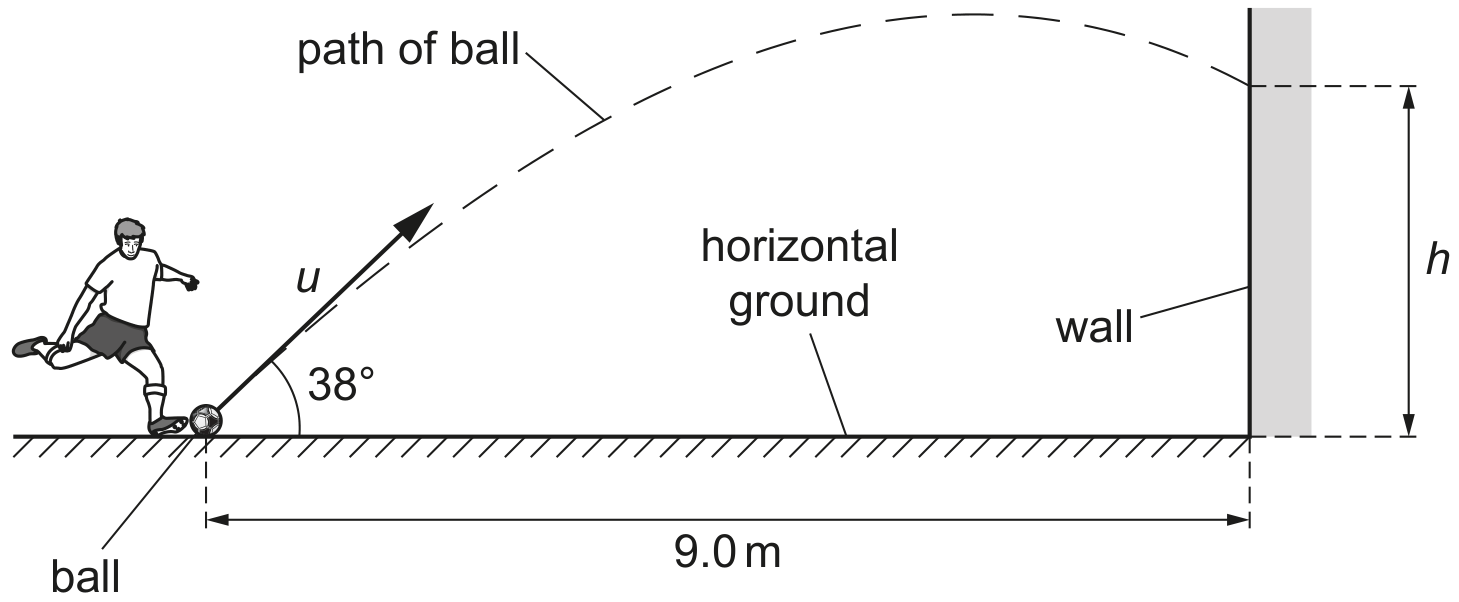
A ball on horizontal ground is kicked towards a vertical wall. Fig. 2.1 shows the path of the ball.

Fig. 2.1 (not to scale)

Fig. 2.1 (not to scale)

The ball has an initial velocity u at an angle of 3838^{\circ} to the ground. The ball travels a horizontal distance of 9.0 m before striking the wall at a height h above the ground. The horizontal component uHu_{\mathrm{H}} of the initial velocity of the ball is 9.5 ms19.5 \mathrm{~ms}^{-1}.

Air resistance is negligible.

Question 2(b)

(a)

The speed of the ball just after striking the wall is less than its speed just before striking the wall.

State what this indicates about the nature of the collision of the ball with the wall.

[ 1 ]

Question 7

[Maximum number: 1]

Two satellites in deep space collide inelastically.
What happens to the total kinetic energy and total momentum?

total

kinetic energy

total

momentum

conserved

conserved

conserved

reduced

reduced

conserved

reduced

reduced

Question 7

[Maximum number: 1]

What is the principle of conservation of momentum?

A

Force is equal to the rate of change of momentum.

B

Momentum is the product of mass and velocity.

C

The total momentum of a system remains constant provided no external force acts on it.

D

The total momentum of two bodies after collision is equal to their total momentum before collision.

Question 7

[Maximum number: 1]

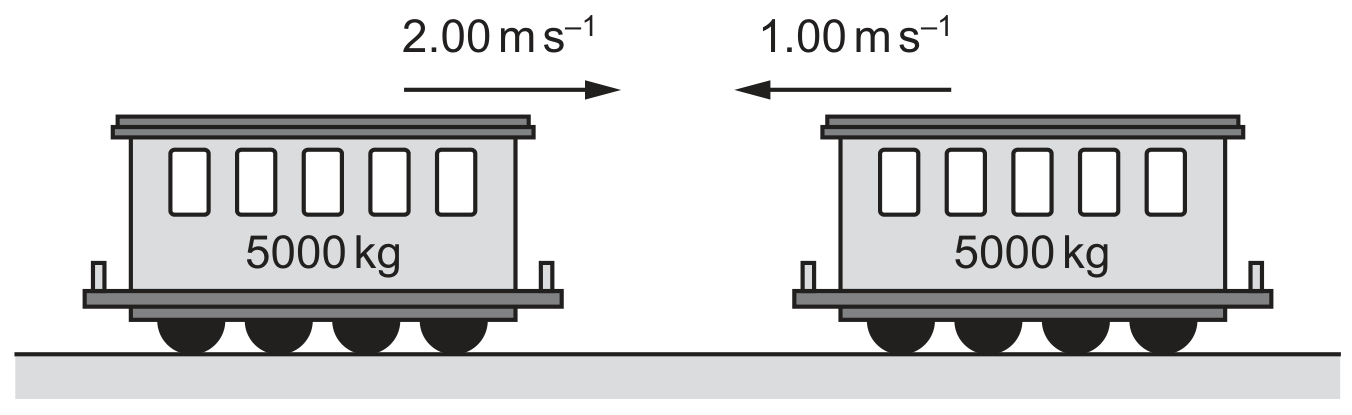
Two train carriages each of mass 5000 kg roll toward one another on a level track. One is travelling at 2.00 m s12.00 \mathrm{~m} \mathrm{~s}^{-1} and the other at 1.00 ms11.00 \mathrm{~ms}^{-1}, as shown.

Question image

They collide and join together.
What is the kinetic energy lost during the collision?

A

1250J

B

7500J

C

11250J

D

12500J

Question 3

Question 3(b)

(a)

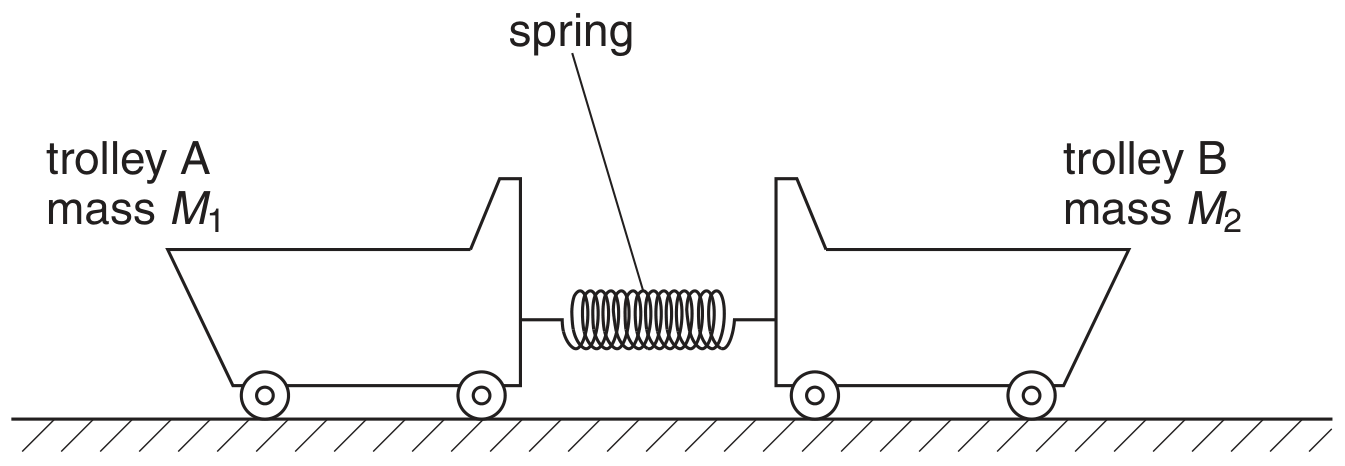
The spring in (a) is used to join together two frictionless trolleys A and B of mass M1M_{1} and M2M_{2} respectively, as shown in Fig. 3.2.

Fig. 3.2

Fig. 3.2

The trolleys rest on a horizontal surface and are held apart so that the spring is extended.

The trolleys are then released.

[ 6 ]

Question 3(b)(i)

(i)

Explain why, as the extension of the spring is reduced, the momentum of trolley A is equal in magnitude but opposite in direction to the momentum of trolley B .

[ 2 ]

Question 3(b)(ii)

(ii)

At the instant when the extension of the spring is zero, trolley A has speed V1V_{1} and trolley B has speed V2V_{2}.
Write down
1. an equation, based on momentum, to relate V1V_{1} and V2V_{2},
2. an equation to relate the initial energy E stored in the spring to the final energies of the trolleys.

[ 2 ]

Question 3(b)(iii)

(iii)

1. Show that the kinetic energy EKE_{\mathrm{K}} of an object of mass m is related to its momentum p by the expression

EK=p22m.E_{\mathrm{K}}=\frac{p^{2}}{2 m} .

2. Trolley A has a larger mass than trolley B.

Use your answer in (ii) part 1 to deduce which trolley, A or B, has the larger kinetic energy at the instant when the extension of the spring is zero.

[ 2 ]

Question 8

[Maximum number: 1]

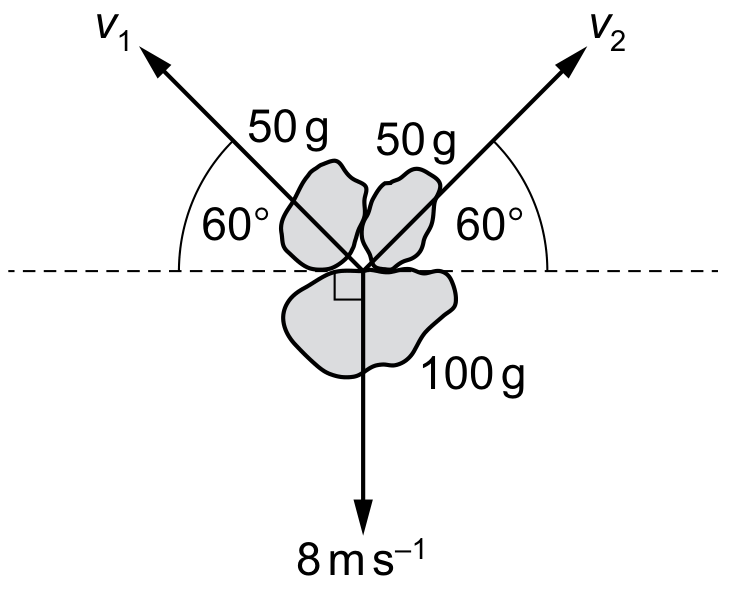
A stationary firework explodes into three pieces moving in the same plane. The masses and the velocities of the three pieces immediately after the explosion are shown.

Question image

What are speeds v1v_{1} and v2v_{2} ?

v1/ms1v_{1} / \mathrm{m} \mathrm{s}^{-1}

v2/ms1v_{2} / \mathrm{m} \mathrm{s}^{-1}

4.0

4.0

9.2

9.2

14

14

16

16

Question 8

[Maximum number: 1]

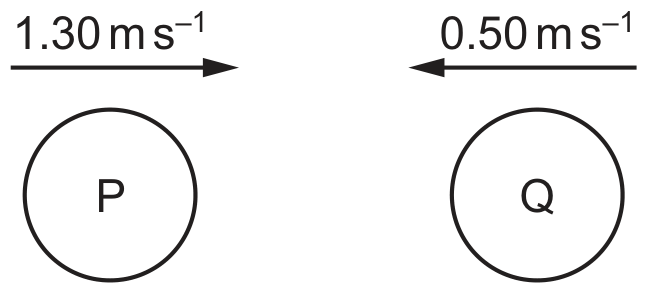
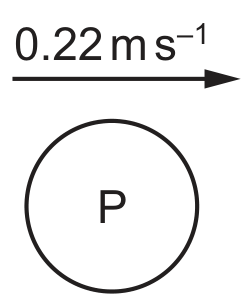
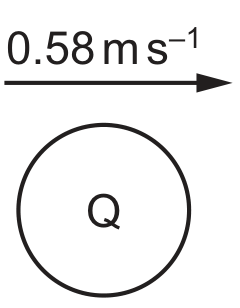
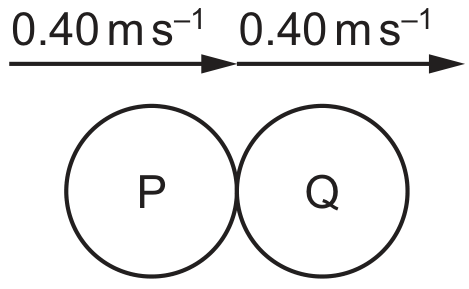
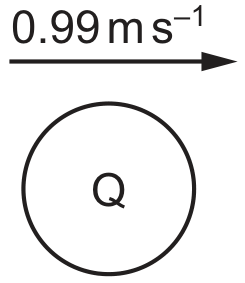
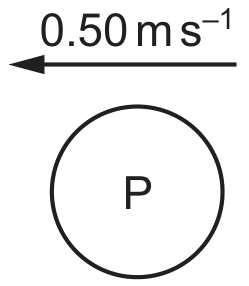
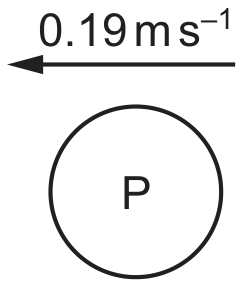
Two balls P and Q , of equal mass, move along a straight line directly towards each other as shown.

Question image

Ball P has velocity 1.30 m s11.30 \mathrm{~m} \mathrm{~s}^{-1} to the right. Ball Q has velocity 0.50 ms10.50 \mathrm{~ms}^{-1} to the left.
P and Q collide with one another. The collision is perfectly elastic and the total momentum is conserved.

Which diagram correctly shows the motion of P and Q after the collision?

Question image
Question image
Question image
Question image
Question image
Question image

Question 9

[Maximum number: 1]

A body of mass m, moving at velocity v, collides with a stationary body of the same mass and sticks to it.
Which row describes the momentum and kinetic energy of the two bodies after the collision?

momentum

kinetic energy

m v

14mv2\frac{1}{4} m v^{2}

m v

18mv2\frac{1}{8} m v^{2}

2 m v

12mv2\frac{1}{2} m v^{2}

2 m v

mv2m v^{2}

Question 9

[Maximum number: 1]

Which statement about a perfectly elastic collision between two objects is correct?

A

Total kinetic energy is conserved and the relative speed of approach equals the relative speed of separation.

B

Total kinetic energy is conserved but the relative speed of approach does not equal the relative speed of separation.

C

Total kinetic energy is not conserved and the relative speed of approach does not equal the relative speed of separation.

D

Total kinetic energy is not conserved but the relative speed of approach does equal the relative speed of separation.

0 selected