
Question 1
A particle of mass 0.6 kg is projected with a speed of down a line of greatest slope of a smooth plane inclined at to the horizontal.
Use an energy method to find the speed of the particle after it has moved 15 m down the plane.
EduNinjaA particle of mass 0.6 kg is projected with a speed of 4 m s−1 down a line of greatest slope of a smooth plane inclined at 10∘ to the horizontal.
Use an energy method to find the speed of the particle after it has moved 15 m down the plane.
A cyclist has mass 85 kg and rides a bicycle of mass 20 kg . The cyclist rides along a horizontal road against a total resistance force of 40 N . Find the total work done by the cyclist in increasing his speed from 5 m s−1 to 10 m s−1 while travelling a distance of 50 m .
A car of mass 800 kg is moving on a straight horizontal road with its engine working at a rate of 22.5 kW . Find the resistance to the car's motion at an instant when the car's speed is 18 m s−1 and its acceleration is 1.2 m s−2.
A car of mass 600 kg travels along a straight horizontal road. The resistance to the car's motion is constant and equal to R N.
Find the value of R, given that the car's acceleration is 1.4 m s−2 at an instant when the car's speed is 18 m s−1 and its engine is working at a rate of 22.5 kW .
Find the rate of working of the car's engine when the car is moving with a constant speed of 15 m s−1.
A crane is lifting a load of 1250 kg vertically at a constant speed V m s−1. Given that the power of the crane is a constant 20 kW , find the value of V.
A train is moving at constant speed V m s−1 along a horizontal straight track. Given that the power of the train's engine is 1330 kW and the total resistance to the train's motion is 28 kN , find the value of V.
One end of a light inextensible string is attached to a block. The string makes an angle of 60∘ above the horizontal and is used to pull the block in a straight line on a horizontal floor with acceleration 0.5 m s−2. The tension in the string is 8 N . The block starts to move with speed 0.3 m s−1. For the first 5 s of the block's motion, find
the work done by the tension in the string.
A crane is used to raise a block of mass 600 kg vertically upwards at a constant speed through a height of 15 m . There is a resistance to the motion of the block, which the crane does 10000 J of work to overcome.
Find the total work done by the crane.
Given that the average power exerted by the crane is 12.5 kW , find the total time for which the block is in motion.
A block is pulled in a straight line along horizontal ground by a force of constant magnitude acting at an angle of 60∘ above the horizontal. The work done by the force in moving the block a distance of 5 m is 75 J . Find the magnitude of the force.

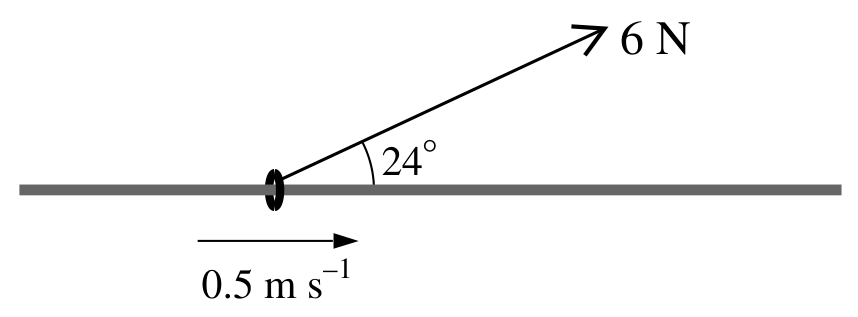
A ring is threaded on a fixed horizontal bar. The ring is attached to one end of a light inextensible string which is used to pull the ring along the bar at a constant speed of 0.5 m s−1. The string makes a constant angle of 24∘ with the bar and the tension in the string is 6 N (see diagram). Find the work done by the tension in a period of 8 s .