
EduNinja

A-Level CAIE Mathematics A23.8 Differential equationsQuestion Bank

Question 3

[Maximum number: 6]
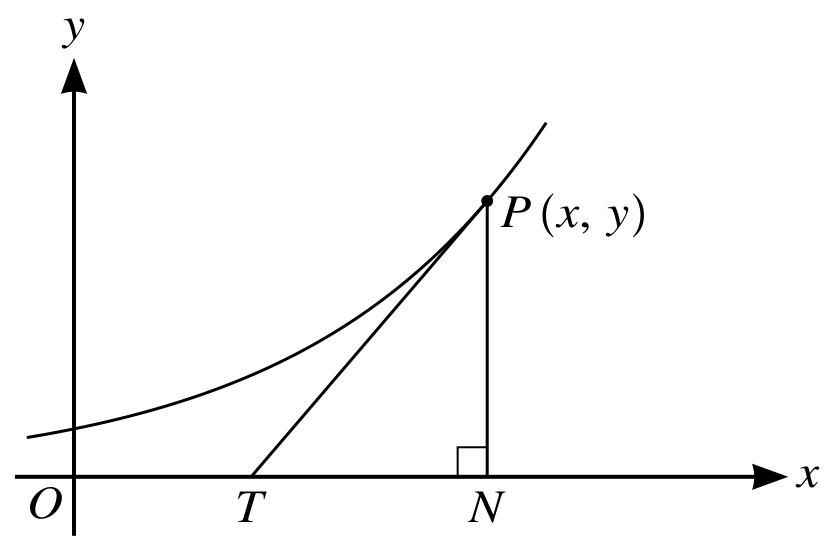
Question image

In the diagram, the tangent to a curve at the point P with coordinates (x, y) meets the x-axis at T. The point N is the foot of the perpendicular from P to the x-axis. The curve is such that, for all values of x, the gradient of the curve is positive and T N=2.

Question 3(i)

(a)

Show that the differential equation satisfied by x and y is dy dx=12y\frac{\mathrm{d} y}{\mathrm{~d} x}=\frac{1}{2} y.

[ 1 ]

Question 3(ii)

(b)

The point with coordinates (4,3) lies on the curve.

Solve the differential equation to obtain the equation of the curve, expressing y in terms of x.

[ 5 ]

Question 4

[Maximum number: 7]

The number of insects in a population t weeks after the start of observations is denoted by N. The population is decreasing at a rate proportional to Ne0.02tN \mathrm{e}^{-0.02 t}. The variables N and t are treated as continuous, and it is given that when t=0, N=1000 and dN dt=10\frac{\mathrm{d} N}{\mathrm{~d} t}=-10.

Question 4(i)

(a)

Show that N and t satisfy the differential equation

dN dt=0.01e0.02tN.\frac{\mathrm{d} N}{\mathrm{~d} t}=-0.01 \mathrm{e}^{-0.02 t} N .

Question 4(ii)

(b)

Solve the differential equation and find the value of t when N=800.

[ 6 ]

Question 4(iii)

(c)

State what happens to the value of N as t becomes large.

[ 1 ]

Question 4

[Maximum number: 7]

The variables x and y satisfy the differential equation

(1cosx)dy dx=ysinx(1-\cos x) \frac{\mathrm{d} y}{\mathrm{~d} x}=y \sin x

It is given that y=4 when x=πx=\pi.

Question 4(a)

(a)

Solve the differential equation, obtaining an expression for y in terms of x.

[ 6 ]

Question 4(b)

(b)

Sketch the graph of y against x for 0<x<2π0<x<2 \pi.

[ 1 ]

Question 5

Question 5(ii)

(a)

The variables x and θ\theta satisfy the differential equation

xtanθ dx dθ+cosec2θ=0x \tan \theta \frac{\mathrm{~d} x}{\mathrm{~d} \theta}+\operatorname{cosec}^{2} \theta=0

for 0<θ<12π0<\theta<\frac{1}{2} \pi and x>0. It is given that x=4 when θ=16π\theta=\frac{1}{6} \pi. Solve the differential equation, obtaining an expression for x in terms of θ\theta.

[ 6 ]

Question 4

[Maximum number: 6]

The variables x and y are related by the differential equation

dy dx=6ye3x2+e3x\frac{\mathrm{d} y}{\mathrm{~d} x}=\frac{6 y \mathrm{e}^{3 x}}{2+\mathrm{e}^{3 x}}

Given that y=36 when x=0, find an expression for y in terms of x.

Question 4

[Maximum number: 7]

The variables x and θ\theta are related by the differential equation

sin2θ dx dθ=(x+1)cos2θ\sin 2 \theta \frac{\mathrm{~d} x}{\mathrm{~d} \theta}=(x+1) \cos 2 \theta

where 0<θ<12π0<\theta<\frac{1}{2} \pi. When θ=112π,x=0\theta=\frac{1}{12} \pi, x=0. Solve the differential equation, obtaining an expression for x in terms of θ\theta, and simplifying your answer as far as possible.

Question 4

[Maximum number: 7]

Given that x=1 when t=0, solve the differential equation

dx dt=1xx4,\frac{\mathrm{d} x}{\mathrm{~d} t}=\frac{1}{x}-\frac{x}{4},

obtaining an expression for x2x^{2} in terms of t.

Question 4

[Maximum number: 7]

The variables x and y satisfy the differential equation

dy dx=xy1+x2\frac{\mathrm{d} y}{\mathrm{~d} x}=\frac{x y}{1+x^{2}}

and y=2 when x=0.
Solve the differential equation, obtaining a simplified expression for y in terms of x.

Question 4

[Maximum number: 1]

During an experiment, the number of organisms present at time t days is denoted by N, where N is treated as a continuous variable. It is given that

dN dt=1.2e0.02tN0.5\frac{\mathrm{d} N}{\mathrm{~d} t}=1.2 \mathrm{e}^{-0.02 t} N^{0.5}

When t=0, the number of organisms present is 100 .

Question 4(i)

(a)

Find an expression for N in terms of t.

Question 4(ii)

(b)

State what happens to the number of organisms present after a long time.

[ 1 ]

Question 4

[Maximum number: 7]

The variables x and θ\theta are related by the differential equation

sin2θ dx dθ=(x+1)cos2θ\sin 2 \theta \frac{\mathrm{~d} x}{\mathrm{~d} \theta}=(x+1) \cos 2 \theta

where 0<θ<12π0<\theta<\frac{1}{2} \pi. When θ=112π,x=0\theta=\frac{1}{12} \pi, x=0. Solve the differential equation, obtaining an expression for x in terms of θ\theta, and simplifying your answer as far as possible.

0 selected