
IB Biology SL Ecology: Populations, Sampling, Food Webs, and Energy Flow
Exam-ready IB Biology guide for Ecology + Energy Flow with locked EduNinja visuals.
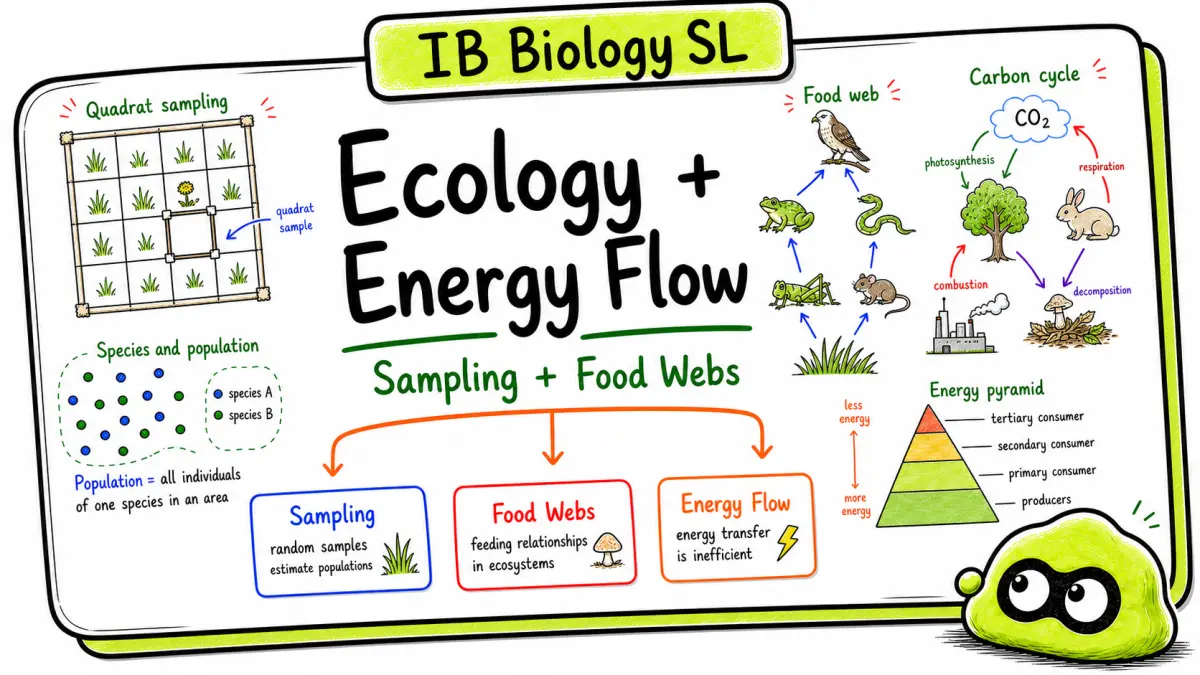
This revision guide turns Ecology + Energy Flow into an exam-ready map for IB Biology SL. It focuses on the definitions, diagrams, calculations, and explanation moves that usually separate a vague answer from a mark-worthy one.
Quick Answer
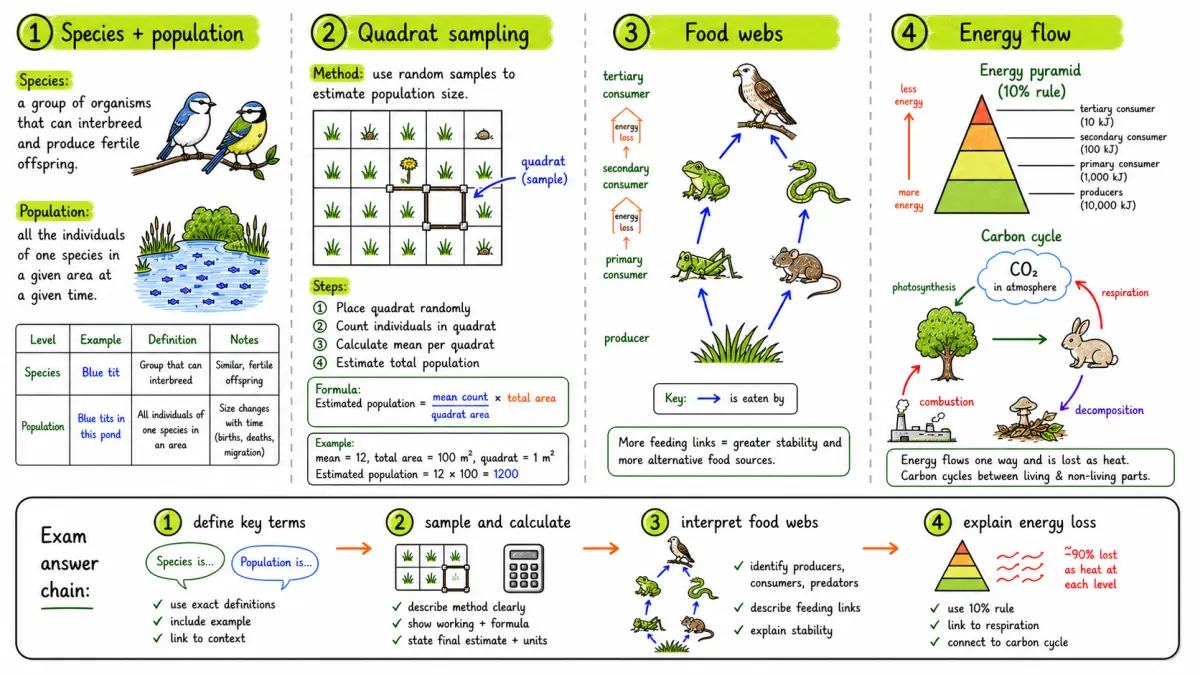
Learn the core language first: species, population, quadrat. Then connect it to the visual method: Species + population, Quadrat sampling, Food webs, Energy flow. In the exam, your answer should move through: define key terms, sample and calculate, interpret food webs, explain energy loss.
Core Concept That Gets Marks
The main idea is not to memorise isolated notes. Treat Ecology + Energy Flow as a linked system: Species + population gives the starting terms, Quadrat sampling builds the method, Food webs provides the diagram or calculation, and Energy flow turns it into exam wording.
Visual Route
Use the study board below as the article's visual route. Each block is deliberately tied to the exam chain, so the image is not just decorative: it tells you what to define, what to draw, what to calculate or compare, and how to finish the explanation.
| Board block | What to do in the exam |
|---|---|
| Species + population | Use precise terms, label the diagram, and link the point to the question command word. |
| Quadrat sampling | Use precise terms, label the diagram, and link the point to the question command word. |
| Food webs | Use precise terms, label the diagram, and link the point to the question command word. |
| Energy flow | Use precise terms, label the diagram, and link the point to the question command word. |
Weak Answer vs Mark-Worthy Answer
| Weak answer habit | Mark-worthy fix |
|---|---|
| Uses topic words without defining them. | Define the exact term before applying it. |
| Draws a diagram with missing labels. | Label axes, arrows, variables, stages, or components. |
| Gives a memorised fact only. | Link the fact to the data, diagram, or command word. |
| Stops after calculation. | Add a short interpretation or conclusion. |
How To Build The Answer
- Define key terms: connect it to Species + population.
- Sample and calculate: connect it to Quadrat sampling.
- Interpret food webs: connect it to Food webs.
- Explain energy loss: connect it to Energy flow.
Worked Exam Move
When the question asks about species, write one exact definition, add a labelled diagram or calculation if relevant, and then use the question context. Avoid simply listing population, quadrat, food web; the examiner needs to see why each point matters.
Common Mistakes
- Confusing species with a related term or using it without context.
- Confusing population with a related term or using it without context.
- Confusing quadrat with a related term or using it without context.
- Confusing food web with a related term or using it without context.
Mini Checklist
- Key terms are defined.
- Diagram labels are readable.
- Data, arrows, equations, or examples are used.
- The final sentence answers the command word directly.
FAQ
What should I revise first for Ecology + Energy Flow? Start with Species + population and Quadrat sampling, because they give you the vocabulary and method.
How should I use diagrams? Draw only the parts that answer the question, but label them carefully. For this topic, useful visuals include quadrat sampling grid, species and population dots, food web arrows.
What makes the final answer stronger? Finish by using the command word: explain, compare, calculate, justify, or evaluate. The last sentence should make the mark scheme link obvious.
Related Revision Links
- More IB Biology revision guides
- Topic practice questions
- Mark scheme wording practice
Study Order For This Topic
Do not revise Ecology + Energy Flow as a flat list of notes. Start with Species + population, because that gives you the language the question is likely to use. Then move to Quadrat sampling, where most students need to show a method, diagram, calculation, or comparison. After that, use Food webs to practise applying the idea to a new context. Finish with Energy flow, because that is usually where the explanation mark or final method mark appears.
This order matters for IB Biology because exam questions rarely reward recognition alone. The answer has to show that you can move from a term to a method, then from a method to an explanation. If you only memorise the first two words on the page, your answer may sound correct but still miss the markscheme link.
Command Word Plan
| Command word | How to answer for this topic |
|---|---|
| Define | Use one clean sentence for species or population, then stop before the definition becomes vague. |
| Describe | Name the visible feature in the diagram or data first, then add a labelled detail from Quadrat sampling or Food webs. |
| Explain | Use because, therefore, or so that. The answer should connect quadrat to food web rather than listing both separately. |
| Calculate | Write the formula or method, substitute values, show units where relevant, and finish with a short interpretation. |
| Evaluate | Give the strongest point, then add a condition or limitation. Avoid ending with only "it depends". |
What The Image Is Checking
The cover and study-board image are not decoration. They lock the revision into a visual route: quadrat sampling grid, species and population dots, food web arrows, and energy pyramid. When you look at the image, ask whether you can explain each drawing in one sentence without reading the article. If you cannot, that is the part to practise before doing a timed question.
For the body study board, use the bottom exam chain as your marking checklist. Your answer should move through define key terms, sample and calculate, interpret food webs, and explain energy loss. If one step is missing, the answer usually becomes a note rather than an exam response.
Practice Routine
Use this 25-minute routine before opening a full paper:
- Spend five minutes rewriting the key terms: species, population, quadrat.
- Spend five minutes redrawing one visual from the cover, such as quadrat sampling grid or food web arrows.
- Spend seven minutes answering one short question using the chain: define key terms, sample and calculate, interpret food webs, explain energy loss.
- Spend five minutes marking only the missing wording, not the whole page.
- Spend three minutes turning the correction into one flashcard or one error-log sentence.
This keeps revision active. The goal is not to make the notes longer; it is to make the next answer more precise.
Markscheme Language To Reuse
Strong answers usually contain three things: the exact term, the visible evidence, and the final consequence. For this topic, that means using words such as species, population, quadrat, and food web in a sentence that actually answers the question. A weak answer often names the word but does not show what changes, what is measured, what is compared, or why the result matters.
Before you finish, read your last sentence. If it could fit almost any topic, rewrite it. The last sentence should clearly belong to Ecology + Energy Flow.
Turn this guide into IB Biology SL practice.
Open the matching Eduninja workspace, question bank and syllabus-linked study tools.
Related articles
More course notes, updates and study resources from the Eduninja blog.
A-Level Biology Photosynthesis: Light-Dependent Reactions, Calvin Cycle, and Exam Answers
Exam-ready A-Level Biology guide for Photosynthesis with locked EduNinja visuals.
IB Biology SL Nucleic Acids: DNA, RNA, Base Pairing, and Replication
Exam-ready IB Biology guide for DNA + RNA with locked EduNinja visuals.
IGCSE Maths 0580 Algebra, Graphs, and Geometry: Methods That Win Marks
Exam-ready IGCSE Maths guide for Algebra + Graphs with locked EduNinja visuals.