Question 1
[Maximum number: 3]
On the axes below, sketch the graph of y=|(x-2)(x+1)(x+2)| showing the coordinates of the points where the curve meets the axes.
 EduNinja
CAIE IGCSE Additional Math 4.4. Sketch cubic polynomials and moduli question practice helps you revise this syllabus point with the course map in view. Use this page to focus on one topic, check the style of questions available, and connect each attempt back to the knowledge area it is testing.
EduNinja keeps Additional Math practice aligned to CAIE, so you can move from topic review into exam-style question bank work without losing the syllabus structure. Start with a small set, mark the weak steps, then return to nearby topic links when a definition, graph, calculation, or explanation needs repair.
On the axes below, sketch the graph of y=|(x-2)(x+1)(x+2)| showing the coordinates of the points where the curve meets the axes.
ALGEBRA
Quadratic Equation
For the equation ,
Binomial Theorem
where n is a positive integer and
Arithmetic series
Geometric series
2. TRIGONOMETRY
Identities
Formulae for
On the axes, sketch the graph of , stating the intercepts with the axes.
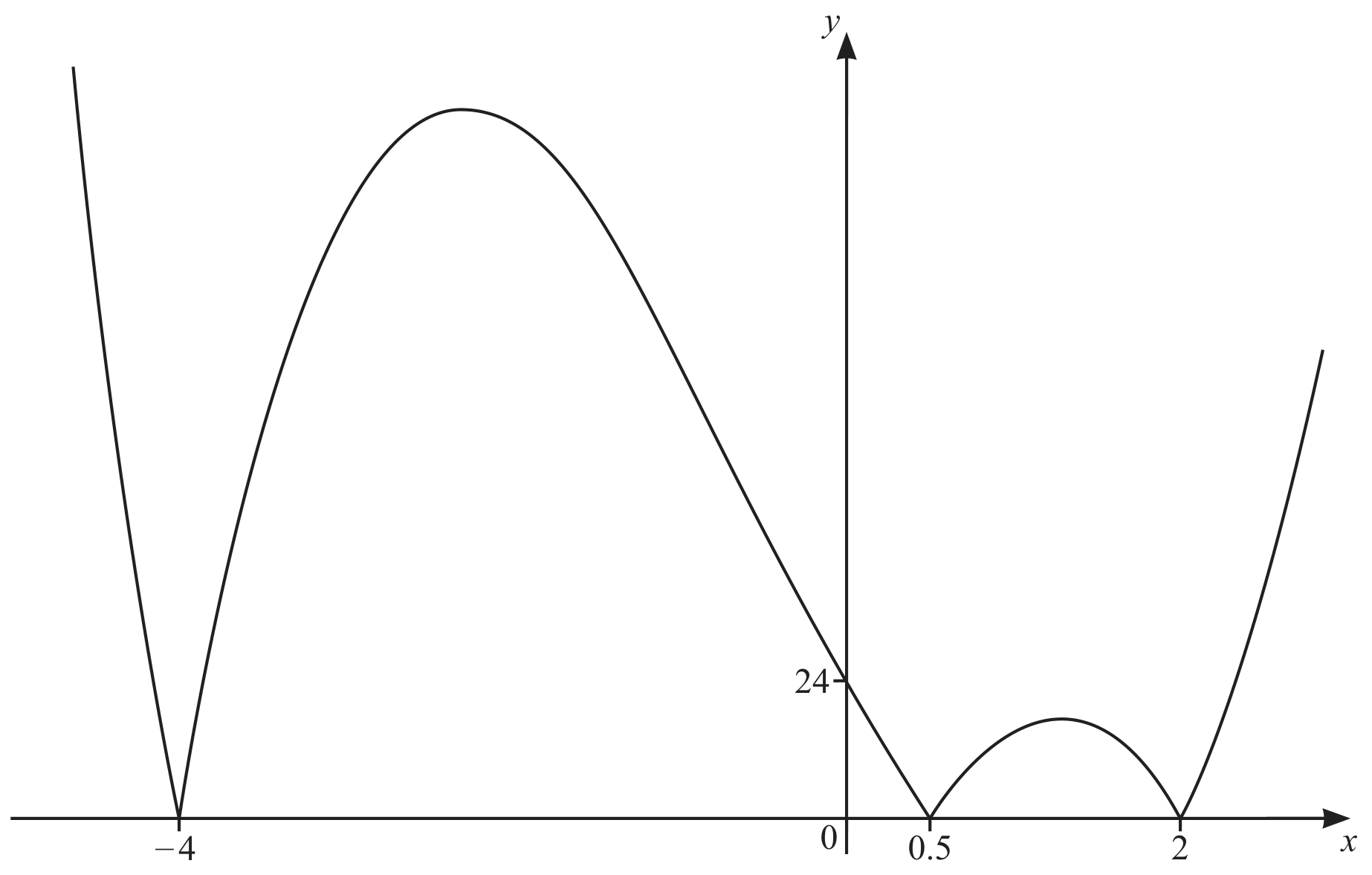
The diagram shows the graph of , where f(x) is a cubic polynomial. Find the two possible expressions for f(x) in terms of linear factors with integer coefficients.
On the axes, sketch the graph of y=3(x-3)(x-1)(x+2) stating the intercepts with the coordinate axes.
A curve has equation .
On the axes below, sketch the graph of , stating the coordinates of the points where the curve meets the axes.
Find the values of k for which the equation has one distinct root only.
On the axes, sketch the graph of stating the intercepts with the coordinate axes.
The polynomial q(x) is given by .
On the axes, sketch the graph of y=q(x) stating the intercepts with the coordinate axes.
A curve has equation y=f(x), where .
On the axes below, sketch the graph of y=f(x), stating the intercepts with the coordinate axes.
Find the values of k such that the equation f(x)=k has 3 distinct solutions.
On the axes, sketch the graph of , stating the intercepts with the coordinate axes.
Find the possible values of the constant k for which has exactly 4 different solutions.