
EduNinja

IGCSE Additional Math13.4. Compose and resolve velocitiesTopic Practice

13.4. Compose and resolve velocities

CAIE IGCSE Additional Math 13.4. Compose and resolve velocities question practice helps you revise this syllabus point with the course map in view. Use this page to focus on one topic, check the style of questions available, and connect each attempt back to the knowledge area it is testing.

EduNinja keeps Additional Math practice aligned to CAIE, so you can move from topic review into exam-style question bank work without losing the syllabus structure. Start with a small set, mark the weak steps, then return to nearby topic links when a definition, graph, calculation, or explanation needs repair.

Question 6

Question 6(a)

(a)

In this question, i is a unit vector due east and j is a unit vector due north.
A cyclist rides at a speed of 4 ms14 \mathrm{~ms}^{-1} on a bearing of 015015^{\circ}. Write the velocity vector of the cyclist in the form x i+y j, where x and y are constants.

[ 2 ]

Question 6(b)

(b)

A vector of magnitude 6 on a bearing of 300300^{\circ} is added to a vector of magnitude 2 on a bearing of 230230^{\circ} to give a vector v. Find the magnitude and bearing of v.

[ 5 ]
Question 6

[Maximum number: 8]

In this question lengths are in centimetres and time, t, is in seconds.
A particle P is moving in a straight line with a speed of 26 in the direction of the vector (512)\binom{5}{-12}.

Question 6(a)

(a)

Find the velocity vector of P.

When t=0, P passes through a point A which has position vector (36)\binom{3}{6}.

[ 2 ]

Question 6(b)

(b)

Write down the position vector of P at time t.

At the same time that P passes through A, a particle Q passes through a point B.
The position vector of Q at time t is given by (8t5225t)\binom{8 t-5}{2-25 t}.
The distance between P and Q at time t is d.

[ 2 ]

Question 6(c)

(c)

Show that d2=mt2+nt+rd^{2}=m t^{2}+n t+r, where m, n and r are integers to be found.

[ 3 ]

Question 6(d)

(d)

Hence show that P and Q do not collide.

[ 1 ]

Question 8

[Maximum number: 5]

In this question all distances are in km.
A ship P sails from a point A, which has position vector (00)\binom{0}{0}, with a speed of 52kmh152 \mathrm{kmh}^{-1} in the direction of (512)\binom{-5}{12}.

Question 8(a)

(a)

Find the velocity vector of the ship.

[ 1 ]

Question 8(b)

(b)

Write down the position vector of P at a time t hours after leaving A.

At the same time that ship P sails from A, a ship Q sails from a point B, which has position vector (128)\binom{12}{8}, with velocity vector (2545)kmh1\binom{-25}{45} \mathrm{kmh}^{-1}.

[ 1 ]

Question 8(c)

(c)

Write down the position vector of Q at a time t hours after leaving B.

[ 1 ]

Question 8(f)

(d)

Find the value of t when P and Q are first 2 km apart.

[ 2 ]

Question 9

[Maximum number: 5]

In this question, all lengths are in metres.

Question 9(a)

(a)

A particle P has position vector (2+12t55t)\binom{2+12 t}{5-5 t} at a time t seconds, t0t \geqslant 0.

[ 5 ]

Question 9(a)(i)

(i)

Write down the initial position vector of P .

[ 1 ]

Question 9(a)(ii)

(ii)

Find the speed of P.

[ 2 ]

Question 9(a)(iii)

(iii)

Determine whether P passes through the point with position vector (15848)\binom{158}{-48}.

[ 2 ]

Question 10

[Maximum number: 9]

In this question, time is in seconds.

Question 10(a)

(a)

At time t=0, particle P starts from the point with position vector -30 j.
P travels with speed 58 ms158 \mathrm{~ms}^{-1} in the direction 20 i+21 j.
Find the position vector of P at time t.

[ 3 ]

Question 10(b)

(b)

Also at time t=0, particle Q starts from the point with position vector -10 i+18 j.
Q travels with speed 75 ms175 \mathrm{~ms}^{-1} at an angle α\alpha above the positive x-axis, where tanα=724\tan \alpha=\frac{7}{24}.
Find the position vector of Q at time t.

[ 4 ]

Question 10(c)

(c)

Determine whether P and Q collide.

T
[2]

[ 2 ]

Question 11

[Maximum number: 9]

In this question i is a unit vector in the positive x-direction and j is a unit vector in the positive y-direction. Time is in seconds and distances are in metres.

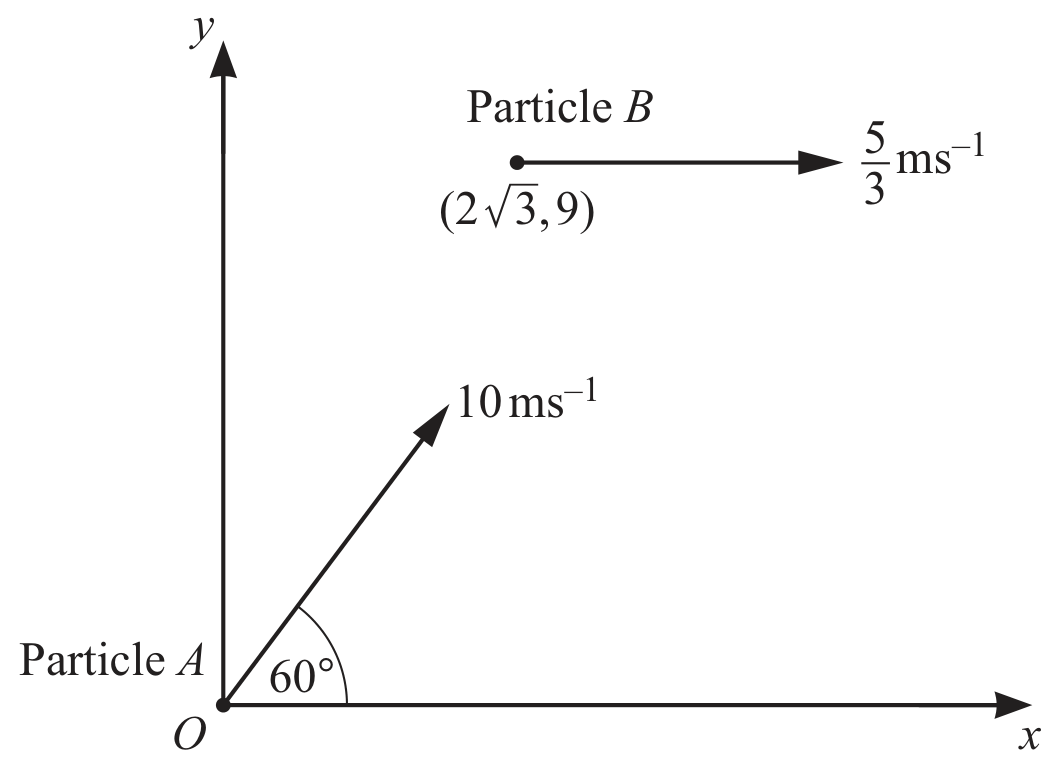
The diagram shows the initial positions and velocities of two particles, A and B, that move in the x-y plane.

Question image

Particle A starts from the origin O at time t=0. It moves with constant speed 10 ms110 \mathrm{~ms}^{-1} in the direction 6060^{\circ} above the x-axis.

Question 11(a)

(a)

Find the exact values of the components of the velocity of particle A in the x-direction and the y-direction.

[ 2 ]

Question 11(b)

(b)

Find, in terms of t, the position vector of particle A at time t.

Particle B starts from the point (23,9)(2 \sqrt{3}, 9) at time t=0. It moves with constant speed 53 ms1\frac{5}{3} \mathrm{~ms}^{-1} parallel to the positive x-axis.

[ 1 ]

Question 11(c)

(c)

Find, in terms of t, the position vector of particle B at time t.

[ 2 ]

Question 11(d)

(d)

Hence show that the particles collide.

[ 4 ]

Question 12

[Maximum number: 7]

In this question, the x - and y-directions are east and north respectively. The units are metres and seconds. Boat A starts from the origin O and moves with constant speed 53 ms15 \sqrt{3} \mathrm{~ms}^{-1} on a bearing of 030030^{\circ}. After 100 seconds boat B starts from point P, which has position vector (01000)\binom{0}{1000}.
Boat B moves with constant speed 10 ms110 \mathrm{~ms}^{-1} on a bearing of 060060^{\circ}.

Question 12(a)

(a)

Find the velocity of each boat in vector form.

[ 2 ]

Question 12(b)

(b)

Show that the two boats will collide.

[ 5 ]
0 selected