

EduNinja

IB Maths AA SL 3.1 Three-dimensional geometry

IB Maths AA SL 3.1 Three-dimensional geometry
IB Mathematics: analysis and approaches guide, first assessment 2021

Practise 3D geometry by finding lengths, angles, volumes and surface areas for solids using diagrams, coordinates and formulae.

How this is tested

  • calculate 3D distances from coordinates or diagrams using Pythagoras in two or three dimensions
  • find angles between an edge and a base by selecting the right triangle and using tan, sin or cos
  • combine cone, sphere or hemisphere formulae to find volume, surface area, radius or slant height

Question 8

[Maximum number: 12]

A manufacturer creates an ice cream model consisting of two parts.
The top part consists of a hemisphere of ice cream with radius r cmr \mathrm{~cm}.
The bottom part consists of a cone of ice cream with radius r cmr \mathrm{~cm} and height h cmh \mathrm{~cm}, which is wrapped in a wafer coating.
This is shown in the following diagram.
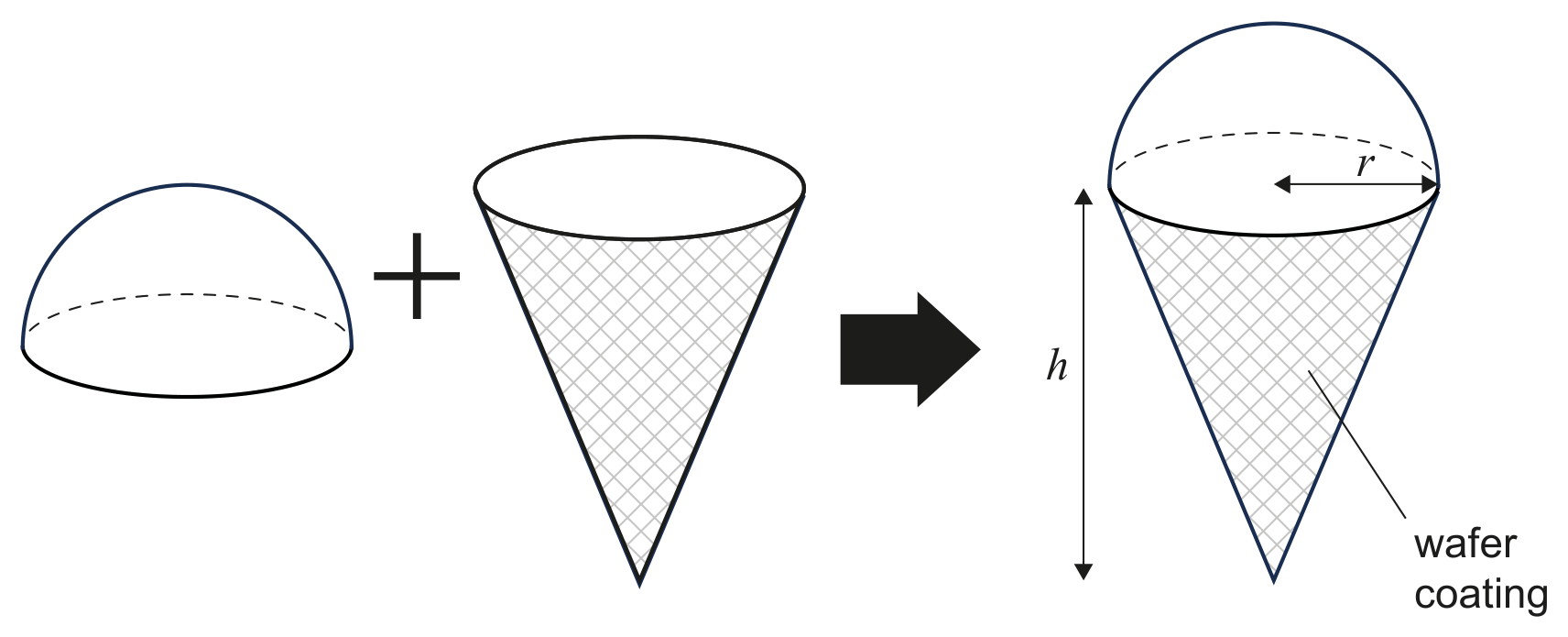
Figure for Question 8 — IB Maths AA SL

The manufacturer changes the dimensions of the model to ensure that the total volume, V, of ice cream is 120 cm3120\mathrm{~cm}^{3}.

Question 8(a)

(a)

Consider the case where r=3 and h=8.

[ 7 ]

Question 8(a)(i)

(i)

Show that the total volume, V, of ice cream is 132 cm3132 \mathrm{~cm}^{3}, correct to 3 significant figures.

Question 8(a)(ii)

(ii)

Determine the curved surface area, S, of the wafer coating.

[ 7 ]

Question 8(b)

(b)

Show that h=3602πr3πr2h=\frac{360-2 \pi r^{3}}{\pi r^{2}}.

[ 3 ]

Question 8(c)

(c)

Hence, show that the curved surface area of the wafer coating is given by

S=πrr2+(3602πr3πr2)2.S=\pi r \sqrt{r^{2}+\left(\frac{360-2 \pi r^{3}}{\pi r^{2}}\right)^{2}} .
[ 2 ]