

EduNinja

IB Maths AA SL 1.8 Infinite Geometric Series

IB Maths AA SL 1.8 Infinite Geometric Series
IB Mathematics: analysis and approaches guide, first assessment 2021

Practise testing geometric-series convergence and using a sum to infinity in exact algebraic, repeating-decimal, iterative-function and motion contexts.

How this is tested

  • check |r| < 1 before using a sum to infinity and explain non-convergence when it fails
  • apply S_infinity = u_1/(1-r) and retain exact values in algebraic or contextual problems
  • derive a restriction on a parameter from the convergence condition before evaluating the series

Question 9(e)(ii)

[Maximum number: 5]

A particle P moves in a straight line so that its displacement, s cms \mathrm{~cm}, from a fixed point O at time t seconds is given by s(t)=2(1t5)sin(2πt3)s(t)=2^{\left(1-\frac{t}{5}\right)} \sin \left(\frac{2 \pi t}{3}\right), where t0t \geq 0.
The following diagram shows part of the graph of y=s(t).
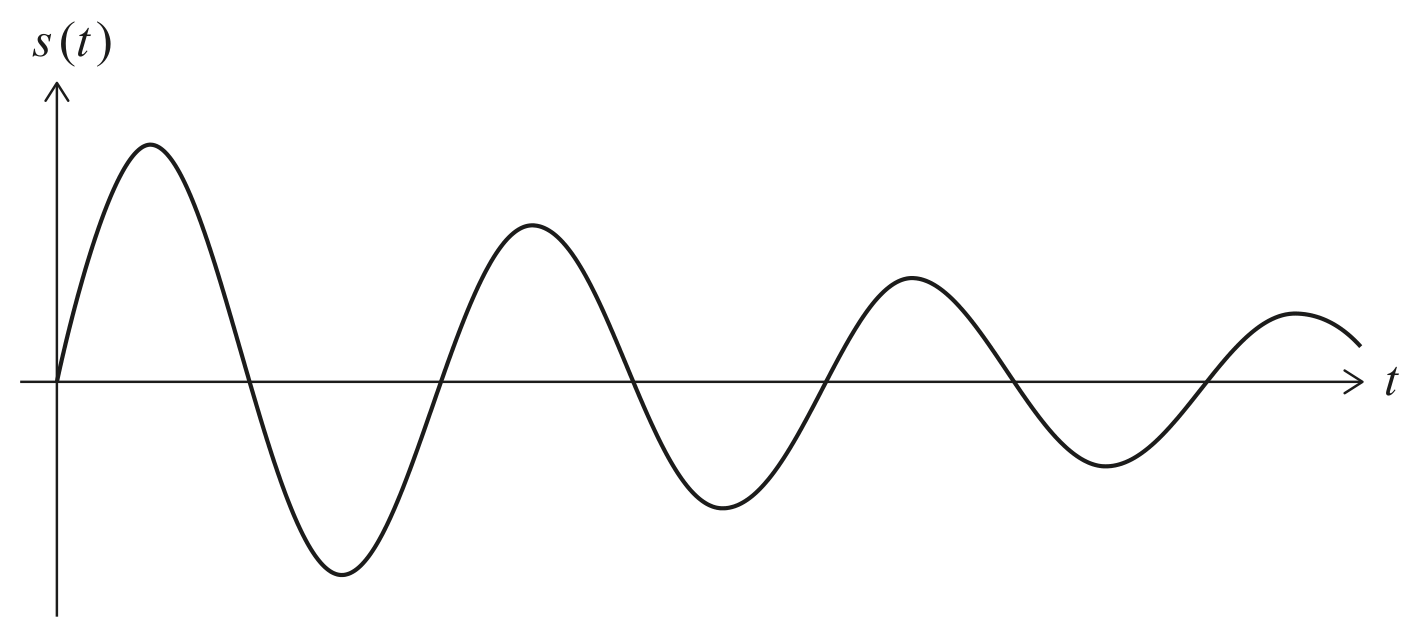
Figure for Question 9(e)(ii) — IB Maths AA SL

The particle passes through O every T seconds. A sequence u1,u2,u3,u_{1},u_{2},u_{3},\ldots is formed where u1,u2,u3,u_{1},u_{2},u_{3},\ldots are the largest distances from O in each of the intervals 0<t<T,T<t<2T,2T<t<3T,0<t<T, T<t<2T, 2T<t<3T,\ldots respectively.

It is known that u1,u2,u3,u_{1},u_{2},u_{3},\ldots form a geometric sequence.

Calculate the total distance travelled by the particle if it were to continue to move in this way indefinitely.