[Maximum number: 5]
Let , for x>0.
(a)
Find .
[ 2 ]
(b)
Find .
[ 1 ]
(c)
Solve .
[ 2 ]
 EduNinja
Let , for x>0.
Find .
Find .
Solve .
Consider the function .
Find the coordinates of A.
Find .
Given and f(1.2)=7.32, find f(x).
Consider the function defined by . The graph of f passes through the point A(3,-15).
Find the gradient of the tangent to the graph of f at the point A .
Write down the equation of the normal to the graph of f at point A .
The normal to the graph of f at point A intersects the graph of f again at a second point B .
Find the coordinates of B.
Consider the function , where .
Hence, find .
Consider the function , where .
Find .
Find the equation of the tangent to the graph of f at x=1.
Let , for .
The graph of f has a maximum at the point A . Write down the coordinates of A .
Let . The graph of f is shown in the following diagram.
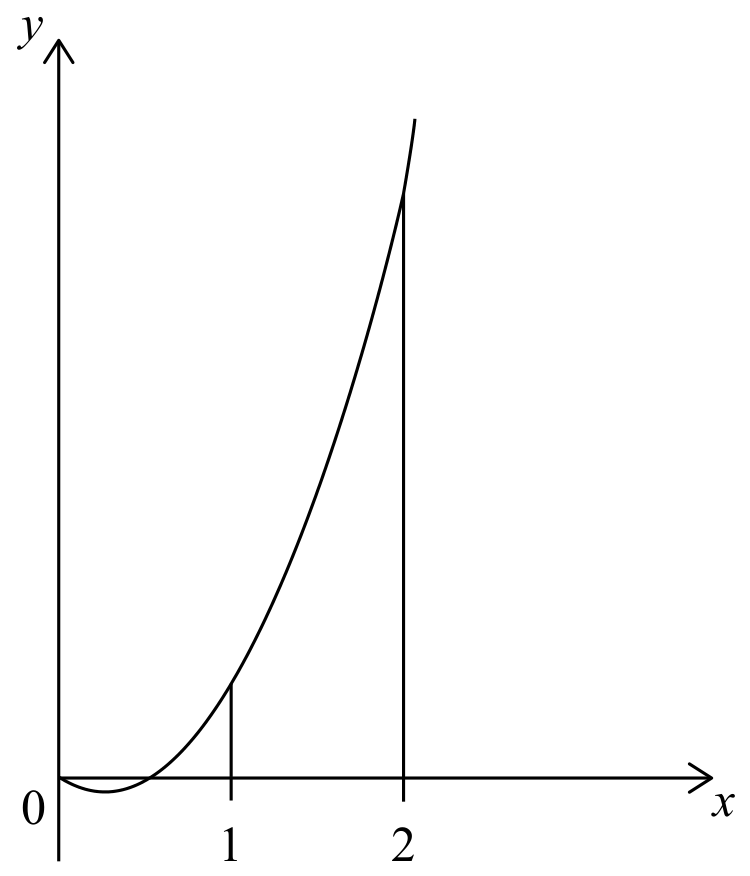
Find .
Find the area of the region enclosed by the graph of f, the x-axis and the lines x=1 and x=2.
The derivative of a function g is given by , where . The graph of g passes through the point (0,4). Find g(x).
Hence, find the value of .