
EduNinja

IGCSE Physics6.1.1 The EarthQuestion Bank

Question 37

[Maximum number: 1]

Which row about the orbits of the Earth and the Moon is correct?

approximate time
for the Earth
to orbit the Sun

approximate time
for the Moon
to orbit the Earth

1 day

30 days

30 days

1 day

365 days

1 day

365 days

30 days
Question 37

[Maximum number: 1]

Which data is needed to calculate the average orbital speed of a satellite around a planet?

the distance of the
satellite from the
centre of the planet

the radius
of the planet

the period
of rotation of
the planet

the time for the
satellite to orbit
the planet once

×

×

×

×

χ\boldsymbol{\chi}

×

key
✓ = needed
x= not needed

Question 38

[Maximum number: 1]

The average distance from the Earth to the Sun is 1.5×10¹¹ m1.5 \times 10^{11} \mathrm{~m}.
What is the orbital speed of the Earth?

A

4.0×10⁵ km/4.0 \times 10^{5} \mathrm{~km} / day

B

1.3×10⁶ km/1.3 \times 10^{6} \mathrm{~km} / day

C

2.6×10⁶ km/2.6 \times 10^{6} \mathrm{~km} / day

D

1.9×10¹⁴ km/1.9 \times 10^{14} \mathrm{~km} / day

Question 38

[Maximum number: 1]

The Earth orbits the Sun once in approximately 365 days.
The average radius of the orbit is 1.5×10¹¹ m1.5 \times 10^{11} \mathrm{~m}.
What is the average orbital speed of the Earth?

A

3.0×10⁴ m/s3.0 \times 10^{4} \mathrm{~m} / \mathrm{s}

B

1.1×10⁸ m/s1.1 \times 10^{8} \mathrm{~m} / \mathrm{s}

C

2.6×10⁹ m/s2.6 \times 10^{9} \mathrm{~m} / \mathrm{s}

D

1.3×10¹⁵ m/s1.3 \times 10^{15} \mathrm{~m} / \mathrm{s}

Question 38

[Maximum number: 1]

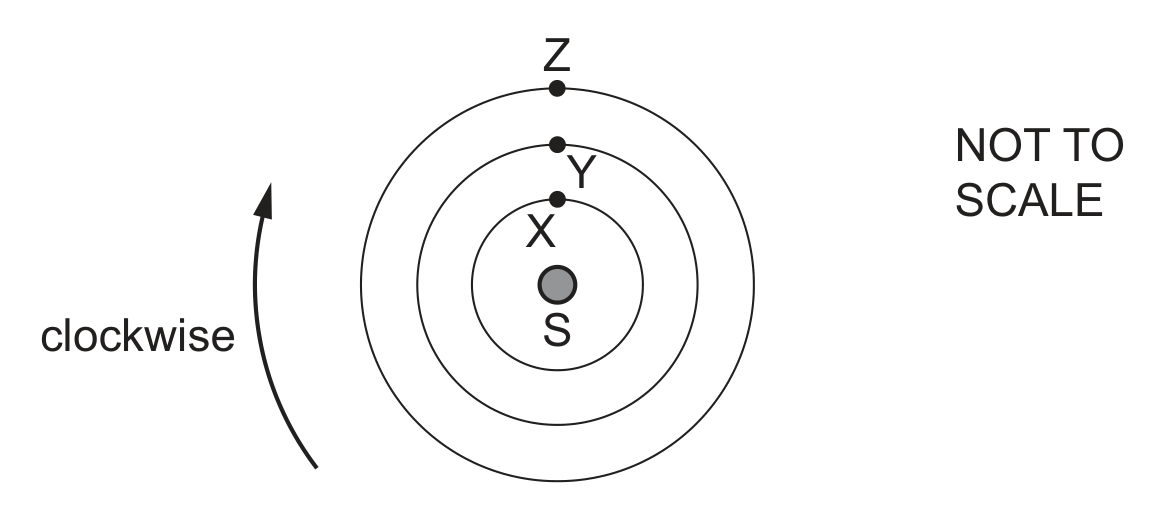
The diagram shows a star S and the initial arrangement of three planets, X, Y and Z.

Question image

Each planet orbits clockwise in a circle about S.
The time for one orbit of Y is three times the time taken for one orbit of X.
The time for one orbit of Z is twice the time taken for one orbit of Y.

Starting from the initial arrangement, which diagram shows the positions of the planets after X has made one complete orbit?

Question 38

[Maximum number: 1]

The time taken for the Earth to orbit the Sun is approximately 365 days.
The average radius of the Earth's orbit around the Sun is 1.5×10⁸ km1.5 \times 10^{8} \mathrm{~km}.
What is the average orbital speed of the Earth?

A

30 m/s30 \mathrm{~m} / \mathrm{s}

B

4.8×10³ m/s4.8 \times 10^{3} \mathrm{~m} / \mathrm{s}

C

3.0×10⁴ m/s3.0 \times 10^{4} \mathrm{~m} / \mathrm{s}

D

4.1×10¹⁰ m/s4.1 \times 10^{10} \mathrm{~m} / \mathrm{s}

Question 38

[Maximum number: 1]

It is summer in the northern hemisphere of the Earth in June.
Which statement explains why?

A

The Earth is closer to the Sun in June.

B

The Earth spins on its axis in the opposite direction to that in which it rotates around the Sun.

C

The Moon is full in June.

D

The north pole of the axis of the Earth's rotation is tilted towards the Sun in June.

Question 38

[Maximum number: 1]

A space station orbits the Earth at a distance of 7000 km from the Earth's centre. It makes 15 orbits in every 24 -hour period.

What is the speed of the space station in its orbit?

A

2900 km/h2900 \mathrm{~km} / \mathrm{h}

B

4400 km/h4400 \mathrm{~km} / \mathrm{h}

C

8800 km/h8800 \mathrm{~km} / \mathrm{h}

D

27000 km/h27000 \mathrm{~km} / \mathrm{h}

Question 38

[Maximum number: 1]

Approximately how long does it take for the Moon to make one complete orbit of the Earth?

A

24 hours

B

1 month

C

1 season

D

1 year

Question 39

[Maximum number: 1]

The orbit of the Moon around the Earth is modelled as a circular path of radius 3.8×10⁵ km3.8 \times 10^{5} \mathrm{~km}.
The orbital period is 29.5 days (710 hours).

What is the orbital speed of the Moon?

A

5.4×10² km/h5.4 \times 10^{2} \mathrm{~km} / \mathrm{h}

B

1.1×10³ km/h1.1 \times 10^{3} \mathrm{~km} / \mathrm{h}

C

1.7×10³ km/h1.7 \times 10^{3} \mathrm{~km} / \mathrm{h}

D

3.4×10³ km/h3.4 \times 10^{3} \mathrm{~km} / \mathrm{h}

0 selected