Question 1
[Maximum number: 1]
Which quantity is measured in newton seconds (Ns)?
A
impulse
B
moment
C
power
D
work done
 EduNinja
Which quantity is measured in newton seconds (Ns)?
impulse
moment
power
work done
A rocket is stationary on the launchpad. At time t=0, the rocket engines are switched on and exhaust gases are ejected from the nozzles of the engines. The rocket accelerates upwards.
Fig. 1.1 shows how the acceleration of the rocket varies between time t=0 and time .
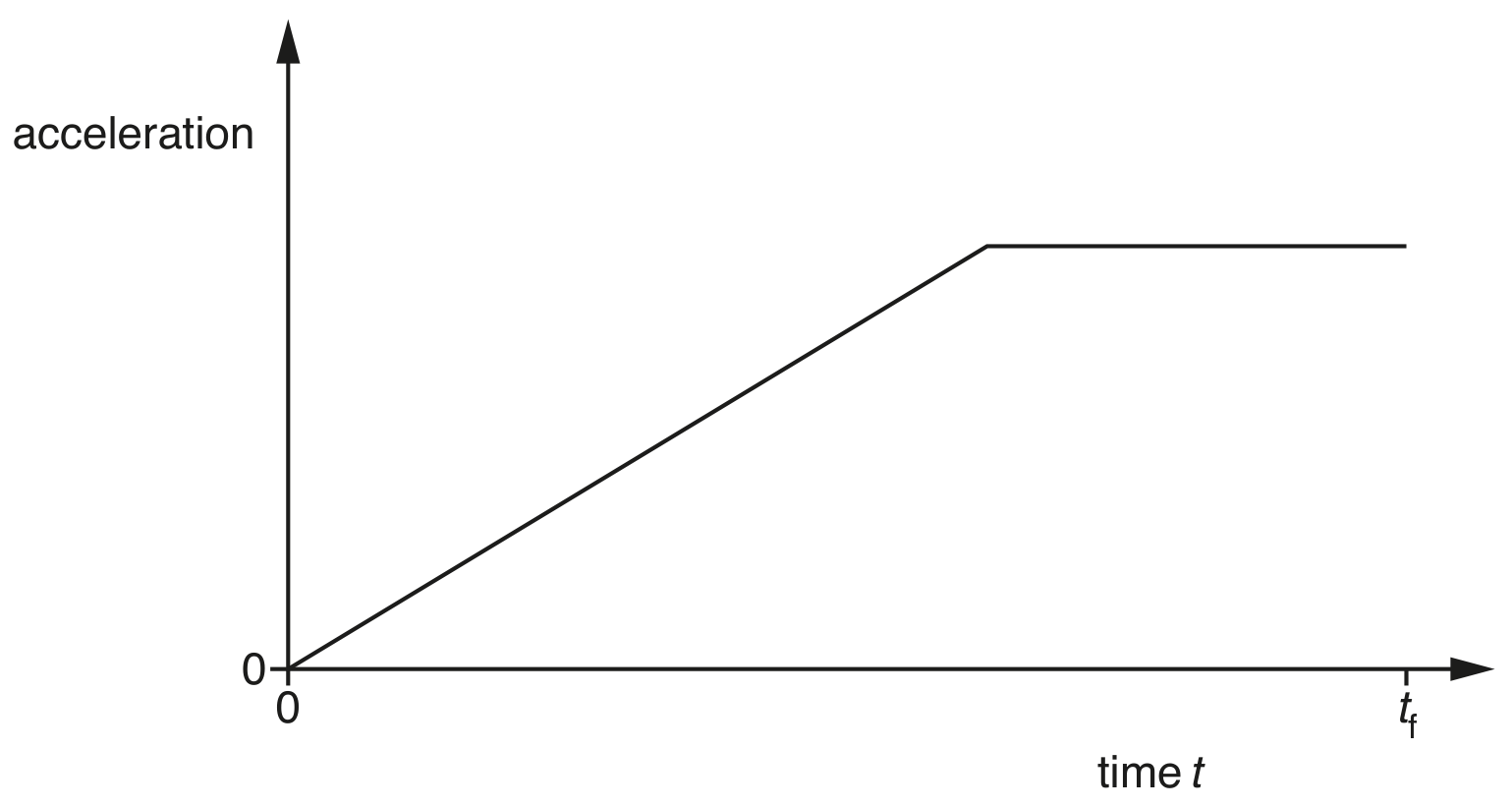
Fig. 1.1
Some time later, the rocket is far from the Earth. The effect of the Earth's gravity on the motion of the rocket is insignificant. As the rocket accelerates, its momentum increases.
State the principle of the conservation of momentum.
Explain how the principle of the conservation of momentum applies to the accelerating rocket and the exhaust gases.
An aeroplane of mass lands with a speed of , on a horizontal runway at time t=0. The aeroplane decelerates uniformly as it travels along the runway in a straight line until it reaches a speed of at .
Calculate:
the momentum of the aeroplane when its speed is .
Fig. 1.1 shows an ice-hockey player moving on ice. He is preparing to hit the solid disc called a puck.
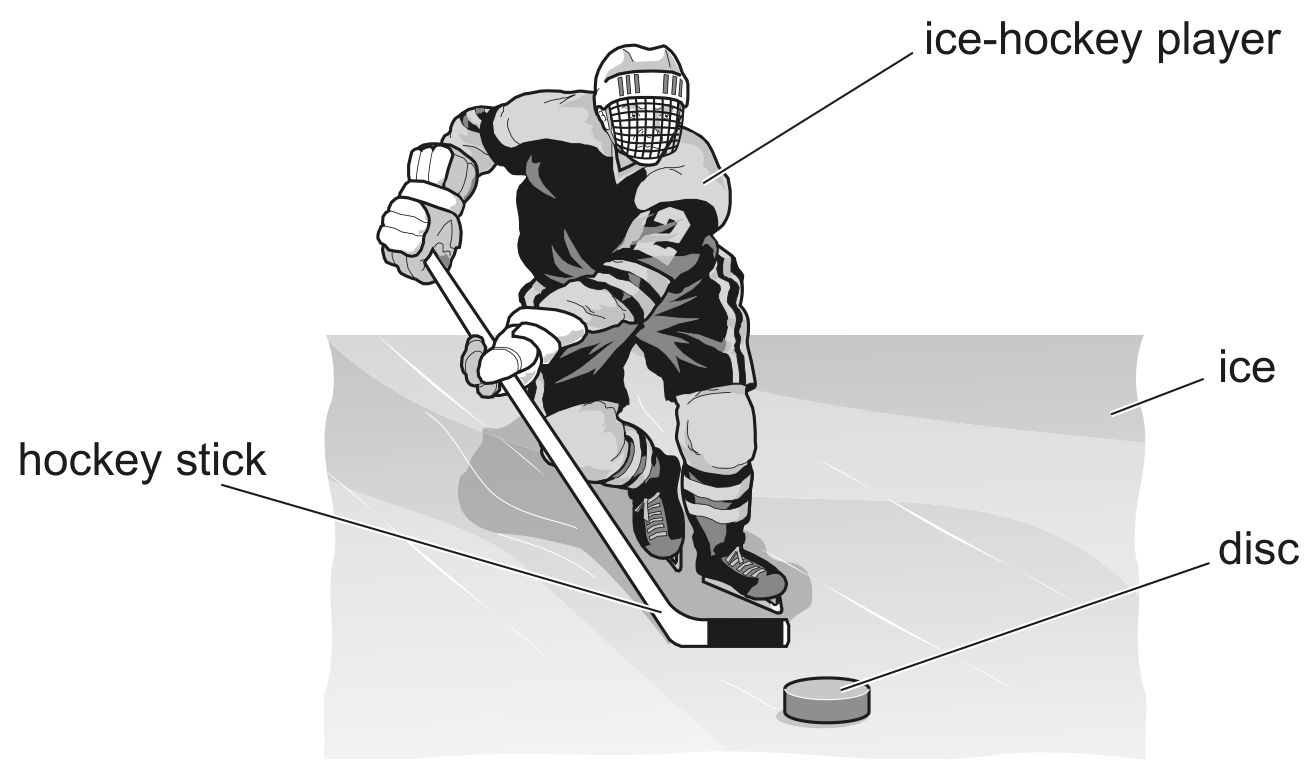
Fig. 1.1
The disc of mass 0.16 kg is moving horizontally across the surface of the ice at a speed of .
Calculate the magnitude of the momentum of the disc.
The hockey player strikes the disc with his hockey stick and the momentum of the disc changes. The disc gains momentum of at to the original direction of travel of the disc, as shown in Fig. 1.2.
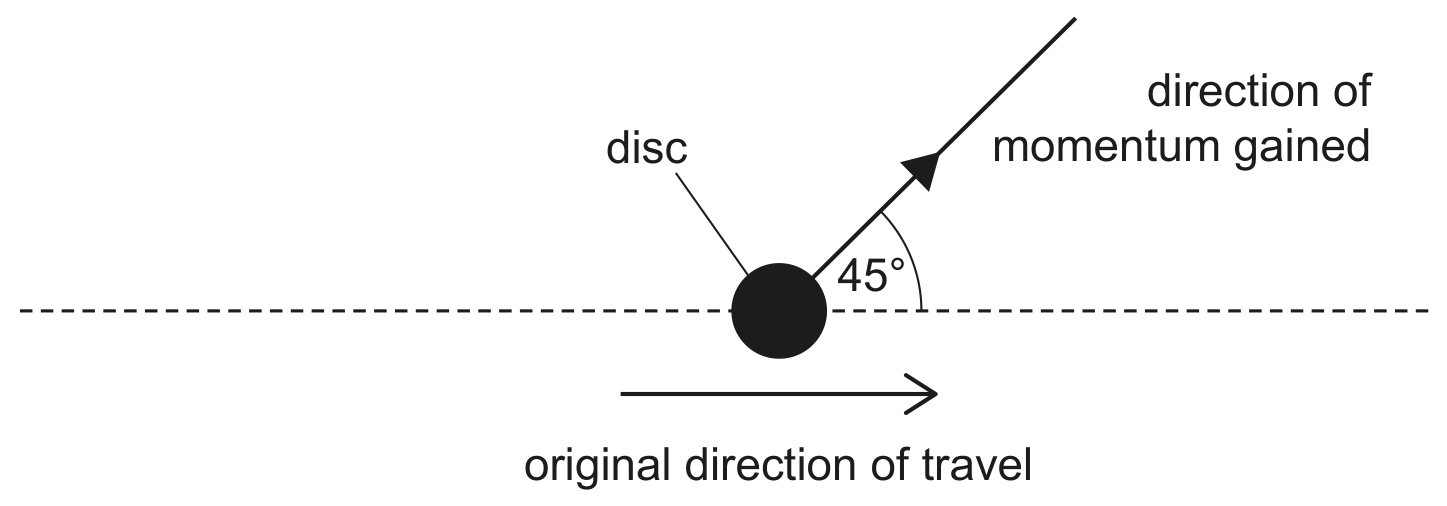
Fig. 1.2 (view from above)
State the magnitude of the impulse exerted on the disc and the direction, in degrees, of the impulse relative to the original direction of travel.
magnitude of impulse =
direction of impulse: to original direction
Determine the magnitude of the new momentum of the disc and its new direction relative to the original direction of travel by drawing a scale diagram.
direction of new momentum: to original direction
Two blocks, A and B, are joined by a thin thread that passes over a frictionless pulley. Block A is at rest on a rough horizontal surface and block B is held at rest, just below the pulley.
Fig. 1.1 shows the thread hanging loose.
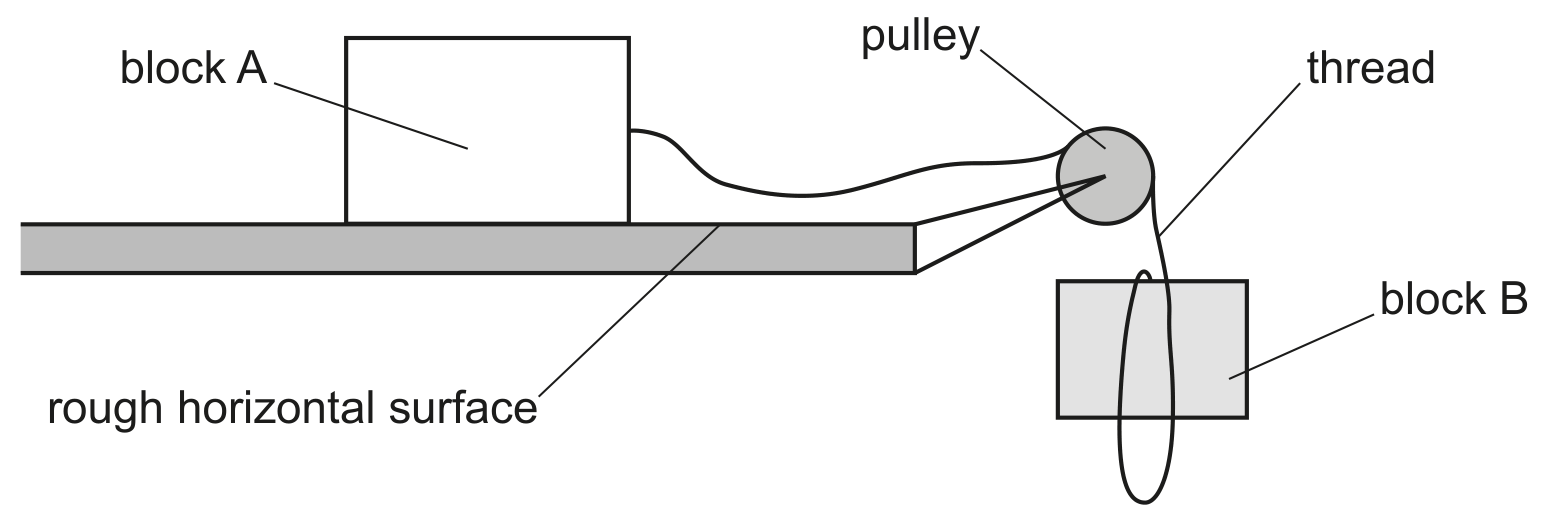
Fig. 1.1 (not to scale)
Block B is released and it falls vertically. The thread remains loose until block B has fallen a distance of 0.45 m .
The mass of block B is 0.50 kg .
The mass of block A is 2.0 kg.
When the thread tightens, it pulls on block A which moves to the right at a speed of .
Calculate the impulse exerted on block A as it accelerates from rest to .
impulse = [3]
A girl holds a rubber ball out of a window of a tall building. The mass of the ball is 0.20 kg . The ball is at rest 10 m above a concrete path.
The girl releases the ball and it falls towards the path. The ball strikes the path and bounces vertically upwards.
Fig. 1.1 shows the ball falling towards the path.
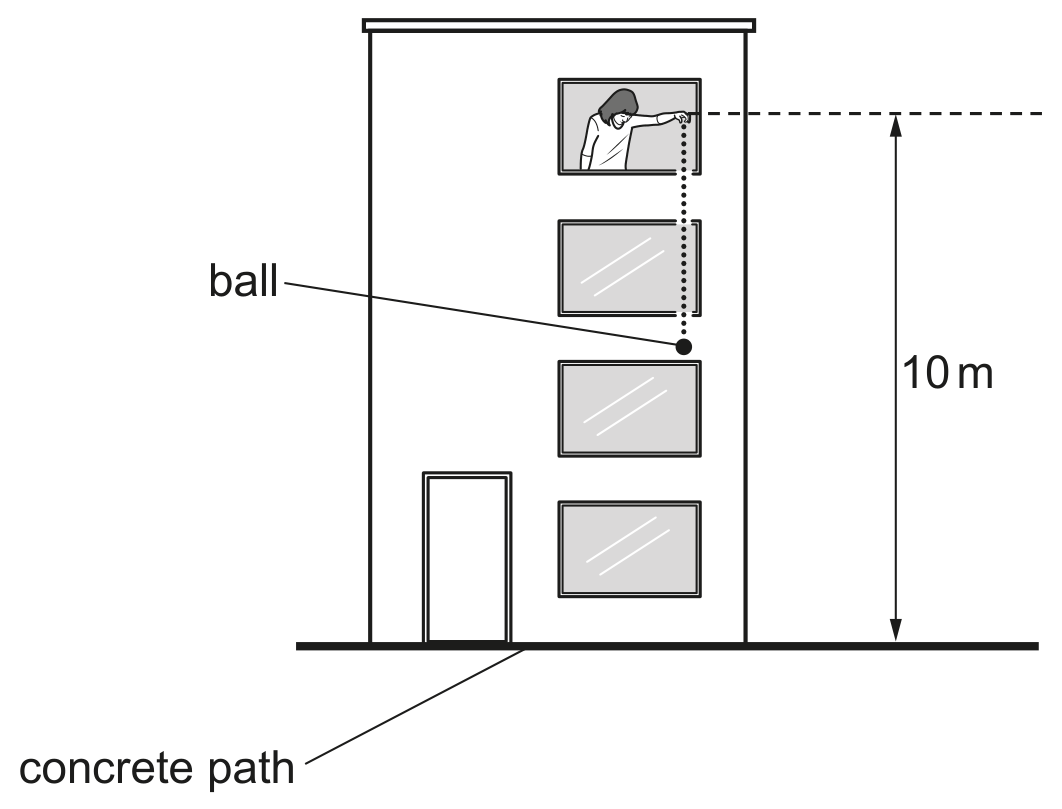
Fig. 1.1
The speed of the ball immediately before it strikes the path is .
The speed of the ball immediately after it strikes the path is .
Show that the change in momentum of the ball when it bounces off the path is .
The ball is in contact with the path for 0.25 s .
Calculate the average resultant force on the ball when it is in contact with the path.
force = [2]
[Total: 9]
Fig. 2.1 shows a dummy of mass 70 kg used in a crash test to investigate the safety of a new car.
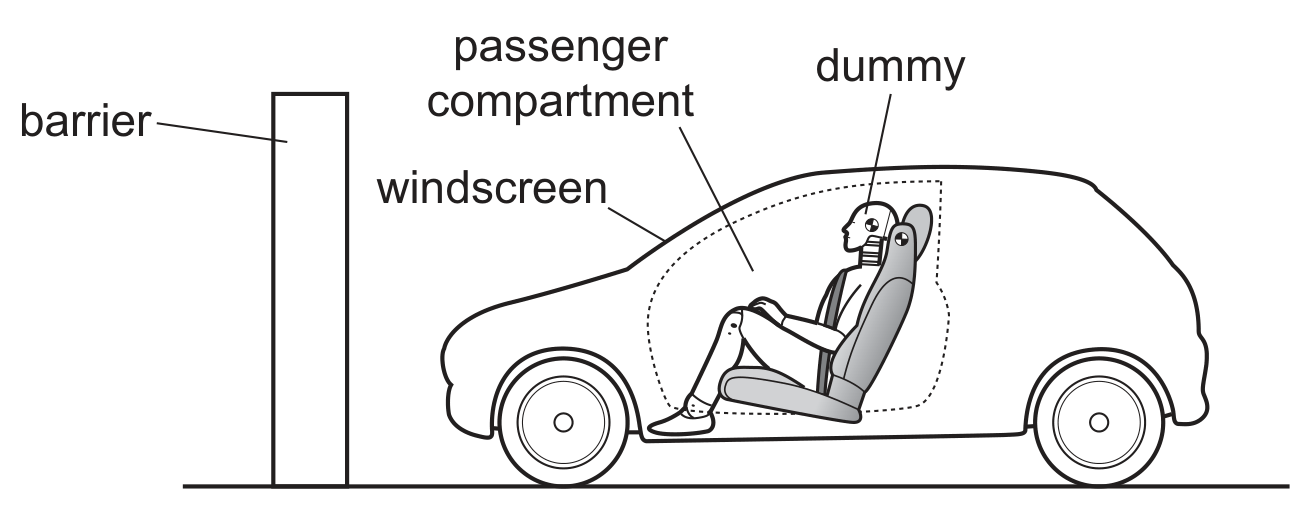
Fig. 2.1
The car approaches a solid barrier at . It crashes into the barrier and stops suddenly.
Calculate the momentum of the dummy immediately before the crash.
Determine the impulse that must be applied to the dummy to bring it to rest.
impulse =
Fig. 2.1 shows a model fire engine. Its brakes are applied.
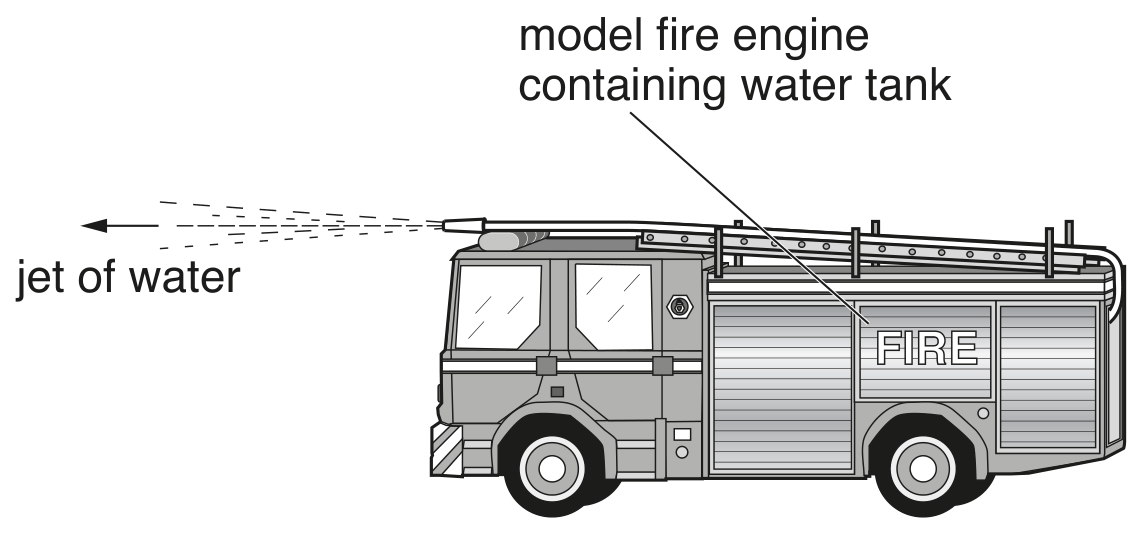
Fig. 2.1
0.80 kg of water is emitted in the jet every 6.0 s at a velocity of relative to the model.
Calculate the change in momentum of the water that is ejected in 6.0 s .
momentum =
Calculate the magnitude of the force acting on the model because of the jet of water.
force =
The brakes of the model are released.
State and explain the direction of the acceleration of the model.
Statement
Explanation
Fig. 2.1 is the top view of a small ship of mass . The ship is moving slowly sideways at as it comes in to dock.
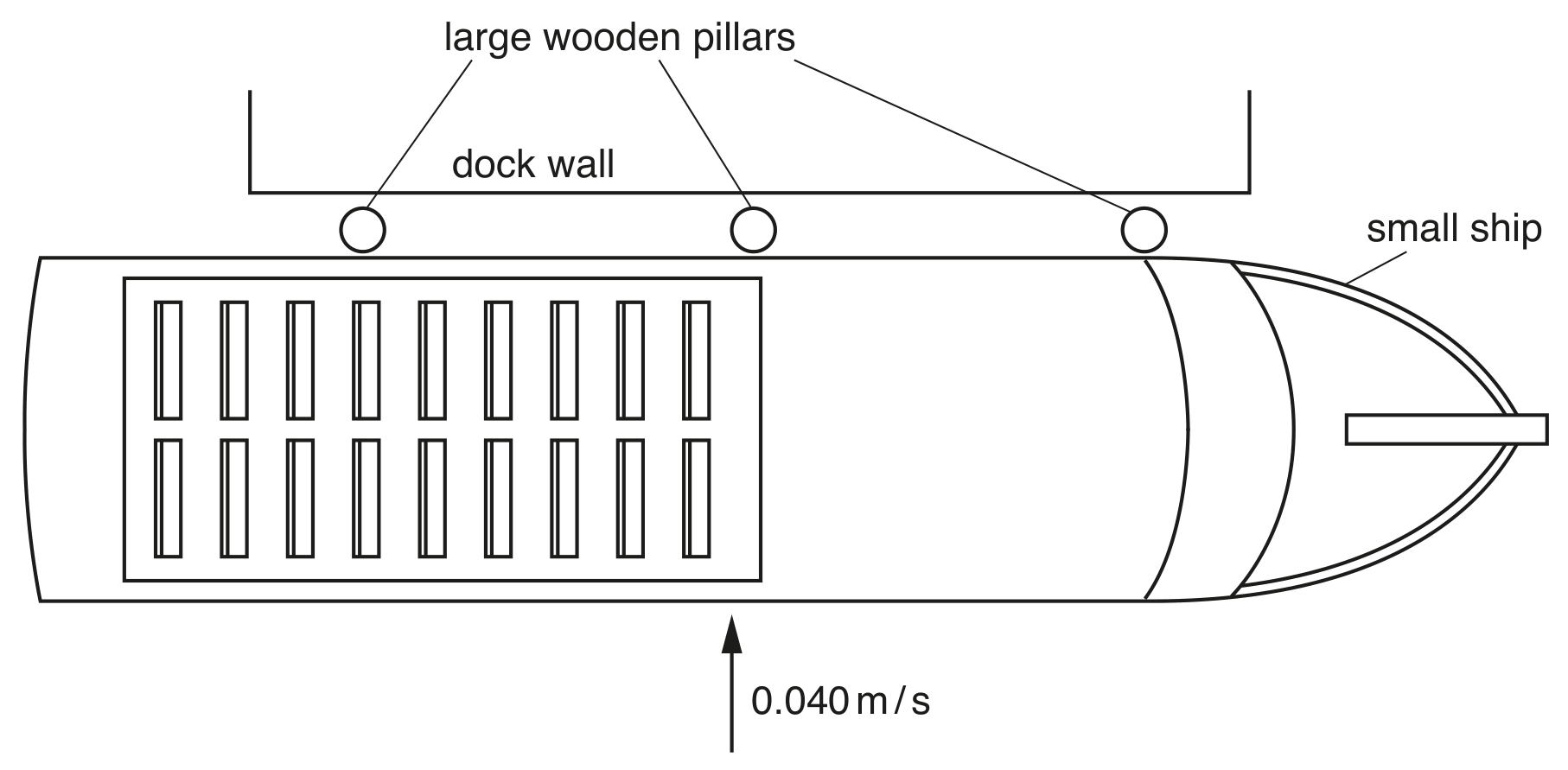
Fig. 2.1
The ship hits the wooden pillars which move towards the dock wall.
The ship is in contact with the pillars for 0.30 s as it comes to rest.
Calculate the average force exerted on the side of the ship.
Dock walls sometimes have the pillars replaced with rubber car tyres.
Explain how this reduces the possibility of damage when a boat docks.
[Total: 9]
Complete the definitions by giving the name of each quantity.
mass × acceleration =
force × time =
Fig. 2.2 shows a man using a golf club to hit a ball.
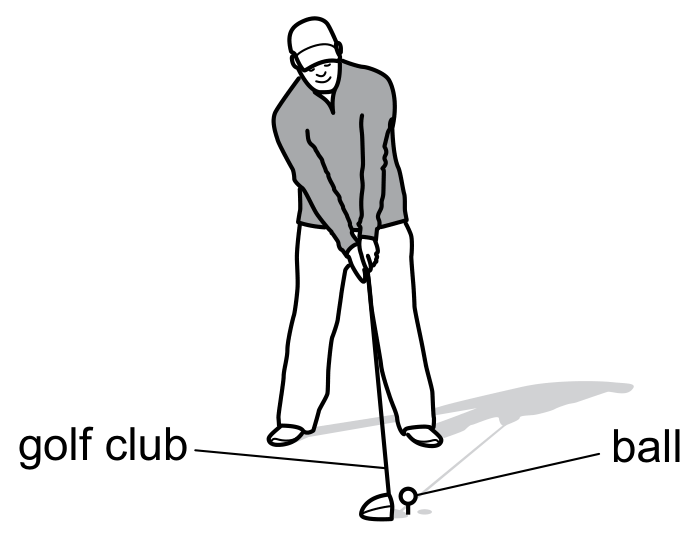
Fig. 2.2
The ball has a mass of 0.046 kg . The golf club is in contact with the ball for a duration of and the ball leaves the golf club at a speed of .
Calculate the momentum of the ball as it leaves the golf club.
Calculate the average resultant force acting on the ball while it is in contact with the golf club.