Question 35
A sample of a radioactive isotope has an initial rate of emission of 128 counts per minute and a half-life of 4 days.
How long will it take for the rate of emission to fall to 32 counts per minute?
2 days
4 days
8 days
12 days
EduNinjaA sample of a radioactive isotope has an initial rate of emission of 128 counts per minute and a half-life of 4 days.
How long will it take for the rate of emission to fall to 32 counts per minute?
2 days
4 days
8 days
12 days
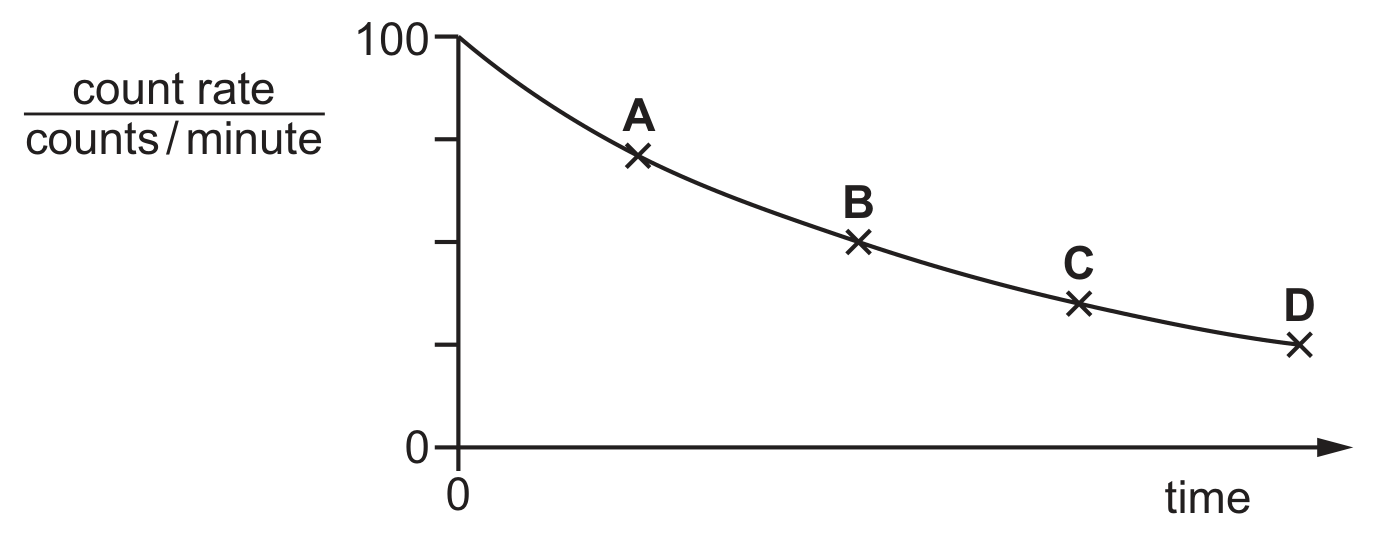
The half-life of carbon-14 is 5700 years.
An object containing carbon-14 has a count rate of 100 counts/minute when it is first formed. The graph shows how the count rate decreases over time.
Which point on the graph corresponds to a time 11400 years after the formation of the object?

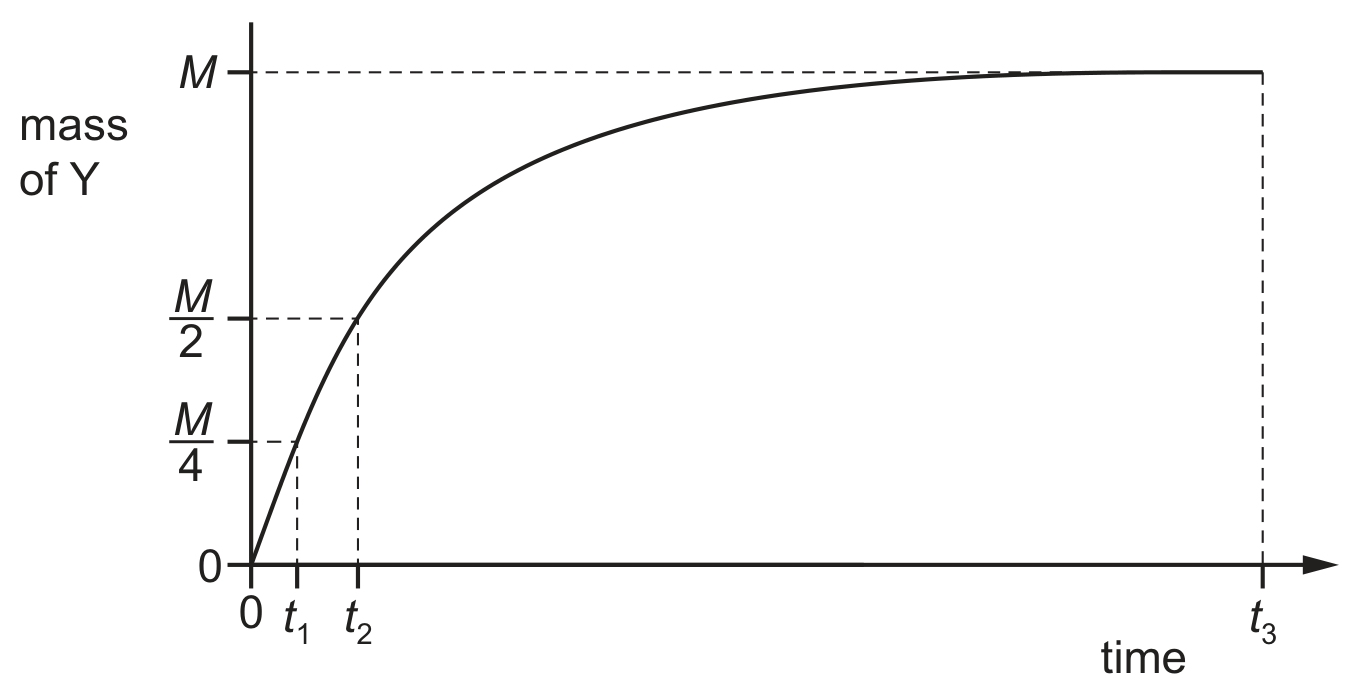
Radioisotope X decays to the stable isotope Y. The graph shows how the mass of Y present in a sample varies with time.

Which time interval gives the half-life of X ?
t2−t1
t3−t2
t2
21t3
Which row correctly matches three radioactive sources to their uses?
emits alpha-particles
and has a long half-life
emits beta-particles
and has a long half-life
emits gamma radiation
and has a short half-life
monitoring the thickness
of aluminium foil
smoke alarm
tracer to be injected
to detect cancer
monitoring the thickness
of aluminium foil
tracer to be injected
to detect cancer
smoke alarm
smoke alarm
monitoring the thickness
of aluminium foil
tracer to be injected
to detect cancer
smoke alarm
tracer to be injected
to detect cancer
monitoring the thickness
of aluminium foil
Which type of radioactive source is suitable for use in measuring and controlling the thickness of paper in a paper-manufacturing factory?
type of emission
half-life
alpha
long
alpha
short
beta
long
beta
short
The reading on a detector placed near a radioactive material is 536 counts per second.
The background count rate is 44 counts per second.
The half-life of the radioactive material is 34 hours.
What is the reading on the detector after 68 hours?
44 counts per second
123 counts per second
134 counts per second
167 counts per second
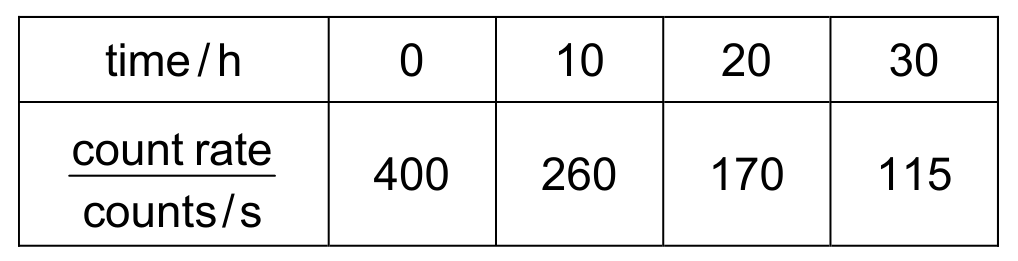
A radioactive isotope of sodium has a half-life of 15 h .
The table gives data from an experiment to show how the rate of decay of the isotope varies with time.
The background count rate has not been subtracted from these data.

What is the background radiation count rate?
12 counts/s
15 counts/s
20 counts/s
30 counts/s
A radioactive isotope has a half-life of 8 days.
A detector close to a sample of this isotope gives a count rate of 200 counts per minute.
Without the source, the background count is 20 counts per minute.
What is the count rate due to the source after 8 days?
80 counts per minute
90 counts per minute
100 counts per minute
110 counts per minute
The background count rate measured by a radiation counter is 40 counts per minute (cpm).
With the counter close to a radioactive source, the counter reading is 960 cpm .
The half-life of the source is 20 minutes.
What is the counter reading one hour later?
115 cpm
120 cpm
155 cpm
160 cpm
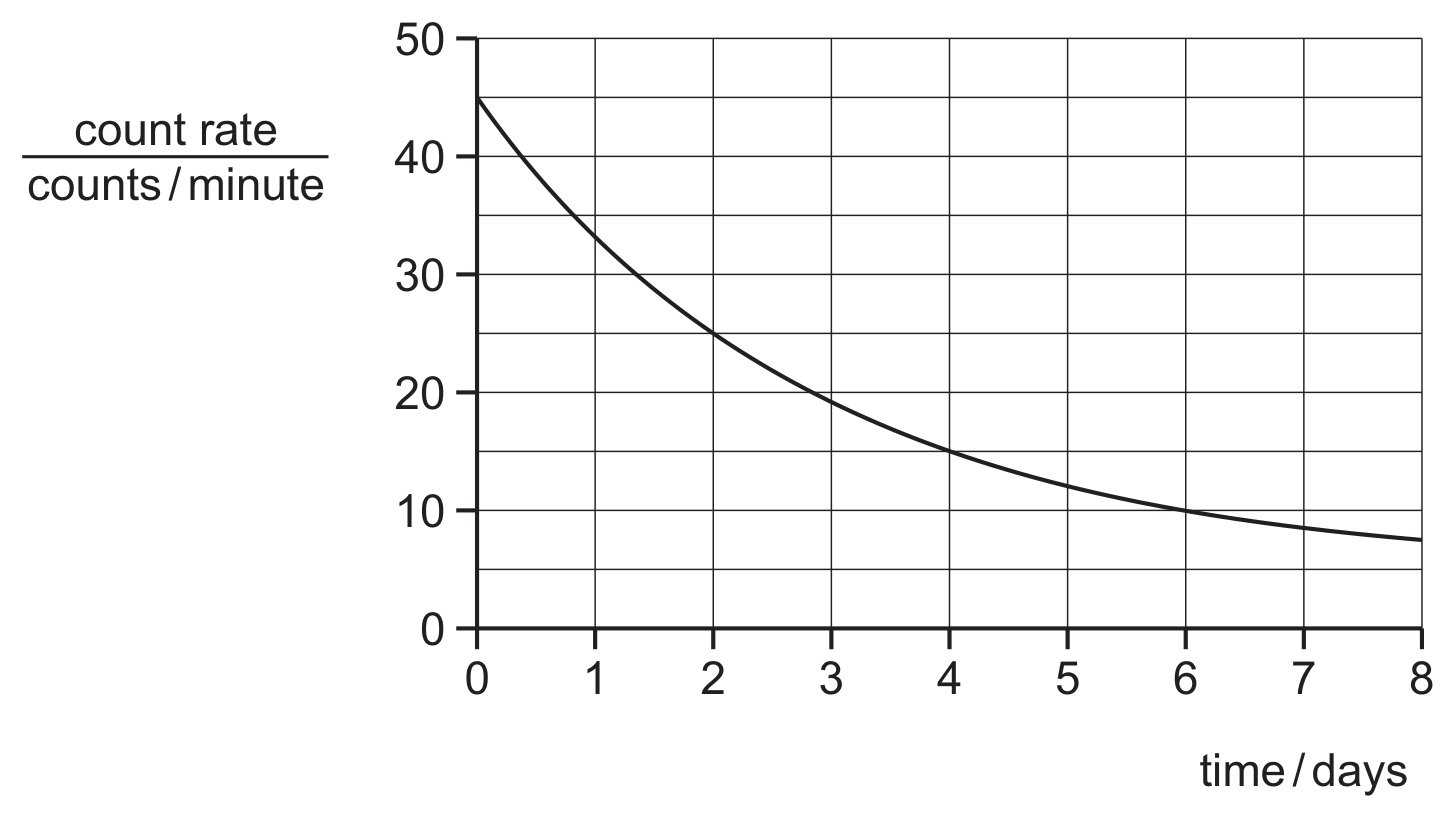
The graph shows how the count rate registered by a counter near to a sample of a radioactive isotope changes over a period of a few days. The background count rate is 5 counts per minute.

What is the half-life of the isotope?
2.0 days
2.5 days
3.0 days
4.0 days