EduNinja

IGCSE Physics5.2.1 Detection of radioactivityQuestion Bank

Question 31

[Maximum number: 1]

A student is investigating the count rate of a radioactive substance.
How must he adjust his reading for the background count?

A

Add the background count to his reading.

B

Ignore the background count as it will not affect his reading.

C

Subtract the background count from his reading.

D

Take repeat readings to eliminate the background count.
Question 34

[Maximum number: 1]

A radiation detector in a laboratory is measuring background radiation.
Which row describes the readings and the cause?

readings

cause

vary with no pattern

background radiation is random

vary with no pattern

radiation detectors are unstable

slowly increase during the day

background radiation increases as temperature increases

slowly reduce during the day

background radiation decreases as temperature increases

Question 35

[Maximum number: 1]

A radioactive source is placed near a detector connected to a counter.
210 counts are recorded by the counter in 3 minutes.
The background count rate is 20 counts per minute (cpm).
What is the corrected count rate for the radioactive source?

A

50 cpm

B

70 cpm

C

190 cpm

D

270 cpm

Question 35

[Maximum number: 1]

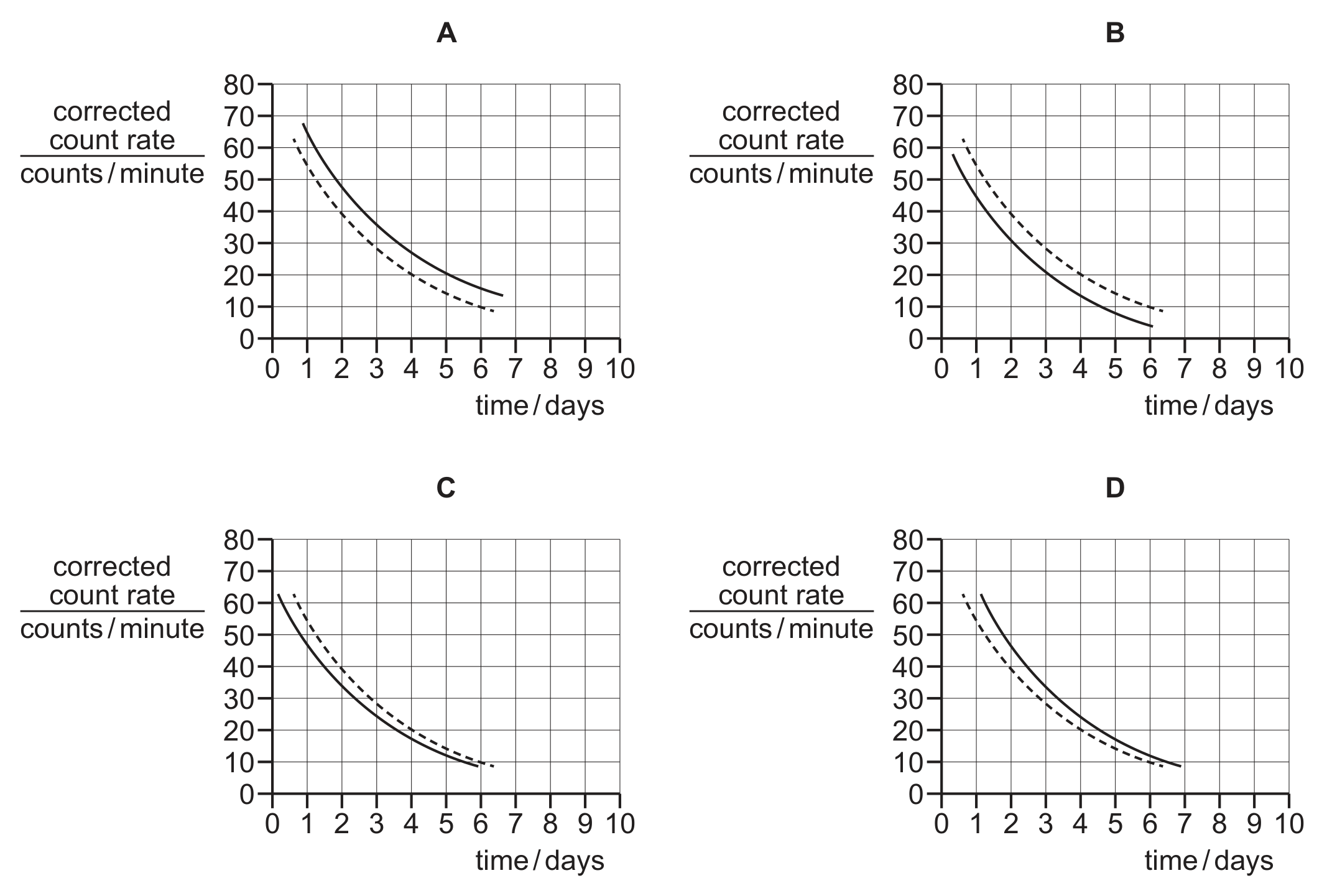
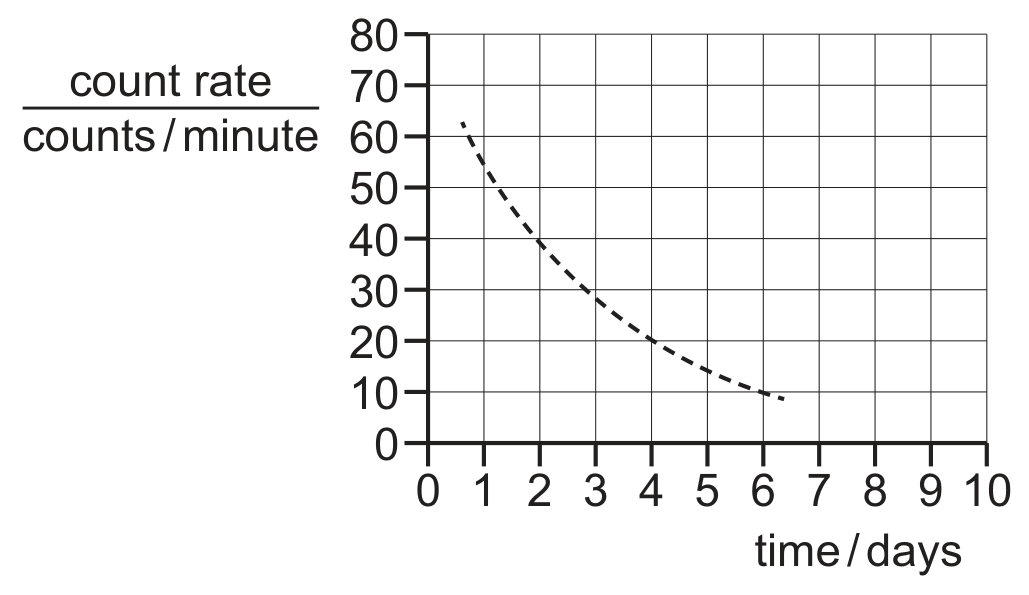
The dashed line on the graph shows the decay curve recorded from a sample of a particular radioactive isotope. The count rate includes background radiation.

Question image

Which curve shows the corrected count rate for the decay?

Question image

Question 39

[Maximum number: 1]

A teacher holds a radioactive source near a detector.
The reading on the detector is 320 counts/min.
The detector is switched on again after the source has been removed and it shows a reading of 20 counts/min.

What is the counts/min solely due to the source and why is there a reading on the detector when there is no radioactive source present?

counts/min
due to the source

reason for reading
with no source

300

zero error on detector

300

background radiation

340

zero error on detector

340

background radiation

Question 9

Question 9(c)

(a)

State two different sources of background radiation.

1

2

[ 2 ]

Question 10

[Maximum number: 2]

A radiation detector is placed on the bench in a laboratory. It detects a background count rate of 40 counts/minute.

Question 10(a)

(a)

State what is meant by background radiation. Suggest one source for it.

[ 2 ]

Question 9

Question 9(b)

(a)

A radiation detector is set up in a laboratory where there are no radioactive samples.

On six separate occasions, the detector is switched on for 1.0 minute and the background count is recorded. The counts are:

232725242025\begin{array}{llllll} 23 & 27 & 25 & 24 & 20 & 25 \end{array}
[ 1 ]

Question 9(b)(ii)

(i)

Suggest a possible source for this background radiation.

[ 1 ]

Question 10

[Maximum number: 4]

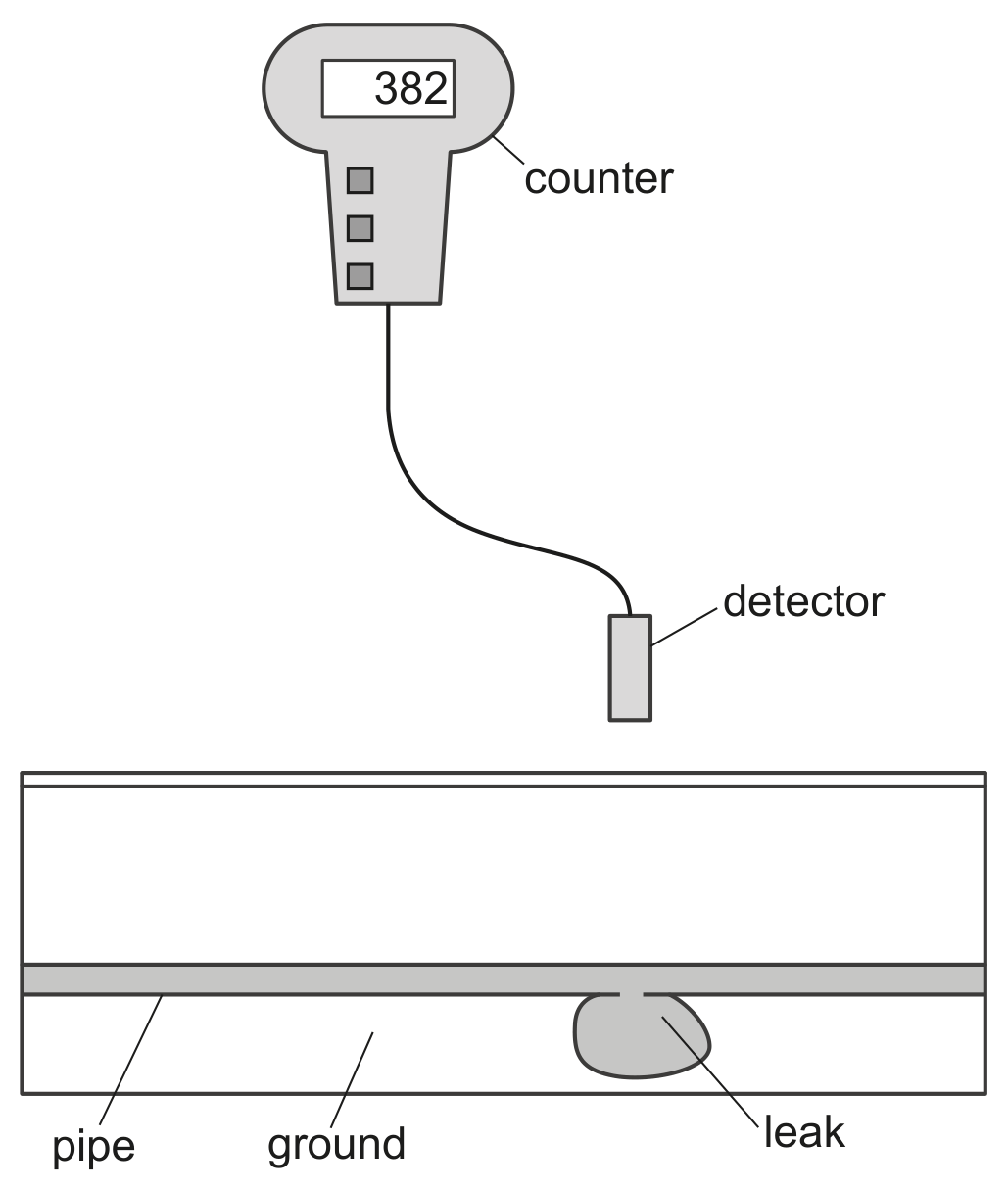
Leaks in underground water pipes are detected using radioactive tracers. Fig. 10.1 shows a radiation detector above a water pipe.

Fig. 10.1

Fig. 10.1

Question 10(a)

(a)

Before the radioactive tracer is added to the water, the detector measures the background radiation above the pipe. The average background radiation is 26 counts/minute.

[ 4 ]

Question 10(a)(i)

(i)

Define background radiation.

[ 1 ]

Question 10(a)(ii)

(ii)

Suggest one source of radiation that may make a significant contribution to the background count rate.

[ 1 ]

Question 10(a)(iii)

(iii)

A radioactive tracer is added to the water. The counter in Fig. 10.1 shows the count rate in counts/minute above the leak in the water pipe.

Determine the count rate due to the tracer.

[ 2 ]

Question 10

Question 10(b)

(a)

A radiation detector in a laboratory records a reading of 10 counts / min. There are no radioactive samples in the laboratory.

[ 2 ]

Question 10(b)(i)

(i)

Explain why the radiation detector records a reading and suggest a possible source.
explanation
source

[ 2 ]
0 selected