EduNinja

IGCSE Physics5.1.1 The atomQuestion Bank

Question 32

[Maximum number: 1]

Which statement about the structure of an atom is correct?

A

It contains positively charged particles only.

B

It contains negatively charged particles only.

C

It contains no charged particles.

D

It contains positively charged particles and negatively charged particles.
Question 32

[Maximum number: 1]

A scientist fires alpha-particles at a very thin sheet of gold and detects the particles that pass through.

Which statement about the results of the scattering experiment is correct?

A

Alpha-particles are attracted to the nucleus of the atoms in the metal sheet.

B

Half the mass of the atom is concentrated in the nucleus.

C

Most of the alpha-particles are deflected, showing that the nucleus is very dense.

D

Only a small number of alpha-particles are deflected, but some of these are deflected through large angles.

Question 33

[Maximum number: 1]

A nuclide of strontium is represented by 3890Sr{ }_{38}^{90} \mathrm{Sr}.
Which row gives the number and location of the electrons in an atom of 3890Sr{ }_{38}^{90} \mathrm{Sr} ?

number of

electrons

location of electrons

38

in the nucleus

38

surrounding the nucleus

52

in the nucleus

52

surrounding the nucleus

Question 33

[Maximum number: 1]

The scattering of α\alpha-particles by a thin metal foil supports the nuclear model of an atom. Why are α\alpha-particles used rather than neutrons?

A

because they always travel more slowly

B

because they are heavier

C

because they are larger in diameter

D

because they have a positive charge

Question 33

[Maximum number: 1]

How are positive and negative ions formed from atoms?

positive ion

negative ion

add positive charge to the nucleus

add an electron to the atom

add positive charge to the nucleus

remove positive charge from the nucleus

remove an electron from the atom

add an electron to the atom

remove an electron from the atom

remove positive charge from the nucleus

Question 33

[Maximum number: 1]

The scattering of alpha-particles from a thin gold foil produces the following observations.
- Most of the alpha-particles pass through the foil.
- Most of the alpha-particles are virtually undeflected.
- A small fraction of the alpha-particles are deflected through large angles.
- A very small fraction of the alpha-particles bounce back from the foil.

Which conclusion does not follow from these observations?

A

Most of the mass of the gold atom is in its nucleus.

B

Most of the atom is empty space.

C

The nucleus consists of protons and neutrons.

D

The nucleus must be charged.

Question 33

[Maximum number: 1]

The scattering of particles by a thin gold foil provided scientists with evidence for the nuclear atom.

Which particles were scattered by the gold nuclei in the thin foil?

A

α\alpha-particles

B

β\beta-particles

C

neutrons

D

protons

Question 33

[Maximum number: 1]

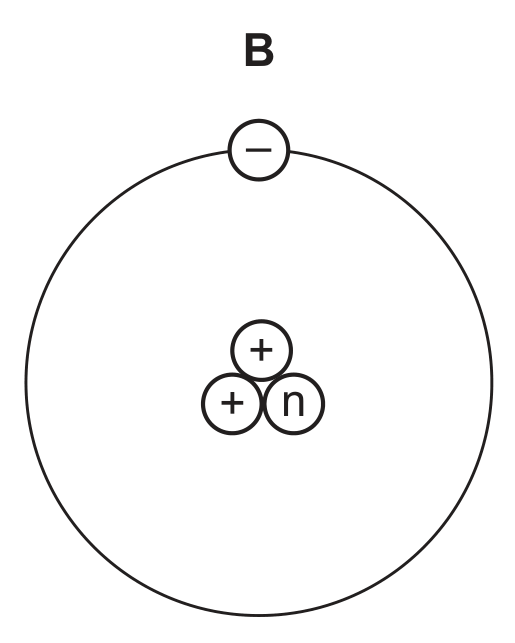
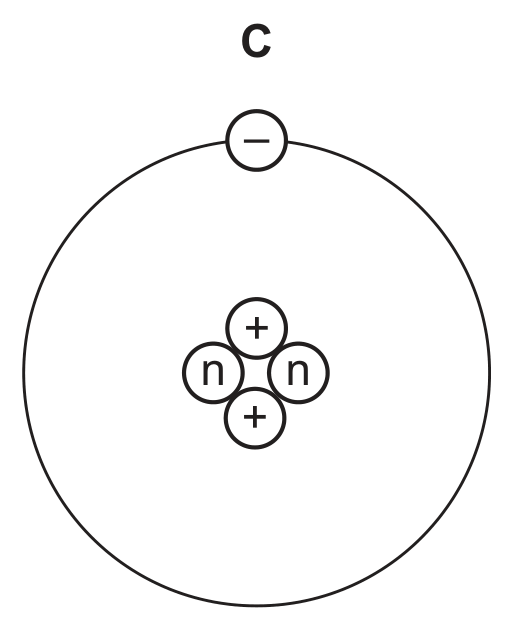
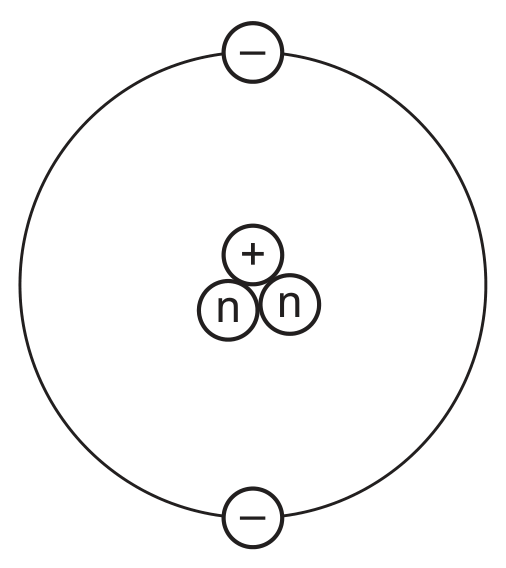
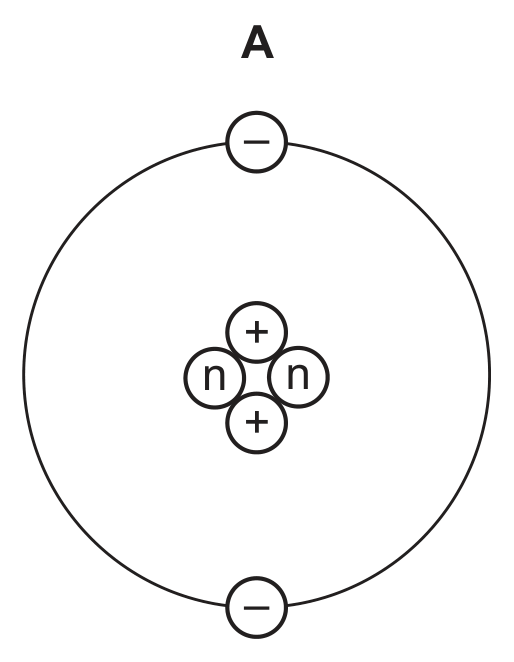
Which diagram shows the structure of a neutral atom?

Question image
Question image
Question image
D

D

Question 34

[Maximum number: 1]

A magnesium ion has a double positive charge and a chloride ion has a single negative charge.
Which statement is correct?

A

A chlorine atom gains an electron to form the chloride ion.

B

A chlorine atom loses a proton to form the chloride ion.

C

A magnesium atom loses an electron to form the magnesium ion.

D

A magnesium atom gains two electrons to form the magnesium ion.

Question 34

[Maximum number: 1]

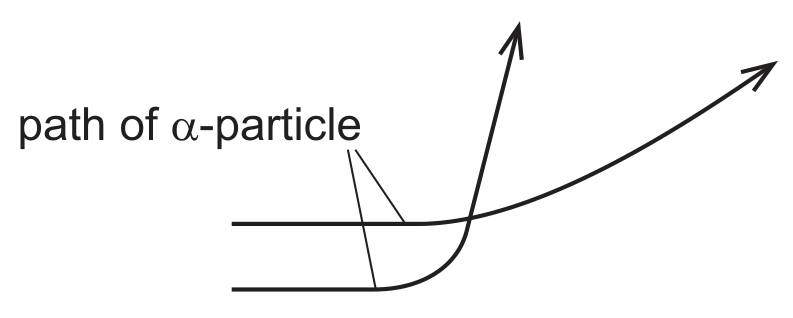
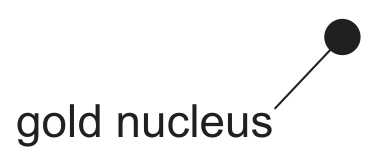
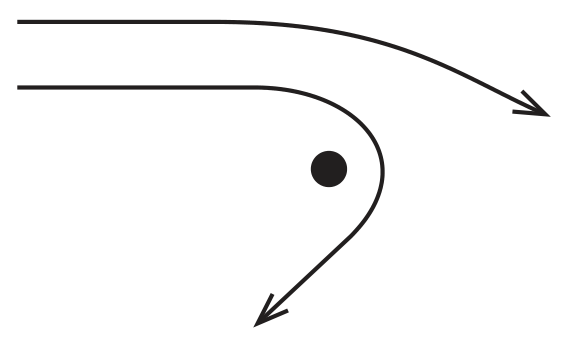
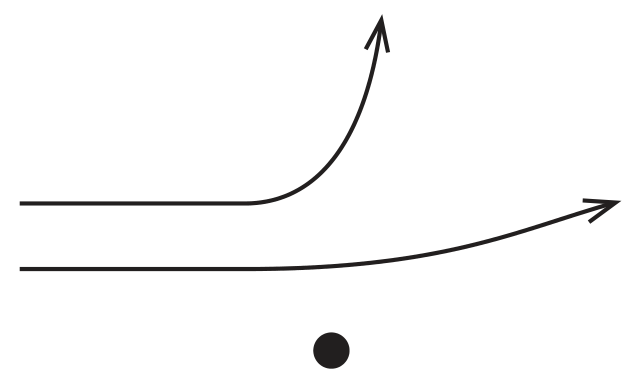
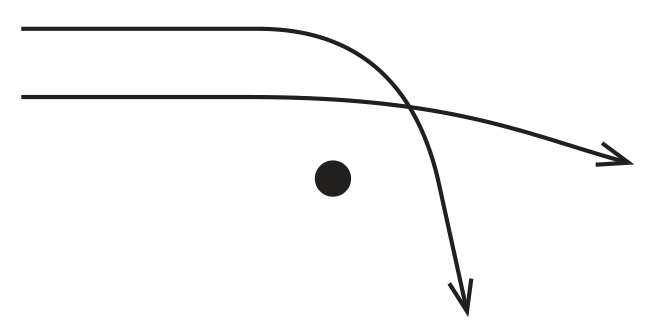
The scattering of α\alpha-particles by a thin gold foil provides evidence for the nuclear model of the atom.

Two α\alpha-particles of the same energy are incident on a nucleus of gold.
Which diagram shows the correct paths followed by the α\alpha-particles as they pass close to the nucleus?

Question image
Question image
B

B

C

C

D

D

0 selected