Question 1
Question 1(a)
Question 1(a)(i)
(a)
(i)
Calculate the energy, in joules, stored in the battery when fully charged.
energy =
 EduNinja
Calculate the energy, in joules, stored in the battery when fully charged.
A wind turbine has a maximum output power of 1.8 MW . The turbine operates at maximum power for 4.0 h .
Define the unit kWh .
Fig. 3.1 shows a model of a wind turbine used to demonstrate the use of wind energy to generate electricity. The wind is blowing towards the model, as shown.
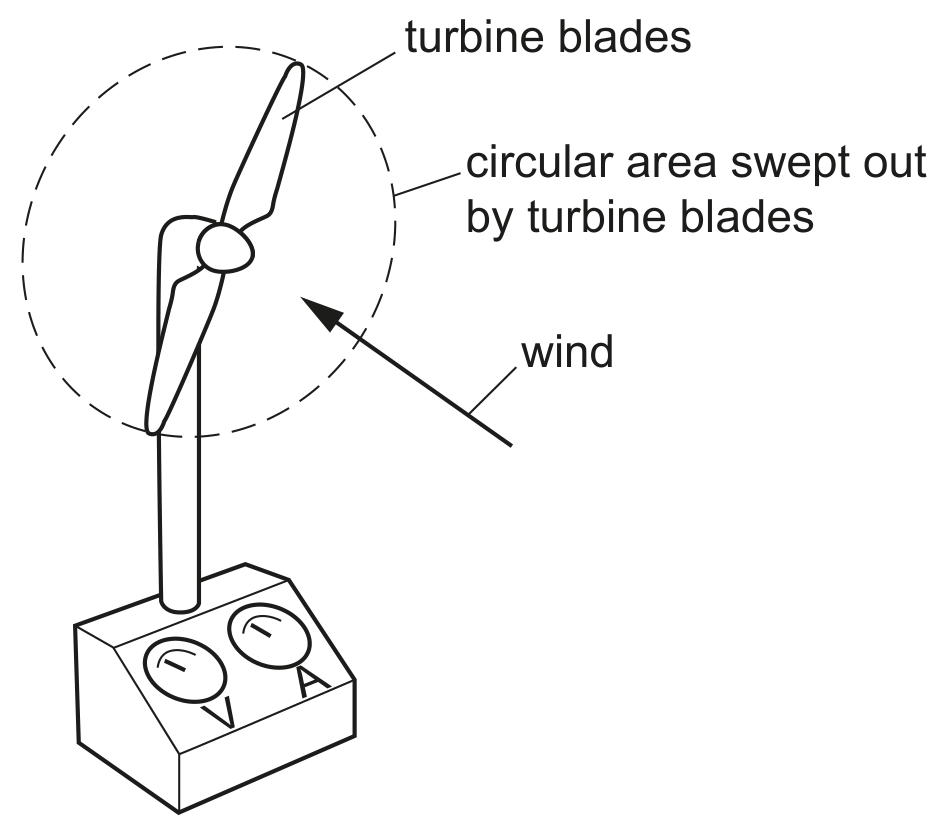
Fig. 3.1
The output current of the generator is 2.0 A . The output potential difference (p.d.) of the generator is 11 V .
Calculate the output power of the generator.
A student carries out an experiment to determine the thermal capacity of a metal block. The block is heated by an electric heater for 23 minutes. The current in the heater is 3.0 A at a potential difference (p.d.) of 12 V .
The temperature of the block rises from to .
Calculate the thermal capacity of the block.
thermal capacity =
Fig. 5.1 shows a plastic cup. The cup contains sand, an electric heater and a thermometer.
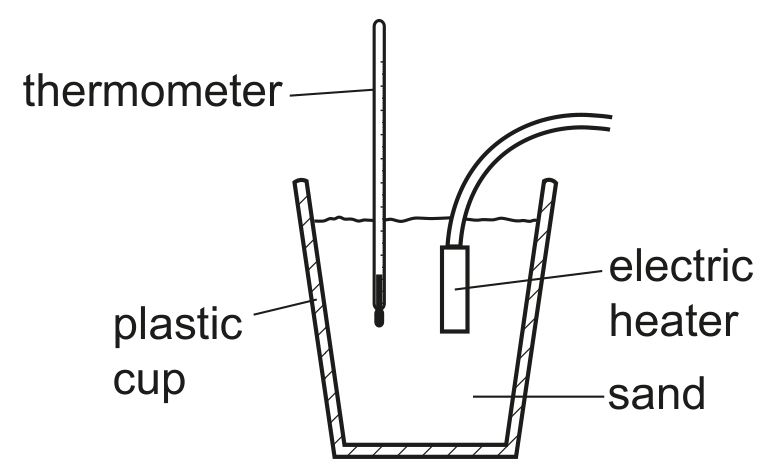
Fig. 5.1
The power of the heater is 50 W . The mass of the sand in the cup is 550 g . The initial temperature of the sand is . The heater is switched on for 2.0 minutes. The temperature is recorded until the temperature stops increasing. The highest temperature recorded by the thermometer is .
Calculate the energy supplied by the heater.
Fig. 5.1 shows a kitchen tap that supplies instant boiling water.
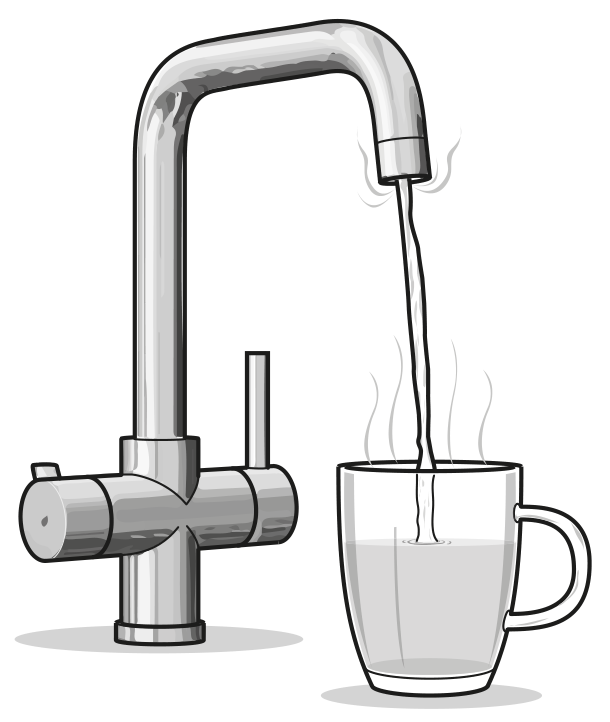
Fig. 5.1
Cold water passes over an electric immersion heater inside the tap.
The boiling point of water is .
The immersion heater is powered by the mains at a voltage of 230 V . When the tap is opened, the heater switches on and the current in the heater is 13 A .
Calculate the thermal energy produced by the heater in 60 s .
The cost of electrical energy is $ 0.25 for each unit of 1 kWh. A 2200 W heater is switched on for 48 minutes.
What is the cost of this use?
$ 0.44
$ 0.55
$ 26
$ 440
Fig. 6.2 shows an electric circuit.
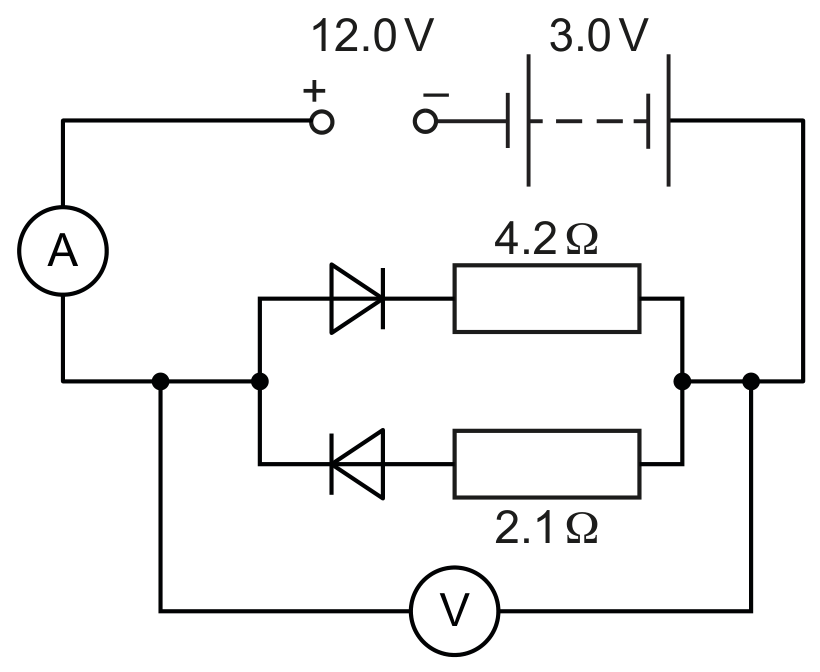
Fig. 6.2
Calculate the electrical power transferred in the resistor.
[Total: 11]
There is a current I in a resistor for a time t. The potential difference (p.d) across the resistor is V.
What does the product IVt represent?
the charge flowing through the resistor
the energy transferred by the resistor
the power dissipated by the resistor
the resistance of the resistor
An electric fire is connected to a 240 V supply and transfers energy at a rate of 1.0 kW . How much charge passes through the fire in 1.0 h ?
42 C
250 C