EduNinja

IGCSE Physics4.2.4 ResistanceQuestion Bank

Question 25

[Maximum number: 1]

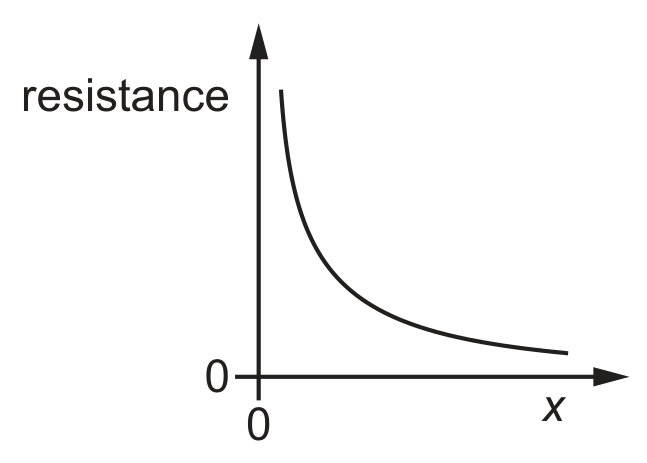
A student does an experiment to investigate the resistance of a metal wire.
The graph shows the results from the experiment.
Question image

What is plotted on the x-axis?

A

diameter of the wire

B

length of the wire

C

temperature of the wire

D

current in the wire
Question 25

[Maximum number: 1]

A wire has a uniform circular cross-sectional area.
Which statement is correct?

A

The resistance of the wire is directly proportional to its cross-sectional area and inversely proportional to its diameter.

B

The resistance of the wire is directly proportional to its cross-sectional area and inversely proportional to its length.

C

The resistance of the wire is directly proportional to its length and inversely proportional to its cross-sectional area.

D

The resistance of the wire is directly proportional to its length and inversely proportional to its diameter.

Question 26

[Maximum number: 1]

A laboratory has a standard wire of known resistance. It also has other wires, made from the same material as the standard wire, but of different lengths and diameters.

Which wire would definitely have a resistance of less than the standard wire?

wire length

wire diameter

longer

larger

longer

smaller

shorter

larger

shorter

smaller

Question 26

[Maximum number: 1]

A student determines the resistance of resistor R. She uses a circuit including a voltmeter and an ammeter.

Which circuit does she use?

Question 26

[Maximum number: 1]

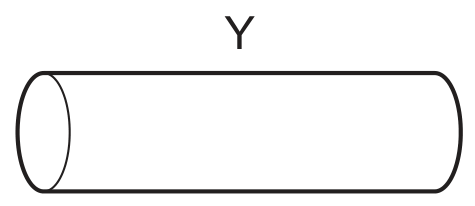
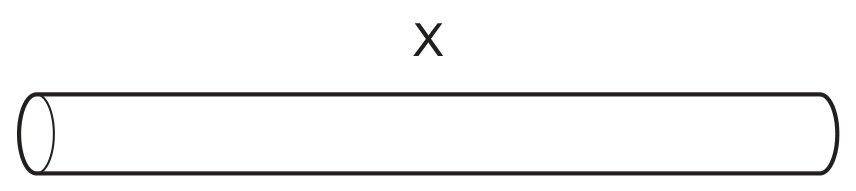
A piece of metal wire X with a uniform diameter has resistance R.

Question image

A second piece of wire Y is made of the same metal and has a uniform diameter. Y has double the cross-sectional area of X and half the length of X.

Question image

What is the resistance of Y?

A

R4\frac{R}{4}

B

R2\frac{R}{2}

C

R

D

4 R

Question 26

[Maximum number: 1]

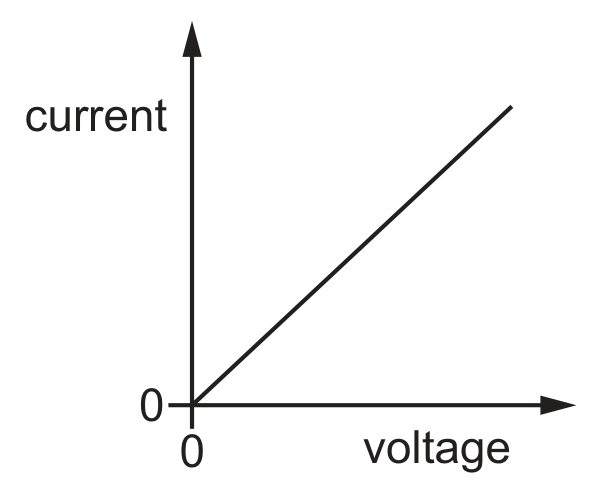
The diagram shows the current-voltage graph for a metal wire.

Question image

What can be deduced from the graph?

A

As voltage increases, the temperature of the wire increases.

B

As voltage increases, the temperature of the wire decreases.

C

As voltage increases, the resistance of the wire increases.

D

As voltage increases, the resistance of the wire remains constant.

Question 26

[Maximum number: 1]

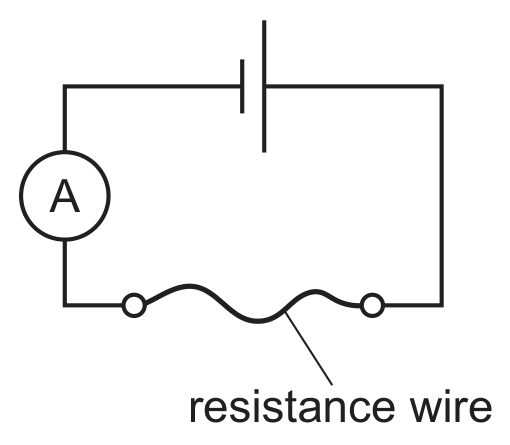
A student is investigating a resistance wire.
She measures the current in a 50 cm length of resistance wire.

Question image

The student repeats the experiment using a 100 cm length of the same resistance wire.
What is the effect of this change on the current in the circuit and on the resistance of the wire?

effect on

current

effect on

resistance

decreases

decreases

decreases

increases

increases

decreases

increases

increases

Question 26

[Maximum number: 1]

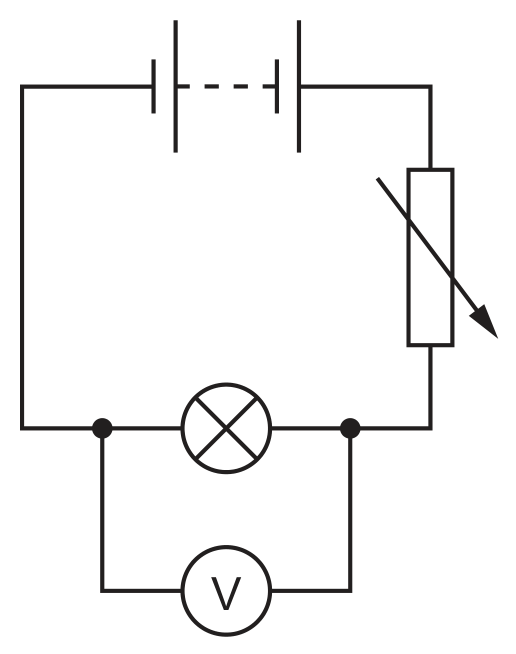
The diagram shows a circuit used to control the potential difference (p.d.) across a lamp.
The variable resistor is adjusted until the p.d. across the lamp is 6.0 V .
The current in the lamp is 0.5 A .

Question image

What is the resistance of the lamp?

A

0.083Ω0.083 \Omega

B

3.0Ω3.0 \Omega

C

6.5Ω6.5 \Omega

D

12.0Ω12.0 \Omega

Question 26

[Maximum number: 1]

A resistor and a battery are connected in series.
The value of the resistor is 20Ω20 \Omega.
The potential difference (p.d.) of the battery is 4.0 V .
What is the current in the resistor?

A

0.20 A0.20 \mathrm{~A}

B

4.0 A4.0 \mathrm{~A}

C

5.0 A5.0 \mathrm{~A}

D

80 A80 \mathrm{~A}

Question 6

Question 6(a)

(a)

On Fig. 6.1, sketch the current-voltage graph of a filament lamp and explain its shape.

Fig. 6.1

Fig. 6.1

explanation

[ 3 ]

Question 6(b)

(b)

Fig. 6.2 shows an electric circuit.

Fig. 6.2

Fig. 6.2

[ 2 ]

Question 6(b)(ii)

(i)

Calculate the current in the 4.2Ω4.2 \Omega resistor.

current =
[ 2 ]
0 selected